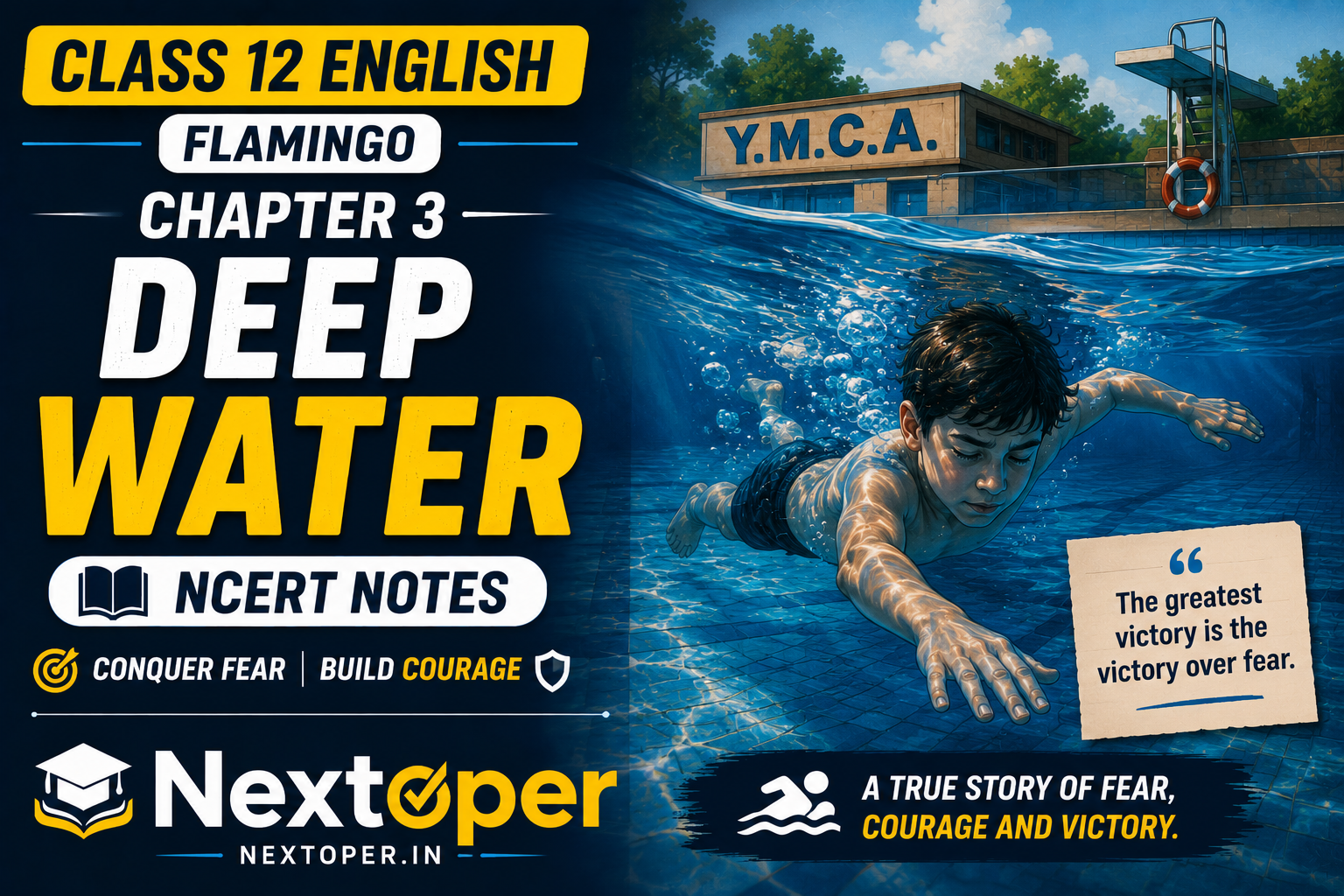
Class 12 English Flamingo Chapter 3 Deep Water PDF Notes
Introduction
These Class 12 English Flamingo Chapter 3 Notes cover everything you need for “Deep Water” by William Douglas. You will get a clear summary, character sketches, and themes. We have also added MCQs, PYQs, and FAQs. All content follows the NCERT textbook and CBSE syllabus 2025-26. These notes will help you write better exam answers. Let’s begin your revision journey!
📥 Download Free Notes PDF — No Signup Needed!
👉 Click Here to Download from Nextoper.in
Table of Contents
- Chapter Overview
- Chapter Summary
- Character Analysis
- Themes & Values
- Key Definitions & Glossary
- Important Questions & Answers
- MCQs with Answers
- Quick Revision Points
- Previous Year Questions (PYQs)
- People Also Ask (FAQs)
- Conclusion
Chapter Overview: Class 12 English Flamingo Chapter 3 Notes
Here is a quick snapshot before you start your Class 12 English Flamingo Chapter 3 notes.
| Detail | Information |
|---|---|
| Chapter Name | Deep Water |
| Subject | English (Flamingo — Prose) |
| Class | 12 |
| Board | CBSE |
| Session | 2025-26 |
| Author | William O. Douglas |
| Textbook | Flamingo (NCERT) |
| Type | Autobiographical narrative |
Chapter Summary — Deep Water
This section of your Class 12 English Flamingo Chapter 3 notes covers the full story in simple language.
The Decision to Learn Swimming
William Douglas was ten or eleven years old. He decided to learn swimming. The Yakima River was too dangerous. So he chose the safer Y.M.C.A. pool instead. He bought water wings and entered the pool. He felt shy about his thin legs. But he overcame his shyness.
An Old Fear Returns
Douglas already had a fear of water. This fear began at age three or four. Big ocean waves had once knocked him down at a beach. He felt buried and breathless that day. This memory came back at the pool. Slowly, though, he gained some confidence.
The Misadventure
One day, Douglas sat alone by the pool. A big eighteen-year-old boy arrived. He called Douglas “Skinny” and threw him into the deep end. Douglas sank straight to the bottom. He swallowed water and panicked.
The Struggle to Survive
Douglas tried his planned escape. He wanted to spring up like a cork. But each attempt failed. He sank again and again. His arms and legs froze with terror. He could not even scream. Finally, he lost consciousness completely.
Rescue and Aftermath
Other boys pulled Douglas out and revived him. He walked home shaking and weak. For days, he felt sick and scared. He avoided water completely after this. The fear stayed with him for years. It ruined his fishing and boating trips.
Deciding to Conquer the Fear
As an adult, Douglas grew tired of this fear. He hired a swimming instructor in October. The instructor used a rope and pulley system. Douglas practiced for months, very patiently. Slowly his panic began reducing.
Becoming a Swimmer
The instructor taught him breathing and kicking. Each skill was built piece by piece. By April, Douglas could finally swim. But small fears still remained inside him. He tested himself again and again.
Final Victory Over Fear
Douglas swam two miles across Lake Wentworth. He also swam across Warm Lake later. Both times, fear tried to return briefly. But he laughed at it and continued. He had finally conquered his old terror completely.
Character Analysis
This section of our Class 12 English Flamingo Chapter 3 notes explains the three key figures in the chapter.
William Douglas
- Determined: he refused to let fear control his entire life.
- Shows deep self-awareness while describing his own panic.
- Reflective, drawing larger life lessons from a childhood trauma.
- Patient enough to practice swimming for nearly a year.
The Big Boy (Bully)
- Around eighteen years old, physically strong and careless.
- Throws Douglas into deep water as a thoughtless prank.
- Shows no real malice, just poor judgment about consequences.
- Represents sudden, unexpected dangers we face in life.
The Swimming Instructor
- Patient and methodical in his teaching approach.
- Breaks swimming into small, manageable skill pieces.
- Uses a rope-and-pulley system for safety and trust-building.
- Symbolises the value of good mentorship and guidance.
Themes and Values in the Chapter
These themes appear repeatedly across CBSE exam questions, so revise them carefully.
- Fear and Its Consequences: a single traumatic event can create a lasting phobia that affects daily life for years.
- Courage and Determination: Douglas shows that fear can be defeated through patient, repeated effort over time.
- Triumph of the Human Spirit: the chapter celebrates inner victory over psychological barriers, not just physical skill.
- Importance of Mentorship: the instructor’s careful guidance proves how the right support accelerates personal growth.
- Acceptance of Death’s Inevitability: Douglas reflects that real terror lies in fearing death, not in death itself.
Key Definitions and Glossary
This table from our Class 12 English Flamingo Chapter 3 notes covers the NCERT glossary words.
| Word | Meaning in Simple English |
|---|---|
| Treacherous | Dangerous and unpredictable |
| Misadventure | An unlucky, harmful accident |
| Subdued my pride | Controlled my embarrassment |
| Bob to the surface like a cork | Float up quickly and easily |
| Flailed at the surface | Struck the water wildly |
| Curtain of life fell | Lost consciousness, near death |
| Aversion | A strong dislike or fear |
| Vestiges | Small remaining traces |
Important Questions and Answers
This is one of the most exam-relevant sections of our Class 12 English Flamingo Chapter 3 notes.
2-Mark Questions
Q: What was the “misadventure” Douglas faced? A: An eighteen-year-old boy threw Douglas into the pool’s deep end. Douglas nearly drowned during this frightening incident.
Q: How did Douglas’s fear of water begin? A: Big waves once knocked him down at a beach. He was only three or four years old then.
Q: What method did the instructor use first? A: He attached a rope and pulley to Douglas’s belt. They practiced crossing the pool together repeatedly.
Q: How did Douglas finally confirm his fear was gone? A: He swam across Lake Wentworth and Warm Lake. He faced his fear directly and overcame it.
5-Mark Questions
Q: How does Douglas describe the panic of nearly drowning? A: Douglas uses vivid, sensory language to show his terror.
- He describes water with a “dirty yellow tinge.”
- His “lungs were ready to burst” from holding breath.
- His arms and legs felt like “dead weights.”
- He says, “terror that knows no understanding, no control.” This detailed imagery helps readers feel his exact fear.
Q: Describe the steps Douglas took to overcome his fear. A: Douglas followed a slow, structured process.
- He hired an instructor and trained for months.
- He learned breathing, kicking, and basic strokes first.
- He tested himself alone in the pool afterward.
- He then swam in open lakes to confirm his courage. This gradual exposure helped him truly conquer his terror.
Q: What larger meaning does Douglas draw from this experience? A: Douglas connects his childhood terror to a deeper truth about life.
- He quotes Roosevelt: “All we have to fear is fear itself.”
- He realises death itself brings peace, not pain.
- True suffering comes from fearing death, not death itself. This experience strengthened his will to live fully and fearlessly.
📚 Want More Free Notes?
Visit Nextoper.in — All Class 9 to 12 CBSE Notes. 100% Free!
MCQs — Deep Water with Answers
These MCQs from our Class 12 English Flamingo Chapter 3 notes are based on common CBSE exam patterns.
Q1. Who is the author of “Deep Water”? (A) Robert Frost (B) William Douglas (C) Kamala Das (D) Nelson Mandela ✅ Answer: (B) — William O. Douglas wrote this autobiographical narrative.
Q2. Where did the misadventure take place? (A) Yakima River (B) Y.M.C.A. pool (C) Lake Wentworth (D) Warm Lake ✅ Answer: (B) — He was thrown into the Y.M.C.A. swimming pool’s deep end.
Q3. How old was Douglas when he nearly drowned? (A) 5 or 6 (B) 8 or 9 (C) 10 or 11 (D) 14 or 15 ✅ Answer: (C) — The chapter states he was ten or eleven years old.
Q4. What did Douglas use while first entering the pool? (A) Goggles (B) Water wings (C) A life jacket (D) Flippers ✅ Answer: (B) — He bought a pair of water wings before entering.
Q5. Who threw Douglas into the deep end? (A) His father (B) An instructor (C) A big eighteen-year-old boy (D) His mother ✅ Answer: (C) — An older, muscular boy tossed him in as a prank.
Q6. What device did the swimming instructor use? (A) Floating ring (B) Rope and pulley (C) Diving board (D) Snorkel ✅ Answer: (B) — A belt-rope-pulley system controlled his movement safely.
Q7. How long did Douglas train before he could swim? (A) Two weeks (B) One month (C) About seven months (D) Two years ✅ Answer: (C) — Training ran from October until April, roughly seven months.
Q8. Where did Douglas test his courage after pool training? (A) Yakima River (B) Columbia River (C) Lake Wentworth and Warm Lake (D) Pacific Ocean ✅ Answer: (C) — He swam across both lakes to confirm his victory.
Q9. Whose quote does Douglas mention near the end? (A) Mahatma Gandhi (B) Franklin D. Roosevelt (C) Abraham Lincoln (D) Winston Churchill ✅ Answer: (B) — He quotes Roosevelt’s “All we have to fear is fear itself.”
Q10. What does “Deep Water” symbolise besides the literal pool? (A) Adventure (B) Depth of psychological fear (C) Wealth (D) Friendship ✅ Answer: (B) — The title reflects both literal water and deep-rooted fear.
Quick Revision Points
Use these bullets from our Class 12 English Flamingo Chapter 3 notes for fast last-minute revision.
- William Douglas wrote “Deep Water” from his book Of Men and Mountains.
- The chapter is an autobiographical narrative told in first person.
- Douglas feared water since age three or four, from a beach incident.
- The misadventure happened at the Y.M.C.A. pool in Yakima.
- A big boy threw him into the nine-foot deep end.
- His plan to “bob like a cork” repeatedly failed.
- He lost consciousness; the curtain of life fell.
- The fear ruined his fishing, boating, and swimming trips for years.
- An instructor used rope, pulley, breathing, and kicking drills.
- Training lasted from October to April, roughly seven months.
- He tested himself at Lake Wentworth and Warm Lake.
- He quotes Roosevelt: “All we have to fear is fear itself.”
- The title is both literal and symbolic of inner fear.
- Central theme: courage defeats fear through persistence.
Previous Year Questions (PYQs)
This PYQ table is a key addition in our Class 12 English Flamingo Chapter 3 notes that most other sites skip.
| Year | Question | Marks |
|---|---|---|
| 2014 (Delhi) | Write a paragraph on how positive attitude and courage aid success, using ideas from the chapter. | 5 |
| 2017 (All India) | Describe how Douglas overcame his fear of water. | 5 |
| 2019 (Compartment) | How does Douglas convey the panic he felt while drowning? | 5 |
Model Answer (2017 — How did Douglas overcome his fear?): Douglas hired a swimming instructor after years of suffering. The instructor used a belt and rope system for safety. Douglas slowly learned breathing and leg movements. He practiced patiently for about seven months. He then tested himself alone in the pool. Finally, he swam across two open lakes. This gradual, repeated exposure helped him fully conquer his terror.
Model Answer (2014 — Positive attitude and courage): Douglas’s story proves that courage grows through consistent effort. He did not give up despite repeated failures and panic. His instructor’s patient guidance played a key supporting role. Each small success built his confidence further over time. This shows that persistence, not talent alone, creates real success. A positive attitude helps us face our biggest personal fears.
Model Answer (2019 — Conveying panic): Douglas uses vivid sensory imagery to show his panic clearly. He describes “dirty yellow” water and lungs “ready to burst.” His limbs felt like “dead weights,” frozen with terror. He repeats phrases like “down, down, endlessly” for emphasis. This first-person narration makes the fear feel real and immediate. These literary techniques help readers experience his drowning vividly.
Featured Snippet Answer
Deep Water by William Douglas is a Class 12 English Flamingo chapter about a near-drowning incident at a swimming pool. The chapter describes how Douglas developed a deep fear of water as a child, and how he later overcame this fear through patient swimming training and repeated practice in open lakes as an adult.
People Also Ask — FAQs
These answers complete our Class 12 English Flamingo Chapter 3 notes with quick, direct responses.
❓ Q: What is the misadventure in Deep Water by William Douglas? 💡 A: Class 12 English Flamingo Chapter 3 describes the misadventure as Douglas nearly drowning. An older boy threw ten-year-old Douglas into the Y.M.C.A. pool’s deep end, causing him to swallow water and sink, triggering lifelong fear of water.
❓ Q: How did Douglas overcome his fear of water in Deep Water? 💡 A: Douglas hired a swimming instructor and trained patiently for about seven months. He learned breathing and kicking techniques gradually. He then tested his courage by swimming across open lakes, finally conquering his old terror completely.
❓ Q: What is the theme of the chapter Deep Water Class 12? 💡 A: The central theme of Deep Water is overcoming fear through courage, persistence, and proper guidance. It also explores mentorship, psychological resilience, and the idea that fear itself is often worse than the actual danger faced.
❓ Q: Why is the title Deep Water appropriate? 💡 A: The title works on two levels. Literally, it refers to the nine-foot-deep pool where Douglas nearly drowned. Symbolically, it represents the deep, lasting psychological fear that haunted him for years before he finally overcame it.
❓ Q: Who is the author of Deep Water Class 12 English? 💡 A: William O. Douglas, a former U.S. Supreme Court Justice, wrote Deep Water. The excerpt is taken from his book Of Men and Mountains and describes his real childhood experience of nearly drowning.
Conclusion
These Class 12 English Flamingo Chapter 3 notes covered everything about “Deep Water” by William Douglas. You learned the summary, character sketches, themes, and key glossary terms. You also practiced MCQs, PYQs, and FAQs for exam readiness. Remember the core lesson: fear can always be conquered through patience and courage. Keep practicing with Nextoper.in’s free study material regularly. Visit us anytime for more Class 12 English Flamingo Chapter 3 notes and other chapters too. Good luck with your CBSE board exam preparation this year!
More Notes from This Subject
Continue building your topical knowledge with these related Class 12 English Flamingo notes.
- Class 12 English Flamingo Chapter 1 Notes — The Last Lesson PDF Notes
- Class 12 English Flamingo Chapter 2 Notes — Lost Spring PDF Notes
- All Class 12 English Flamingo Notes — Nextoper.in
👤 About the Author
This article is written by the Nextoper Editorial Team.
We provide 100% free CBSE study notes for Class 9 to 12 students.
All our notes follow the latest NCERT syllabus 2025-26.
No signup needed. No cost. Just free notes for every student.