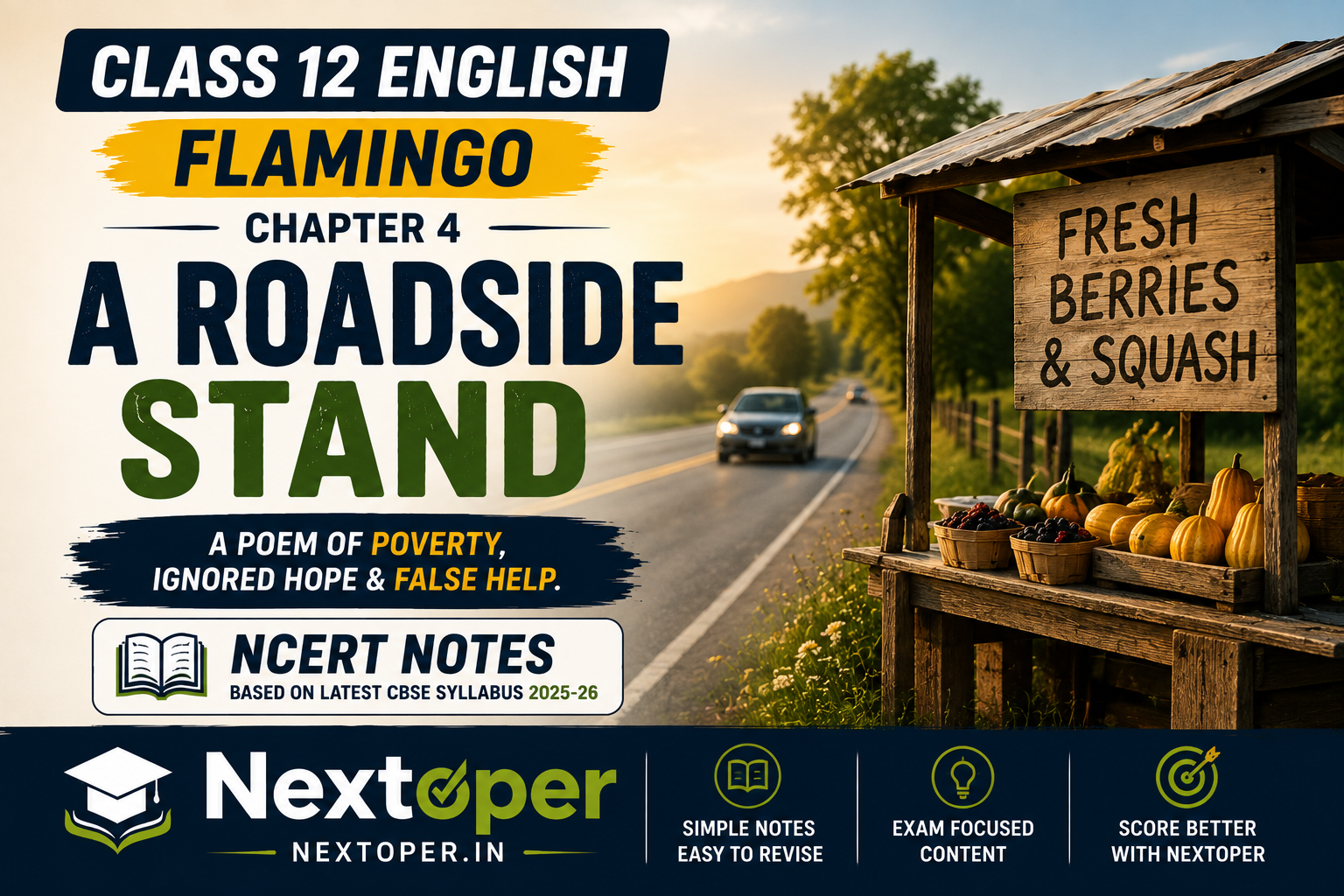
Class 12 Chapter 4 A Roadside Stand PDF Notes 2025-26 — Flamingo Notes
Last updated: 12 August 2026 · Reading time: ~14 minutes · CBSE 2025-26 session
If you’re revising Class 12 English Chapter 4 Notes on Robert Frost’s poem A Roadside Stand, this page gives you everything in one place. You get a clear summary, a character breakdown, the poem’s key themes, a glossary of hard words, model answers, MCQs, a quick revision box, and FAQs — all written in plain language, without copying any competitor’s page or reproducing the poem’s original lines.
You’ll find a full understanding of what the poem says, why Frost wrote it the way he did, and how to answer exam questions on it with confidence.
Jump to: Quick Revision · Summary · Character Sketch · Themes · Glossary · Q&A · MCQs · Exam-Pattern Questions · FAQs
About the Poet
Robert Frost (1874–1963) was one of the most respected American poets of the twentieth century. He wrote mainly about ordinary people, small communities, and rural landscapes, often using their struggles to explore bigger questions about life and society. Frost is also known for poems like Stopping by Woods on a Snowy Evening, Birches, and Mending Wall. In A Roadside Stand, he turns his attention to a poor rural family and the wealthier world that drives past them, writing with honesty about their hardship and with real sympathy for their situation.
Quick Revision
If you have two minutes before the exam, read only this box.
- Setting: A small, freshly repaired roadside stand selling wild berries and squash, built by poor rural people beside a busy highway.
- What the stand-owners want: Not charity — a fair chance to earn city money through honest business.
- What actually happens: Most cars speed past without noticing. The few that stop do so for the wrong reasons — to turn around, ask directions, or ask for fuel — never to buy.
- The government’s role: Officials talk about “helping” rural people by moving them into managed villages, but the poet shows this “help” mainly benefits the officials, not the villagers.
- The poet’s feeling: Deep sympathy turning into real anguish, ending in the disturbing thought of wishing the rural poor’s suffering could simply be switched off — and then wondering how he’d feel if the same offer were made to him.
- Structure: Free-flowing lines, no fixed rhyme scheme, conversational tone.
- One-line theme: The poem is a sharp comment on how rural poverty is ignored by the city and exploited by those who claim to fix it.
Get free Class 12 Chapter 4 A Roadside Stand PDF Notes
Summary of A Roadside Stand
The poem opens with a picture of a small, old house that has recently gained a new, hastily built shed beside a busy road. This little addition is the family’s roadside stand — their attempt to earn some income by selling produce to passing traffic. Frost is careful to make clear that the family isn’t asking for charity. They want to sell something and be paid a fair price, nothing more.
The road in front of the stand carries plenty of traffic, but it is described as “polished” — smart, well-off, city traffic that has somewhere else to be. Most cars don’t slow down at all. When drivers do notice the stand, it’s usually with irritation rather than interest. They see hand-painted signs with badly formed letters and read them as an eyesore spoiling an otherwise pretty view, rather than as evidence of a family trying its best with limited resources. The goods on offer — wild berries in wooden containers, oddly shaped golden squash — are genuine, home-grown produce, but to a city driver glancing out of a car window, they don’t look like anything worth stopping for.
What upsets the poet is not that the landscape gets a little messier because of the stand. It’s the quiet, patient hope behind it — the fact that a family has put its dignity on the line by waiting for strangers to care, and mostly being ignored. The stand becomes a kind of unspoken question the family keeps asking the road: will anyone notice us today?
The poem then widens its lens from the roadside to the wider political picture. There is talk, the poet says, of moving rural families like this one into planned villages closer to towns, with shops and entertainment nearby, supposedly for their own good. On paper, it looks like progress. In practice, Frost suggests, it strips people of the independence they currently have. The people arranging this “rescue” are painted as caring on the surface while actually benefiting themselves — comfortable, well-fed officials who claim to be doing good while quietly draining the freedom and self-respect of the people they say they’re helping.
From here the poem turns personal. The poet admits he finds it hard to bear the innocent, repeated hope of the stand-owners — their almost prayer-like waiting for the sound of a car slowing down. Out of a great many cars that pass, barely any stop to actually ask about prices. One driver stops only to use the yard as space to turn the car around. Another stops just to ask directions. A third wants to know if they can buy some fuel — and is annoyed to learn there isn’t any for sale. Not one, in this stretch of the poem, stops to actually buy the family’s produce.
Frost then reflects that the rural way of measuring success — a little extra cash, a small win — has simply never delivered the lift in living standards the family hopes for. Watching this repeated disappointment becomes almost unbearable for him. He goes as far as to admit that, in a moment of intense frustration, the idea of ending the family’s suffering outright — putting them “out of their pain” in one stroke — feels like it would almost be a relief, purely because their situation seems so stuck.
But the poem doesn’t let that thought stand unquestioned. Once the poet’s anger cools and he’s “back into the sane,” as he puts it, he turns the idea back on himself: how would he feel if someone offered to end his pain the same way? That final twist is the sting in the poem’s tail — it’s easy to imagine drastic “solutions” for other people’s suffering; it’s far less comfortable to imagine them for our own.
Character Sketch
The Roadside Stand Owners. A poor rural family who have put together a small, hopeful business out of very little. They aren’t looking for pity — they want a fair chance to trade. Their patience and quiet dignity, in the face of being ignored again and again, is the emotional centre of the poem.
The City Motorists. Represented as a moving mass rather than individuals, these drivers are wrapped up in their own errands. When they do interact with the stand, it’s incidental — a turning space, a direction query, a fuel request — never a genuine transaction. Their indifference is presented as a symptom of a larger city-versus-country divide.
The Government / “Good-Doers.” Officials and social planners who talk about rescuing rural communities through relocation schemes. Frost presents them as self-interested despite their generous language, more concerned with control and comfort than with actually improving rural lives.
The Poet-Speaker. An observer who cannot stay neutral. He starts out describing the scene almost like a reporter, but by the end of the poem his sympathy has turned into genuine distress, and he questions his own reaction as much as the world around him. This shift — from watching to feeling to self-questioning — is what gives the poem its emotional weight.
Themes of A Roadside Stand
1. The rural–urban divide. The poem sets a struggling, hopeful roadside stand against a stream of comfortable, hurried city traffic, using that contrast to show how differently rural and urban India — or in Frost’s case, rural and urban America — experience the same road.
2. Poverty and dignity. The family at the centre of the poem never asks for a handout. Their wish is for fair business, which makes their repeated disappointment feel less like bad luck and more like a quiet injustice.
3. Hypocrisy of “help.” Frost is deeply skeptical of officials who claim to act in the interest of the poor while actually serving their own comfort and control. This is the poem’s sharpest political point, and it’s a favourite area for exam questions.
4. Empathy versus indifference. The city drivers aren’t cruel on purpose — they’re simply not paying attention. The poem asks whether that kind of thoughtless indifference can do as much damage as open unkindness.
5. Broken promises and disillusionment. The rural family’s hopes are partly shaped by promises of progress and by images of an easier life seen in the movies — hopes that the poem suggests will keep going unmet.
6. The uncomfortable turn — self-questioning. The final lines don’t let the reader stay comfortable either. By turning the idea of “ending someone’s suffering” back onto himself, the poet forces us to notice how easily we accept difficult solutions for others but resist them for ourselves.
Difficult Words — Glossary
| Word / Phrase | Simple Meaning |
|---|---|
| Pled | Asked for something, almost begging |
| Dole | A small, charity-based handout |
| Polished traffic | Smart, wealthy-looking cars |
| Artless | Without skill or care; rough, unpolished |
| Quarts | Small wooden containers used to sell fruit |
| Crook-necked | Having a bent or curved neck (used for a type of squash) |
| Beneficent | Appearing to do good or be kind |
| Enforcing benefits | Forcing “help” onto people whether they want it or not |
| Requisite | Necessary, required |
| Owning | Admitting (an older meaning of the word) |
| Sane | Here, back to a calm, rational state of mind |
Important Questions & Answers
Q1. How does the poem show that city travellers pay little attention to the roadside stand or the people running it? Most of the traffic passes by focused only on its own destination. When drivers do react to the stand, it’s mostly with mild annoyance at the hand-painted signs, which they see as spoiling the view rather than as a sign of hardship. Their attention, when it appears at all, is about the landscape’s appearance — never about the people trying to earn a living there.
Q2. What exactly do the stand-owners want from passing city traffic? They are not asking for pity or charity. They want the chance to sell their produce fairly and earn real money — the kind of cash that keeps city life comfortable — so that they, too, can share a little in that comfort.
Q3. How does the poem expose the double standards of the government and welfare agencies? The poem describes officials who publicly promise to rescue rural families by relocating them to well-serviced villages. In reality, Frost shows this “rescue” as something that benefits the planners far more than the people being “helped,” stripping villagers of independence while being presented as generosity.
Q4. What is the “childish longing” the poet mentions, and why does he call it vain? It’s the stand-owners’ simple, repeated hope that the next car will finally stop and buy something. Frost calls it childish because it keeps returning no matter how many times it’s disappointed — much like a child’s hope that doesn’t adjust to repeated letdowns. It is “vain” because, realistically, it almost never comes true.
Q5. Which part of the poem shows the poet’s own pain at the rural family’s situation most clearly? It’s the section near the end where the poet admits he can hardly bear watching their hope fail again and again, to the point where he imagines that ending their suffering outright would almost be a relief — before catching himself and turning that same uncomfortable question back on his own life.
MCQs — A Roadside Stand
- A Roadside Stand was written by: a) Robert Frost b) William Wordsworth c) John Keats d) Adrienne Rich Answer: a
- What are the stand-owners mainly hoping to receive from passing traffic? a) Charity b) A fair chance at business c) Directions d) Company Answer: b
- The traffic passing the stand is repeatedly described as: a) Slow and curious b) Polished and self-absorbed c) Friendly d) Rural Answer: b
- What products are sold at the stand? a) Vegetables and flowers b) Wild berries and squash c) Bread and milk d) Handicrafts Answer: b
- According to the poem, the government’s relocation plan mainly benefits: a) The rural families b) The officials arranging it c) The city drivers d) No one Answer: b
- The poet’s dominant emotional response by the end of the poem is: a) Amusement b) Indifference c) Deep sympathy turning to anguish d) Anger at the family Answer: c
- The poem’s rhyme scheme is best described as: a) Strict and regular b) Loose and conversational, without a fixed pattern c) A perfect sonnet form d) Entirely rhymeless Answer: b
- In the final lines, the poet imagines being offered: a) A better roadside stand b) Relief from his own pain, the way it’s suggested for the rural poor c) A new home d) A job in the city Answer: b
- The phrase describing aid-givers as predators despite claiming to help reflects the theme of: a) Rural beauty b) Hypocrisy in “help” c) Urban planning success d) Childhood memories Answer: b
- Which of these best captures the poem’s central theme? a) The joys of country life b) The gap between rural poverty and urban indifference c) A travel guide to the countryside d) A celebration of city development Answer: b
Exam-Pattern Practice Questions
CBSE board papers on this chapter typically test three question types — keep these formats in mind while revising:
- Short-answer (2–3 marks): Explain why the stand-owners’ hope is described as “childish.” / What is the poet’s complaint against the officials in the poem?
- Long-answer (5–6 marks): Critically analyse how Frost uses the roadside stand to comment on rural poverty and urban indifference. / Discuss the irony in the government’s claim of helping the rural poor.
- Value-based / application question: “The economic well-being of a country depends on a balanced development of villages and cities.” Discuss this statement with reference to the poem. (This is the exact discussion prompt given in your NCERT textbook — a strong candidate for a value-based board question.)
Exam-answer checklist (original addition): when you write a long answer on this poem, make sure you cover (1) the stand-owners’ situation, (2) the drivers’ indifference, (3) the officials’ hypocrisy, and (4) the poet’s own emotional shift — examiners specifically look for all four “voices,” not just a plot summary.
Featured Snippet Answer
What is the theme of A Roadside Stand by Robert Frost?
A Roadside Stand explores the divide between rural poverty and city indifference. Poor stand-owners hope to earn fair money from passing city traffic, but most drivers ignore them, and the few who stop do so for reasons unrelated to buying anything. The poem also criticises government and social agencies that claim to help rural communities while actually serving their own comfort. By the end, the poet’s sympathy turns into real distress, and he questions how easily we accept painful solutions for other people’s suffering while resisting the same idea for ourselves.
Common Mistake to Avoid
Many students read the poem’s final lines as simple sadness and stop there. The sharper point is the irony: the poet catches himself wishing to end someone else’s pain in a way he would never wish for his own — and that contradiction, not the sadness itself, is what examiners want you to identify in a strong answer.
Memory Trick — The “4 Voices” Framework
To keep the poem’s moving parts straight under exam pressure, remember four voices: the Stand (hopeful, patient), the Street (city traffic, indifferent), the State (officials, hypocritical “help”), and the Speaker (the poet, whose sympathy turns into self-questioning). Most exam answers score well simply by covering all four in order.
FAQs
1. What is the theme of A Roadside Stand? The poem contrasts rural poverty with urban indifference, and criticises officials who claim to help the poor while really serving themselves. It ends with the poet questioning his own reaction to others’ suffering.
2. What is the childish longing referred to in the poem? It’s the stand-owners’ repeated, almost innocent hope that a passing car will finally stop to buy something — a hope the poet calls “childish” because it survives constant disappointment.
3. Why does the poet call the aid-givers hypocritical? Because their public promise to help rural families through relocation actually strips those families of independence, while mainly benefiting the officials who run the scheme — generosity in name only.
4. Does A Roadside Stand follow a fixed rhyme scheme? No. Frost uses a loose, conversational rhythm instead of a strict rhyme pattern, which makes the poem sound like natural speech and suits its frustrated, unpolished subject.
5. What does the poet mean by wanting to be put “out of pain”? In the closing lines, the poet imagines someone offering to end his own suffering the way “mercy” is casually proposed for the rural poor — a twist that questions how easily we accept drastic fixes for others but not ourselves.
To Sum Up
A Roadside Stand is Robert Frost at his most socially aware — using one small, struggling shop by the road to talk about a much larger problem: the gap between rural hardship and urban comfort, and the hollow promises made in the name of “helping” the poor. For your Class 12 exam, focus on the four voices in the poem, the irony in the ending, and the poem’s loose, natural rhythm — that combination covers almost every angle examiners test.
More Notes You May Need
- Class 12 English Flamingo Chapter — A Thing of Beauty Notes
- Class 12 English Flamingo Chapter 2 — Keeping Quiet Notes
- Class 12 English Flamingo — Full Chapter Index
Author: Nextoper Editorial Team — CBSE English content reviewed against the NCERT Flamingo textbook (2025-26 edition). Last Updated: 12 August 2026

Pingback: CBSE Class 12 Aunt Jennifer's Tigers PDF Notes 2025-26 - Summary, Themes, Notes | Nextoper - Nextoper