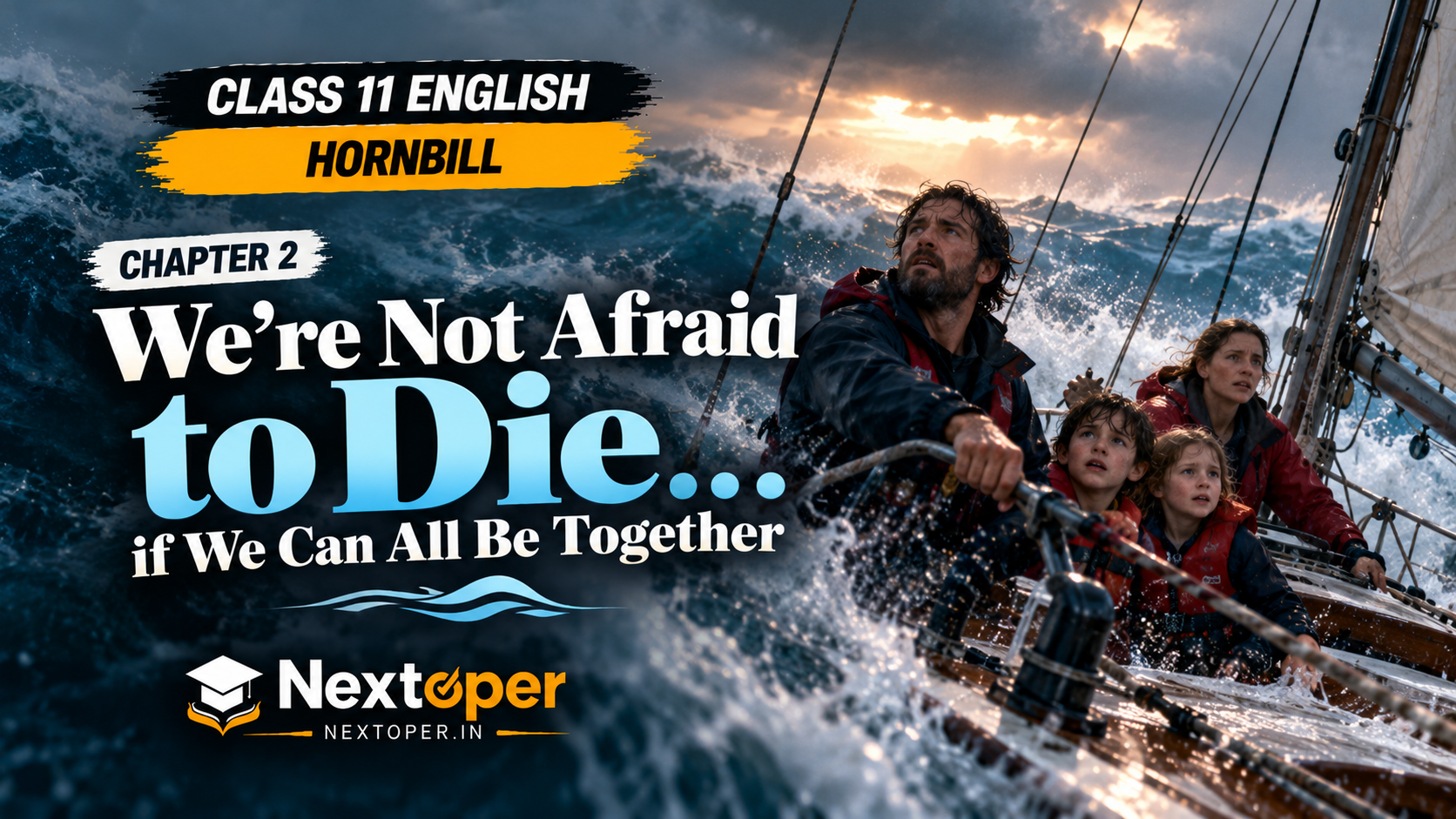
CBSE Class 11 English Chapter 2 PDF Notes Hornbill We’re Not Afraid to Die… if We Can All Be Together | Nextoper Notes
These Class 11 English Chapter 2 PDF Notes We’re Not Afraid to Die notes make revision fast. You get a summary, a timeline, characters, themes, NCERT answers and 10 MCQs. Every point follows the NCERT Hornbill text.
How we prepared this: We wrote from the NCERT Hornbill Chapter 2 text (Reprint 2026-27). We checked it against that text on 2026-10-20. Wording is our own.
What is We’re Not Afraid to Die about? (Chapter overview)
Chapter 2 of NCERT Hornbill, the Class 11 English textbook, is a first-person sea story. Gordon Cook and Alan East wrote this account of a family’s sea voyage. The trip turns into a fight for survival in the southern Indian Ocean.
Save Free Notes PDF – Class 11 English Chapter 2 PDF Notes | Click Here to Save
NCERT is the National Council of Educational Research and Training. It makes the textbooks that CBSE, the Central Board of Secondary Education, uses. Captain James Cook is the famous explorer whose round-the-world voyage the family wanted to repeat.
| Detail | Fact |
|---|---|
| Chapter title | “We’re Not Afraid to Die… if We Can All Be Together” |
| Textbook | Hornbill, NCERT English textbook for Class 11 (Reprint 2026-27) |
| Chapter number | Chapter 2 |
| Authors | Gordon Cook and Alan East |
| Type of text | First-person adventure account (NCERT’s teacher note calls it an account of a family’s ordeal) |
| Boat | Wavewalker, a 23-metre, 30-ton wooden-hulled boat |
| Planned voyage | Three years, 105,000 kilometres, copying Captain James Cook’s voyage of 200 years earlier |
| On board | The narrator, Mary, Jonathan (6), Suzanne (7), Larry Vigil and Herb Seigler |
| Crisis | A giant wave at about 6 p.m. on 2 January |
| Safe landing | Ile Amsterdam, a tiny volcanic island with a French scientific base |
What is the summary of We’re Not Afraid to Die?
In July 1976, a family sails from Plymouth to repeat Captain James Cook’s famous voyage. A giant wave wrecks their boat, Wavewalker, in the southern Indian Ocean. After days of pumping and repairs, they reach the tiny island of Ile Amsterdam safely.
Part 1: The dream and the voyage
The narrator is a 37-year-old businessman. He and his wife Mary dreamed of sailing like Captain James Cook. For 16 years they trained in British waters.
Their boat, Wavewalker, was built by professionals. They spent months fitting it out and testing it in rough weather. In July 1976 the family left Plymouth with Jonathan, aged six, and Suzanne, aged seven.
The plan was a three-year, 105,000-kilometre trip. The first leg to Cape Town was pleasant. At Cape Town they hired two crewmen, Larry Vigil and Herb Seigler.
Part 2: The wave and the fight to stay afloat
Two days after leaving Cape Town, strong gales began. They blew for weeks. The waves worried the narrator most, rising up to 15 metres.
On 25 December they were 3,500 kilometres east of Cape Town. They still had a Christmas with a tree. On 2 January the weather turned worse.
The narrator slowed the boat and tied everything down. At about 6 p.m. an ominous silence fell. A near-vertical wave, almost twice the height of the others, struck Wavewalker.
The wave threw the narrator overboard. He felt strangely peaceful for a moment. Then his lifeline pulled him back as another wave righted the boat.
Mary shouted that they were sinking. The narrator gave her the wheel and went below. Larry and Herb were already pumping.
He found the starboard side smashed open. With a hammer, screws and canvas, he covered the holes. When the pumps clogged and one electric pump failed, a spare pump saved them.
Mayday calls got no reply. Suzanne’s head was badly swollen, and she had a deep cut. She had stayed silent because she did not want to worry her father.
Part 3: The search for Ile Amsterdam
By 3 January the leak was under control. But nearly all the main rib frames were smashed. Wavewalker could not reach Australia.
The charts showed two small islands to the east. One was Ile Amsterdam, a French scientific base. On 4 January, after 36 hours of pumping, the water was almost gone.
They could not use the main mast without tearing the hull apart. So they hoisted only the storm jib. Mary found corned beef and biscuits, their first meal in almost two days.
Black clouds returned that afternoon. By 5 January the situation was desperate again. Jonathan said they were not afraid of dying if they could all be together.
The narrator built a sea anchor to protect the weak side. That evening he and Mary held hands and felt the end was near. Yet the boat survived the storm.
On 6 January he worked out their position with a sextant and a spare compass. He told Larry to steer 185 degrees. Then he fell asleep.
At 6 p.m. the children woke him with a hug. Suzanne said he had found the island, a bleak volcanic rock. To him it felt like the most beautiful island in the world.
The next morning all 28 islanders cheered and helped them ashore. On land, the narrator thought of his crew, Mary and the children. Suzanne’s head injury later needed six minor operations.
Day-by-day timeline

| When | What happens | Why it matters |
|---|---|---|
| July 1976 | The family leaves Plymouth, England | The long-planned dream begins |
| At Cape Town | Larry Vigil and Herb Seigler join | Shows careful planning |
| 25 December | They are 3,500 km east and enjoy Christmas with a tree | Shows family spirit before the storm |
| 2 January, dawn | Waves turn gigantic; the crew secures the boat | Shows seamanship |
| 2 January, about 6 p.m. | Ominous silence, then the giant wave | The turning point |
| 3 January | Water is under control, but the rib frames are smashed | Australia is now out of reach |
| 4 January | 36 hours of pumping end; they hoist the storm jib and eat | A short moment of hope |
| 5 January | Jonathan speaks the title line; the boat heaves to | The emotional climax |
| 6 January | Sextant work, course 185°, Suzanne’s card; island seen at 6 p.m. | The rescue moment |
| Next morning | All 28 islanders help them ashore | Safety at last |
Memory trick: Link 2-3-4-5-6 to five W words: Wave, Wreck, Water, Words, Win.
| Date | W word | Event |
|---|---|---|
| 2 January | Wave | The giant wave hits |
| 3 January | Wreck | Rib frames are found smashed |
| 4 January | Water | 36 hours of pumping end |
| 5 January | Words | Jonathan speaks the title line |
| 6 January | Win | The island is sighted |
Who are the main characters in We’re Not Afraid to Die?
The main characters are the narrator, his wife Mary and their children, Jonathan and Suzanne. Two crewmen, Larry Vigil and Herb Seigler, complete the group. Each shows a different kind of courage, and the children’s bravery is the emotional centre.
| Character | Who they are | Key quality and proof |
|---|---|---|
| The narrator | 37-year-old businessman and captain of Wavewalker | Resourceful: he patches the holes with canvas and finds a spare pump |
| Mary | The narrator’s wife | Steady: she stays at the wheel for the crucial hours |
| Jonathan (Jon) | Six-year-old son | Calm and loving: he says they are not afraid if they are together |
| Suzanne (Sue) | Seven-year-old daughter | Brave and caring: she hides her injuries and makes a card |
| Larry Vigil | American crewman | Cheerful: he pumps through the worst hours |
| Herb Seigler | Swiss crewman | Cheerful: he pumps beside Larry and stays optimistic |
NCERT’s text never names the narrator. The byline lists Gordon Cook and Alan East as authors. In exams, write “the narrator”.
What are the main themes of We’re Not Afraid to Die?
The main themes are courage, optimism, family togetherness and teamwork, all shown through action. The chapter also shows human struggle against nature and the reasons people take risks. Each theme links to a moment in the text, which gives you proof for answers.
| Theme | Where you see it | How to use it |
|---|---|---|
| Courage under pressure | The narrator keeps working with cracked ribs and broken teeth | Use in character and long answers |
| Optimism | Larry, Herb and Suzanne stay cheerful; the narrator keeps calculating | Answers the NCERT “direst stress” question |
| Family togetherness | Jonathan’s line and the hug on 6 January | Use for the title’s meaning |
| Teamwork | Mary steers, the crewmen pump, the narrator repairs | Use for “who saved the ship?” questions |
| Human against nature | Fifteen-metre waves and a vertical wall of water | Use for setting and mood |
| Why people take risks | A lifelong dream and 16 years of training | Answers the NCERT question on adventure |
Which five lines matter most, and why?
Five short lines carry most of the meaning and mood of this chapter. They cover the silence before the wave, the island, Suzanne’s pain and Jonathan’s title line. Learn what each line shows about character or mood, and explain it in your answer.
| Line from the text | Why it matters |
|---|---|
| “ominous silence” | The wind drops before the wave. Sound warns the reader that danger is near. |
| “felt quite peaceful” | The narrator accepts death while sinking. It shows shock and a strange calm. |
| “I didn’t want to worry you” | Suzanne hides her pain. Her courage is really care for her father. |
| “we aren’t afraid of dying if we can all be together” | The title line. Love makes fear smaller, and it gives the narrator fresh will. |
| “the most beautiful island in the world” | Irony: a bleak rock looks beautiful because it means safety. |
What do the difficult words in We’re Not Afraid to Die mean?
The chapter uses sailing words such as storm jib, stern, hatch and sextant. It also uses phrases such as ominous silence and pinpricks in the vast ocean. The table explains each term in simple words, with the line where it appears.
| Word | Meaning in simple words | In the chapter |
|---|---|---|
| honing | Sharpening a skill by practice | “honing our seafaring skills” for 16 years |
| seafaring | Linked to travel by sea | The family’s sailing skills |
| gale | A very strong wind | Gales blew for weeks |
| storm jib | A small, strong sail for storms | The only sail they could use later |
| stern | The back of a boat | The wave rolled up behind it |
| ominous silence | A quiet that warns of danger | The calm before the giant wave |
| capsizing | Turning over in the water | Wavewalker nearly capsized |
| hatch | An opening in a ship’s deck | Waterproof hatch covers stopped the leaks |
| Mayday calls | Radio calls asking for urgent help | No one answered |
| sextant | A tool that helps find your position at sea | Used on 6 January |
| sea anchor | A drag that steadies a boat in a storm | Made from rope and two paraffin barrels |
| heave-to | To hold a boat nearly still, facing the waves | Used to protect the weak starboard side |
| pinpricks in the vast ocean | Tiny islands in a huge sea | Ile Amsterdam and its neighbour |
| tousled head | A head with messy hair | Jonathan at the narrator’s bunk |
What are the NCERT questions and answers for We’re Not Afraid to Die?
NCERT gives five exercise sets for this chapter in the Hornbill textbook. The sets cover understanding, discussion, language, vocabulary and small research tasks like map work. Each exact question appears below, followed by a model answer written in our own words.
Understanding the text
Q1. List the steps taken by the captain (i) to protect the ship when rough weather began. (ii) to check the flooding of the water in the ship.
(i) He dropped the storm jib and tied a heavy mooring rope across the stern. He double-lashed everything and ran a life-raft drill. Everyone wore lifelines, oilskins and life jackets.
(ii) He covered the smashed starboard side with canvas and waterproof hatch covers. Most water then flowed over the side. When the pumps failed, he connected a spare electric pump from under the chartroom floor.
Q2. Describe the mental condition of the voyagers on 4 and 5 January.
On 4 January they felt tired but hopeful. The water was almost gone, and they ate their first meal in nearly two days.
Then black clouds returned, and fear came back by 5 January. That evening the narrator and Mary held hands and felt the end was very near.
Q3. Describe the shifts in the narration of the events as indicated in the three sections of the text. Give a subtitle to each section.
NCERT marks the three sections with short breaks. Follow those breaks, not the dates alone.
Section 1 – “From Dream to Disaster”: It starts proud and planned. Then it turns fast and frightening when the wave strikes.
Section 2 – “Hanging On”: The pace slows. The mood is tired and quiet, with despair, Jonathan’s line and Suzanne’s card.
Section 3 – “Land at Last”: Tension builds over the calculations. Then joy and relief arrive when the island appears.
Talking about the text
Q1. What difference did you notice between the reaction of the adults and the children when faced with danger?
The adults acted and carried the worry: the narrator repaired, calculated and hid his doubt. The children stayed calm and thought of others. Suzanne hid her pain, and Jonathan spoke of togetherness, not fear.
Q2. How does the story suggest that optimism helps to endure “the direst stress”?
Larry and Herb stayed cheerful while pumping for hours. The narrator kept calculating even when unsure, and Suzanne made a funny card. Optimism here means doing the next useful thing.
Q3. What lessons do we learn from such hazardous experiences when we are face-to-face with death?
Prepare well, stay calm and work as a team. Notice other people’s courage. Hope gives you the strength to keep trying.
Q4. Why do you think people undertake such adventurous expeditions in spite of the risks involved?
People follow a dream, test their limits and feel proud of the challenge. The narrator trained for 16 years first, so the risk felt worth taking. This is an opinion question, so give two reasons and one example.
Thinking about language
Q1. How many words does your language have for “storm”?
Hindi has toofan, aandhi, chakravaat (cyclone) and jhanjhaavaat. Write the words from your own language if it differs.
Q2. Think of terms for different kinds of vessels in your language.
Hindi examples are naav, nauka, kashti and jahaaz. Match each to boat, ship or small boat.
Q3. Which Indian language does “catamaran” come from?
It comes from Tamil. The word is kattumaram, meaning tied logs. Check your dictionary to confirm.
Q4. Have you heard any boatmen’s songs? What emotions do they express?
Boatmen’s songs often express longing for home, hope and courage. Their rhythm also matches the pull of the oars. Bengal’s Bhatiali songs are one example.
Working with words
Q1. Ship words with other meanings: knot, stern, boom, hatch, anchor.
| Word | Ship meaning | Other meaning |
|---|---|---|
| knot | Unit of a ship’s speed | A tied loop, or “a knot in my stomach” |
| stern | Back of a boat | Strict, as in “a stern teacher” |
| boom | Pole holding a sail | A deep sound, or a sudden rise in sales |
| hatch | Opening in a deck | To break out of an egg, or to hatch a plan |
| anchor | Weight that holds a ship | A news presenter, or a person you rely on |
Q2. What do airship, flagship and lightship mean?
An airship is a large engine-driven craft lighter than air. A flagship is the main ship of a fleet, or a company’s best product. A lightship is an anchored ship with a bright light that guides other ships.
Q3. In which meaning is “take on” used in the third paragraph?
It means take sb on: to employ or engage someone. The line is “we took on two crewmen”.
Things to do
Q1. Label the parts of the yacht using the terms in the box.
Match each arrow in the NCERT picture to the terms below.
| Term | Meaning | Where it sits |
|---|---|---|
| bow | The front of the boat | Opposite the stern |
| stern | The back of the boat | Near the rudder |
| mast | The tall pole that holds the sails | Rises from the deck |
| boom | The pole along the bottom of the mainsail | Attached to the mast |
| mainsail | The largest sail | Hangs from the main mast |
| cabin | The enclosed living space below deck | Where the children stayed |
| cockpit | The open area where the boat is steered | Near the back |
| rudder | The blade under the stern that steers the boat | Below the water |
Q2. Ile Amsterdam information from the Internet. NCERT gives this table.
| Detail | As given in NCERT’s table |
|---|---|
| Location | South Indian Ocean, between the southernmost parts of Australia and South Africa |
| Latitude and longitude | 37 92 S, 77 67 E (printed this way in NCERT) |
| Sovereignty | France |
| Political status | Part of French Southern and Antarctic Lands |
| Population | 35 (meteorological station staff) |
| Land area | 86 square kilometres |
Q3. Locate Ile Amsterdam on the world map.
Find the southern Indian Ocean. The island lies between the southern tips of Africa and Australia, far south of India.
Can you test yourself with 10 MCQs?
Yes, these 10 MCQs test the names, dates and key facts from the chapter. Cover the answer line, pick an option, then read the one-line reason that follows. Aim for eight or more correct before you move on to long answers.
Q1. What is the name of the family’s boat?
- a) Seawalker
- b) Wavewalker
- c) Windrunner
- d) Cape Queen
Answer: b. The text names the 23-metre boat Wavewalker.
Q2. From which port did the family begin the voyage?
- a) Cape Town
- b) Sydney
- c) Plymouth
- d) Ile Amsterdam
Answer: c. They set sail from Plymouth, England, in July 1976.
Q3. Who joined the family at Cape Town?
- a) Two Swiss sailors
- b) Larry Vigil (American) and Herb Seigler (Swiss)
- c) Two French scientists
- d) Larry Vigil (Swiss) and Herb Seigler (American)
Answer: b. The text names an American and a Swiss crewman, in that order.
Q4. How high did the waves rise during the early gales?
- a) 5 metres
- b) 10 metres
- c) 15 metres
- d) 30 metres
Answer: c. They rose up to 15 metres, as high as the main mast.
Q5. What did the narrator drop to slow the boat on 2 January?
- a) The storm jib
- b) The main anchor
- c) The dinghies
- d) The mainsail
Answer: a. He dropped the storm jib and lashed a mooring rope across the stern.
Q6. What came just before the giant wave?
- a) A loud roar from the radio
- b) A burst of lightning
- c) An ominous silence
- d) A drop in temperature
Answer: c. The wind dropped and the sky grew dark, which the narrator calls an ominous silence.
Q7. Where was the spare electric pump found?
- a) In the children’s cabin
- b) Under the chartroom floor
- c) On the deck
- d) In the life raft
Answer: b. He remembered another pump under the chartroom floor, and it worked.
Q8. Who said they were not afraid of dying if they could all be together?
- a) Suzanne
- b) Mary
- c) Larry
- d) Jonathan
Answer: d. Six-year-old Jonathan said it on 5 January.
Q9. For how long had the crew pumped continuously by 4 January?
- a) 12 hours
- b) 24 hours
- c) 36 hours
- d) 48 hours
Answer: c. The text says 36 hours of continuous pumping.
Q10. Which course did the narrator tell Larry to steer on 6 January?
- a) 85 degrees
- b) 185 degrees
- c) 285 degrees
- d) 360 degrees
Answer: b. He asked Larry to steer a course of 185 degrees.
How can you revise We’re Not Afraid to Die in five minutes?
Learn the order of events, the key names and Jonathan’s title line first. Use the five W words to fix the dates, then repeat who did what. The box below holds the facts you need the night before a test.

What practice questions can you try?
These six practice questions were written by Nextoper.in and are not taken from past papers. We have included no previous-year questions because we could not verify any. For the official format, see the CBSE sample papers on the CBSE Academic website.
- (1 mark) Why did the narrator hire two crewmen at Cape Town? Hint: think of the southern Indian Ocean.
- (1 mark) What did the narrator use to work out their position on 6 January? Hint: two tools.
- (3 marks) Why could the crew not use the main mast on 4 January? Hint: hull damage and rigging pressure.
- (3 marks) How did Suzanne’s card help the family? Hint: mood, thanks, hope.
- (5 marks) “Courage in this story is shared, not single.” Do you agree? Hint: one point each for the narrator, Mary, the crewmen, Suzanne and Jonathan.
- (5 marks, value-based) What does the chapter teach you about staying calm in a crisis? Hint: preparation, action, support.
What mistakes do students make in We’re Not Afraid to Die answers?
Students often mix up dates, names and numbers in their answers. Common slips include 28 versus 35 islanders, reaching Australia, and who spoke which line. Check each fact against the text, and use the table below to avoid seven slips.
| Common mistake | The fix |
|---|---|
| Writing that 35 people live on Ile Amsterdam in a story answer | The story says all 28 inhabitants cheered. The 35 figure comes from NCERT’s separate information table. |
| Saying the family reached Australia | They never did. Wavewalker was too damaged, so they reached Ile Amsterdam. |
| Mixing up who said or did what | Jonathan spoke the title line. Suzanne hid her injuries and made the card. |
| Writing “we are not afraid to die alone” | The idea is the opposite. The children are not afraid together. |
| Placing the giant wave on 25 December or 5 January | It struck on 2 January at about 6 p.m. Christmas was the calm before. |
| Giving the narrator a name in answers | NCERT’s text never names him. Write “the narrator”. |
| Calling the chapter a poem | It is a first-person prose account in Hornbill. |
What is We’re Not Afraid to Die in one short answer?
We’re Not Afraid to Die is a first-person sea story from NCERT Hornbill, Class 11. A family and two crewmen sail into the southern Indian Ocean. A giant wave wrecks their boat, Wavewalker, and they pump and patch for days. The children’s calm courage steadies the narrator, and they reach Ile Amsterdam alive.
Frequently asked questions about We’re Not Afraid to Die
Who wrote “We’re Not Afraid to Die… if We Can All Be Together”?
Gordon Cook and Alan East wrote it, and NCERT prints both names under the title. A narrator tells the story in the first person, with his wife and children aboard. NCERT’s text never names him, so write “the narrator” in exam answers.
What is the main theme of We’re Not Afraid to Die?
The main theme is courage and hope when people face extreme danger together. Optimism, teamwork and family love help everyone on board keep going and stay alive. Jonathan’s calm words, Suzanne’s hidden pain and the crewmen’s cheerful pumping all support this idea.
Why does the narrator call Ile Amsterdam “the most beautiful island in the world”?
The island is a bleak piece of volcanic rock with little vegetation. Still, the narrator calls it the most beautiful island because it means safety at last. Its beauty comes from relief after days near death, not from its looks.
What happened to Wavewalker on January 2?
At about 6 p.m. on 2 January, a near-vertical wave struck Wavewalker. It was almost twice the height of the other waves and broke over the ship. The decks were smashed and the starboard side bashed open, so water poured in.
Is “We’re Not Afraid to Die” a true story?
NCERT presents it as a first-person account of an ordeal that a family goes through. Other study sites call it a true story, but NCERT’s pages do not say so. In exams, call it a first-person adventure narrative and stick to the text.
How should you use these Class 11 English Chapter 2 notes?
Read the summary once, then study the timeline, the characters and the key lines. Next, write the NCERT answers in your own words and then take the 10 MCQs. Finish with the mistakes table to check every fact before your test.
Every person in this story adds something, and your revision can work the same way. Revise with these Class 11 English Chapter 2 We’re Not Afraid to Die notes. Check each fact against your textbook, then explain every point in your own words.
Related notes
- Class 11 English Chapter 1 The Portrait of a Lady notes (previous chapter)
- Class 11 English Hornbill notes: all chapters (subject hub)
Sources
- NCERT Hornbill Class 11 English, Chapter 2 (Reprint 2026-27), including the Notes page.
- CBSE Academic website for official syllabus and sample papers.