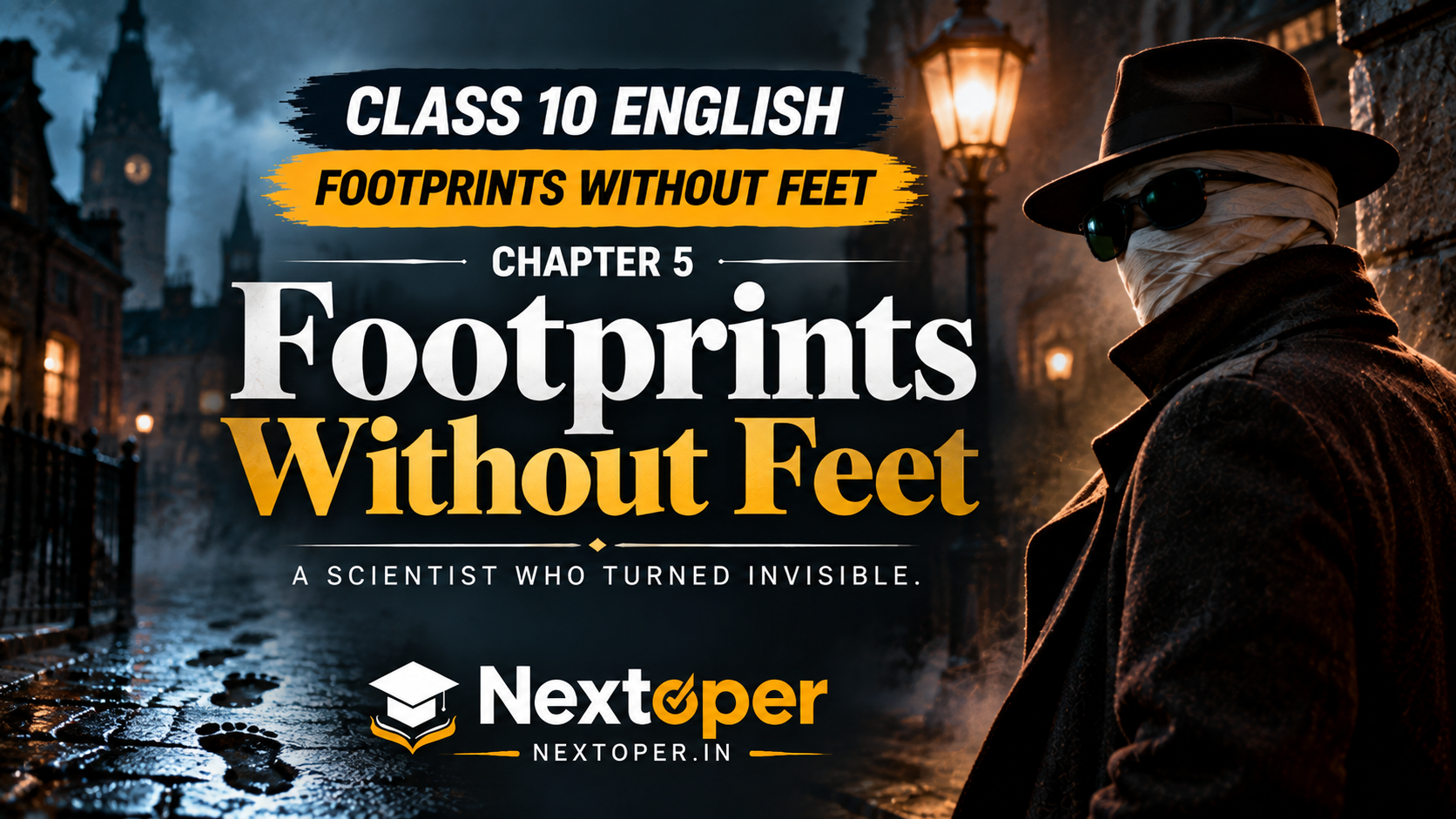
CBSE Class 10 English Footprints Without Feet Chapter 5 Notes 2026-27 | Nextoper
These Class 10 English Footprints Without Feet Chapter 5 notes explain the story simply. You get the summary, Griffin’s character, themes, NCERT answers, MCQs and a quick revision sheet. Everything here is checked against the NCERT text.
Want to truly understand the chapter? Start with the summary and read down.
Table of Contents
- Chapter Overview at a Glance
- Footprints Without Feet Summary
- Griffin Character Sketch
- Themes and Message
- Difficult Words (Glossary)
- NCERT Questions and Answers
- Where Students Lose Marks
- Practice MCQs
- Quick Revision
- Board-Style Practice Questions
- Short Answer in One Paragraph
- FAQs
- To Sum Up
Chapter Overview at a Glance
This chapter is a short excerpt from a famous science-fiction novel. Read the table once. It gives you the facts examiners love to test.
| Item | Detail |
|---|---|
| Chapter | 5, Footprints Without Feet |
| Author | H.G. Wells |
| Source | Adapted from the novel The Invisible Man |
| Main character | Griffin, a scientist |
| Key places | London, Drury Lane, the village of Iping |
| Season | Mid-winter (January) |
| Big idea | Does he use, or misuse, his discovery? |
The question in the chapter’s opening box is the whole chapter in one line. Griffin misuses his discovery. Keep that answer ready.
Footprints Without Feet Summary
The story follows Griffin from one escape to the next. Each escape ends in a new crime. Read it in five parts.
Part 1: The footprints in London
Two boys see fresh muddy footprints on a doorstep. No one is there.
More prints appear and lead down the street. Then they fade away.
The boys have been following Griffin. He is a scientist who has made his body invisible. He swallowed certain rare drugs after many experiments.
His body became as clear as glass. It stayed as solid as glass too.
Part 2: Why he became a wanderer
Griffin was brilliant but lawless. His landlord disliked him and tried to throw him out. In revenge, Griffin set the house on fire.
To escape unseen, he took off his clothes. Now he had no home, no clothes and no money. Only the mud gave him away.
Part 3: The London store
It was mid-winter and bitterly cold. Griffin slipped into a big London store to keep warm. After closing time, he helped himself to everything.
He put on warm clothes, shoes, an overcoat and a wide-brimmed hat. Now he looked like a normal man.
He ate cold meat and coffee from the restaurant kitchen. Then he had sweets and wine from the grocery section.
He fell asleep on a pile of quilts. He woke too late. Assistants were already arriving.
He panicked and ran. They chased him.
He escaped only by pulling off the clothes. Once again he was invisible and freezing.
Part 4: Drury Lane
Griffin now wanted clothes and a way to hide his missing head. He hurried to Drury Lane, the heart of London’s theatre world. He found a theatrical shop.
He came out in bandages, dark glasses and a false nose. He also wore bushy whiskers and a big hat.
He attacked the shopkeeper from behind. Then he robbed him.
This is the story’s cruelest moment. It shows he will hurt anyone to stay hidden.
Part 5: The inn at Iping
Griffin took a train to the village of Iping. He booked two rooms at the inn. Mrs Hall, the landlord’s wife, tried to be friendly.
Griffin refused. He said he wanted solitude for his work.
He added that an accident had hurt his face. Mrs Hall decided he was an eccentric scientist.
His stolen money soon ran out. He said a cheque was on its way. Then a strange burglary happened.
A clergyman and his wife heard noises in their study before dawn. They heard money chinking. The clergyman rushed in with a poker and shouted, “Surrender!”
The room looked empty. They searched under the desk, behind the curtains and up the chimney. Yet the housekeeping money was gone.
Later that morning, Mr and Mrs Hall saw Griffin’s door open. His clothes and bandages lay about the room. Mrs Hall heard a sniff close to her ear.
The hat leapt up and hit her face. The chair charged at them, legs first.
It pushed them out and seemed to lock the door. Mrs Hall thought spirits had entered her furniture.
Neighbours blamed witchcraft. But people noticed that Griffin suddenly had cash again. The village constable was sent for.
Mrs Hall demanded to know how he came out of an empty room. Griffin lost his temper. He cried, “You don’t understand who or what I am!”
He threw off his bandages, whiskers, spectacles and nose. The people in the bar saw a headless man. Mr Jaffers, the constable, arrived with a warrant.
Jaffers tried to arrest him anyway. Griffin kept stripping and vanished piece by piece.
He hit out at everyone who tried to help. Jaffers was knocked unconscious.
Griffin shook himself free. No one knew where to lay hands on him.
Save Free Notes PDF — No Signup Needed! Click Here to Save
The story in five F’s
Here is a memory trick for the plot. Each “F” is one crime or escape.
| F | What happened |
|---|---|
| Fire | He burns his landlord’s house |
| Food | He raids the London store and eats |
| Face | He robs Drury Lane for a disguise |
| Furniture | The “haunted” chair at the inn |
| Fight | He knocks out Jaffers and escapes |
Griffin Character Sketch
Griffin is the only character who matters in this excerpt. Examiners often ask you to judge him. You need both sides: his genius and his lack of ethics.
Griffin at a glance
| Trait | Proof from the text |
|---|---|
| Brilliant | Experiment after experiment led to a working discovery |
| Lawless | Arson, theft, robbery and assault |
| Selfish | Uses invisibility only for himself |
| Quick-tempered | Becomes furious when Mrs Hall questions him |
| Cunning | Uses bandages and glasses to hide; lies about a cheque |
| Violent | Attacks a shopkeeper and knocks out Jaffers |
Brilliant, but not noble
Griffin proved that a human body can become invisible. That is a real scientific achievement. Nobody in the story questions his intelligence.
But he never thinks about anyone else. He wants only comfort, money and escape. That is why he is called “lawless” and not just “clever”.
Other characters in one line each
| Character | Role |
|---|---|
| Mrs Hall | The inn’s landlady; kind at first, then terrified |
| The clergyman | Loses his housekeeping money; says “Extraordinary affair!” |
| Mr Jaffers | The brave constable who tries to arrest an unseen man |
| The two boys | The first people to notice the footprints |
Themes and Message
The story is fun, but it has a serious point. Four themes appear again and again.
1. Science needs ethics
Griffin has talent but no conscience. His discovery could have helped people.
Instead he used it for revenge and theft. A discovery is only as good as the person using it.
2. Power without responsibility is dangerous
Invisibility lets Griffin do wrong without being caught. That freedom makes him bolder each time. The story warns you about unchecked power.
3. Invisibility has a cost
Griffin is free from being seen. But he is cold, hungry and homeless.
He cannot even wear clothes without becoming visible. His great power makes his life harder, not easier.
4. Loneliness
Griffin wants solitude, yet he ends up isolated. No one can trust him. In the end, he is a fugitive with nowhere to go.
Difficult Words (Glossary)
Knowing these words helps you read the passage faster. It also helps you write richer answers.
| Word | Meaning | Where it appears |
|---|---|---|
| Imprints | Marks left by pressing on a surface | The boys see muddy imprints |
| Bewildered | Completely confused | The boys following the footprints |
| Transparent | Letting light pass through; clear | Griffin’s body, like glass |
| Eject | To force someone to leave | The landlord tries to eject him |
| Lawless | Not obeying the law | How the author describes Griffin |
| Callously | Without caring about others’ pain | He attacks the shopkeeper callously |
| Solitude | Being alone | His reason for coming to Iping |
| Eccentric | Odd or unusual in behaviour | Mrs Hall’s view of her guest |
| Irritable | Easily annoyed | His temper at the inn |
| Hysterics | Wild, uncontrolled panic | Mrs Hall after the chair attack |
| Constable | A police officer in a village | Mr Jaffers |
| Warrant | An official paper ordering an arrest | The magistrate’s warrant |
| Prophetic | Correctly predicting the future | Science-fiction writers, in “Talk about it” |
NCERT Questions and Answers
These answers are in simple language. You can use them as a base and add your own words. Keep your answer length close to the limits given.
Read and Find Out (Page 26)
Q1. How did the invisible man first become visible?
Griffin first became visible in a big London store. After closing time, he put on shoes, an overcoat and a hat.
The clothes covered his invisible body. He looked like a normal man.
Exam tip: The footprints only showed that someone was there. They did not make him visible. Clothes did.
Q2. Why was he wandering the streets?
Griffin was homeless. His landlord tried to evict him, so he burned down the house.
He had to remove his clothes to escape unseen. That left him without a home, clothes or money.
Read and Find Out (Page 28)
Q1. Why does Mrs Hall find the scientist eccentric?
A stranger arriving at an inn in winter was unusual. His face was bandaged and he wore dark glasses.
He refused to talk and said he wanted solitude. Mrs Hall decided he was an odd scientist.
Q2. What curious episode occurs in the study?
Very early one morning, a clergyman and his wife heard noises downstairs. They heard money chinking.
They found the study empty. Yet the desk was open and the housekeeping money was missing.
Q3. What other extraordinary things happen at the inn?
The landlord and his wife found Griffin’s door open and the room empty. His clothes lay about. Then Mrs Hall heard a sniff, and the hat struck her face.
The chair charged at them and pushed them out. She believed the room was haunted.
Think About It (Page 31)
Q1. “Griffin was rather a lawless person.” Comment.
Griffin showed no respect for law or other people. He burned his landlord’s house in revenge.
He stole clothes and food from a London store. He robbed a theatrical shopkeeper after attacking him from behind.
At Iping, he robbed the clergyman’s desk. He hit out at people when the constable tried to arrest him.
Jaffers was knocked unconscious. Every time, Griffin chose his own safety over others.
Q2. How would you assess Griffin as a scientist?
Griffin was brilliant. He carried out experiment after experiment.
In the end he made the human body as transparent as glass. That is a great achievement.
But a real scientist cares about people. Griffin cared only about himself.
He used his discovery for crime, not for good. So he was a gifted scientist but not a responsible one.
Talk About It (Page 31)
These questions ask for your own opinion. There is no single right answer. Give a clear view and support it with a reason.
Q1. Would you like to become invisible? What advantages and disadvantages?
Advantages: You could watch events unseen. You could avoid awkward moments. Disadvantages: No one could see or talk to you.
You would feel lonely. Griffin shows that invisibility brings cold, hunger and danger.
Q2. Are there invisible forces around us? What if we could see them?
Yes. Magnetism, gravity, sound waves and radio waves are invisible. Atoms and germs are too small to see.
If we could see them all, the world would look crowded and confusing. Not seeing them lets us focus on what matters.
Q3. What makes glass or water transparent? Could a man become invisible?
Glass and water let visible light pass through. The light is not absorbed or scattered much. So you see straight through them.
A human body is different. It has skin, blood and muscle that absorb and scatter light. Making all of it transparent is not possible with today’s science.
There is one more catch. Your eyes work by absorbing light.
A fully transparent eye could not see. So Griffin would likely be blind.
Where Students Lose Marks
Most marks are lost on small slips, not hard questions. Check yourself against these five.
| Common mistake | Fix |
|---|---|
| Saying footprints made him “visible” | Clothes made him visible; footprints made him detectable |
| Writing “Griffin was expelled from college” | This is not in the NCERT text. Do not add it |
| Mixing up the novel and the excerpt | Answer only from the chapter you studied |
| Calling the constable the “minister” | The clergyman lost the money; Jaffers is the constable |
| Writing only “he was a thief” | Add arson, robbery and assault with examples |
Teacher’s note: Some websites contain these errors. If your answer matches a website word for word, check it against your textbook.
You may also see one more mix-up online. Some sites say free electrons let light pass through water.
It is the other way round. Free electrons make metals shiny and opaque.
Practice MCQs
Try each one before reading the answer key. Cover the key with your hand.
- Who wrote Footprints Without Feet? (a) Isaac Asimov (b) H.G. Wells (c) Bal Phondke (d) Roald Dahl
- How did Griffin make his body invisible? (a) A machine (b) A mirror (c) Rare drugs (d) A magic spell
- Why did Griffin set fire to the house? (a) For fun (b) To hide a crime (c) His landlord tried to eject him (d) To keep warm
- Which season is it in the story? (a) Summer (b) Mid-winter (c) Spring (d) Monsoon
- Where did Griffin first find warm clothes? (a) A big London store (b) The inn (c) A school (d) A railway station
- Which items made up his disguise at Drury Lane? (a) Wig and crown (b) Bandages, dark glasses, false nose (c) Mask and cape (d) Helmet
- Which village did Griffin travel to? (a) Iping (b) Oxford (c) Windsor (d) Kent
- What did the clergyman carry when he entered the study? (a) A lamp (b) A sword (c) A poker (d) A book
- What did Mrs Hall believe was behind the moving furniture? (a) Thieves (b) Spirits (c) Rats (d) The wind
- What was the constable’s name? (a) Hall (b) Jaffers (c) Wells (d) Griffin
Answer key: 1-b, 2-c, 3-c, 4-b, 5-a, 6-b, 7-a, 8-c, 9-b, 10-b.
Why 6 is (b): He needed to cover the “empty space above his shoulders”. Bandages, glasses and a false nose did that.
Quick Revision
This is your two-minute sheet. Read it top to bottom.
One-line plot: An invisible scientist, Griffin, robs and fights his way from London to Iping. He escapes the constable at the end.
Order of events
- Boys see footprints in London
- Griffin burned his landlord’s house
- Hides in a big London store, wears clothes, oversleeps
- Strips and runs
- Robs a theatrical shop at Drury Lane
- Takes a train to Iping
- Clergyman’s study is robbed
- Furniture “attacks” Mr and Mrs Hall
- Griffin reveals himself, knocks out Jaffers and escapes
Must-remember facts
- Author: H.G. Wells
- Excerpt from: The Invisible Man
- Griffin’s body: as transparent as glass, but solid
- His disguise: bandages, dark glasses, false nose, whiskers, large hat
- Constable: Mr Jaffers
- Mrs Hall: landlord’s wife at the Iping inn
- Core message: science without ethics is harmful
Five-F memory trick: Fire, Food, Face, Furniture, Fight.
Board-Style Practice Questions
These match the style of questions CBSE asks from the supplementary reader. They are practice questions built from the textbook exercises.
They are not copied from any past paper. Check the latest CBSE sample paper for the current word limits and marks.
Short answer (about 30–40 words)
- Why did Mrs Hall think her guest was eccentric?
- Why did Griffin enter the big London store?
- What curious thing happened in the clergyman’s study?
- Why did Griffin have to remove his clothes after the fire?
Long answer (about 100–120 words)
- “Griffin was rather a lawless person.” Comment with examples.
- How would you assess Griffin as a scientist?
- Describe the strange events at the inn at Iping.
- Does Griffin use or misuse his discovery? Give reasons.
How to write a top-scoring long answer
Use this simple four-step frame. It works for Questions 5, 6 and 8.
| Step | What to write |
|---|---|
| Opening line | State your view clearly |
| Proof 1 | One strong example from the story |
| Proof 2 and 3 | Two more examples, each in one line |
| Closing line | Tie it back to the theme |
Model answer for Question 8
Griffin clearly misused his discovery. He could have used invisibility to help people. Instead he used it for revenge and crime.
He burned his landlord’s house, robbed a store and attacked a shopkeeper. At Iping, he stole from a clergyman and fought a constable. He never once thought of others.
A discovery should serve society. Griffin served only himself.
Short Answer in One Paragraph
Footprints Without Feet by H.G. Wells is the story of Griffin, a scientist who turns invisible by swallowing rare drugs. He burns his landlord’s house and steals clothes, food and money.
He frightens the villagers of Iping. In the end he knocks out the constable and escapes. The chapter teaches that scientific talent must come with responsibility.
FAQs
How did the invisible man first become visible?
Griffin first became visible in a big London store. After closing time, he put on shoes, an overcoat and a wide-brimmed hat.
The clothes made him look like a normal man. Earlier, two boys only noticed his muddy footprints, so he was detected but not visible.
Why was Griffin wandering the streets?
Griffin was wandering because he had no home, clothes or money. His landlord tried to throw him out, so Griffin set the house on fire.
To escape unseen, he took off his clothes. That left him homeless and invisible in the cold London winter.
How did Griffin become invisible?
Griffin carried out experiment after experiment on invisibility. Finally he swallowed certain rare drugs.
His body became as transparent as a sheet of glass, yet it stayed solid. The story does not describe the drugs or the formula in detail.
Why is Griffin called a lawless person?
Griffin broke the law again and again. He burned his landlord’s house and stole from a store.
He robbed a shopkeeper and a clergyman, and he fought the constable. He cared only about himself and never thought about the harm he caused others.
What is the moral of Footprints Without Feet?
The chapter warns that scientific talent without ethics is dangerous. Griffin was brilliant, but he used invisibility for revenge, theft and violence.
A true scientist should use discoveries to help society. The opening question has a clear answer: Griffin misused his discovery.
To Sum Up
Griffin made a great discovery and wasted it. Here, each escape led to a bigger crime.
Remember three things for the exam. Clothes made him visible.
He was brilliant but not noble. The message is that science needs ethics.
Now test yourself. Try the practice questions without looking at the answers. Then read the chapter once more from your NCERT book.
More Notes You May Like
- Class 10 English Chapter 4: A Question of Trust Notes
- Class 10 English Chapter 3 PDF Notes: The Midnight Visitor
- All Class 10 English Footprints Without Feet Notes
Read the original chapter on the official NCERT website to check any line.
About the author: Written by the Nextoper Editorial Team. Notes are prepared from the NCERT textbook and checked against it line by line.
Spotted an error? Tell us and we will fix it.
Last updated: 5 October 2026. Based on NCERT Reprint 2026-27.


Pingback: CBSE Class 10 English Chapter 7 The Necklace Notes - Summary, Characters, Themes and Questions | Nextoper Notes - Nextoper