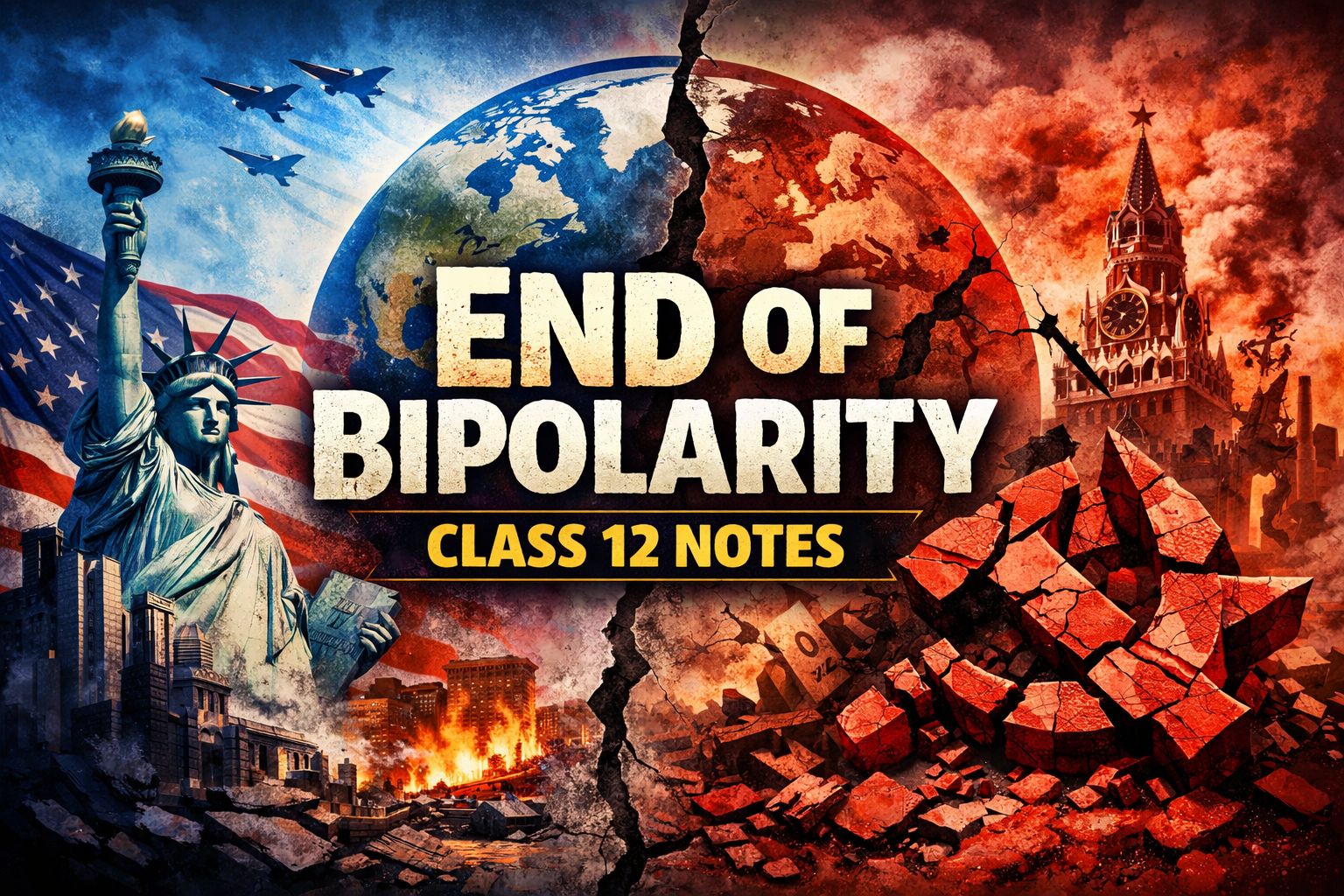
End of Bipolarity Class 12 CBSE – 20 Important Questions, 20 MCQs & Essential Notes | Don’t Miss Before Board Exam
| Field | Detail |
|---|---|
| Chapter | 1 – The End of Bipolarity |
| Subject | Political Science (Contemporary World Politics) |
| Class | 12 |
| Board | CBSE |
| Content Type | MCQs, Q&A, Important Notes |
| Exam Weight | 5–8 marks / Check latest syllabus |
The End of Bipolarity Class 12 CBSE Question Answer page is your one-stop resource to score high in board exams on this crucial chapter. Chapter 1 of Contemporary World Politics covers the collapse of the Soviet Union, the end of the Cold War, and the dramatic shift in global power — all topics that regularly appear in CBSE board exams for 1, 3, and 5 marks.
On this page, you will find 20 carefully selected questions with model answers (covering 1-mark, 3-mark, and 5-mark formats), 20 MCQs with difficulty labels and explanations, important definitions, exam tips, and quick revision flashcards. Everything is written in simple language so you can read, understand, and write answers directly in your board exam.
If you master this chapter, you are setting up a strong foundation for the entire Contemporary World Politics book. The examiner loves questions from this chapter — especially on Gorbachev’s reforms, Shock Therapy, and India-Russia relations.
Table of Contents
- Chapter Summary – End of Bipolarity Class 12 CBSE
- Important Questions and Answers – End of Bipolarity Class 12 CBSE
- MCQ Questions – End of Bipolarity Class 12 CBSE
- Important Notes – End of Bipolarity Class 12 CBSE
- Quick Revision Flashcards
- FAQ – End of Bipolarity Class 12 CBSE Questions and Answers
- Related Notes on Nextoper — Internal Links
- Useful External Resources
Chapter Summary – End of Bipolarity Class 12 CBSE
The End of Bipolarity describes how the Soviet Union — one of the world’s two superpowers — collapsed in 1991. Built after the 1917 Russian Revolution, the USSR became a powerful socialist state but suffered from a stagnant economy, political authoritarianism, and rising nationalism. Mikhail Gorbachev introduced reforms called perestroika (restructuring) and glasnost (openness) in 1985. These reforms, instead of saving the system, unleashed forces that led to its disintegration. In December 1991, Russia, Ukraine, and Belarus declared the USSR dissolved, forming the Commonwealth of Independent States (CIS). Post-Soviet countries underwent painful economic transitions called Shock Therapy. The world moved from a bipolar to a unipolar order dominated by the United States. India maintained strong ties with Russia even after the Soviet collapse.
For detailed notes, visit our The End of Bipolarity Class 12 Complete Notes.
Important Questions and Answers – End of Bipolarity Class 12 CBSE
1-Mark Questions
Q1. What does USSR stand for?
Ans. USSR stands for Union of Soviet Socialist Republics.
Q2. When did the Berlin Wall fall?
Ans. The Berlin Wall fell on 9 November 1989.
Q3. What is perestroika?
Ans. Perestroika means restructuring. It was Gorbachev’s policy to reform the Soviet economic and political system.
Q4. What does CIS stand for?
Ans. CIS stands for Commonwealth of Independent States, formed in December 1991 after the Soviet Union’s dissolution.
Q5. Who was the last leader of the Soviet Union?
Ans. Mikhail Gorbachev was the last leader of the Soviet Union (1985–1991).
3-Mark Questions
Q6. What were the main features of the Soviet political system?
Ans. The Soviet political system had three defining features. First, the Communist Party of the Soviet Union (CPSU) had a monopoly on power — no other party or opposition was allowed. Second, the economy was completely planned and controlled by the state, with no private ownership of land or production assets. Third, the system was highly centralised and bureaucratic, meaning ordinary citizens had little say in governance. These features made the system powerful in the short term but rigid and unable to adapt to changing needs over time.
Q7. What is glasnost? Why did Gorbachev introduce it?
Ans. Glasnost means openness. Gorbachev introduced it as part of his reforms in 1985 to allow greater freedom of speech and transparency in government. The Soviet system had become deeply corrupt and stagnant, and ordinary people were not allowed to speak freely or criticise the government. Gorbachev believed that opening up public debate would help identify problems and allow reforms to take place. However, glasnost also meant people could now openly criticise the Communist Party, which weakened its authority and contributed to the USSR’s eventual collapse.
Q8. What was the Warsaw Pact?
Ans. The Warsaw Pact was a military alliance formed by the Soviet Union and eight East European communist countries in 1955. It was the Soviet bloc’s response to NATO (North Atlantic Treaty Organisation), the Western military alliance. The Pact held together countries like Poland, East Germany, Hungary, and Czechoslovakia under Soviet military leadership. After the fall of communist regimes in Eastern Europe in 1989–1991, the Warsaw Pact was dissolved, marking the formal end of the Soviet military bloc.
Q9. Mention three causes of the disintegration of the Soviet Union.
Ans. The Soviet Union collapsed due to several interconnected causes. First, economic stagnation — the Soviet economy was draining resources on military spending and satellite states, leading to consumer goods shortages and declining productivity. Second, political authoritarianism — the Communist Party was corrupt, unaccountable, and unable to meet citizens’ growing aspirations for freedom and better governance. Third, rise of nationalism — republics like the Baltic states (Estonia, Latvia, Lithuania), Ukraine, and Georgia demanded independence, and this nationalist surge became impossible to control, especially after Gorbachev’s reforms loosened central authority.
Q10. Explain the concept of a ‘unipolar world’ that emerged after 1991.
Ans. Before 1991, the world was bipolar — dominated by two superpowers, the USA and the USSR. After the Soviet Union’s collapse, the USA emerged as the world’s only superpower, creating a unipolar world. In a unipolar world, one power dominates military, economic, and political decisions globally. The US used this position to expand the influence of capitalism and liberal democracy worldwide. Institutions like the World Bank and IMF, backed by US power, became key advisors to post-Soviet countries. However, countries like India and Russia preferred a multipolar world where several powers share influence.
Q11. How did Shock Therapy affect ordinary citizens in Russia?
Ans. Shock Therapy caused serious hardship for ordinary Russian citizens. The sudden shift to capitalism meant 90% of industries were put up for sale to private buyers, often at throwaway prices. The value of the ruble (Russian currency) collapsed, and inflation wiped out people’s savings. Food security worsened as collective farms broke down, and Russia began importing food. The social welfare system — which previously provided subsidised healthcare, education, and housing — was dismantled. A mafia-like class of oligarchs emerged who grabbed state assets at low prices. The middle class and intellectuals were pushed into poverty or emigrated.
Q12. What role did Boris Yeltsin play in the dissolution of the Soviet Union?
Ans. Boris Yeltsin was a key figure in the USSR’s final collapse. Originally a Communist Party member, he broke with the party and became a popular elected leader of the Russian Republic. In August 1991, when Communist Party hardliners staged a coup against Gorbachev, Yeltsin publicly opposed it and became a national hero. In December 1991, Yeltsin led Russia, Ukraine, and Belarus in declaring the Soviet Union dissolved and forming the CIS. Russia under Yeltsin inherited the USSR’s seat in the UN Security Council and all its international treaty commitments.
Q13. How did India benefit from its relationship with the Soviet Union during the Cold War?
Ans. India’s relationship with the Soviet Union was multi-dimensional and highly beneficial. Economically, the USSR helped build India’s public sector industries like steel plants at Bhilai, Bokaro, and Visakhapatnam, and accepted Indian currency for trade when India lacked foreign exchange. Politically, the Soviet Union backed India’s stand on Kashmir in the UN and supported India during conflicts, especially the 1971 war with Pakistan. Militarily, India received advanced military technology and hardware from the USSR when few other countries were willing to supply it. This relationship gave India strategic strength and economic support during a critical period of its development.
5-Mark Questions
Q14. Explain the factors that forced Gorbachev to initiate reforms in the Soviet Union.
Ans. By the mid-1980s, the Soviet Union was in deep crisis, and Mikhail Gorbachev, who became General Secretary in 1985, could see that the system needed major reforms.
The first major factor was economic stagnation. The Soviet economy had spent enormous resources on maintaining a nuclear and military arsenal to match the United States. It also funded satellite states in Eastern Europe and the five Central Asian republics. This caused a severe economic burden, consumer goods shortages, and declining GDP growth. Food imports increased every year, showing the failure of collective farming.
The second factor was the Soviet Union’s technological backwardness compared to the West. While Western nations were undergoing information and technology revolutions, Soviet industry was falling behind in innovation, infrastructure, and efficiency. Citizens who were previously told the Soviet system was superior could now compare and see the reality.
The third factor was political authoritarianism and corruption. The Communist Party was unaccountable and corrupt. Ordinary citizens suffered under slow bureaucracy, rampant corruption, and a government that suppressed freedom of speech. The party’s refusal to recognise the aspirations of different republics created growing resentment.
The fourth factor was the Soviet invasion of Afghanistan in 1979. This prolonged and costly military campaign drained resources further and lowered the Soviet Union’s international standing.
Gorbachev responded with perestroika (economic and political restructuring) and glasnost (openness and transparency). However, these reforms had unintended consequences — they unleashed nationalist forces and public demands that ultimately led to the Soviet Union’s disintegration rather than its revival.
[Image: Diagram of causes of Soviet disintegration | Alt text: End of Bipolarity Class 12 CBSE – Causes of Soviet Disintegration Diagram]
Q15. What was Shock Therapy? Was it the best way to transition from communism to capitalism? Give your assessment.
Ans. After the Soviet Union collapsed in 1991, the former communist countries of Russia, Central Asia, and Eastern Europe had to transition to a capitalist, democratic system. The model they followed — influenced heavily by the World Bank and IMF — came to be called Shock Therapy.
Shock Therapy involved several dramatic changes. All state-owned industries were immediately privatised and sold to private buyers. Collective farms were replaced by private farming. A free trade regime replaced the controlled economy, opening doors to foreign investment and currency convertibility. The break-up of existing trade alliances among Soviet bloc countries pushed each state to directly integrate with the Western economic system.
The results of Shock Therapy were largely disastrous for ordinary citizens. In Russia, about 90% of industries were sold, often at throwaway prices in what was called “the largest garage sale in history.” The ruble’s value collapsed, wiping out savings. Inflation soared. The collapse of collective farming led to food insecurity. Social welfare systems that provided healthcare, education, and housing were dismantled. A powerful mafia class emerged, and many intellectuals and professionals emigrated. Russia’s real GDP in 1999 was actually lower than in 1989.
In assessment, Shock Therapy was not the best way to transition. The shock was real, but the therapy was absent. A more gradual transition — as China attempted — might have preserved some social welfare gains while introducing market reforms. Shock Therapy prioritised speed and ideology over the well-being of ordinary citizens, and its consequences took over a decade to recover from.
[Image: Map of post-Soviet states | Alt text: End of Bipolarity Class 12 CBSE – Map of Commonwealth of Independent States]
Q16. Describe the consequences of the disintegration of the Soviet Union for world politics.
Ans. The collapse of the Soviet Union in 1991 had profound and lasting consequences for world politics.
First, the end of the Cold War. The ideological rivalry between capitalism (led by the US) and socialism (led by the USSR) that had dominated global politics for over four decades came to an end. The massive arms race, nuclear buildup, and military blocs that had kept the world in a state of tension were no longer necessary. This created possibilities for new peace initiatives.
Second, the rise of a unipolar world. With the Soviet Union gone, the United States became the world’s only superpower. Capitalism became the globally dominant economic system, and liberal democracy emerged as the preferred political model. International financial institutions like the World Bank and IMF gained enormous influence over developing and post-Soviet countries.
Third, the emergence of new nations. Fifteen new sovereign states emerged from the former Soviet republics. The Baltic states (Estonia, Latvia, Lithuania) and East European countries sought membership in the European Union and NATO. Central Asian republics pursued ties with Russia, the West, China, and their regional neighbours. Each new country had its own identity, interests, and economic challenges.
Fourth, new conflicts and instabilities. Many former Soviet republics experienced civil wars, ethnic conflicts, and secessionist movements — such as in Chechnya, Tajikistan, Nagorno-Karabakh, and the Balkans (especially Yugoslavia). Central Asia became a zone of geopolitical competition between major powers.
Fifth, India’s strategic adjustment. For India, the disintegration meant recalibrating its foreign policy. Indo-Russian relations remained strong, but India also began engaging more actively with the US and other Western powers. The multipolar vision shared by India and Russia — emphasising the UN, collective security, and independent foreign policy — became a key framework for India’s global engagement.
[Image: Timeline of Soviet disintegration | Alt text: End of Bipolarity Class 12 CBSE – Timeline of USSR Disintegration 1985 to 1991]
Q17. Explain India’s relations with Russia in the post-Cold War period.
Ans. Even after the Soviet Union’s disintegration, India maintained its strongest bilateral relationship with Russia. This relationship is built on a deep historical foundation of trust, shared interests, and mutual benefit.
India and Russia share a vision of a multipolar world order — they believe the international system should be governed through cooperation among several major powers rather than domination by one superpower. This shared vision informs their approach to the United Nations, global security, and regional conflicts.
The Indo-Russian Strategic Partnership of 2001 formalised this relationship, and more than 80 bilateral agreements have been signed. In the defence sector, India remains one of Russia’s largest arms customers. The Indian military sources most of its hardware from Russia, including aircraft, naval vessels, and missile systems.
In energy and economy, Russia is crucial for India as an oil-importing nation. India seeks to increase energy imports from Russia and Central Asian republics like Kazakhstan and Turkmenistan. Russia has also supported India’s civil nuclear energy programme and assisted India’s space industry, including providing a cryogenic rocket engine at a critical time.
Diplomatically, Russia has consistently supported India on the Kashmir issue in the UN. Both countries share interests in combating international terrorism and have cooperated on intelligence sharing. Russian cultural influence — through Hindi films, shared art, and history — remains popular in Russia and many post-Soviet countries, reflecting a people-to-people connection that goes beyond government policy.
This relationship benefits both countries. India gains military technology, energy support, and diplomatic backing. Russia gains a large and reliable market for arms and technology, and a strategic partner in building a multipolar international order.
Q18. Describe the nature of the Soviet economy before its collapse. How was it different from Western capitalism?
Ans. The Soviet economy was based on the principles of socialism — the opposite of capitalism. It had several distinctive features that set it apart from the market economies of the West.
The most fundamental difference was ownership. In the Soviet system, all land and productive assets were owned by the state. There was no private property in any significant economic sense. In contrast, Western capitalism is built on private ownership of property and the means of production.
The Soviet economy was a planned economy. The state — through central planning agencies — decided what to produce, how much to produce, and at what price goods would be sold. In the West, these decisions are made by the market mechanism — supply, demand, and price signals.
Despite its rigid structure, the Soviet system achieved some impressive outcomes. It had a complex communications network, vast energy resources (oil, iron, steel), advanced machinery production, and an efficient transport system connecting remote areas. The government subsidised basic necessities — healthcare, education, childcare, and housing — ensuring a minimum standard of living for all citizens.
However, the Soviet system could not match Western countries in consumer goods quality, technological innovation, or economic flexibility. As citizens became aware of the gap between their own standard of living and that of Western countries, the political and psychological legitimacy of the Soviet system began to crack. This economic comparison was a key factor in pushing people toward supporting reform and ultimately independence.
Q19. “The rise of nationalism was the most immediate cause of the disintegration of the Soviet Union.” Examine the statement.
Ans. This statement is largely accurate. While economic stagnation and political failure were deep-rooted causes of Soviet decline, it was rising nationalism — the desire of different republics to govern themselves — that delivered the final blow.
The Soviet Union consisted of 15 republics with very different ethnic, linguistic, cultural, and religious identities. For decades, these identities were suppressed under centralised Communist Party control. Russia dominated the system, and people from other republics often felt neglected or exploited — they believed they were paying too high an economic and cultural price to remain within the Union.
When Gorbachev introduced glasnost (openness), people were able to express these long-suppressed feelings publicly for the first time. Nationalist movements emerged — first in the Baltic republics (Lithuania declared independence in 1990, the first Soviet republic to do so), then in Ukraine, Georgia, and others.
Paradoxically, Russia itself developed a nationalist movement. Russian citizens felt that the Soviet system was using Russian resources to subsidise backward Central Asian republics. In June 1990, the Russian parliament declared its own independence from the Soviet Union — a remarkable moment when the core republic rejected the entity it had dominated.
The 1991 coup attempt by Communist Party hardliners was meant to reverse reforms and restore central control, but it failed — and its failure accelerated the collapse. In December 1991, Russia, Ukraine, and Belarus signed the Belavezha Accords, declaring the Soviet Union dissolved.
While Gorbachev’s reforms created the conditions for nationalism to emerge openly, the underlying nationalist sentiments had been building for decades. Some historians argue that the Soviet Union was always a temporary arrangement held together by force, and that once the force was removed, its disintegration was inevitable.
Q20. Write an essay on the consequences of Shock Therapy for the post-Soviet states.
Ans. Shock Therapy, the rapid economic transition from communism to capitalism implemented in Russia, Central Asia, and Eastern Europe in the 1990s, had devastating consequences for the people of these regions.
The transition was guided by the World Bank and IMF, who insisted on immediate privatisation, free trade, and removal of government subsidies. In theory, this was meant to quickly create efficient market economies. In practice, the “shock” was enormous and the “therapy” failed to materialise for most ordinary citizens.
In Russia, the consequences were especially severe. About 90% of state industries were privatised, often sold at far below their actual value in what observers called “the largest garage sale in history.” Vouchers were given to all citizens to participate in privatisation, but most people sold them cheaply in the black market because they needed immediate cash. The result was that a small group of oligarchs — businessmen with connections — acquired vast national wealth, while ordinary people were left with nothing.
The ruble collapsed, and hyperinflation wiped out the savings of an entire generation. The collective farm system disintegrated, leading to food insecurity. Russia, which had once been food-sufficient, began importing food. By 1999, Russia’s real GDP was lower than it had been in 1989 — ten years of economic progress had been erased.
The social welfare system — one of the few genuine achievements of the Soviet state — was dismantled. Healthcare, education, and housing subsidies were removed. The middle class shrank dramatically. Intellectuals, scientists, and professionals emigrated in large numbers — a brain drain that weakened Russia for years.
Politically, democratic institutions were weak. Constitutions were drafted hastily, giving executive presidents enormous powers with little parliamentary oversight. In Central Asian states, presidents extended their own terms without democratic consent.
Recovery only began around 2000, driven primarily by exports of natural resources — oil, natural gas, and minerals. This reveals a troubling truth: the post-Soviet economies that recovered did so mainly because of natural resource wealth, not because of the market reforms introduced by Shock Therapy.
The experience of Shock Therapy remains a cautionary tale in economics and development. It shows that rapid ideological transitions without adequate social protection and institutional capacity can cause more harm than the system they replace.
MCQ Questions – End of Bipolarity Class 12 CBSE
Q1. [Easy] Which revolution led to the formation of the USSR?
a) French Revolution
b) American Revolution
c) Russian Revolution of 1917
d) Industrial Revolution
✅ Answer: (c) Russian Revolution of 1917
💡 Explanation: The USSR was formed after the Bolshevik-led socialist revolution in Russia in 1917.
Q2. [Easy] The Berlin Wall was built in which year?
a) 1945
b) 1955
c) 1961
d) 1971
✅ Answer: (c) 1961
💡 Explanation: The Berlin Wall was built in 1961 to separate East Berlin (communist) from West Berlin (capitalist).
Q3. [Easy] What does ‘glasnost’ mean?
a) Restructuring
b) Openness
c) Independence
d) Revolution
✅ Answer: (b) Openness
💡 Explanation: Glasnost means openness and was Gorbachev’s policy to allow freedom of expression in the Soviet Union.
Q4. [Easy] Who was the General Secretary of the Communist Party of the Soviet Union in 1985?
a) Boris Yeltsin
b) Joseph Stalin
c) Nikita Khrushchev
d) Mikhail Gorbachev
✅ Answer: (d) Mikhail Gorbachev
💡 Explanation: Gorbachev became General Secretary in March 1985 and initiated major reforms.
Q5. [Easy] The CIS was formed in which year?
a) 1989
b) 1990
c) 1991
d) 1993
✅ Answer: (c) 1991
💡 Explanation: The Commonwealth of Independent States was formed in December 1991 when Russia, Ukraine, and Belarus declared the Soviet Union dissolved.
Q6. [Easy] The Warsaw Pact was a:
a) Economic alliance
b) Cultural treaty
c) Military alliance
d) Trade agreement
✅ Answer: (c) Military alliance
💡 Explanation: The Warsaw Pact (1955) was the Soviet bloc’s military alliance, comparable to NATO in the West.
Q7. [Easy] Which country succeeded the USSR in the United Nations Security Council?
a) Ukraine
b) Belarus
c) Kazakhstan
d) Russia
✅ Answer: (d) Russia
💡 Explanation: Russia was accepted as the successor state of the Soviet Union and inherited its UN Security Council seat.
Q8. [Easy] What does ‘perestroika’ mean?
a) Openness
b) Democracy
c) Restructuring
d) Independence
✅ Answer: (c) Restructuring
💡 Explanation: Perestroika means restructuring and was Gorbachev’s policy to reform the Soviet economic and administrative system.
Q9. [Medium] Which of the following was NOT a cause of the disintegration of the Soviet Union?
a) Economic stagnation
b) Rise of nationalism
c) Soviet invasion of Afghanistan
d) Formation of the United Nations
✅ Answer: (d) Formation of the United Nations
💡 Explanation: The UN’s formation in 1945 predates and is unrelated to the Soviet collapse. The other three are direct contributing causes.
Q10. [Medium] Shock Therapy was influenced by the advice of which international organisations?
a) UN and WHO
b) World Bank and IMF
c) NATO and EU
d) ASEAN and G20
✅ Answer: (b) World Bank and IMF
💡 Explanation: The World Bank and IMF pushed post-Soviet countries to rapidly privatise and adopt free-market policies — a model called Shock Therapy.
Q11. [Medium] Which was the FIRST Soviet republic to declare independence?
a) Ukraine
b) Estonia
c) Lithuania
d) Georgia
✅ Answer: (c) Lithuania
💡 Explanation: Lithuania declared independence in March 1990, becoming the first of the 15 Soviet republics to do so.
Q12. [Medium] The Soviet economy was different from Western capitalism because:
a) It allowed multi-party elections
b) It was based on private property
c) The state owned and controlled all means of production
d) Citizens had full economic freedom
✅ Answer: (c) The state owned and controlled all means of production
💡 Explanation: In the Soviet system, all land and productive assets belonged to the state — the opposite of capitalist private ownership.
Q13. [Medium] What was the main engine of post-2000 economic recovery for most post-Soviet states?
a) Technology exports
b) Tourism
c) Export of natural resources like oil and gas
d) Foreign aid from the USA
✅ Answer: (c) Export of natural resources like oil and gas
💡 Explanation: Countries like Russia, Kazakhstan, and Azerbaijan recovered mainly due to revenues from oil, gas, and mineral exports.
Q14. [Medium] The Soviet invasion of Afghanistan took place in:
a) 1971
b) 1975
c) 1979
d) 1985
✅ Answer: (c) 1979
💡 Explanation: The Soviet Union invaded Afghanistan in 1979, further weakening its economy and global image.
Q15. [Medium] India and Russia share a vision of:
a) A unipolar world led by the US
b) A bipolar world
c) A multipolar world order
d) A world without nuclear weapons
✅ Answer: (c) A multipolar world order
💡 Explanation: Both India and Russia believe in a world where several powers share influence, rather than one superpower dominating.
Q16. [Medium] Which of the following countries split peacefully into two nations after the Soviet collapse?
a) Yugoslavia
b) Czechoslovakia
c) Georgia
d) Ukraine
✅ Answer: (b) Czechoslovakia
💡 Explanation: Czechoslovakia peacefully split into the Czech Republic and Slovakia. Yugoslavia, in contrast, broke apart violently.
Q17. [Hard] Which of the following BEST explains why Shock Therapy failed to deliver prosperity in Russia?
a) Russia refused to privatise industries
b) Restructuring was done by government policy, not market forces
c) Restructuring through market forces led to collapse of industries and no alternative was created
d) Russia maintained its old Soviet trade alliances
✅ Answer: (c) Restructuring through market forces led to collapse of industries and no alternative was created
💡 Explanation: Because industries were restructured purely through markets with no government-directed industrial policy, entire sectors disappeared with nothing to replace them.
Q18. [Hard] Which statement about the Baltic Republics is CORRECT?
a) They joined the CIS in December 1991
b) They declared independence and later joined NATO in March 2004
c) They remained part of Russia after the Soviet collapse
d) They were the last republics to leave the USSR
✅ Answer: (b) They declared independence and later joined NATO in March 2004
💡 Explanation: Estonia, Latvia, and Lithuania became UN members in September 1991 and joined NATO in March 2004.
Q19. [Hard] Which of these is an INCORRECT match?
a) Perestroika – Gorbachev – Restructuring
b) Shock Therapy – World Bank and IMF – Economic Transition
c) CIS – December 1991 – Russia, Ukraine, Belarus
d) Berlin Wall – Built in 1965 – Divided Germany
✅ Answer: (d) Berlin Wall – Built in 1965 – Divided Germany
💡 Explanation: The Berlin Wall was built in 1961, not 1965. All other matches are correct.
Q20. [Hard] Which of the following BEST describes why nationalist unrest was strongest in the “European” part of the Soviet Union rather than Central Asia?
a) Central Asian republics had stronger communist parties
b) European republics felt they were subsidising backward Central Asian regions economically
c) Central Asian republics were given more autonomy
d) European republics had larger populations
✅ Answer: (b) European republics felt they were subsidising backward Central Asian regions economically
💡 Explanation: People in Russia, the Baltic states, and Ukraine felt alienated partly because they believed their economic resources were being used to maintain less developed Central Asian republics, fuelling nationalist sentiment.
Important Notes – End of Bipolarity Class 12 CBSE
Key Definitions to Remember
Bipolarity: A world order dominated by two superpowers — the USA and the USSR — each leading their own bloc of allies during the Cold War.
Perestroika: Literally means ‘restructuring’. Gorbachev’s policy introduced in 1985 to reform the stagnant Soviet economic and administrative system.
Glasnost: Literally means ‘openness’. Gorbachev’s policy of allowing freedom of speech, transparency, and public debate in the Soviet system.
Shock Therapy: The rapid and complete transition from a state-controlled socialist economy to a free-market capitalist economy, as implemented in post-Soviet countries in the 1990s with IMF and World Bank guidance.
CIS (Commonwealth of Independent States): The loose confederation formed in December 1991 by former Soviet republics after the USSR’s dissolution. Russia, Ukraine, Belarus, and later Central Asian and Caucasus republics joined.
Second World: The Soviet bloc — USSR and the East European communist countries that followed its political and economic model, also called the socialist bloc.
Warsaw Pact: The military alliance formed in 1955 among the Soviet Union and East European communist countries as a counterpart to NATO.
Unipolar World: A global order dominated by a single superpower. After 1991, the USA became the sole superpower, creating a unipolar world.
Multipolar World: A global order where several major powers — not just one — share influence and responsibility. Both India and Russia advocate this model.
Oligarchs: A small group of extremely powerful and wealthy businessmen who acquired enormous assets during Russia’s post-Soviet privatisation process.
Important Formulas / Diagrams / Laws
Timeline of Soviet Disintegration (must memorise):
- 1917 — Russian Revolution; USSR formed
- 1979 — Soviet invasion of Afghanistan
- 1985 — Gorbachev becomes General Secretary; begins reforms
- 1988 — Independence movement begins in Lithuania
- 1989 November — Berlin Wall falls
- 1990 February — Gorbachev allows multi-party politics
- 1990 March — Lithuania first to declare independence
- 1991 August — Failed coup against Gorbachev
- 1991 September — Baltic states become UN members
- 1991 December — USSR officially dissolved; CIS formed
- 1991 December 25 — Gorbachev resigns
[Image: Causes of Soviet Disintegration concept map | Alt text: End of Bipolarity Class 12 CBSE – Causes of Disintegration of USSR Concept Map]
Key Leaders to Know:
- Vladimir Lenin (1870–1924): Founder of the USSR
- Joseph Stalin (1879–1953): Rapid industrialisation; authoritarian rule
- Nikita Khrushchev (1894–1971): Denounced Stalin; peaceful coexistence
- Leonid Brezhnev (1906–82): Détente with the West; invaded Afghanistan
- Mikhail Gorbachev (born 1931): Perestroika, glasnost; last Soviet leader
- Boris Yeltsin (1931–2007): First elected President of Russia; dissolved USSR
Exam Tips for This Chapter
- Always mention two key terms together: When writing about Gorbachev’s reforms, always mention both perestroika and glasnost — writing just one will cost you marks.
- In 5-mark answers, use the timeline: The timeline of Soviet disintegration is factual and impresses examiners. Mention key dates like 1985 (Gorbachev), 1989 (Berlin Wall), and 1991 (CIS).
- Draw a diagram for Shock Therapy answers: A simple flow chart showing the steps of Shock Therapy (privatisation → free trade → social welfare removal) makes a 5-mark answer much stronger.
- India-Russia relations is a high-scoring topic: The 4 dimensions — Economic, Political, Military, Cultural — should be memorised with at least one example each.
- Do not confuse CIS with USSR: CIS was formed after the Soviet dissolution. Never write that CIS replaced the Soviet Union — it was a new, looser arrangement.
- “Largest garage sale in history”: This phrase from the NCERT textbook is likely to appear as a short-answer question. Remember it refers to Russia selling 90% of its industries at throwaway prices.
- Common mistake — Baltic states vs Central Asian states: Nationalist unrest was strongest in the Baltic and European parts (Russia, Ukraine, Lithuania), NOT in Central Asia as many students assume.
- For 1-mark questions: Memorise definitions of perestroika, glasnost, CIS, Shock Therapy, Warsaw Pact, Second World, and bipolarity — these are frequent targets.
Quick Revision Flashcards
🔹 Berlin Wall: Built in 1961 to divide capitalist West Berlin from communist East Berlin; fell on 9 November 1989, symbolising the end of the Cold War.
🔹 USSR: Union of Soviet Socialist Republics — a socialist superpower formed after the 1917 Russian Revolution and dissolved in December 1991.
🔹 Perestroika: Gorbachev’s 1985 policy of restructuring the Soviet economy and administrative system to make it more efficient and responsive.
🔹 Glasnost: Gorbachev’s 1985 policy of openness, allowing Soviet citizens to freely discuss and criticise government policies — which unintentionally weakened Communist Party authority.
🔹 Shock Therapy: The rapid, IMF/World Bank-influenced transition from socialism to capitalism in post-Soviet countries, which caused widespread poverty and economic collapse rather than prosperity.
🔹 CIS (Commonwealth of Independent States): The loose organisation formed by former Soviet republics in December 1991 after declaring the USSR dissolved; Russia became its successor state.
🔹 Warsaw Pact (1955): Soviet Union’s military alliance with East European communist nations — the socialist bloc’s equivalent of NATO.
🔹 Unipolar vs Multipolar World: After the USSR’s collapse, the US created a unipolar world; India and Russia advocate a multipolar world where several powers share global influence.
🔹 Perestroika’s Unintended Consequence: Gorbachev’s reforms, instead of saving the Soviet system, unleashed nationalism and public demand for independence that accelerated the USSR’s collapse.
🔹 Indo-Russian Strategic Agreement (2001): Over 80 bilateral agreements signed between India and Russia; covers defence, energy, space, science, and shared diplomatic positions.
FAQ – End of Bipolarity Class 12 CBSE Questions and Answers
Q: Why did Gorbachev’s reforms lead to the collapse of the USSR rather than saving it?
A: Gorbachev’s reforms — perestroika and glasnost — were intended to modernise and strengthen the Soviet system. However, by allowing greater freedom of expression (glasnost), people could now openly criticise the Communist Party and demand independence. By loosening central control (perestroika), he released nationalist forces that the government could no longer control. Those who wanted faster reforms were disappointed; those in the party who wanted to protect their privileges were threatened. Gorbachev lost support from all sides, and the reforms set in motion a chain of events — from Baltic independence movements to the 1991 coup — that ended the Soviet Union itself.
Q: What is the difference between the Second World and the Third World?
A: The “Second World” refers to the Soviet Union and its communist-controlled East European allies — countries that followed a socialist economic model. The “Third World” referred to countries — mostly in Asia, Africa, and Latin America — that were not aligned with either the US-led First World (Western capitalist democracies) or the Soviet-led Second World. With the collapse of the Second World in 1991, the terms lost their political meaning, though “Third World” is still sometimes used loosely to describe developing countries.
Q: How is India’s foreign policy approach different from what Shock Therapy suggests?
A: Shock Therapy was based on rapid, wholesale adoption of Western capitalism and abandonment of state involvement in the economy. India, in contrast, followed a more gradual path — moving towards economic liberalisation beginning in 1991 while retaining a significant public sector and social welfare role for the government. India also maintained strategic autonomy in foreign policy rather than aligning completely with Western institutions like the IMF. This cautious approach helped India avoid the social catastrophe that Shock Therapy caused in Russia.
Q: Why did Baltic states face stronger nationalist movements than Central Asian republics?
A: During the Cold War, many analysts expected nationalist unrest to be strongest in the ethnically and religiously distinct Central Asian republics. However, the opposite happened. Baltic states (Estonia, Latvia, Lithuania) and other European parts of the Soviet Union — Ukraine, Georgia, and Russia itself — had stronger nationalist movements because their citizens felt economically and culturally superior and believed they were subsidising the poorer Central Asian regions. They also had stronger historical memories of independence and closer cultural ties to Europe, making them more eager to leave the Soviet Union.
Q: What is the significance of India’s support for a multipolar world order?
A: India’s advocacy for a multipolar world order reflects its belief that no single country should dominate global affairs. India argues that decisions affecting the world should be made through multilateral institutions like the United Nations, with meaningful participation from all major powers. This stance allows India to maintain strategic autonomy — it can engage with the US, Russia, China, and other powers without becoming dependent on any one of them. It also reflects India’s belief in sovereign equality — that every country, regardless of size, deserves a voice in global governance.