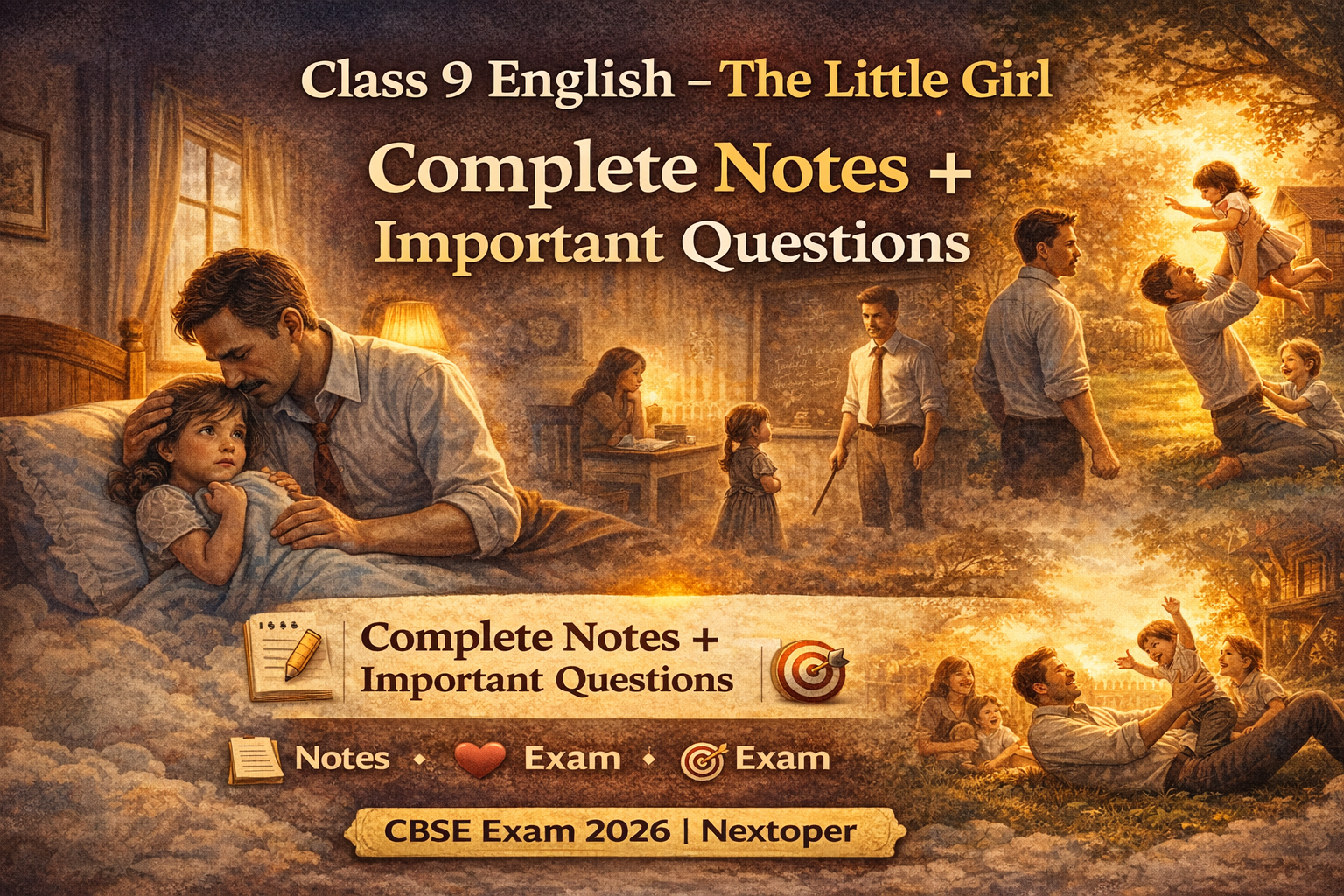
The Little Girl Class 9 CBSE – Complete Notes with 10 Must-Know Concepts & Important Questions
| Field | Detail |
|---|---|
| Chapter | 3 – The Little Girl |
| Subject | English (Beehive) |
| Class | 9 |
| Board | CBSE |
| Exam Weightage | Check latest CBSE syllabus |
The Little Girl Class 9 CBSE is one of the most emotionally resonant chapters in the Beehive textbook — a short story by New Zealand author Katherine Mansfield that explores the strained relationship between a little girl named Kezia and her strict, distant father. On the surface, it is a simple story about fear and misunderstanding. Underneath, it is a deeply moving account of how love can be hidden behind silence, fatigue, and discipline — and how a child slowly learns to see through that surface to the warmth beneath. This chapter appears regularly in board exams, with questions on character sketches, themes, and important lines.
These notes cover everything you need: the complete summary paragraph by paragraph, character sketches of Kezia, her father, and her grandmother, all major themes, word meanings, and five model exam answers. You can use this guide for a full study session or a quick revision sweep before the exam — both work equally well with this structure.
Here is something worth reflecting on before you begin: almost every student can relate to Kezia at some point in their life — that feeling of not quite understanding why a parent seems hard to approach. This story gives language to that feeling and resolves it beautifully. Connecting with the story personally will make your exam answers richer and more memorable.
Table of Contents
- About the Author – Katherine Mansfield
- The Little Girl Class 9 CBSE – Complete Chapter Summary
- Character Sketches – Kezia, Father, and Grandmother
- Themes and Literary Devices in The Little Girl Class 9 CBSE
- Word Meanings from the Chapter
- Important Questions – The Little Girl Class 9 CBSE
- Quick Revision – 10 Key Points to Remember
- Related Notes on Nextoper – Internal Links
- Useful External Resources – Outbound Links
About the Author – Katherine Mansfield
Katherine Mansfield (1888–1923) was born in Wellington, New Zealand, and went on to become one of the most celebrated short story writers in the English language. She spent much of her adult life in Europe and produced a remarkable body of work in a very short lifetime — she died at just 34 years of age.
Mansfield’s stories are known for their emotional precision, subtle characterisation, and ability to find profound meaning in everyday domestic moments. She had a particular gift for writing about childhood, family relationships, and the quiet tensions that build between people who love each other but struggle to show it. The Little Girl is a perfect example of this — a small, intimate story with a large emotional truth at its core.
[Image: Portrait illustration of Katherine Mansfield with her name and birth–death years | Alt text: The Little Girl Class 9 CBSE – author Katherine Mansfield]
The Little Girl Class 9 CBSE – Complete Chapter Summary
Kezia’s World at Home
The story centres on Kezia, a young girl living with her mother, father, and grandmother. Her home is comfortable but carries an atmosphere of quiet tension. Every morning, her father leaves for work after giving her a brief, mechanical kiss. Every evening, his loud voice fills the hallway as he comes home, and Kezia instinctively shrinks from it.
When her grandmother gently encourages her to spend time with her father, Kezia tries. But the conversations are awkward and one-sided. Her father would ask what she had done that day, and Kezia, nervous and tongue-tied, could barely answer. He would tease her, calling her a “little brown owl” — a remark he perhaps intended as playful, but which Kezia received as mockery.
She found herself genuinely puzzled: why was her father so different from other fathers she observed? Why did he never laugh or play?
The Birthday Gift and Its Consequences
Kezia’s grandmother suggested she make a pincushion as a birthday gift for her father — a way to build a connection between them. Kezia was enthusiastic. She carefully stitched a small cushion from yellow silk and then looked around for material to stuff it with. She found sheets of paper on her mother’s bedroom table, tore them up, and used them as filling.
The problem, which Kezia had no way of knowing, was that those sheets of paper contained her father’s carefully prepared speech for the Port Authority — an important professional document. When her father discovered what had happened, he was furious. He summoned Kezia and, despite her frightened, tearful explanation that she had not understood what the papers were, he punished her by striking her hands with a ruler.
Kezia was devastated. She cried for a long time and whispered the question to herself: what did God make fathers for? In her mind at that moment, her father was not just strict — he was cruel.
Watching the Macdonalds
Next door lived the Macdonald family, and Kezia sometimes watched them through the fence. Mr. Macdonald was everything Kezia’s father was not — he chased his children around the garden, lifted the baby into the air, rolled on the grass with them, and laughed openly and freely. The whole family tumbled together in joyful chaos.
Watching them, Kezia made a quiet, sad observation: there were simply different kinds of fathers in the world. Some were warm and playful; hers was not. This scene is important in the chapter because it deepens Kezia’s sense of loss without making her bitter — she is still too young and too innocent for bitterness. She just wonders.
The Night Everything Changed
The turning point of the story arrives one night when Kezia’s mother is unwell and taken to hospital, accompanied by the grandmother. Kezia is left at home with the family cook, Alice. In the middle of the night, she wakes up screaming from a nightmare — she had dreamed of a menacing butcher with a knife coming toward her.
Her father heard her cries and came immediately to her room. He picked her up gently, carried her to his own large bed, and lay down beside her. He said very little. But his presence — his warmth, his size, his solid steadiness — made Kezia feel completely safe. She snuggled close to him and held on tight.
As she lay there, she became aware for the first time of how exhausted he was. She could feel the tiredness in his body. And in that quiet moment, something shifted inside her. She whispered softly that he had a big heart, and she meant it completely.
Kezia had not been wrong to notice her father’s sternness. But she had been wrong to think it was the whole story. His love had always been there — expressed not in play or laughter, but in the fact that at the first sound of her crying, he had come running.
[Image: An illustration of a father carrying a small child to his bed at night | Alt text: The Little Girl Class 9 CBSE – father comforting Kezia at night]
Character Sketches – Kezia, Father, and Grandmother
Kezia
Kezia is a sensitive, imaginative, and deeply feeling child. She observes the world around her carefully — noticing the difference between her father and Mr. Macdonald, watching the way adults behave, and trying to make sense of relationships she does not yet fully understand. Her fear of her father is genuine, not exaggerated, and stems from a real lack of warmth in their daily interactions.
What makes Kezia admirable is her capacity for growth. By the end of the story, she has moved from fear to genuine understanding — not because her father changed, but because she found a new way to see him. She represents the emotional journey that many children make toward understanding their parents.
The Father
Kezia’s father is one of the most carefully drawn characters in the chapter. He is not a villain. He is a hardworking man carrying significant professional responsibilities, and the weight of that work leaves him with little energy for warmth or play at home. His punishment of Kezia over the torn papers is harsh, but it comes from genuine stress rather than cruelty.
His true character is revealed at night — when he hears Kezia’s screams and responds instantly, without hesitation. He does not lecture her or dismiss her fear. He simply picks her up and keeps her safe. That instinct is the truest expression of who he is.
The Grandmother
Kezia’s grandmother is the quiet heart of the household. She is warm, patient, and wise. She understands both Kezia’s fear and her father’s distance, and she tries gently to bring them closer together — first by encouraging Kezia to talk to him, and then by suggesting the birthday gift project. Her role is small but essential: she is the bridge that the story is built on.
Themes and Literary Devices in The Little Girl Class 9 CBSE
Key Themes
Parental Love and Misunderstanding is the story’s central theme. Kezia’s father loves her deeply, but he expresses that love through provision and protection rather than play and warmth. Children, the story suggests, need both — and when only one is present, fear and distance can fill the gap that tenderness leaves empty.
Emotional Growth and Empathy tracks Kezia’s journey across the story. She begins by seeing her father as a frightening authority figure and ends by genuinely understanding him. That shift — from judgment to empathy — is the story’s emotional core, and it is a journey that the author presents without sentimentality or shortcuts.
Childhood Innocence is handled with great delicacy. Kezia’s question — what did God make fathers for? — is both funny and heartbreaking. It captures perfectly the way children process pain: literally, simply, and completely sincerely.
Family Bonds and Communication runs as a quieter theme throughout. The distance between Kezia and her father exists not because they do not love each other, but because they have not yet found a shared language for that love. The night scene provides that language — not words, but physical closeness and presence.
Literary Devices
- Contrast: The warm, playful Macdonald father versus Kezia’s stern, exhausted father; the daytime fear versus the nighttime comfort.
- Symbolism: The pincushion represents Kezia’s desire for connection; the torn speech represents the painful cost of misunderstanding.
- Irony: The birthday gift — meant to build love — ends up causing the most painful incident in their relationship.
- Third-Person Limited Narration: The story is told from close to Kezia’s perspective, which means readers experience the father’s behaviour exactly as she does — from the outside, without explanation, until the very end.
Word Meanings from the Chapter
| Word | Meaning |
|---|---|
| Stammer | To speak with involuntary pauses or repetitions |
| Stern | Serious, strict, and unsmiling in manner |
| Laboriously | Done with considerable effort and difficulty |
| Snuggled | Moved close and settled comfortably against someone |
| Wretched | Deeply unhappy or miserable |
| Nightmare | A frightening dream that causes the sleeper to wake in distress |
| Hue and cry | A loud commotion or public outcry |
| Gasping | Breathing in sharply due to surprise or fear |
| Grave | Having a serious, solemn expression |
| Trembled | Shook slightly, usually from fear or cold |
Important Questions – The Little Girl Class 9 CBSE
Q1. Who wrote “The Little Girl” and what is it about? (1 Mark) The Little Girl was written by Katherine Mansfield. It is about a young girl named Kezia who fears her strict father but eventually discovers his deep love for her after he comforts her during a nightmare.
Q2. Describe the birthday gift incident and its effect on Kezia. (3 Marks) Kezia’s grandmother suggested she make a pincushion as a birthday gift for her father. Kezia stitched the cushion carefully but used sheets of paper from her mother’s room as stuffing, not knowing they contained her father’s important speech for the Port Authority. When her father discovered the destroyed document, he punished her by striking her hands with a ruler. Kezia was deeply hurt and confused — she had genuinely not understood what she was doing. The incident widened the distance between them significantly and left Kezia questioning why fathers existed at all.
Q3. How does Kezia’s perception of her father change by the end of the story? What causes this change? (3 Marks) At the start of the story, Kezia sees her father as a frightening, cold, and sometimes cruel figure. She compares him unfavourably to the Macdonald father next door, who plays openly with his children. The change happens on the night her mother is hospitalised and Kezia wakes up screaming from a nightmare. Her father comes to her immediately, carries her to his bed, and lies beside her until she feels calm and safe. As she lies there, Kezia notices for the first time how utterly exhausted her father is — the tiredness is written into his whole body. She understands in that moment that his distance was never indifference; it was the weight of a man working very hard for his family.
Q4. Compare the character of Kezia’s father with Mr. Macdonald. What does this comparison reveal about different expressions of parental love? (5 Marks) Kezia’s father and Mr. Macdonald represent two very different ways of being a parent, and the contrast between them is central to the story’s meaning. Mr. Macdonald is immediately recognisable as a warm, demonstrative father — he plays actively with his children every evening, laughing, rolling on the grass, and tossing the baby in the air. His love is visible, physical, and joyful. Kezia watches him from her window with something that is part admiration and part longing. Her own father, by contrast, is formal, exhausted, and brief in his daily interactions with her. He kisses her mechanically in the morning and frightens her with his loud voice in the evening. The birthday gift incident, where he punishes her physically, seems to confirm her fear of him. However, the story ultimately argues that Kezia has been reading only one part of her father’s character. Mr. Macdonald’s love is easy to see because it looks like play and laughter. Kezia’s father’s love is harder to see because it looks like work, discipline, and responsibility. When he comes running at the sound of her nightmare and holds her through the night, the story reveals that his love is no less real — it is simply expressed differently. The comparison between the two fathers gently challenges readers to look past the surface of how people show care and ask what lies underneath.
Q5. What is the central theme of The Little Girl, and how does Katherine Mansfield develop it through the story? (5 Marks) The central theme of The Little Girl is the gap between parental love and a child’s understanding of it, and the emotional growth that comes from bridging that gap. Katherine Mansfield develops this theme very carefully across the story’s three distinct phases. In the first phase, Kezia experiences her father entirely from the outside — as a large, loud, intimidating presence who offers little warmth. Her fear is presented sympathetically and without judgment; she is simply responding to what she can observe. In the second phase, the birthday gift incident deepens that fear into something closer to genuine pain. Kezia meant to do something loving and was punished for it; the injustice of this, from her perspective, feels absolute. The contrast with the Macdonald household sharpens her sense of what she is missing. In the third and final phase, the nightmare scene dissolves Kezia’s fear not through explanation or apology, but through experience. She feels, rather than hears, the truth about her father — his exhaustion, his solidity, his immediate response to her distress. Mansfield is making a subtle but important point: some truths about the people we love can only be understood through direct, physical experience. Words and observation are not always enough. The story’s quiet message is that love between parents and children is often asymmetric — parents carry more weight than children can see — and that growing up involves slowly learning to recognise that invisible weight and feel grateful for it.
Quick Revision – 10 Key Points to Remember
- The Little Girl Class 9 CBSE is written by Katherine Mansfield, a celebrated short story writer from New Zealand known for her emotional, character-driven narratives.
- The story’s protagonist is Kezia, a sensitive young girl who fears her strict, busy father and does not understand why he is so different from other fathers she observes.
- Kezia’s grandmother plays a gentle but pivotal role — she encourages Kezia to connect with her father and suggests the birthday gift idea that sets the plot’s central conflict in motion.
- The pincushion incident — where Kezia unknowingly destroys her father’s important speech while trying to make him a birthday gift — is the story’s main conflict and the lowest point in their relationship.
- Mr. Macdonald, the neighbour, is used as a contrast figure: his visible, playful parenting style highlights what Kezia feels she is missing at home.
- The story’s turning point comes when Kezia’s mother is hospitalised and Kezia wakes screaming from a nightmare about a butcher with a knife.
- Kezia’s father responds to her nightmare immediately and tenderly — carrying her to his own bed and staying with her, which is the first unambiguous act of warmth Kezia experiences from him.
- Kezia’s line — that her father has a big heart — marks her emotional shift from fear to understanding, and is one of the most important lines in the chapter for exam purposes.
- The story’s key themes are parental love and misunderstanding, emotional growth, childhood innocence, and the importance of empathy in family relationships.
- For board exams, practise character sketches of both Kezia and her father, the significance of the nightmare scene, and the contrast between Kezia’s father and Mr. Macdonald — these are the most frequently examined areas of this chapter.
Related Notes on Nextoper
Explore these related CBSE notes on Nextoper to strengthen your preparation:
- Class 9 English Beehive Chapter 3 Notes – The Little Girl
- Class 9 English Beehive Chapter 2 Notes – The Sound of Music
- Class 9 English Beehive Chapter 4 Notes – A Truly Beautiful Mind



Pingback: Class 9 English Beehive Chapter 5 Notes The Snake and the Mirror
Pingback: Class 9 English Beehive Chapter 10 Notes – Kathmandu
Pingback: Class 9 Moments Chapter 1 Notes - The Lost Child | Nextoper
Pingback: Class 9 English Beehive Chapter 4 Notes - A Truly Beautiful Mind | Nextoper - Nextoper
Pingback: Class 9 English Beehive Chapter 2 Notes – The Sound of Music | Nextoper - Nextoper
Pingback: Class 9 English Beehive Chapter 1 Notes – The Fun They Had | Nextoper Notes - Nextoper