The Fun They Had Class 9 CBSE – Complete Notes with 10 Must-Know Concepts for Easy Board Prep
Quick Overview
| Field | Detail |
|---|---|
| Chapter | Chapter 1 – The Fun They Had |
| Subject | English – Beehive |
| Class | 9 |
| Board | CBSE |
| Exam Weightage | Check latest CBSE syllabus |
The Fun They Had Class 9 CBSE is the very first chapter in the Beehive textbook, and it sets a thoughtful, imaginative tone for the entire year of English study. Written by Isaac Asimov, one of the greatest science fiction writers of the twentieth century, this story is set in the year 2157 — a future where children study at home using mechanical teachers and printed books no longer exist.
Through the eyes of an eleven-year-old girl named Margie, the story asks a question that feels surprisingly relevant even now — can technology ever truly replace the human warmth and joy of learning together in a real school? These notes cover the complete summary, all major characters, themes, key passages, important word meanings, and board-style exam questions to help you prepare The Fun They Had with confidence.
What makes this chapter so interesting is how it uses the future as a mirror for the present. Asimov wrote this story in 1951, long before computers or tablets existed in classrooms. Yet his imagined future feels eerily familiar today. Reading this chapter carefully will not only help you score well in your CBSE Class 9 English exam but also make you think more deeply about what good education actually means.
Table of Contents
- About the Author – Isaac Asimov
- The Fun They Had Class 9 CBSE – Complete Summary
- The Discovery of the Real Book
- The Mechanical Teacher and Margie’s School Life
- The County Inspector’s Visit
- Tommy Explains Old Schools – The Fun They Had Class 9 CBSE
- Margie’s Imagination – Old Schools vs Future Schools
- Character Sketches – The Fun They Had Class 9 CBSE
- Themes of The Fun They Had Class 9 CBSE
- Important Word Meanings
- Important Questions – The Fun They Had Class 9 CBSE
- Quick Revision – Key Points to Remember
- Related Notes on Nextoper – Internal Links
- Useful External Resources – Outbound Links
About the Author – Isaac Asimov
Isaac Asimov (1920–1992) was an American author and professor of biochemistry at Boston University. He wrote or edited over 500 books across science, science fiction, and history, making him one of the most prolific writers of the twentieth century.
His science fiction is known for being grounded in real scientific ideas rather than fantasy. The Fun They Had, written in 1951, is a short but deeply meaningful story that imagines what education might look like if technology completely took over the classroom.
Asimov’s genius lies in how he uses a simple story about two children and an old book to ask big questions about learning, connection, and what truly makes education worthwhile.
The Fun They Had Class 9 CBSE – Complete Summary
The Fun They Had Class 9 CBSE opens on 17 May 2157, when a thirteen-year-old boy named Tommy discovers something extraordinary in the attic of his house — a real, printed book.
The book is old and dusty, with yellowed pages and words that stand completely still on the paper. To Margie and Tommy, children who have grown up with digital screens where words move and change, a book with fixed printed words seems almost magical — and very strange.
Margie writes about this discovery in her diary, and the story unfolds from there — exploring what schools were like in the past compared to the isolated, mechanical education system of their future world.
The Discovery of the Real Book
When Tommy shows Margie the old book, her first reaction is curiosity mixed with confusion. She has seen books before, but only on telebooks — television screens that can hold millions of books and display moving text.
Tommy explains that once you finish reading a printed book, you simply throw it away. Margie finds this wasteful compared to her telebook, which can store an unlimited number of titles. Yet there is something about the physical book — its texture, its stillness, its age — that draws both children in.
The book turns out to be about schools from hundreds of years ago — schools with human teachers, shared classrooms, and children learning together. This discovery sparks Margie’s curiosity about a kind of education she has never experienced and can barely imagine.
This opening scene is deceptively simple. Asimov uses a child finding an old book to immediately contrast two completely different worlds — the warm, communal past and the cold, isolated future. It is the foundation on which the entire story is built.
The Mechanical Teacher and Margie’s School Life
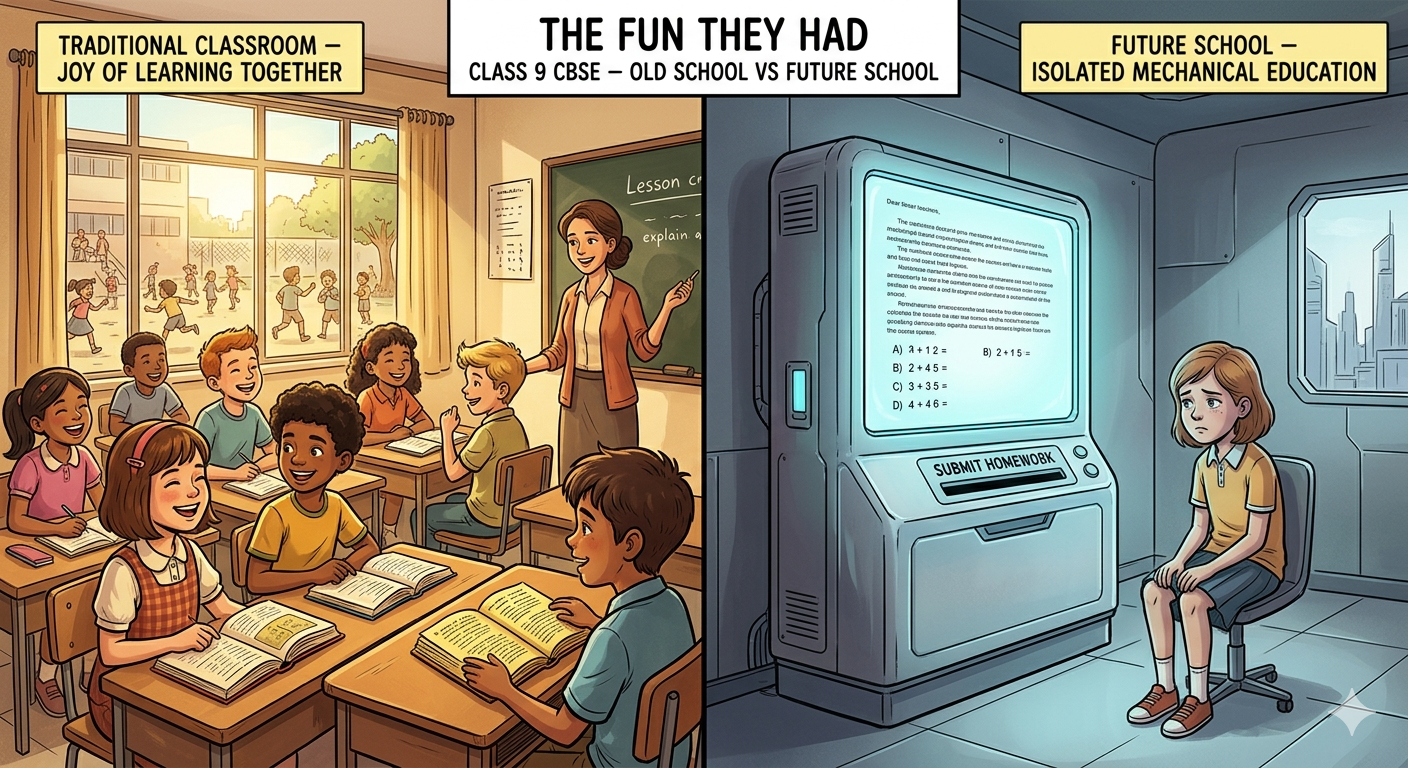
Margie’s school experience is very different from anything we would recognize today. She does not travel to a school building, sit with classmates, or interact with a human teacher. Her entire education happens in a small room right next to her bedroom, delivered by a large black mechanical machine with a big screen.
How the Mechanical Teacher Works
- The screen displays all lessons — from arithmetic to geography — in a fixed, programmed sequence
- Margie submits her homework and test papers through a slot on the machine
- The machine calculates her marks instantly and records her progress
- There is no discussion, no encouragement, and no flexibility — the machine simply moves through its program regardless of how Margie feels
Margie deeply dislikes this arrangement. She finds the mechanical teacher cold, impersonal, and relentless. The machine gives her test after test in geography, and her performance keeps getting worse. There is no one to explain things differently, no teacher to notice her confusion, and no classmate to ask for help.
Her frustration with this system is one of the most emotionally honest parts of The Fun They Had Class 9 CBSE, and it forms the core of the story’s argument about the limits of mechanical education.
The County Inspector’s Visit
Because Margie’s geography scores are consistently declining, her mother — Mrs. Jones — calls the County Inspector to examine the machine.
The Inspector is described as a round little man with a red face who arrives carrying a box full of tools, dials, and wires. He is kind to Margie, giving her an apple before he begins his work. But his kindness does not change the fundamental nature of what he does — he treats the educational problem as a technical problem.
What the Inspector Finds and Does
After examining the mechanical teacher carefully, the Inspector determines that the geography sector was programmed too fast for Margie’s level. He slows the machine down to match the average performance level of a ten-year-old student and declares that Margie’s overall progress is quite satisfactory.
Margie had secretly hoped the Inspector would take the machine away entirely — permanently ending her mechanical schooling. She feels disappointed when she realizes he has simply repaired it and left it in place.
This scene is significant because it shows how in this future world, educational problems are diagnosed and fixed like technical faults — not with understanding, patience, or human connection, but with tools, dials, and adjustments to a program.
Tommy Explains Old Schools – The Fun They Had Class 9 CBSE
After the Inspector’s visit, Margie and Tommy return to reading the old book together. The book is about schools from the past, and Tommy begins explaining what those schools were actually like.
What Tommy Tells Margie About Old Schools
Tommy tells Margie that in the past, teachers were not machines — they were human beings. This seems almost impossible to Margie, who immediately argues that a man could not possibly be smart enough to teach everything a machine could teach.
Tommy explains patiently that human teachers did not need to know everything. They taught specific subjects and worked with groups of children at a time, not one student alone. He also reveals something that genuinely surprises Margie — children in the old schools did not study at home. They went to a special building called a school, where all the children from the neighborhood came together to learn.
Margie struggles to picture this. Her entire school experience has been solitary — just her and a screen in a room next to her bedroom. The idea that learning could be a shared, social, communal experience is foreign to her in a way that is both touching and telling.
Margie’s Imagination – Old Schools vs Future Schools
The final and most emotionally powerful section of The Fun They Had Class 9 CBSE comes when Margie’s mother calls her to school and she reluctantly goes to sit in front of her mechanical teacher again.
As the screen lights up with the arithmetic lesson, Margie’s mind wanders. She begins imagining what those old schools must have been like — and what she pictures is vivid, warm, and full of life.
What Margie Imagines
- Children from the whole neighborhood walking to school together, laughing and shouting in the schoolyard
- Students sitting together in the same classroom, working on the same lessons
- Friends helping each other with homework after school
- Real human teachers standing at the front of the room, explaining things, noticing who was struggling, and responding with understanding
This imagined scene stands in complete contrast to Margie’s reality — a silent room, a machine displaying problems on a screen, and no one to share the experience with.
The story ends with Margie thinking about how much fun those children must have had. It is a quiet, melancholic ending that carries the entire weight of the story’s message.
Old Schools vs Future Schools – Key Differences
| Old Schools | Future Schools |
|---|---|
| Human teachers | Mechanical teachers |
| Group learning in shared classrooms | Individual learning at home |
| Social interaction and friendship | Complete isolation |
| Emotional connection with learning | Cold, programmatic instruction |
| Children walking to school together | No physical school building |
Character Sketches – The Fun They Had Class 9 CBSE
Margie
Margie is eleven years old and the emotional center of the story. She is curious, sensitive, and quietly unhappy with her mechanical education. She hates her school — not because she dislikes learning, but because she dislikes the loneliness and rigidity of the machine. Her imagination at the end of the story reveals a child who instinctively understands that real learning should feel different from what she experiences every day.
Tommy
Tommy is thirteen and slightly more knowledgeable than Margie. He is the one who finds the old book and explains the past to her. He represents a bridge between the forgotten world of traditional education and the mechanical present. He is curious and confident, but unlike Margie, he does not seem to feel the same emotional longing for the old way of learning.
Mrs. Jones
Margie’s mother is practical and orderly. She believes children learn best when they follow a regular schedule, and she enforces Margie’s school hours strictly. She represents a generation that has fully accepted mechanical education as normal and superior — and who no longer questions it.
The County Inspector
The Inspector is a technical expert who represents the system — efficient, analytical, and well-meaning, but entirely focused on fixing the machine rather than understanding the child. His kindness is real, but it is limited. He gives Margie an apple and speaks gently, yet he never once asks how she feels about her education or whether the mechanical system is actually helping her grow.
[Image: comparison illustration showing a traditional classroom with a human teacher on one side and a child alone with a mechanical screen on the other | Alt text: The Fun They Had Class 9 CBSE – old school vs future school comparison]
Themes of The Fun They Had Class 9 CBSE
Understanding the themes is essential for long-answer and essay questions in your CBSE exam:
Technology versus human connection — The central tension of the story is between the efficiency of machines and the warmth of human relationships. Asimov does not say technology is evil — he simply shows what is lost when it replaces human interaction entirely.
The joy of learning together — The title itself captures this theme. The “fun they had” refers to the joy of shared learning — something Margie has never experienced and can only imagine.
Loneliness of isolated education — Margie’s school life is efficient but emotionally empty. The story suggests that learning divorced from community and friendship is incomplete.
Nostalgia and imagination — Margie has never attended a traditional school, yet she longs for it simply from reading about it. This shows how deeply human beings are wired for connection.
The limits of mechanical thinking — The County Inspector treats Margie’s falling grades as a technical malfunction rather than a human problem. The story quietly critiques systems that reduce students to data points.
Important Word Meanings
| Word | Meaning |
|---|---|
| Crinkly | Wrinkled or having many small folds |
| Attic | A space or room just below the roof of a building |
| Telebook | A book displayed on a television or digital screen |
| Sector | A distinct part or section of something |
| Dispute | A disagreement or argument |
| Loftily | In a proud, superior, or condescending manner |
| Scornful | Showing contempt or a lack of respect |
| Slot | A narrow opening for inserting something |
Important Questions – The Fun They Had Class 9 CBSE
1 Mark Questions
Q: Who wrote The Fun They Had? The Fun They Had was written by Isaac Asimov, an American science fiction writer and biochemistry professor.
Q: When is the story set? The story is set on 17 May 2157, more than a century in the future from our present time.
Q: What did Tommy find in his attic? Tommy found an old, printed paper book with yellowed and crinkly pages — something neither he nor Margie had ever seen before.
3 Marks Questions
Q: How is Margie’s school different from the schools of the past described in the old book? Margie’s school consists of a mechanical teacher — a large black machine with a screen — located in a room next to her bedroom. She studies alone, submits work through a slot, and receives instant, impersonal assessments. In contrast, the old schools described in the book had human teachers who interacted with students, a special building where all children from the neighborhood came together, and a shared, social learning environment. The key difference is that old schools fostered friendship, cooperation, and emotional connection, while Margie’s school offers only programmatic efficiency with no human warmth.
Q: Why was the County Inspector called, and what did he do? Margie’s mother called the County Inspector because Margie’s geography scores had been consistently declining despite her using the mechanical teacher regularly. The Inspector examined the machine carefully and discovered that the geography sector had been programmed to run at a pace that was too fast for Margie’s age level. He slowed it down to match the average performance of a ten-year-old student and declared her overall progress satisfactory. Margie had hoped the machine would be taken away, but she was disappointed when the Inspector simply repaired it and left.
5 Marks Questions
Q: What is the central message of The Fun They Had? How does Isaac Asimov convey it through Margie’s character? The central message of The Fun They Had is that technology, however efficient, cannot replace the human connection that makes learning truly meaningful. Isaac Asimov conveys this through Margie — a child who has never attended a traditional school but instinctively understands that something important is missing from her education. Throughout the story, Margie is unhappy, lonely, and disengaged. Her mechanical teacher delivers lessons efficiently but offers no encouragement, no flexibility, and no understanding. When she reads about old schools — where children walked to school together, sat in shared classrooms, helped each other with homework, and learned from human teachers who knew them as individuals — she feels an immediate and powerful longing for something she has never experienced. The story ends with Margie imagining the fun those children must have had, while she sits alone in front of her screen completing her arithmetic lesson. Asimov never directly criticizes the mechanical system. He simply shows the contrast between two worlds and lets the reader feel the difference. The message is clear: real education is not just the transmission of information — it is a shared human experience, and the joy of learning together is something no machine can replicate.
Quick Revision – Key Points to Remember
- The Fun They Had Class 9 CBSE is written by Isaac Asimov and is the first chapter in the Beehive textbook
- The story is set on 17 May 2157, in a future where mechanical teachers have replaced human ones
- Tommy, aged thirteen, finds an old printed book in his attic — something neither child has seen before
- Margie is eleven years old and deeply dislikes her school, which is run by a mechanical teacher in her home
- The mechanical teacher gives lessons on a screen, accepts homework through a slot, and calculates marks instantly
- Margie’s geography scores decline because the machine’s geography sector was programmed too fast for her level
- The County Inspector slows the geography sector down and declares Margie’s progress satisfactory
- Tommy explains that old schools had human teachers and a special building where all neighborhood children studied together
- Margie imagines children laughing, playing in the schoolyard, and helping each other — and realizes those children must have had great fun
- The title The Fun They Had refers to the joy of shared, communal learning that Margie’s generation has completely lost
- The story’s main themes are technology versus human connection, loneliness of isolated learning, and the joy of learning together
- Isaac Asimov wrote this story in 1951, decades before computers entered classrooms, making it a remarkably prescient work
Related Notes on Nextoper
Explore these related CBSE notes on Nextoper to strengthen your preparation:
- Class 9 English Beehive Chapter 3 Notes – The Little Girl
- Class 9 English Beehive Chapter 2 Notes – The Sound of Music
- Class 9 English Beehive Chapter 4 Notes – A Truly Beautiful Mind
Prepared by the Nextoper Editorial Team | Based on NCERT Class 9 English Beehive | For CBSE Board Exam Preparation



Pingback: Class 9 English Beehive Chapter 2 Notes – The Sound of Music
Pingback: Class 9 English Beehive Chapter 3 Notes The Little Girl | Nextoper
Pingback: Class 9 English Beehive Chapter 4 Notes – A Truly Beautiful Mind
Pingback: Class 9 English Beehive Chapter 5 Notes The Snake and the Mirror
Pingback: Class 9 English Beehive Chapter 6 Notes - My Childhood
Pingback: Class 9 English Beehive Chapter 10 Notes – Kathmandu
Pingback: Class 9 English Beehive Chapter 11 If I Were You Notes
Pingback: Class 9 Moments Chapter 1 Notes - The Lost Child | Nextoper
Pingback: Class 9 The Adventures of Toto Moments Notes
Pingback: Class 9 English Moments Chapter 3 Iswaran the Storyteller Notes