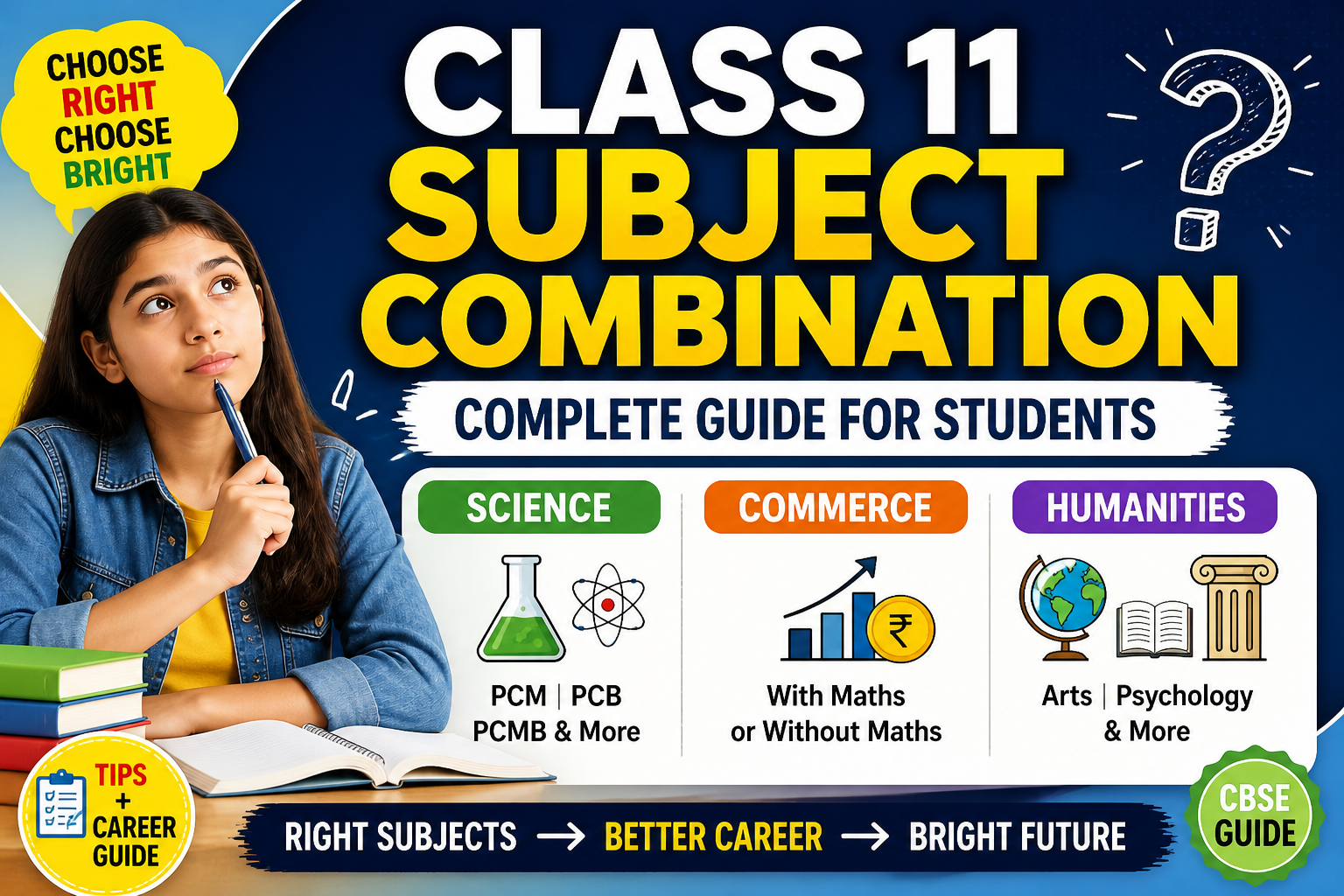
Class 11 Subject Combination: Free Complete Guide for Students
| Field | Details |
|---|---|
| Applies To | CBSE Class 10 students choosing Class 11 stream |
| Key Streams | Science / Commerce / Humanities (Arts) |
| Popular Combinations | PCM, PCB, Commerce + Maths, Humanities + Psychology |
| Cross-Stream Option | Yes — CBSE allows certain mixed combinations |
| Vocational Option | Yes — available under CBSE skill electives |
| Helpline | CBSE: 1800-11-8002 (toll-free) |
Choosing the right Class 11 subject combination is one of the most important decisions of your academic life — and this guide walks you through every option, step by step. If you’re staring at the stream selection form feeling completely lost, you’re not alone. Thousands of students across India feel exactly the same pressure every April and May, unsure whether they’re making the right choice or just picking what everyone around them is picking.
The good news is that the CBSE system gives you more flexibility than most people realise. Science, Commerce, and Humanities are the three main paths — but within each stream, and even across streams, you have real choices. There are combinations with Maths, without Maths, with Psychology, with Business Studies, with Computer Science, and even with vocational subjects like Artificial Intelligence or Mass Media Studies.
You don’t need to have your entire career figured out right now. What you need is a clear head, honest self-reflection, and the right information. Students like Priya from Pune switched from PCM to Commerce after realising her strengths lay in Economics — and she went on to clear CA Foundation in her first attempt. The right subject combination is the one that works for you, not your neighbour’s son.
What’s in This Guide?
- Why This Decision Matters More Than You Think
- What Are the Three Streams in Class 11 CBSE?
- What Is the Right Class 11 Subject Combination for You?
- Can You Mix Subjects Across Streams? What CBSE Actually Allows
- What Happens If Your Class 10 Marks Don’t Meet the Cutoff?
- 5 Mistakes Students Make When Choosing Their Stream
- Class 11 Subject Combination FAQ
- 6 Things to Do Right Now Before You Finalise Your Subjects
- Explore More on Nextoper — Related Guides
- Official Resources That Can Help You
Why This Decision Matters More Than You Think
The subjects you pick in Class 11 don’t just affect your board exam — they determine which entrance exams you can appear for, which college courses you’re eligible for, and in some cases, which careers remain open to you. A student who picks PCM (Physics, Chemistry, Maths) can attempt JEE for engineering. A student who drops Maths in favour of Biology (PCB) is eligible for NEET for medicine. These aren’t interchangeable paths.
That said, the decision is not as permanent as it feels. CBSE does allow subject changes within a limited window after admission — typically within the first few weeks of school opening. Every school has its own policy, but the option exists. What you cannot do is change streams halfway through Class 11 and expect the same syllabus coverage for boards. So while there’s a small safety net, it’s better to get it right from the start.
How Your Class 10 Performance Plays a Role
Most CBSE schools set internal cutoffs for stream allocation. Science, particularly PCM, typically requires an aggregate of 60–70% and strong scores in Maths and Science. Commerce usually requires 55–60%. Humanities is often the most accessible in terms of marks — but that does not make it a lesser stream. It is simply structured differently and prepares you for different careers.
Here’s what this looks like in practice: Arjun scored 58% in Class 10 with weak Maths performance. His school wouldn’t allow him into PCM. Rather than trying to force his way in, his counsellor helped him explore Commerce with Maths — a combination that suited his strengths in Economics and Business Studies. He later qualified for B.Com (Hons) at a top Delhi University college.
The Hidden Cost of Following the Crowd
One of the most common mistakes students make is choosing Science — especially PCM — simply because it seems like the “safe” or “respectable” option. Parents often push for it. Friends go for it. But if you don’t genuinely have interest or aptitude in Physics and Maths, Class 11 will be an uphill battle from week one.
CBSE Class 11 is significantly harder than Class 10. The jump in difficulty is real, especially in Science. Going in without motivation or the right aptitude can affect your board performance, your mental health, and your college prospects. Choosing a stream that genuinely interests you is not settling — it’s smart strategy.
What Are the Three Streams in Class 11 CBSE?
Every CBSE school structures Class 11 around three broad streams. Within each stream, students choose a combination of five subjects — typically four core subjects and one elective or optional subject. Here’s a breakdown:
Science Stream
The Science stream is for students aiming at careers in engineering, medicine, research, pharmacy, architecture, data science, and related fields.
PCM Combination (Physics, Chemistry, Mathematics):
- Core subjects: Physics, Chemistry, Maths, English
- Optional 5th subject: Computer Science, Physical Education, Economics, or Psychology
- Leads to: JEE Main/Advanced (engineering), NDA, B.Sc. (Maths/Physics/CS)
PCB Combination (Physics, Chemistry, Biology):
- Core subjects: Physics, Chemistry, Biology, English
- Optional 5th subject: Maths, Computer Science, Physical Education
- Leads to: NEET (MBBS/BDS), B.Sc. (Agriculture, Biotech, Nursing)
PCMB Combination (Physics, Chemistry, Maths + Biology):
- All four taken together — highly demanding but keeps both JEE and NEET options open
- Recommended only for students with strong academic performance and clear intent
Commerce Stream
The Commerce stream suits students interested in business, finance, accounting, law, and management.
Commerce with Maths:
- Subjects: Accountancy, Business Studies, Economics, Mathematics, English
- Leads to: CA Foundation, B.Com (Hons), BBA, Economics (Hons)
Commerce without Maths:
- Subjects: Accountancy, Business Studies, Economics, Informatics Practices (or any elective), English
- Leads to: B.Com, BBA, BA (Economics), Hotel Management
Most commerce colleges prefer Commerce with Maths for their top programmes — so if you can handle Maths, it’s worth keeping.
Humanities / Arts Stream
Humanities is one of the most diverse and flexible streams — and one of the most misunderstood. It covers subjects like History, Political Science, Geography, Psychology, Sociology, Philosophy, and Literature.
Popular Combinations in Humanities:
- History + Political Science + Economics + Geography + English
- History + Political Science + Psychology + Sociology + English
- Political Science + Economics + Maths + Geography + English (this is a cross-stream mix — see next section)
Humanities leads to: UPSC, Law (CLAT), Journalism, Social Work, BA Programme, mass media, teaching, and many more.
What Is the Right Class 11 Subject Combination for You?
There is no single right answer — but there is a right process. Use this three-part framework before making your decision.
Step 1: Start With What You Genuinely Enjoy
Think back to Class 9 and 10. Which subjects did you look forward to? Which ones felt like work? Not which ones you scored well in — which ones you enjoyed. Scoring well in a subject you hate is not the same as being good at it. Enjoyment is a strong predictor of long-term performance.
- If you liked problem-solving, numbers, and logical thinking → Science (PCM) or Commerce with Maths
- If you were drawn to biology, living systems, and health → PCB
- If history, current events, society, and writing energised you → Humanities
- If business, money management, and entrepreneurship excited you → Commerce
Step 2: Map to Career Directions (Not Just One Job)
You don’t need a specific job in mind. You need a direction. Ask yourself: Do I see myself working with data and systems? With people and communities? With creative expression? With finance and business? With science and research?
| Career Direction | Recommended Stream + Combination |
|---|---|
| Engineering / Tech | Science — PCM + CS |
| Medicine / Healthcare | Science — PCB (+ Maths optional) |
| Finance / CA / Banking | Commerce — with Maths |
| Law / Civil Services / Journalism | Humanities — Pol Sci + History + Economics |
| Business / Entrepreneurship | Commerce — with or without Maths |
| Psychology / Social Work | Humanities — Psychology + Sociology |
| Design / Architecture | Science — PCM (architecture requires Maths) |
| Mass Media / Writing | Humanities — or Commerce + any |
Step 3: Be Honest About Your Marks and Aptitude
This is not about being pessimistic. If your Maths score in Class 10 was below 50%, taking PCM in Class 11 will be genuinely difficult. That’s just true — not a judgment. If Biology was your weakest subject, PCB may not serve you well. Use your Class 10 performance as one honest data point, not the only one, but don’t ignore it.
Can You Mix Subjects Across Streams? What CBSE Actually Allows
[GAP FILL] This is one of the most important things competitors missed — and it’s something students ask constantly.
Yes, CBSE allows cross-stream subject combinations — but individual schools decide whether they’ll offer them. The CBSE board itself doesn’t restrict a student from combining, say, Maths (typically a Science/Commerce subject) with History and Political Science (Humanities subjects). What limits you is school infrastructure and the combinations your school offers.
Common Mixed Combinations That Work
- Humanities + Maths: Political Science + History + Economics + Maths + English
- Opens doors to: Economics (Hons), Statistics, BBA, and even some engineering programmes
- Ideal for: Students who love social sciences but are also strong in Maths
- Commerce + Computer Science: Accountancy + Business Studies + Economics + CS + English
- Leads to: BCA, B.Com with IT specialisation, fintech, business analytics
- Science + Economics: Physics + Chemistry + Maths + Economics + English
- Useful for: Students aiming for Economics (Hons) but keeping engineering as backup
- Science (PCM) + Psychology: Physics + Chemistry + Maths + Psychology + English
- For: Students considering neuroscience, cognitive science, or engineering psychology
How to Check If Your School Offers Mixed Combinations
Most schools list their available subject combinations during the admission process. If yours doesn’t, ask the Class 11 coordinator directly. Don’t assume the standard streams are your only options. Some students have successfully advocated for custom combinations — especially in private schools with more flexibility.
What Happens If Your Class 10 Marks Don’t Meet the Cutoff? {#marks-cutoff}
[GAP FILL] This is an emotionally charged situation that competitors barely addressed — and it deserves honest, practical attention.
If your school’s cutoff for Science is 70% and you scored 62%, you may be declined for that stream. Here’s what you can actually do:
Option 1: Appeal to the School Principal
Some schools have discretionary provisions. If you have a genuine interest in Science and your Maths/Science subject scores are strong even if your aggregate is lower, write a formal appeal letter. Mention your specific subject scores, not just the aggregate.
Option 2: Apply to a Different School
CBSE doesn’t set a universal cutoff — individual schools do. A school closer to your home or a different affiliated school may have a lower or more flexible cutoff for the same stream. This is a real option many students don’t consider.
Option 3: Reconsider With Fresh Eyes
Sometimes the cutoff is a signal worth listening to. If your Class 10 Maths score was 45% and you want PCM, be honest: Class 11 Physics and Maths are significantly harder. This isn’t failure — it’s redirection. Commerce with Maths or Humanities with Economics can still lead to strong, well-paying careers.
Option 4: Consider Open Schooling (NIOS)
NIOS (National Institute of Open Schooling) is a CBSE-recognised board that gives students complete flexibility in subject combinations with no stream restrictions. Students who need unconventional combinations or couldn’t access a preferred stream sometimes enrol in NIOS for Class 11–12 before transitioning back to regular college.
5 Mistakes Students Make When Choosing Their Stream
Mistake 1: Choosing Based on What Friends Are Taking
This is the single most common reason students end up in the wrong stream. Your friend’s career path and your career path are different things. If your best friend is taking PCM and you’re genuinely drawn to Commerce, that’s important information — listen to it.
Mistake 2: Treating Science as the “Safe” Option
Science is not safer than Commerce or Humanities. All three streams have clear, viable, well-paying career paths. The only “unsafe” choice is picking a stream you don’t have interest in and then performing poorly across two years of boards and entrance exams.
Mistake 3: Ignoring Aptitude Tests
CBSE and many schools offer career aptitude assessments. These are not perfect, but they’re useful data points. If three different assessments suggest your strengths align with creative fields and social sciences, that’s worth taking seriously — even if it surprises you.
Mistake 4: Deciding Based Only on Class 10 Marks in One Subject
Your overall profile matters — not just one exam. A student who scored 55% in Maths but has consistently shown curiosity and logical thinking might still do well in PCM with the right coaching and effort. One data point is not a verdict.
Mistake 5: Not Talking to People Already in That Field
Before finalising your stream, speak to at least one person who is currently working in a career your stream leads to. Not just a counsellor or a teacher — an actual working professional. Ask them what their day looks like. It will tell you more than any brochure.
Class 11 Subject Combination FAQ
Q: Can I take Maths with Humanities in Class 11? A: Yes, you can — but only if your school offers this combination. CBSE as a board doesn’t prohibit it. Many students combine Political Science, History, and Economics with Mathematics, which is especially useful for Economics Honours at Delhi University or Statistics programmes. Ask your school coordinator if they support this stream mix.
Q: What happens if I choose the wrong stream and want to change later? A: Most CBSE schools allow subject changes within the first few weeks of Class 11 — usually before the first unit test. After that window closes, changing becomes very difficult because the syllabus coverage will have diverged. If you’re unsure, ask your school’s exact policy on this before completing your admission form.
Q: Will Commerce without Maths affect my college options? A: Some college programmes — like B.Com (Hons) at Delhi University — prefer or require Maths at Class 12. Others, like BBA, BA Economics, and Hotel Management, don’t. If you’re considering dropping Maths, research the specific college courses you’re interested in before making that call. It’s a bigger factor than most students realise.
Q: Can I study Biology and Maths together in Class 11? A: Yes — this is the PCMB combination (Physics, Chemistry, Maths, Biology). It keeps both JEE and NEET options open but comes with a heavy workload. Most students who take PCMB are advised to drop one for Class 12 unless they are confident in managing both. It’s a smart safety net, not a long-term plan for most students.
Q: Do colleges care which elective I chose as my 5th subject? A: It depends on the college and course. For Engineering (JEE) and Medicine (NEET), the core four subjects matter — Physics, Chemistry, Maths/Bio. The 5th subject rarely affects eligibility. However, for specific courses like Computer Science at top colleges or Media Studies programmes, the right 5th subject can strengthen your profile. When in doubt, choose a subject you’ll genuinely enjoy.
6 Things to Do Right Now Before You Finalise Your Subjects
- List the subjects you enjoyed most in Class 9 and 10 — not just the ones you scored well in. Write them down. Patterns here are meaningful.
- Shortlist 2–3 career directions you’re genuinely curious about — not just what sounds impressive. Use the career direction table in this guide as a starting point.
- Check your school’s specific subject combination chart — ask for the complete list of combinations they offer, including any mixed or vocational options. Don’t assume only three standard paths exist.
- Look at your Class 10 subject-wise marks — identify your three strongest subjects. Your combination should ideally overlap with at least two of them.
- Speak to one senior (Class 12 student or recent pass-out) in each stream you’re considering — ask them honestly: what’s the hardest part? What do they wish they’d known before choosing?
- Fill the CBSE or your school’s career aptitude assessment if offered — treat it as data, not destiny. If the results surprise you, discuss them with your school counsellor or a trusted teacher before dismissing them.
Explore More on Nextoper
Official Resources That Can Help You
1. CBSE Official Website — cbse.gov.in The official CBSE portal lists all subject codes, combination rules, and school-wise information. Use it to verify which subjects your school is officially affiliated to offer — this matters if you want an unconventional combination. Students finalising their stream should bookmark this site for official circulars and any changes to the curriculum.
2. CBSE Academic Website — cbseacademic.nic.in This portal hosts the official Class 11 and 12 syllabi for every subject — free to download. Before committing to a subject combination, download the actual syllabus for each subject you’re considering and spend 20 minutes reading it. This gives you a real-world sense of what you’ll be studying, not just a vague idea of the subject name.
3. NCERT — ncert.nic.in NCERT publishes free textbooks for all Class 11 CBSE subjects. Before finalising your stream, download a sample chapter from the subjects you’re unsure about. Reading even one chapter of NCERT Economics or Physics will tell you far more about your interest in that subject than any advice column can.
Conclusion
Choosing your Class 11 subject combination is hard — and it’s okay to feel overwhelmed by it. This is a real decision with real consequences, and it makes complete sense that it feels heavy. But it is also a decision you can make thoughtfully, with the right information and honest self-reflection. Many students who felt lost at this exact point went on to thrive. A student from Chennai who nearly chose PCM out of pressure ended up taking Humanities with Economics and Psychology — and is today completing a Master’s in Behavioural Economics from a top institution. The right path existed for her. It exists for you too. Your next step: go back to the career direction table in this guide, pick the two paths that resonate most, and talk to one real person in each field this week. And whenever you need CBSE resources, subject notes, or guidance — Nextoper is here for you, completely free.

Pingback: PCB vs PCM Stream: Easy Steps to Choose the Right One | Nextoper - Nextoper
This guide really highlights how important honest self-reflection is before finalizing a Class 11 stream, especially given the flexibility CBSE now offers with mixed combinations. The story about Priya shifting from PCM to Commerce perfectly illustrates that it’s never too late to pivot once you identify your true strengths in subjects like Economics.