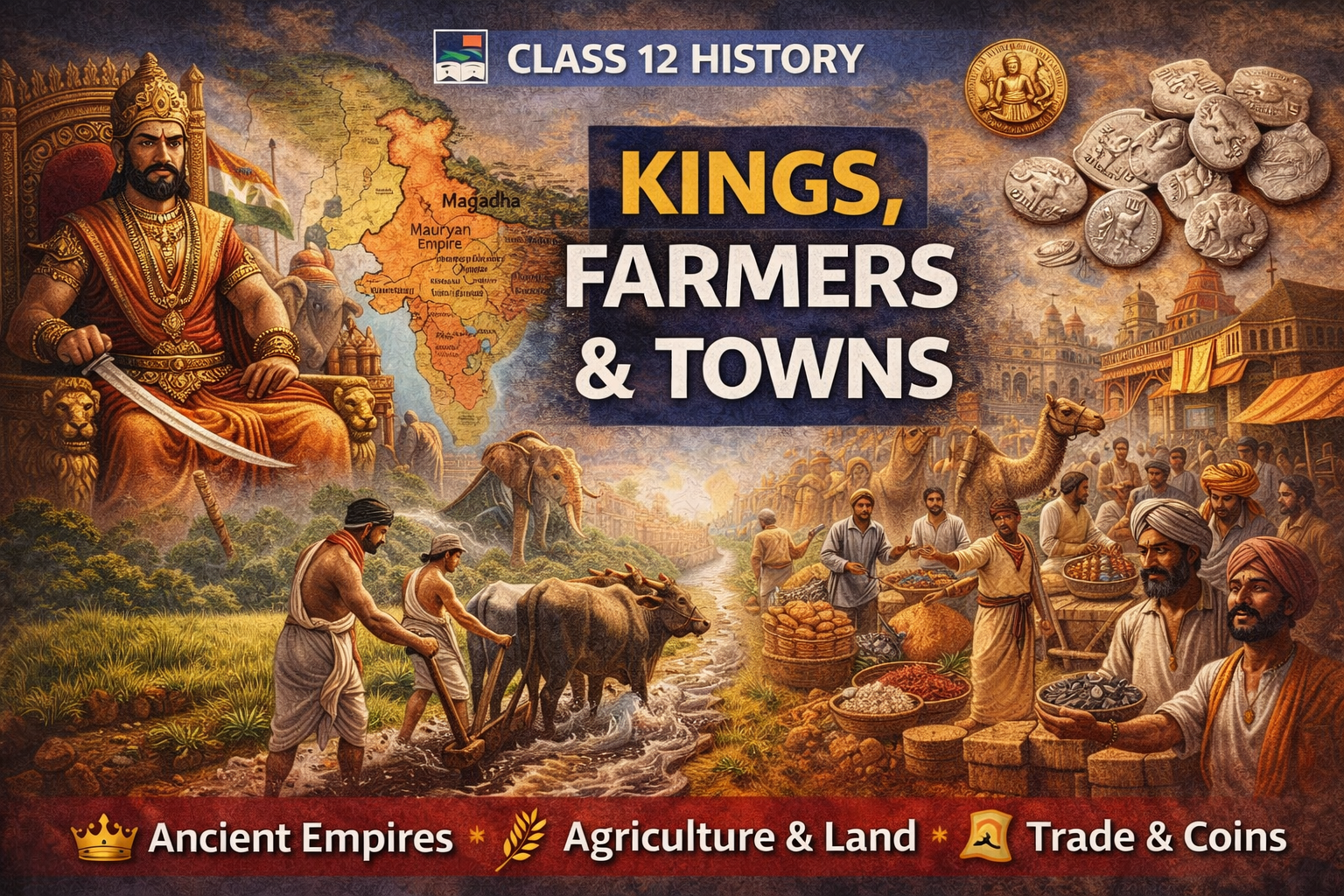
Kings Farmers and Towns Class 12 CBSE – Complete Notes with 10 Must-Know Concepts
| Field | Detail |
|---|---|
| Chapter | Theme 2 – Kings, Farmers and Towns: Early States and Economies |
| Subject | History (Themes in Indian History) |
| Class | 12 |
| Board | CBSE |
| Exam Weightage | Check latest CBSE syllabus |
Kings Farmers and Towns Class 12 CBSE covers one of the most fascinating periods in Indian history — roughly 600 BCE to 600 CE — a span of 1,200 years during which early states, powerful empires, flourishing trade networks, and new agricultural practices all took shape. This chapter carries significant weight in the CBSE Class 12 History board exam, and questions from it appear almost every year.
These notes will walk you through every major theme of the chapter: the rise of the sixteen mahajanapadas, the Mauryan Empire and Asoka’s dhamma, changing agricultural practices, the growth of towns, the role of coinage and trade, and critically — how historians use inscriptions and epigraphy to reconstruct all of this. By the end, you will also know how to answer both short-answer and long-answer board questions confidently.
Think of this chapter as the story of how a scattered group of kingdoms slowly transformed into organised empires with taxes, armies, trade routes and written records. Every concept here connects directly to the world you live in — how governments tax people, how trade networks work, and why coins matter in an economy.
Table of Contents
- How Historians Study This Period — Epigraphy and Sources
- The Sixteen Mahajanapadas — Kings Farmers and Towns Class 12 CBSE
- Rise of Magadha — The Most Powerful Mahajanapada
- The Mauryan Empire and Asoka’s Dhamma
- How Inscriptions Are Deciphered — Brahmi and Kharosthi
- Post-Mauryan Kingdoms and New Notions of Kingship
- Agriculture, Land Grants and Rural Society — Kings Farmers and Towns Class 12
- Towns, Trade and Coins in Early India
- Limitations of Inscriptional Evidence
- Important Questions – Kings Farmers and Towns Class 12 CBSE
- FAQ – Kings Farmers and Towns Class 12 CBSE
- Quick Revision – Key Points to Remember
- Related Notes on Nextoper — Internal Links
- Useful External Resources
How Historians Study This Period — Epigraphy and Sources
Epigraphy — the study of inscriptions — is one of the most important tools historians use to understand early Indian history. An inscription is any piece of writing engraved on a hard surface: stone, metal, or pottery. Unlike paper manuscripts, inscriptions survive for thousands of years, making them invaluable records.
Some of the most significant developments in Indian epigraphy happened in the 1830s. James Prinsep, an officer working for the East India Company’s mint, successfully deciphered two ancient scripts: Brahmi and Kharosthi. These were the two scripts used in the earliest Indian inscriptions and coins. Most of the inscriptions he studied referred to a king called Piyadassi — meaning “pleasant to behold.” A few also called this king Asoka, who is one of the most celebrated rulers in Buddhist literature.
This discovery opened an entirely new chapter in understanding Indian political history. Scholars began using inscriptions, coins, and literary texts to piece together the histories of major dynasties. Over time, researchers also began examining the connections between political events and broader economic and social changes — and found that these connections were real but rarely straightforward.
Besides inscriptions, historians rely on texts like the Arthashastra (attributed to Kautilya), accounts by foreign visitors like the Greek ambassador Megasthenes, Buddhist and Jaina texts, Sanskrit literary works, and coins. Each source has its own strengths and limitations, which you will learn about later in these notes.
[Image: A close-up photograph of an ancient Asokan rock inscription with Brahmi script visible | Alt text: Kings Farmers and Towns Class 12 CBSE – Asokan inscription in Brahmi script]
The Sixteen Mahajanapadas — Kings Farmers and Towns Class 12 CBSE
The sixth century BCE is widely regarded as a turning point in early Indian history. This era saw the emergence of early states and cities, growing use of iron, the development of coinage, and the rise of new religious philosophies — most notably Buddhism and Jainism.
What Were Mahajanapadas?
A mahajanapada was a large territorial state. The word janapada literally means “the land where a people (jana) sets its foot.” Early Buddhist and Jaina texts list sixteen such states, though the exact lists vary across different texts. The most frequently mentioned include Vajji, Magadha, Koshala, Kuru, Panchala, Gandhara, and Avanti.
Key features of the mahajanapadas:
- Most were ruled by kings (monarchies)
- Some, called ganas or sanghas, were oligarchies — governed by a group of men, collectively called rajas. Both Mahavira and the Buddha belonged to such ganas.
- In the Vajji sangha, rajas collectively controlled land and resources
- Each mahajanapada had a capital city, usually fortified
- Maintaining armies, forts, and bureaucracies required taxes collected from cultivators, traders, and artisans
- Raids on neighbouring states were also considered a legitimate way to acquire wealth
- Gradually, some states built standing armies and regular bureaucracies; others relied on peasant militia
Dharmasutras and the Role of Kshatriyas
From the sixth century BCE, Brahmanas composed Sanskrit texts called Dharmasutras, which laid down rules for rulers. Ideally, rulers were expected to be Kshatriyas — the warrior class. These texts also advised kings on collecting taxes and managing resources.
Rise of Magadha — The Most Powerful Mahajanapada
Between the 6th and 4th centuries BCE, Magadha (in present-day Bihar) grew into the most powerful of all the mahajanapadas. Historians offer multiple explanations for this rise:
- Fertile agricultural land — Magadha’s soil supported high agricultural productivity
- Access to iron mines — Located in present-day Jharkhand, iron provided raw material for tools and weapons
- Elephants — Forests in the region supplied elephants, a crucial component of ancient armies
- River routes — The Ganga and its tributaries enabled cheap and efficient communication and transport
However, early Buddhist and Jaina writers credited Magadha’s rise to ambitious rulers. The most well-known among these were Bimbisara, Ajatasattu, and Mahapadma Nanda, and their capable ministers.
Capitals of Magadha
- Rajagaha (modern Rajgir, Bihar) was the original capital — a fortified city nestled among hills. Its name literally means “house of the king.”
- In the 4th century BCE, the capital shifted to Pataliputra (modern Patna), strategically located along the Ganga for control over trade and communication.
The Mauryan Empire and Asoka’s Dhamma
The expansion of Magadha eventually led to the creation of the Mauryan Empire, the largest and most powerful empire of early India. Chandragupta Maurya founded it around 321 BCE and extended its boundaries as far northwest as Afghanistan and Baluchistan. His grandson Asoka (reigned c. 272/268–231 BCE) later conquered Kalinga (present-day coastal Odisha).
Sources for Mauryan History
Historians piece together the Mauryan story from several types of evidence:
- Archaeological finds — especially sculpture
- Megasthenes’ account — a Greek ambassador at Chandragupta’s court; his writings survive in fragments
- The Arthashastra — parts likely composed by Kautilya (also called Chanakya), Chandragupta’s minister; it describes administrative and military organisation in great detail
- Later Buddhist, Jaina, and Puranic literature
- Asokan inscriptions on rocks and pillars — considered the most valuable primary sources
Asoka’s Dhamma
Asoka was the first known ruler in Indian history to inscribe messages directly to his subjects and officials on stone surfaces. These inscriptions spread his concept of dhamma — a set of universally applicable ethical principles including:
- Respect towards elders
- Generosity towards Brahmanas and ascetics
- Treating slaves and servants kindly
- Respecting all religions and traditions
To spread dhamma, Asoka appointed special officers called dhamma mahamatta.
Administering the Empire
The Mauryan Empire had five major political centres: the capital Pataliputra and four provincial capitals — Taxila, Ujjayini, Tosali, and Suvarnagiri. Administrative control was strongest near the capital and these centres. Taxila and Ujjayini sat on important long-distance trade routes; Suvarnagiri was important for Karnataka’s gold mines.
Communication across the empire took weeks or even months. Megasthenes mentions a military committee with six sub-committees overseeing the navy, transport, infantry, cavalry, chariots, and elephants. This detailed organisation shows the empire’s administrative complexity.
How Inscriptions Are Deciphered — Brahmi and Kharosthi
This is a section most competitors skip — but it appears in CBSE board exams regularly.
Deciphering Brahmi
Most modern Indian scripts (Hindi’s Devanagari, Bengali, etc.) are derived from Brahmi. From the late 18th century, European scholars working alongside Indian pandits compared Brahmi letters with contemporary scripts, working backwards from familiar writing to older specimens. After decades of work by multiple epigraphists, James Prinsep deciphered Asokan Brahmi in 1838.
An important detail: early scholars assumed Asokan inscriptions were in Sanskrit. They were wrong — the language was Prakrit, the everyday language of ordinary people.
Deciphering Kharosthi
Kharosthi was used in inscriptions in northwestern India. The breakthrough came through coins of Indo-Greek kings (c. 2nd–1st centuries BCE), which had names written in both Greek and Kharosthi. Since scholars could read Greek, they matched the symbols and gradually decoded Kharosthi. Prinsep confirmed the underlying language was also Prakrit.
Reading Asokan Inscriptions Carefully
An important analytical skill: Asoka’s inscriptions do not actually use his name — they use titles like devanampiya (“beloved of the gods”) and piyadassi (“pleasant to behold”). His name “Asoka” appears in some separate inscriptions that share identical content, language, and palaeography, which is how epigraphists confirmed they were issued by the same ruler.
[Image: Chart comparing Brahmi script letters with their Devanagari equivalents | Alt text: Kings Farmers and Towns Class 12 CBSE – Brahmi to Devanagari script comparison]
Post-Mauryan Kingdoms and New Notions of Kingship
After the Mauryan Empire collapsed (c. 185 BCE), new kingdoms and chiefdoms emerged across the subcontinent. These rulers developed different strategies to legitimise their authority.
Chiefs and Kings in the South
In the Deccan and further south, kingdoms of the Cholas, Cheras, and Pandyas thrived in Tamilakam (the ancient Tamil country). These were stable and prosperous chiefdoms. A chief differed from a king: he relied on kinship ties for support, received gifts rather than taxes, and typically did not command a regular army or bureaucracy. The early Tamil Sangam texts describe how chiefs acquired and distributed resources.
The Satavahanas (c. 2nd century BCE–2nd century CE) and the Shakas (Central Asian rulers in northwest India) also gained power during this period, often deriving revenues from long-distance trade.
Divine Kings: The Kushanas
The Kushanas (c. 1st century BCE–1st century CE) ruled a vast empire stretching from Central Asia to northwest India. They claimed divine status — colossal statues of Kushana rulers have been found in shrines at Mat near Mathura and in Afghanistan. Many Kushana rulers adopted the title devaputra (“son of god”), possibly influenced by Chinese rulers who called themselves “sons of heaven.”
The Gupta Empire and Samantas
By the 4th century CE, larger states including the Gupta Empire had emerged. The Guptas relied on samantas — local powerful men who controlled land, offered loyalty and military support to the ruler in exchange. A powerful samanta could rise to become a king; a weak ruler could be reduced to subordination.
Gupta history is reconstructed from literature, coins, inscriptions and prashastis — poetic compositions composed in praise of kings. The Prayaga Prashasti (Allahabad Pillar Inscription), composed by the poet Harishena in Sanskrit, praises Samudragupta — arguably the greatest Gupta ruler.
Agriculture, Land Grants and Rural Society — Kings Farmers and Towns Class 12
Popular Perceptions of Kings
Ordinary people rarely left written records. Historians look to story collections like the Jatakas (written in Pali, c. first millennium CE) and the Panchatantra to understand how common people felt about their rulers. The Gandatindu Jataka tells of a wicked king whose subjects — cultivators, herders, elderly people — all cursed him for the double burden of robbers by night and tax collectors by day. When conditions became unbearable, people fled to forests.
Strategies for Increasing Agricultural Production
From c. 6th century BCE, two major strategies were adopted:
- Iron-tipped ploughshare — Used to turn fertile alluvial soil in river valleys like the Ganga and Kaveri. This dramatically increased yields, though it was limited to regions with high rainfall. Farmers in semi-arid areas (parts of Punjab, Rajasthan) and hilly regions continued using hoe agriculture.
- Transplantation of paddy — Seeds were first broadcast; saplings were then transplanted into waterlogged fields. This ensured higher survival rates and yields, though it was extremely labour-intensive.
- Irrigation — Through wells, tanks, and canals. The famous Sudarshana lake in Gujarat, an artificial reservoir, was built during Mauryan rule and repaired by both the Shaka ruler Rudradaman and later by a Gupta ruler.
Differences in Rural Society
Agricultural surplus created social inequality. Buddhist texts mention three distinct rural groups: landless agricultural labourers, small peasants, and large landholders. The term gahapati (used in Pali texts) typically referred to small and medium landholders who headed households and controlled land, labour, and other resources. The village headman — often hereditary — also exercised significant control.
Early Tamil Sangam texts describe similar distinctions: vellalar (large landowners), uzhavar (ploughmen), and adimai (slaves).
Land Grants and New Rural Elites
From the early centuries CE, kings began granting land to Brahmanas and religious institutions. These grants were recorded in inscriptions — usually on stone or copper plates. A notable example is the inscription of Prabhavati Gupta, daughter of Chandragupta II, who granted the village of Danguna to a Brahmin teacher. This was notable because Sanskrit legal texts typically denied women independent access to land — showing that legal texts were not always uniformly enforced.
Land grants are debated by historians. Some see them as strategies to extend agriculture into new areas; others argue they reflect weakening royal power, with kings using grants to win allies.
An agrahara was a land grant to a Brahmana, who was usually exempted from paying land revenue to the king and was often given the right to collect dues from local people.
Towns, Trade and Coins in Early India
Growth of Urban Centres
From c. 6th century BCE, towns emerged across the subcontinent, many as capitals of mahajanapadas. Key points about these early cities:
- Pataliputra began as a village (Pataligrama), became the Mauryan capital, and by the 4th century BCE was one of the largest cities in Asia
- Ujjayini was located on a major land trade route
- Puhar was a coastal city at the start of sea routes
- Mathura was a bustling centre of commercial, cultural, and political life
Archaeological excavations have uncovered Northern Black Polished Ware — fine, glossy pottery likely used by wealthy urban elites. Ornaments, tools, weapons, and figurines in gold, silver, copper, bronze, ivory, glass, and terracotta have also been found.
Votive inscriptions from the 2nd century BCE mention the occupations of city-dwellers: weavers, carpenters, potters, goldsmiths, blacksmiths, scribes, merchants, officials, and religious teachers. Organisations of craftspeople and merchants called shrenis (guilds) procured raw materials, regulated production, and marketed finished goods.
Long-Distance Trade Networks
From the 6th century BCE, overland and riverine routes crossed the subcontinent, extending into Central Asia, East Africa, West Asia, Southeast Asia, and China. Merchants travelled in caravans of bullock carts; seafarers took risky but profitable sea routes. The Periplus of the Erythraean Sea (c. 1st century CE) — written by an anonymous Greek sailor — describes the Malabar coast’s exports: pepper, pearls, ivory, silk, precious stones, and imports of coin, glass, copper, and tin.
Goods traded included salt, grain, cloth, metal ores, stone, timber, and medicinal plants. Spices (especially pepper), textiles, and medicinal plants were in particularly high demand in the Roman Empire.
Coins and Economic Exchange
- Punch-marked coins of silver and copper (c. 6th century BCE onwards) were among the earliest coins. Symbols were punched onto metal surfaces; these coins are found across the subcontinent.
- The first coins to bear rulers’ names and images were issued by the Indo-Greeks (c. 2nd century BCE)
- The Kushanas issued the largest hoards of gold coins (c. 1st century CE), with weights matching contemporary Roman and Parthian coins — proof of integrated international trade
- The Gupta rulers issued spectacular gold coins facilitating long-distance transactions
- Tribal republics like the Yaudheyas of Punjab and Haryana also issued copper coins, showing broad participation in economic exchange
- Roman gold coins found in south India confirm trade links even with regions outside the empire
From c. 6th century CE, gold coin finds decline. Some historians link this to the fall of the Western Roman Empire and reduced long-distance trade; others argue new local trade networks were emerging and coins were in active circulation rather than being hoarded.
Limitations of Inscriptional Evidence
This is a unique section that most competitor websites skip entirely — but CBSE frequently tests it.
Inscriptions have real limitations as historical sources:
- Technical problems: Letters may be faintly engraved, damaged, or missing, making reconstruction uncertain
- Language ambiguity: Some words in inscriptions are specific to a particular place or time and are difficult to translate with certainty
- Incomplete survival: Of the thousands of inscriptions that must have existed, only a fraction survives. Of those discovered, not all have been deciphered, published, or translated
- Limited scope: Inscriptions focus on grand events — kings’ achievements, donations, conquests. Everyday life, routine agricultural practices, and ordinary people’s joys and sorrows are absent
- Biased perspective: Inscriptions almost always reflect the viewpoint of whoever commissioned them, usually rulers or wealthy donors
- Literacy gap: Most people in ancient India could not read. Did Asoka’s rock edicts, placed along roads, actually reach and influence ordinary people?
Epigraphists are trained to assess whether statements in inscriptions are factual, plausible, or exaggerations. For example, Asoka claims that no previous ruler had made arrangements to receive reports — a statement historians must critically evaluate against other evidence.
Important Questions – Kings Farmers and Towns Class 12 CBSE
1 Mark
Q. What is epigraphy? A. Epigraphy is the study of inscriptions engraved on hard surfaces such as stone, metal, or pottery.
3 Marks
Q. Describe the salient features of the mahajanapadas. A. The mahajanapadas were sixteen large territorial states that emerged in the 6th century BCE. Most were ruled by kings, though some called ganas or sanghas were oligarchies where power was shared among a group of rajas. Each mahajanapada had a fortified capital city requiring resources for armies and administration. Rulers collected taxes from cultivators, traders, and artisans, and raiding neighbouring states was also considered a legitimate source of wealth. Gradually, some states built standing armies and regular bureaucracies. The most powerful mahajanapada, Magadha, eventually formed the core of the Mauryan Empire.
Q. What were the main sources used by historians to reconstruct the history of the Mauryan Empire? A. Historians use multiple sources for Mauryan history. Archaeological finds, especially sculpture, provide material evidence. The account of Megasthenes — a Greek ambassador at Chandragupta’s court — offers a contemporary outsider’s perspective, though it survives only in fragments. The Arthashastra, attributed to Kautilya, describes administrative and military organisation in detail. Later Buddhist, Jaina, and Puranic texts also mention the Mauryas. Most importantly, Asoka’s inscriptions on rocks and pillars are regarded as the most reliable primary sources, as they record the ruler’s own messages directly to his subjects and officials.
5 Marks
Q. Discuss the main features of Mauryan administration as revealed by Asokan inscriptions and other sources. A. The Mauryan Empire had five major political centres: the capital Pataliputra and the provincial centres of Taxila, Ujjayini, Tosali, and Suvarnagiri. These centres were strategically positioned — Taxila and Ujjayini on major trade routes, Suvarnagiri near Karnataka’s gold mines. Administrative control was strongest near the capital and these centres; the empire’s regions were too diverse for fully uniform administration.
Communication across the empire was managed via land and riverine routes, with journeys from the centre to the provinces taking weeks. Megasthenes describes a military committee with six sub-committees covering the navy, transport, infantry, cavalry, chariots, and elephants. Kings also relied on the army to enforce control.
Asoka used inscriptions as a direct tool of governance. He proclaimed dhamma — ethical principles including respect for elders, kindness to servants, and religious tolerance — and appointed special officers called dhamma mahamatta to spread these values. His inscriptions show both a desire for uniformity across the empire and an awareness of regional diversity.
Q. Explain how changes in agriculture affected rural society between 600 BCE and 600 CE. A. The period saw significant agricultural transformation. The spread of iron-tipped ploughshares in fertile alluvial valleys like the Ganga and Kaveri greatly increased crop yields. Paddy transplantation, introduced in parts of the Ganga valley, further boosted production, though it required intensive labour. Irrigation through wells, tanks, and canals also expanded, and royal involvement in irrigation works is documented in inscriptions — such as the Sudarshana lake in Gujarat, repaired by both the Shaka ruler Rudradaman and a Gupta-era ruler.
However, the benefits of these changes were unevenly distributed. Rural society became increasingly differentiated. Buddhist texts distinguish between landless labourers, small peasants (gahapati), and large landholders. In Tamil areas, Sangam texts identify vellalar (large landowners), uzhavar (ploughmen), and adimai (slaves). Large landholders and hereditary village headmen became powerful local figures. From the early centuries CE, land grants to Brahmanas and religious institutions created new rural elites (agrahara holders), further reshaping the social and economic structure of villages.
FAQ – Kings Farmers and Towns Class 12 CBSE
Q1. Why is the 6th century BCE considered a turning point in early Indian history? A. The 6th century BCE saw the simultaneous emergence of several major developments: the rise of the sixteen mahajanapadas (territorial states), the growing use of iron tools and weapons, the development of coinage, the expansion of cities, and the rise of new philosophical movements like Buddhism and Jainism. These economic, political, and intellectual changes together mark this era as a foundational turning point.
Q2. Why did Magadha become the most powerful mahajanapada? A. Magadha’s rise is explained by both geographical advantages and political factors. It had fertile agricultural land, access to iron mines in present-day Jharkhand, forests supplying war elephants, and the Ganga river system for communication and trade. Buddhist and Jaina sources also credit ambitious and able rulers — Bimbisara, Ajatasattu, and Mahapadma Nanda — and their skilled ministers for Magadha’s political dominance.
Q3. What was Asoka’s dhamma and how did he spread it? A. Asoka’s dhamma was a set of ethical principles meant to guide both personal and public conduct. It included respect for elders, generosity towards Brahmanas and ascetics, kindness towards servants and slaves, and tolerance of all religions. Asoka spread dhamma by inscribing its principles on natural rocks and polished pillars placed at prominent locations across the empire. He also appointed special officers called dhamma mahamatta to actively promote these values among the people.
Q4. What role did guilds (shrenis) play in early Indian towns? A. Shrenis were organisations of craft producers and merchants that functioned like trade guilds. They procured raw materials for production, regulated manufacturing processes, and marketed the finished goods. Their existence is known from votive inscriptions in various cities from the 2nd century BCE onwards. Shrenis helped organise urban economic activity and enabled craftspeople to meet the growing demands of wealthy urban elites. They were an important component of early Indian commercial life.
Q5. What are the limitations of inscriptional evidence for studying early Indian history? A. Inscriptions have several limitations. Technically, letters may be faintly carved, damaged, or missing. Language-specific words can be hard to interpret accurately. Only a small fraction of ancient inscriptions survive, and of those, many remain undeciphered. Most importantly, inscriptions are selective: they record grand events (conquests, donations, royal decrees) but omit everyday life, agricultural routines, and the perspectives of ordinary people. They also reflect only the viewpoint of whoever commissioned them — usually rulers or wealthy donors.
Quick Revision – Key Points to Remember
- Epigraphy is the study of inscriptions engraved on hard surfaces; James Prinsep deciphered Brahmi and Kharosthi in the 1830s, identifying Asoka as the ruler called Piyadassi.
- The sixteen mahajanapadas were large territorial states of the 6th century BCE; most were monarchies, but some (ganas/sanghas) were oligarchies where rajas shared power collectively.
- Magadha became the dominant mahajanapada due to fertile land, iron mines, war elephants, river routes, and ambitious rulers like Bimbisara and Ajatasattu.
- Chandragupta Maurya founded the Mauryan Empire c. 321 BCE; his grandson Asoka extended it and became famous for spreading dhamma through rock and pillar inscriptions.
- The Mauryan Empire had five major political centres — Pataliputra, Taxila, Ujjayini, Tosali, and Suvarnagiri — and used a specialised military committee described by Megasthenes.
- The Kushanas adopted the title devaputra (“son of god”) to claim divine status; the Guptas depended on samantas (local landholders who provided military support in exchange for loyalty).
- Iron-tipped ploughshares and paddy transplantation increased agricultural yields from the 6th century BCE, but benefits were uneven — rural society divided into large landholders, small peasants, and landless labourers.
- Land grants (especially agraharas to Brahmanas) created new rural elites from the early centuries CE; the Prabhavati Gupta inscription is a key example.
- Shrenis (guilds) organised craft production and trade in early Indian cities; punch-marked coins (6th century BCE) and later Kushana and Gupta gold coins facilitated long-distance commerce.
- Inscriptions have serious limitations as historical sources: they are incomplete, biased towards rulers, and ignore the everyday lives of ordinary people — making critical evaluation essential.
Related Notes on Nextoper
Explore these related CBSE notes on Nextoper to strengthen your board exam preparation:
- Class 12 History Notes: Chapter 1 Bricks, Beads and Bones
- Class 12 History Notes Chapter 1 Bricks, Beads and Bones in Hindi
- Class 12th History Part2 Chapter 7 – An Imperial Capital: Vijayanagara