The Crisis of Democratic Order Class 12 CBSE – Complete Notes with 10 Must-Know Concepts
| Field | Detail |
|---|---|
| Chapter | Chapter 6 – The Crisis of Democratic Order |
| Subject | Political Science (Politics in India Since Independence) |
| Class | 12 |
| Board | CBSE |
| Exam Weightage | Check latest CBSE syllabus |
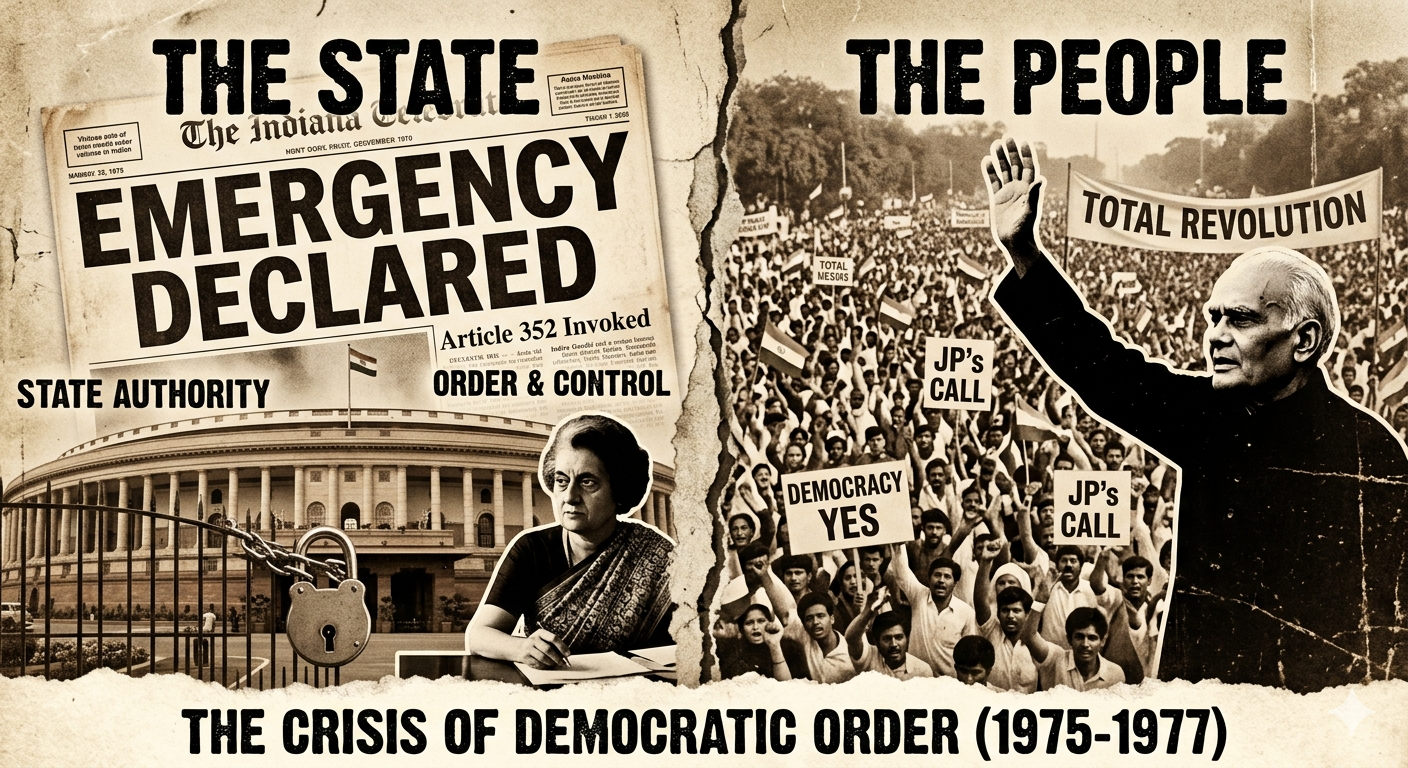
The Crisis of Democratic Order Class 12 CBSE is one of the most important chapters for board exam preparation because it covers a turning point in Indian democracy — the Emergency period of 1975–77. This chapter explains how political tensions, economic problems, and legal battles under Indira Gandhi’s government led to the suspension of democratic rights in India. It is a high-importance chapter both for objective and long-answer type questions.
From these notes, you will understand the background to the Emergency, the Gujarat and Bihar movements, the role of Jay Prakash Narayan, what happened when Emergency was declared, and how India’s democracy bounced back in the 1977 elections. Each concept is explained clearly with examples and key facts so you can revise quickly before your board exam.
Think of this chapter as a real-life case study of what happens when democracy is tested — and why it matters for every citizen. Understanding the Emergency period will not only help you score well in exams but also give you a deeper sense of how the Indian Constitution protects your rights, and what it looks like when those protections are weakened.
Table of Contents
- Background to Emergency – Political and Economic Crisis
- Gujarat and Bihar Movements
- Railway Strike 1974 and Conflict with the Judiciary
- Declaration of Emergency 1975 – Article 352
- Consequences of Emergency – The Crisis of Democratic Order Class 12
- Resistance to Emergency
- The 20-Point Programme During Emergency
- Shah Commission – Investigating the Emergency
- Lok Sabha Elections 1977 – The Janata Party Victory
- Janata Government and Comeback of Congress (1980)
- Important Questions – The Crisis of Democratic Order Class 12 CBSE
- FAQ – The Crisis of Democratic Order Class 12 CBSE
- Quick Revision – Key Points to Remember
- Related Notes on Nextoper
- Useful External Resources
Background to Emergency – Political and Economic Crisis
After winning the 1971 elections with the popular slogan “Garibi Hatao” (Remove Poverty), Indira Gandhi emerged as the most powerful and popular leader in India. Her party, the Indian National Congress, had a massive mandate. However, the years following 1971 saw serious cracks forming beneath the surface of Indian politics.
Party competition became extremely bitter and polarized. Indian politics gradually shifted from being party-based to being centered around one individual — Indira Gandhi. Government authority began to be used as political authority, which was a warning sign for democratic functioning.
On the economic front, things went from bad to worse. The Bangladesh crisis of 1971 put a heavy strain on the Indian economy. The 1973 oil price hike after the Indo-Pakistan war pushed up costs across the country. Inflation rose sharply, industrial growth slowed down, unemployment increased, and a monsoon failure reduced agricultural output. These issues created enormous public anger against the government.
Gujarat and Bihar Movements
These widespread economic problems led to major student-led protests in two key states.
Gujarat Movement (January 1974)
- Reason: Rising prices of essential commodities and corruption at high places
- Joined by: Major opposition parties
- Impact: President’s Rule was imposed in the state
- Demand: Fresh elections to the Legislative Assembly
- Key development: Morarji Desai went on an indefinite fast; fresh elections were held and Congress was defeated
The Gujarat Movement showed that popular anger could translate into political change. When students took to the streets demanding clean governance, it forced the central government to act, even if reluctantly.
Bihar Movement (March 1974)
- Reason: Rising prices, food scarcity, unemployment, and corruption
- Led by: Jay Prakash Narayan (JP) — also known as Lok Nayak
- Declaration: JP declared the movement to be non-violent and restricted to Bihar
- Demand: Dismissal of the Congress government in Bihar and a total revolution in social, economic, and political life
- Impact: The government refused to resign
Jay Prakash Narayan was a respected social reformer and political leader who had long demanded a transformation of India’s social and economic structure. His entry into the movement gave it enormous moral authority and national visibility.
Together, the Gujarat and Bihar movements signaled that a large section of Indian society had lost faith in the Congress government’s ability to deliver economic justice.
Railway Strike 1974 and Conflict with the Judiciary
This is a section most study materials leave out, but it is extremely important for understanding the full picture of the crisis.
Railway Strike 1974
The National Coordination Committee for Railwaymen’s Struggle, led by George Fernandez, called a massive strike of Indian railway workers in 1974. Nearly 17 lakh workers stayed off duty for 20 days. Their demands were related to better bonus and service conditions. The government responded harshly — it declared the strike illegal and arrested the protesters. This showed how the government’s relationship with workers and civil society was breaking down.
Constitutional Conflict with the Judiciary
Simultaneously, a deep conflict developed between the Congress government and the Supreme Court over three key questions:
- Could Parliament abridge Fundamental Rights?
- Could the Right to Property be curtailed through an amendment?
- Parliament amended the Constitution to say Fundamental Rights could be restricted to give importance to Directive Principles of State Policy
The tension reached its peak when Indira Gandhi’s government chose to appoint A.N. Ray as the Chief Justice of India, bypassing three senior judges. This was widely seen as an attempt to control the judiciary and was deeply controversial.
Declaration of Emergency 1975 – Article 352
The Allahabad High Court Verdict
On 12th June 1975, Justice Jag Mohan Lal Sinha of the Allahabad High Court declared Indira Gandhi’s election to the Lok Sabha invalid. She was found guilty of using government services for her election campaign. This verdict technically disqualified her from being a Member of Parliament — and therefore from acting as Prime Minister unless re-elected.
After this verdict, the opposition led by JP organized a massive demonstration at Delhi’s Ramlila Grounds on 25th June 1975. JP called for a nationwide Satyagraha demanding her resignation, and even asked army personnel, government employees, and the police not to follow unconstitutional orders.
What Is Article 352?
Article 352 of the Indian Constitution allows the President to declare a National Emergency when the security of India or any part of it is threatened by external aggression, armed rebellion, or internal disturbances. Such an emergency had been declared earlier during the 1962 Indo-China War. On the night of 25th June 1975, Indira Gandhi invoked this article citing “internal disturbances,” and Emergency was declared across India.
Emergency is essentially an extra-constitutional condition where normal democratic functioning is suspended and the government gets special powers to run the country.
[Image: Timeline diagram showing events from Allahabad HC verdict to Emergency declaration | Alt text: The Crisis of Democratic Order Class 12 CBSE – Emergency 1975 timeline]
Consequences of Emergency – The Crisis of Democratic Order Class 12
The declaration of Emergency had far-reaching consequences for Indian democracy and civil life.
- Opposition party strikes were banned
- Leaders were arrested and jailed, including prominent figures from across parties
- Freedom of the Press was suspended — full press censorship was imposed
- RSS and Jamal-e-Islami were banned
- Federal structure was suspended — states lost significant autonomy
- Fundamental Rights of citizens were suspended
- Preventive Detention was used on a massive scale
Preventive Detention is a legal provision under which a person can be arrested and held in custody not because they have committed a crime, but because the government fears they might commit one. During the Emergency, this provision was misused extensively to silence political opponents.
Resistance to Emergency
Despite the heavy crackdown, resistance did emerge — often in creative and courageous ways.
Political workers who escaped the first wave of arrests went underground and continued to organize protests. Newspapers like the Indian Express and Statesman protested censorship by publishing blank spaces where censored articles should have appeared. Magazines like Seminar and Mainstream chose to shut down completely rather than compromise their editorial integrity.
Respected public figures like Shivarama Karanath and Fanishwarnath Renu returned prestigious national awards such as the Padma Bhushan and Padma Shri as a mark of protest against the suspension of democracy.
The 20-Point Programme During Emergency
One lesser-discussed aspect of the Emergency period is Indira Gandhi’s 20-Point Programme, which she launched as a positive agenda during the Emergency. The programme focused on economic and social reforms and included:
- Land reforms and redistribution of land to the landless
- Eradication of bonded labor
- Workers’ participation in management
- Review of agricultural wages
The government projected the Emergency as a necessary step to restore discipline and accelerate development. Supporters of the Emergency — including the Communist Party of India (CPI) — argued that protests were destabilizing the country and making administration difficult.
Critics, however, argued that genuine development does not require the suspension of democracy and civil liberties.
Shah Commission – Investigating the Emergency
After the Emergency ended and a new government came to power, it set up a formal inquiry into what had happened. This was the Shah Commission.
- Established: May 1977
- Appointed by: Janata Party government
- Type: Inquiry Commission
- Headed by: Chief Justice J.C. Shah
- Purpose: To investigate allegations of abuse of authority, malpractice, and unconstitutional actions taken during the Emergency
The Shah Commission documented numerous instances of excess and abuse by the government during 1975–77. Its findings became an important record of how democratic institutions had been undermined during those two years.
Lok Sabha Elections 1977 – The Janata Party Victory
Eighteen months after declaring Emergency, Indira Gandhi announced fresh elections in March 1977. This decision surprised many — and it ultimately led to her defeat.
The major opposition parties that had been banned or suppressed during the Emergency came together to form the Janata Party. Jay Prakash Narayan served as the moral force behind the coalition. Anti-Congress leaders across the political spectrum joined this new formation. The entire election campaign revolved around one central theme: the Emergency and its threat to India’s democratic character.
Election Result 1977
| Party | Seats Won in Lok Sabha |
|---|---|
| Janata Party and Allies | 330 out of 542 |
| Janata Party alone | 295 seats (clear majority) |
| Congress | Only 154 seats |
Congress lost in nearly every major constituency, including Bihar, Uttar Pradesh, Delhi, Haryana, and Punjab. Middle-caste voters from North India decisively moved away from Congress. The Janata Party became a platform that brought together diverse social groups who were united by their rejection of authoritarian rule.
Janata Government and Comeback of Congress (1980)
Morarji Desai became the Prime Minister under the Janata Government in 1977, after stiff competition for the post among leaders like Charan Singh and Jagjivan Ram.
However, the Janata Party was unable to maintain unity. Internal conflicts and a lack of cohesion led to the party splitting, and the government fell before completing its full term.
Fresh elections were held in 1980. Congress, led by Indira Gandhi, staged a remarkable comeback — winning 353 seats, repeating the kind of majority it had earned in 1971. The split of the Janata Party and the absence of a credible alternative gave Congress a clear path back to power.
The 1980 result showed that while Indian voters are willing to punish a government for authoritarian excess, they also expect the alternative to be stable and capable of governance.
Important Questions – The Crisis of Democratic Order Class 12 CBSE
1 Mark
Q. Under which Article of the Indian Constitution was Emergency declared in 1975? A. Emergency was declared under Article 352 of the Indian Constitution.
3 Marks
Q. What were the main reasons behind the Gujarat Movement of 1974? A. The Gujarat Movement began in January 1974 as a student protest against rising prices of essential commodities and widespread corruption at higher levels of government. Opposition parties joined the movement, intensifying pressure on the government. President’s Rule was eventually imposed in Gujarat, and Morarji Desai went on an indefinite fast demanding fresh elections. The elections were held, and Congress was defeated — marking a significant democratic victory for the movement.
Q. What were the main consequences of the Emergency declared in 1975? A. The Emergency of 1975 had severe consequences for Indian democracy. Opposition party strikes were banned and leaders were jailed using preventive detention. The Freedom of Press was completely suspended and press censorship was enforced. Fundamental Rights of citizens were suspended and the federal structure of governance was weakened. Organizations like the RSS and Jamal-e-Islami were banned. These actions collectively represented a major breakdown of the democratic order.
5 Marks
Q. Describe the role of Jay Prakash Narayan in the political crisis leading up to the Emergency. A. Jay Prakash Narayan, popularly known as JP or Lok Nayak, was a social reformer and political leader who became the central figure of the anti-government movement in the mid-1970s. He led the Bihar Movement from March 1974, driven by rising prices, food scarcity, unemployment, and corruption. JP declared the movement to be non-violent and called for a “Total Revolution” — a complete transformation of India’s social, economic, and political structure. After the Allahabad High Court verdict declared Indira Gandhi’s election invalid, JP organized a massive rally at Delhi’s Ramlila Grounds on 25th June 1975 demanding her resignation. He announced a nationwide Satyagraha and controversially asked army and police personnel not to follow unconstitutional orders. These actions directly triggered the declaration of Emergency by the government. After Emergency ended, JP’s moral authority helped unite opposition parties into the Janata Party for the 1977 elections.
Q. What lessons did India learn from the Emergency period of 1975–77? A. The Emergency of 1975–77 was a watershed moment that left behind important lessons for Indian democracy. First, it demonstrated that democracy was deeply rooted in Indian political culture and that any attempt to permanently suspend it would face strong resistance — both from citizens and political actors. Second, it revealed that the Emergency provisions in the Constitution had ambiguities that could be misused, which prompted later amendments to strengthen safeguards. Third, people became far more aware of civil liberties and the importance of a free press in holding power accountable. Fourth, the 1977 elections proved that the ballot box remains the most powerful democratic tool — citizens used it decisively to punish authoritarian rule. Fifth, the Shah Commission’s findings helped document abuses and created institutional memory about what happens when government overrides constitutional limits.
FAQ – The Crisis of Democratic Order Class 12 CBSE
Q1. Why did Indira Gandhi declare Emergency in 1975? The Allahabad High Court had declared her Lok Sabha election invalid in June 1975, and JP Narayan had organized nationwide protests demanding her resignation. Indira Gandhi cited “internal disturbances” threatening national security and invoked Article 352 to declare Emergency. Critics argue it was primarily a move to protect her political power rather than address a genuine national security threat.
Q2. What is the difference between the Gujarat Movement and the Bihar Movement? Both movements started as student protests against economic hardship and corruption, but they differed in scope and demand. The Gujarat Movement (January 1974) focused on demanding fresh state assembly elections and remained largely a state-level protest. The Bihar Movement (March 1974), led by JP Narayan, demanded a far broader “Total Revolution” targeting the complete transformation of social, economic, and political systems.
Q3. What was the Shah Commission and why is it significant? The Shah Commission was an inquiry commission set up in May 1977 by the Janata Party government, headed by Chief Justice J.C. Shah. It was tasked with investigating all allegations of abuse of authority, malpractice, and violations of constitutional rights that took place during the Emergency. It is significant because its findings documented the excesses of that period and served as a crucial institutional record of the breakdown of democratic order.
Q4. What is Preventive Detention and how was it misused during Emergency? Preventive Detention allows the government to arrest and hold a person in custody based on the apprehension that they might commit an offense, even without proof of an actual crime. During the Emergency, this provision was misused extensively to imprison political opponents, journalists, activists, and opposition leaders without trial, effectively silencing all dissent.
Q5. Why did the Janata Party lose in 1980 despite winning in 1977? The Janata Party won in 1977 on the wave of anti-Emergency sentiment and the promise of restoring democracy. However, it failed to maintain internal unity — competition among leaders like Morarji Desai, Charan Singh, and Jagjivan Ram created constant friction, and the party eventually split. The government fell before its full term. When elections were held in 1980, Congress under Indira Gandhi won 353 seats, taking full advantage of the Janata Party’s collapse.
Quick Revision – Key Points to Remember
- The 1971 elections saw Congress win with the “Garibi Hatao” slogan, making Indira Gandhi the dominant leader in Indian politics.
- Economic problems after 1971 — including inflation, unemployment, and monsoon failure — created mass public discontent against the government.
- The Gujarat Movement (January 1974) was a student protest against rising prices; it led to President’s Rule and fresh elections in which Congress was defeated.
- The Bihar Movement (March 1974) was led by Jay Prakash Narayan (Lok Nayak) who called for a “Total Revolution” of India’s social, economic, and political systems.
- The Railway Strike of 1974, led by George Fernandez, involved 17 lakh workers for 20 days; the government declared it illegal and arrested protesters.
- The Allahabad High Court on 12th June 1975 declared Indira Gandhi’s Lok Sabha election invalid for using government services in her campaign.
- Emergency was declared on 25th June 1975 under Article 352 of the Constitution, citing “internal disturbances.”
- During Emergency, Fundamental Rights were suspended, press censorship was imposed, opposition leaders were jailed, and the RSS and Jamal-e-Islami were banned.
- Indira Gandhi launched a 20-Point Programme during Emergency, focused on land reforms, eradication of bonded labor, and workers’ participation.
- The Janata Party won the 1977 Lok Sabha elections with 295 seats; Morarji Desai became PM, but the party split and Congress returned with 353 seats in 1980.
Related CBSE Notes
If you are studying India’s Foreign Relations Notes, you should also check:
- Class 12 Political Science Chapter 5 – Challenges to and Restoration of Congress System
- Class 12 Political Science Chapter 4 – India’s External Relations
- Class 12 Political Science Chapter 3 – Politics of Planned Development
These CBSE notes will help you build a strong understanding of Political Science concepts.

Woah! I’m really digging the template/theme of this website.
It’s simple, yet effective. A lot of times it’s difficult to get that “perfect balance” between usability
and visual appearance. I must say that you’ve done a excellent job with
this. Additionally, the blog loads extremely fast for me on Safari.
Exceptional Blog!