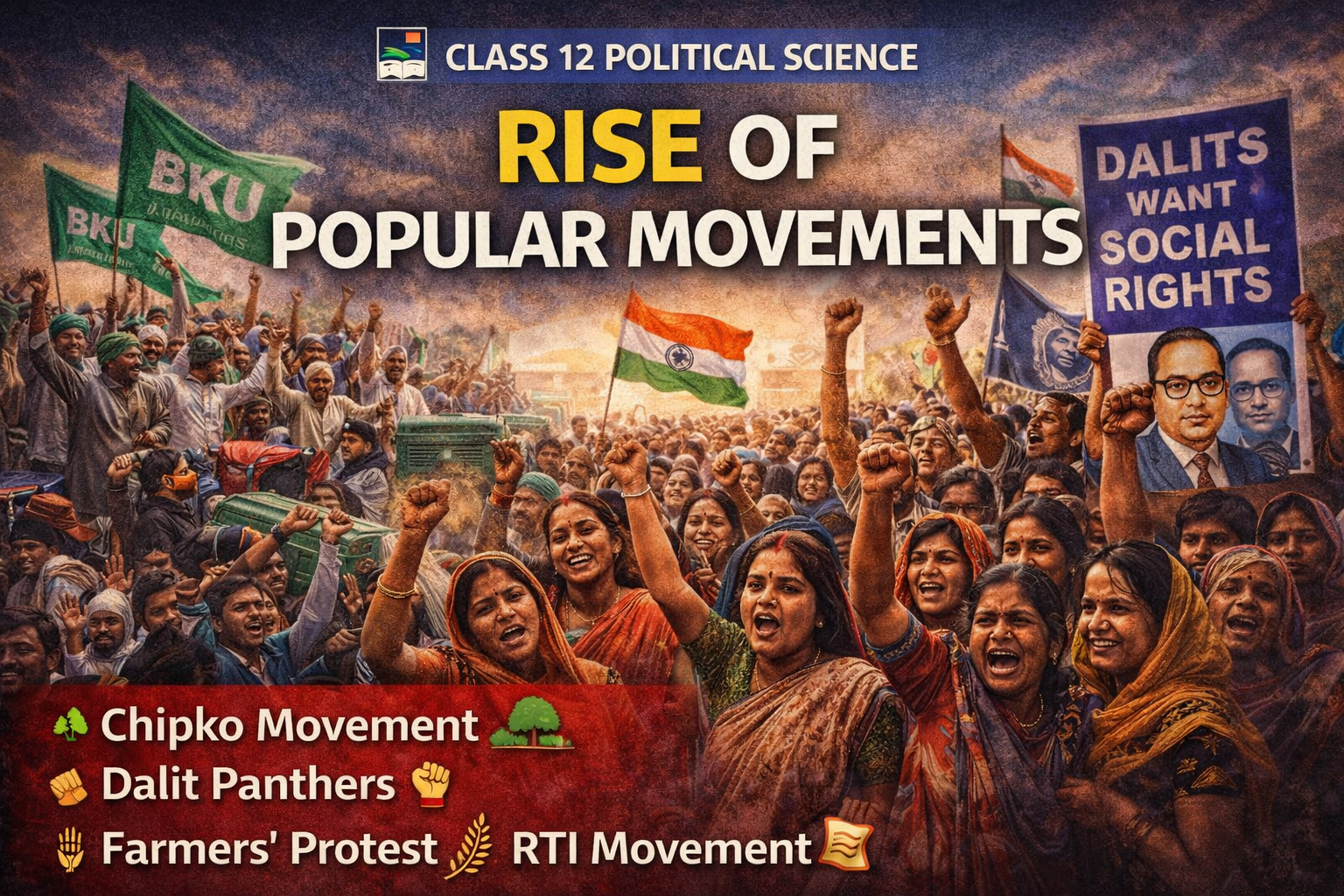
📘 These notes are prepared by the Nextoper editorial team for CBSE board exam preparation. Content is based on the latest NCERT syllabus. 🗓️ Last updated: April 2026
CBSE Class 12 Rise of Popular Movements – Complete Notes with 5 Essential Movements You Must Know
Quick Overview
| Field | Detail |
|---|---|
| Chapter | Chapter 7 – Rise of Popular Movements |
| Subject | Political Science (Politics in India since Independence) |
| Class | 12 |
| Board | CBSE |
| Exam Weightage | Check latest CBSE syllabus |
The Rise of Popular Movements Class 12 CBSE chapter covers a fascinating period in Indian political history — the 1970s onward — when ordinary citizens stepped outside political parties and built mass movements to fight for their rights. This chapter is a high-priority topic for your board exam because it tests conceptual understanding, not just facts.
From these notes, you will learn what popular movements are, which social groups led them, what their core demands were, and how they actually changed Indian laws and policies. Each movement — Chipko, Dalit Panthers, BKU, Anti-Arrack, NBA — is explained in a student-friendly way so you can write confident answers in your exam.
Here is a real-world way to think about it: every time citizens gather to demand clean air, fair wages, or protection from displacement, they are carrying forward the legacy of these movements. Understanding this chapter helps you see democracy not just as voting, but as a living, breathing process of public participation.
Table of Contents
- What Are Popular Movements?
- Party-Based vs. Non-Party Movements — Rise of Popular Movements Class 12 CBSE
- Chipko Movement — Rise of Popular Movements Class 12 CBSE
- Dalit Panthers
- Bharatiya Kisan Union (BKU) and Farmers’ Movements
- National Fish Workers’ Forum
- Anti-Arrack Movement and the Women’s Movement
- Narmada Bachao Aandolan (NBA)
- Movement for Right to Information
- How Popular Movements Strengthened Indian Democracy
- Important Questions — Rise of Popular Movements Class 12 CBSE
- FAQ — Rise of Popular Movements Class 12 CBSE
- Quick Revision — Key Points to Remember
- Related Notes on Nextoper
- Useful External Resources
What Are Popular Movements?
Three decades after Independence, large sections of Indian society — women, students, Dalits, farmers — felt that democratic politics was not addressing their real needs. Political parties focused on elections, but the everyday grievances of marginalised groups were going unheard.
These groups responded by coming together under the banner of social organisations to voice their demands. This collective action outside of formal party politics is what we call popular movements or new social movements. They are not the same as political parties — they do not contest elections — but they play a powerful role in shaping democracy.
Popular movements can be understood through four key questions:
- What are the issues they raise?
- Which sections of society do they mobilise?
- What methods do they use to put pressure on the government?
- What role do they play in a democracy?
[Image: A diagram showing the different types of popular movements in India — environmental, farmers’, Dalit, women’s, and RTI movements | Alt text: Rise of Popular Movements Class 12 CBSE – Types of popular movements diagram]
Party-Based vs. Non-Party Movements — Rise of Popular Movements Class 12 CBSE
Understanding the difference between these two types of movements is a favourite exam topic. Let’s break it down clearly.
Party-Based Movements
These movements are connected to formal political parties. Examples include the trade union movement in post-independence India, where all major parties built their own trade unions in industrial cities like Mumbai, Kolkata, and Kanpur. Peasant agitations in Telangana under Communist party leadership are another example. These movements raised issues of economic injustice and inequality.
These movements did not formally participate in elections, yet they retained links with parties. Individual members and organisations were actively associated with parties. These links helped ensure that the demands of diverse social sections got better representation in party politics.
Non-Party Movements
By the 1970s and 1980s, many politically active people became disillusioned with political parties. The failure of the Janata experiment and political instability were immediate triggers. But the deeper reason was economic — despite impressive growth in the first twenty years of Independence, poverty and inequality persisted on a large scale. Benefits of development did not reach all sections of society equally.
Many groups therefore chose to work outside party politics through mass mobilisation. Students and young activists began organising marginalised communities like Dalits and Adivasis. Middle-class activists launched voluntary organisations among the rural poor.
Because of their voluntary character, these groups came to be known as voluntary organisations or non-party political formations. They believed in democracy and in political participation — but not through parties. They hoped that direct, grassroots participation by citizens would be more effective for resolving local issues. Over time, however, many of these organisations began receiving external funds from international agencies, which weakened the spirit of local initiative.
Chipko Movement — Rise of Popular Movements Class 12 CBSE
The Chipko Movement is one of the most famous environmental movements in India and one of the first in the world. It began in the early 1970s in what is now Uttarakhand, and its story tells us a great deal about how ordinary citizens can challenge powerful interests.
Origins
The movement began in two or three villages of Uttarakhand when the forest department refused to allow villagers to cut ash trees for making agricultural tools. However, the same patch of forest was then allotted to a sports goods manufacturer for commercial use. Enraged by this double standard, the villagers protested.
Their tactic was remarkable — they hugged the trees to prevent them from being cut down. This is what gave the movement its name: Chipko means “to hug” in Hindi.
Demands and Spread
The struggle soon spread across the entire Uttarakhand region. The villagers raised larger issues of ecological and economic exploitation:
- No forest-exploiting contracts should be given to outsiders.
- Local communities must have effective control over natural resources — land, water, and forests.
- The government should provide low-cost raw materials to small local industries.
- Development must not disturb the ecological balance of the region.
- Economic issues of landless forest workers — including guaranteed minimum wage — were also taken up.
Women’s Role — A Novel Aspect
Women played a strikingly active role in the Chipko movement, which was unusual at the time. The forest contractors in the region also supplied alcohol to men. Women held sustained agitations against alcoholism and broadened the movement’s agenda to cover social issues beyond just forests.
Achievement
The movement achieved a major victory when the government issued a ban on felling of trees in the Himalayan regions for fifteen years, until the green cover was fully restored. Beyond this concrete victory, Chipko became a symbol of many popular movements emerging across India in the 1970s and later.
[Image: Women participants in the Chipko movement hugging trees in Chamoli, Uttarakhand in 1973 | Alt text: Rise of Popular Movements Class 12 CBSE – Chipko Movement women hugging trees Uttarakhand]
Dalit Panthers
The Dalit Panthers represent a different but equally important chapter in the story of popular movements. While Chipko fought for ecological rights, Dalit Panthers fought for social dignity and constitutional rights.
Background
Even though the Indian Constitution abolished untouchability and the government passed laws to protect Dalits in the 1960s and 1970s, social discrimination and violence against Dalit communities continued in many ways. Dalit settlements in villages remained segregated. Dalits were denied access to common drinking water sources. Dalit women faced abuse. Collective atrocities were carried out over minor symbolic issues of caste pride.
The Republican Party of India, which Dalits had supported, could not succeed in electoral politics. It remained marginal, faced constant splits, and had to ally with other parties to win elections.
Formation
By the early 1970s, the first generation of Dalit graduates, especially those living in city slums of Maharashtra, began asserting themselves. Dalit Panthers, a militant organisation of Dalit youth, was formed in Maharashtra in 1972. Its immediate inspiration came partly from the Black Panther movement in the United States, which fought against racial discrimination.
The main demands of the Dalit Panthers were:
- Effective implementation of reservations and social justice policies.
- An end to caste-based atrocities and violence against Dalits.
- The larger goal of destroying the caste system entirely and uniting all oppressed sections — landless peasants, urban workers, and Dalits — into one movement.
Activities and Impact
Dalit Panthers fought against increasing atrocities on Dalits across Maharashtra. Their sustained agitations, along with other like-minded organisations, led to the government passing a comprehensive law in 1989 providing rigorous punishment for atrocities against Dalits.
The movement also created a cultural revolution. Dalit writers published autobiographies and literary works exposing the brutalities of the caste system. These works shook the Marathi literary world and made literature more representative of all social sections.
In the post-Emergency period, Dalit Panthers got involved in electoral compromises and underwent many splits, which eventually led to its decline. Organisations like BAMCEF (Backward and Minority Communities’ Employees Federation) took over this space.
Bharatiya Kisan Union (BKU) and Farmers’ Movements
The Bharatiya Kisan Union (BKU) is a landmark in the history of India’s farmers’ movements. Unlike most earlier agrarian struggles that focused on the rural poor, the BKU represented relatively better-off farmers who were still being squeezed by government policies.
Context
Farmers of Haryana, Punjab, and western Uttar Pradesh had benefited from the Green Revolution of the late 1960s. Sugar and wheat became major cash crops. But in the mid-1980s, the beginning of economic liberalisation created a market crisis for cash crops. Farmers faced rising costs and falling incomes.
The Meerut Agitation, 1988
In January 1988, around twenty thousand farmers gathered in Meerut, Uttar Pradesh to protest against the government’s decision to increase electricity rates. They camped outside the district collector’s office for three weeks in an extraordinarily disciplined agitation, with food supplied daily from nearby villages. This was celebrated as a great show of rural power.
Key Demands of the BKU
- Higher government floor prices for sugarcane and wheat.
- Abolition of restrictions on the inter-state movement of farm produce.
- Guaranteed supply of electricity at reasonable rates.
- Waiving of loan repayments for farmers.
- Provision of government pension for farmers.
Characteristics
BKU conducted rallies, demonstrations, sit-ins, and jail bharo (courting arrest) agitations involving tens of thousands — sometimes over a lakh — farmers. The movement used caste panchayats and clan networks to mobilise members and sustain itself without any formal organisational structure.
Crucially, the BKU distanced itself from all political parties until the early 1990s. It functioned as a pure pressure group. Alongside farmers’ organisations in other states — Shetkari Sanghatana of Maharashtra and Rayata Sangha of Karnataka — the BKU won several economic concessions. The farmers’ movement is considered one of the most successful social movements of the 1980s.
National Fish Workers’ Forum
India has the second-largest fishing population in the world. Hundreds of thousands of families along both the eastern and western coasts depend on fishing for their livelihoods. These communities faced a major threat when the government permitted mechanised trawlers and modern fishing technologies that wiped out fish from India’s coastal waters.
Throughout the 1970s and 1980s, local fish workers’ organisations fought state governments over livelihood issues. When economic liberalisation arrived in the mid-1980s, these local organisations came together on a national platform — the National Fishworkers’ Forum (NFF). Fish workers from Kerala took the lead in mobilising fellow workers, including women workers, from other states.
The NFF’s first major victory came in 1991 when it successfully fought a legal battle against the government’s deep sea fishing policy, which had opened India’s waters to large multinational commercial fishing companies. Throughout the 1990s, the NFF fought multiple legal and public battles to protect the interests of subsistence fishers over commercial profits. In July 2002, the NFF called for a nationwide strike to oppose the government’s decision to issue licences to foreign trawlers.
Anti-Arrack Movement and the Women’s Movement
The Anti-Arrack Movement of Andhra Pradesh is a remarkable example of a spontaneous grassroots movement led by rural women. It began as a fight against alcohol but grew into a much larger challenge to social, economic, and political structures.
Origins
In the early 1990s, women in Nellore district of Andhra Pradesh had enrolled in large numbers in the Adult Literacy Programme. During class discussions, women began complaining about the destruction caused by arrack — locally brewed alcohol — in their families. Men were spending their wages on alcohol, family economies were collapsing, and women bore the brunt of both poverty and domestic violence.
Women in Nellore came together spontaneously and forced the closure of local wine shops. News spread fast. Women from about 5,000 villages came together, passed resolutions demanding prohibition, and sent them to district authorities. The arrack auctions in Nellore district were postponed 17 times. This movement gradually spread across the entire state of Andhra Pradesh.
Linkages to Larger Issues
The movement’s slogan was simple — a ban on the sale of arrack. But this demand touched on far deeper issues:
- A nexus between crime, politics, and the alcohol trade had developed. The government collected huge revenues from arrack taxes and was unwilling to act.
- For the first time, rural women openly discussed domestic violence — a private issue that had never been discussed publicly before.
- The movement became part of the broader women’s movement in India.
Earlier, women’s groups had focused mainly on urban middle-class issues — dowry, sexual harassment, property rights. The anti-arrack movement brought rural women into this space and shifted focus to real everyday violence.
Women’s Movement — Broader Demands
The women’s movement through the 1980s focused on sexual violence against women, campaigns against dowry, and demands for gender-equal personal and property laws. During the 1990s, the movement also demanded equal political representation for women. The 73rd and 74th Constitutional Amendments granted reservations for women in local level political offices (panchayats and municipalities). Demands for extending similar reservations to state and central legislatures are still pending, with debate continuing over whether to include a separate sub-quota for Dalit and OBC women.
Narmada Bachao Aandolan (NBA)
The Narmada Bachao Aandolan brought together all the threads of India’s popular movements — environmental concerns, displacement of the poor, questions about development models, and demands for democratic decision-making.
The Sardar Sarovar Project
In the early 1980s, an ambitious dam project was launched in the Narmada valley across Madhya Pradesh, Gujarat, and Maharashtra. It involved 30 big dams, 135 medium dams, and around 3,000 small dams on the Narmada river and its tributaries. The Sardar Sarovar Project in Gujarat and the Narmada Sagar Project in Madhya Pradesh were the largest among these.
Supporters argued the dams would provide drinking water, irrigation, flood control, and electricity to vast areas. But the project required the submergence of 245 villages and the relocation of approximately 2.5 lakh people.
Formation of NBA
Issues of rehabilitation were first raised by local activist groups. Around 1988–89, these issues crystallised under the banner of the NBA — a loose collective of local voluntary organisations. NBA’s most well-known leader was Medha Patkar.
Demands and Positions
The NBA started with a demand for proper and just rehabilitation of all displaced persons. It then broadened its position:
- Local communities must have a say in decision-making about large development projects.
- Communities must have effective control over natural resources — water, land, and forests.
- The government must conduct a cost-benefit analysis of major development projects that includes social and ecological costs, not just economic gains.
- These social costs include forced resettlement, loss of livelihood, cultural destruction, and ecological depletion.
Eventually, the NBA moved to total opposition to the dam, questioning why the poor and Adivasis always had to bear the costs of development that benefited others.
Outcome
The NBA used every democratic means available — court appeals, international mobilisation, public rallies, and Satyagraha-style protests. The Supreme Court ultimately upheld the government’s decision to construct the dam, but directed it to ensure proper rehabilitation. The government’s National Rehabilitation Policy of 2003 is seen as a partial achievement of the NBA’s demands.
The NBA could not garner support from mainstream political parties. Its journey depicted a growing gap between social movements and political parties in Indian politics. By the late 1990s, the NBA had become part of a larger alliance of people’s movements challenging the logic of large-scale development projects across the country.
Movement for Right to Information
The Right to Information (RTI) movement stands out as one of the rare popular movements that succeeded in getting the state to formally accept its core demand.
The movement began in 1990, led by the Mazdoor Kisan Shakti Sangathan (MKSS) in a backward region of Rajasthan called Bhim Tehsil. Villagers demanded copies of records of famine relief work and labourers’ wages on public construction projects — schools, dams, dispensaries — because they knew that funds were being siphoned off while the projects were shown as complete on paper.
The MKSS organised Jan Sunwais (public hearings) in 1994 and 1996, where the administration was asked to explain its conduct in public. In 1996, MKSS formed the National Council for People’s Right to Information in Delhi, raising RTI to a national campaign. After years of struggle, the RTI Bill was tabled in 2004 and received presidential assent in June 2005, giving all citizens the legal right to access information from public authorities.
How Popular Movements Strengthened Indian Democracy — Rise of Popular Movements Class 12 CBSE
This final section is critically important for your board exam. Many 5-mark questions ask you to assess the role of these movements in democracy.
Popular movements strengthened democracy in several key ways:
They represented groups ignored by electoral politics. The groups mobilised by these movements — Dalits, Adivasis, women, fishermen, displaced farmers — were poor and marginalised. Electoral politics did not give them adequate voice. These movements ensured their demands were heard.
They reduced social conflict and alienation. By providing a channel for genuine grievances, popular movements reduced the possibility of deep social conflict and prevented marginalised groups from becoming completely disillusioned with democracy.
They broadened participation. Popular movements suggested new forms of active participation — public hearings, Satyagraha, rallies, court battles — and thereby expanded what participation in democracy could mean.
They were educative. Movements educated citizens about their rights and about what they could expect from democratic institutions.
Critics argue that collective actions like strikes, sit-ins, and rallies disrupt government functioning and delay decision-making. However, these assertive methods arose precisely because routine democratic processes did not have enough space for the voices of marginalised groups.
A genuine concern remains: most popular movements focus on a single issue and represent one section of society. This makes it easier for governments to ignore them. Democratic politics requires broad alliances across disadvantaged groups, but such alliances have not emerged strongly enough. The relationship between popular movements and political parties has also grown weaker over time, creating a vacuum in Indian politics.
Important Questions — Rise of Popular Movements Class 12 CBSE
1 Mark Question
Q. In which state and year was the Dalit Panthers organisation formed? Ans. Dalit Panthers was formed in Maharashtra in 1972.
3 Mark Questions
Q. Explain any three demands of the Bharatiya Kisan Union (BKU).
Ans. The BKU made several important demands on behalf of farmers of western Uttar Pradesh and Haryana. First, it demanded higher government support prices (floor prices) for sugarcane and wheat to protect farmers from market volatility. Second, it demanded guaranteed electricity supply at reasonable and affordable rates, protesting against the government’s decision to raise electricity tariffs. Third, it demanded that the government waive unpaid loans taken by farmers, who were facing a debt crisis as a result of the liberalisation of the economy in the mid-1980s. Additionally, it asked for the abolition of restrictions on inter-state movement of farm produce, and the provision of a government pension for farmers.
Q. What were the origins and main demands of the Anti-Arrack Movement in Andhra Pradesh?
Ans. The Anti-Arrack Movement originated in the early 1990s in Nellore district of Andhra Pradesh, where women enrolled in the Adult Literacy Programme began discussing the damage caused by arrack consumption in their villages. Alcoholism was destroying family economies, and women were suffering domestic violence as a result. Women in Nellore spontaneously organised to shut wine shops. News spread rapidly and women from about 5,000 villages joined the movement. Their primary demand was a complete ban on the sale of arrack. The movement also addressed deeper issues: it exposed the nexus between crime, politics, and the alcohol trade, and for the first time provided a public platform for rural women to openly discuss domestic violence. In this way, the anti-arrack movement also became part of the broader women’s movement in India.
5 Mark Questions
Q. Explain the Chipko Movement. What were its causes, methods, demands, and outcomes?
Ans. The Chipko Movement began in the early 1970s in what is now Uttarakhand and became one of the first major environmental movements in India. Its immediate cause was an act of injustice by the forest department, which refused the villagers permission to cut ash trees for agricultural tools but allotted the same forest to a commercial sports goods manufacturer. This provoked the villagers to protest using a unique tactic — they hugged the trees to physically prevent logging, which gave the movement its name (chipko means to hug).
The movement quickly spread across the Uttarakhand region and raised larger demands: local communities must have effective control over natural resources; no forest contracts should go to outsiders; the government must provide low-cost materials to local small industries; and development must preserve ecological balance. The movement also took up the economic demands of landless forest workers and called for minimum wage guarantees.
A particularly significant aspect of Chipko was the active participation of women. Forest contractors in the region also sold alcohol to men, and women used the movement to campaign against alcoholism and social exploitation. The movement thus broadened into a social movement beyond just tree protection.
The Chipko Movement achieved a major victory: the government issued a ban on felling trees in Himalayan regions for fifteen years until the green cover was restored. Beyond this, it became a powerful symbol of grassroots democracy and inspired similar popular movements across India.
Q. Why did the Narmada Bachao Aandolan oppose the Sardar Sarovar Project? What were its methods and what did it achieve?
Ans. The Narmada Bachao Aandolan (NBA) opposed the Sardar Sarovar Project because the dam’s construction required the submergence of 245 villages and the displacement of approximately 2.5 lakh people, mostly poor communities and Adivasis. The NBA argued that the project’s true costs — forced displacement, loss of livelihood, cultural destruction, and ecological damage — were never properly calculated by the government.
Initially, the NBA demanded proper and just rehabilitation of all affected people. It gradually broadened its position: local communities must have a say in large development decisions; they must have control over natural resources; and the government must conduct transparent cost-benefit analyses of major projects that account for social costs. The NBA questioned the very model of development that sacrificed the poor for benefits that went to others, asking in a democracy why marginalised communities alone must bear the burden of development.
The NBA used a wide range of democratic methods — petitions to the judiciary, international awareness campaigns, public rallies, and Satyagraha-style protests, including Medha Patkar’s Jalsamadhi (standing in rising floodwaters). The Supreme Court ultimately allowed construction to proceed but directed the government to ensure rehabilitation. The government’s National Rehabilitation Policy of 2003 can be seen as a direct achievement of the NBA’s sustained struggle. By the end of the 1990s, the NBA became part of a broader national alliance of people’s movements questioning large-scale development projects.
FAQ — Rise of Popular Movements Class 12 CBSE
Q1. What is the difference between a party-based movement and a non-party political formation?
A party-based movement retains connections with political parties and often works through or alongside them, as the trade union movement did in post-independence India. A non-party political formation, on the other hand, deliberately stays outside party politics. It does not contest elections, does not support any one party, and believes that direct citizen participation at the grassroots level is more effective for resolving local issues. Most popular movements from the 1970s onward — like the Chipko movement, BKU, and NBA — were non-party in nature.
Q2. Why is the Chipko Movement considered a women’s movement as well as an environmental movement?
The Chipko Movement is considered a women’s movement because women played a uniquely active role in it. The forest contractors who exploited the region’s timber also supplied alcohol to men. Women organised sustained agitations against alcoholism and used the platform of the Chipko movement to raise broader social issues affecting women in the region. Their participation was novel and visible, making Chipko simultaneously an environmental movement, a social movement, and a proto-feminist movement.
Q3. Why did the Narmada Bachao Aandolan shift from demanding rehabilitation to opposing the dam entirely?
The NBA initially demanded proper rehabilitation for those displaced by the Sardar Sarovar Project. However, as the movement deepened, it began questioning the fundamental logic of large-scale development projects. The NBA argued that such projects consistently displaced the poorest communities — Adivasis and marginal farmers — while the benefits flowed to others. It also challenged the lack of democratic decision-making in mega-projects: local communities had no say in decisions that destroyed their lives. These broader concerns led the NBA to oppose the dam itself and demand a transparent cost-benefit analysis of all such projects.
Q4. What lessons does the NCERT chapter draw from the history of popular movements?
The chapter argues that popular movements are not a disruption of democracy but an integral part of it. They arose because routine electoral politics did not adequately address the grievances of marginalised groups. These movements ensured that diverse social groups — Dalits, women, farmers, fisherfolk — had their demands heard and represented. They also broadened the concept of political participation beyond just voting. At the same time, the chapter notes a limitation: most movements focus on a single issue and one section of society, which makes it easy to ignore them. A broad, cross-group alliance has not yet fully emerged.
Q5. What was the role of the MKSS in the Right to Information movement?
The Mazdoor Kisan Shakti Sangathan (MKSS) in Rajasthan was the pioneering organisation behind the RTI movement. Starting in 1990 in the Bhim Tehsil region, the MKSS demanded that the government make public all records of famine relief work and construction projects, because villagers knew funds were being misappropriated. The MKSS organised Jan Sunwais (public hearings) where village communities questioned the administration directly. It later formed the National Council for People’s Right to Information in Delhi to push RTI to a national level. This sustained effort ultimately resulted in the RTI Act of 2005.
Quick Revision — Key Points to Remember
- The Chipko Movement began in Uttarakhand in 1973 when villagers hugged trees to stop commercial logging; it resulted in a 15-year ban on felling trees in Himalayan forests.
- Dalit Panthers was formed in Maharashtra in 1972 by Dalit youth to fight caste discrimination; their sustained agitation led to a comprehensive anti-atrocities law in 1989.
- The BKU (Bharatiya Kisan Union) represented farmers of western UP and Haryana and demanded higher crop prices, cheap electricity, loan waivers, and pension for farmers.
- The Anti-Arrack Movement of Andhra Pradesh (1992) was a spontaneous women’s movement that started in Nellore district and spread to 5,000 villages demanding prohibition of arrack.
- The National Fishworkers’ Forum (NFF) was formed in the mid-1980s when liberalisation threatened the livelihoods of coastal fishing communities who depended on subsistence fishing.
- The Narmada Bachao Aandolan opposed the Sardar Sarovar Project to protect the 2.5 lakh people threatened with displacement; it led to the National Rehabilitation Policy of 2003.
- The Right to Information movement, led by MKSS in Rajasthan, succeeded in getting the RTI Act passed in 2005 — one of the rare popular movements to achieve its core demand.
- Non-party political formations chose to work outside electoral politics because they felt political parties failed to represent the interests of marginalised groups.
- Popular movements are an integral part of democracy — they represent new social groups, ensure broader participation, reduce social conflict, and educate citizens about their rights.
- A key limitation of popular movements is that they tend to focus on single issues and single communities, which weakens their overall political impact and makes it easier for governments to ignore them.
Related CBSE Notes
If you are studying India’s Foreign Relations Notes, you should also check:
- Class 12 Political Science Chapter 5 – Challenges to and Restoration of Congress System
- Class 12 Political Science Chapter 4 – India’s External Relations
- Class 12 Political Science Chapter 6 – The Crisis of Democratic Order
These CBSE notes will help you build a strong understanding of Political Science concepts.


Great notes! The chapter is explained very clearlyand the examples of Chipko, Dalit Panthers, and RTI make it easy tounderstand and revise for the CBSE exam.
Really helpful notes! The chapter is well organized, easy to follow, and perfect for quick revision before the CBSE exam.