CBSE Class 12 Kinship Caste and Class – Complete Notes with 10 Must-Know Concepts
| Field | Detail |
|---|---|
| Chapter | Theme 3 – Kinship, Caste and Class: Early Societies |
| Subject | History (Themes in Indian History) |
| Class | 12 |
| Board | CBSE |
| Exam Weightage | Check latest CBSE syllabus |
Introduction
Kinship Caste and Class Class 12 CBSE covers one of the most important chapters for your board exam. This theme explores how Indian society was organized between c.600 BCE and 600 CE — a period of major political and economic change. The chapter draws heavily on the Mahabharata and other textual sources to help us understand social structures like family, marriage, caste, and class.
In these notes, you will learn about how historians use ancient texts to reconstruct social history, the rules of kinship and marriage laid down by Brahmanical texts, the varna and jati systems, the role of gender in access to property, and how groups like Chandalas were placed at the bottom of the social hierarchy. Every concept is explained clearly so that you can revise quickly before your board exam.
Think of this chapter as a mirror of ancient Indian society. Understanding how people were grouped, what rules governed their lives, and how those rules were sometimes followed — and sometimes broken — gives you a powerful lens to analyze Indian history right up to the present day. This topic typically carries significant marks in CBSE board exams, so these notes are designed to cover every angle.
Table of Contents
- What Are Textual Traditions? How Historians Use Them
- The Mahabharata: Central Story and V.S. Sukthankar’s Critical Edition
- Kinship, Family Structure, and the Ideal of Patriliny
- Rules of Marriage: Types, Gotra, and Satavahana Evidence
- The Varna System and Dharmasutras: Kinship Caste and Class Class 12 CBSE
- Jati, Guilds, and Groups Beyond the Four Varnas
- Untouchables: Chandalas and Evidence from Chinese Travellers
- Gender, Property Rights, and Social Status
- Buddhist vs Brahmanical Views on Social Differences
- Historians and the Mahabharata: V.S. Sukthankar and the Critical Edition
- Excavation of Hastinapura: Archaeological Evidence
- Key Glossary: Terms from Kinship Caste and Class Class 12 CBSE
- Important Questions – Kinship Caste and Class Class 12 CBSE
- FAQ – Kinship Caste and Class Class 12 CBSE
- Quick Revision – Key Points to Remember
- Related Notes on Nextoper — Internal Links
- Useful External Resources
What Are Textual Traditions? How Historians Use Them
Historians studying this period between 600 BCE and 600 CE relied heavily on textual traditions — written records that describe or prescribe how society was organized. These texts were not neutral documents. Some texts laid down norms of social behaviour, telling people how they should act, while others described actual social situations and practices.
An important point is that inscriptions also provide glimpses of social actors who might not appear in literary texts. When reading any historical text, a good historian always asks: Who composed this text? For whom was it written? In what language did it circulate? The perspective of the author shapes every word.
This is why CBSE examiners frequently ask students to “read a source critically.” The sources for this period include Sanskrit texts like the Mahabharata, Dharmasutras, Dharmashastras, and inscriptions left by rulers like the Satavahanas.
The Mahabharata: Central Story and V.S. Sukthankar’s Critical Edition
The Central Story
The Mahabharata is a colossal Sanskrit epic that depicts a wide range of social categories and situations. It contains vivid descriptions of battles, forests, palaces, and settlements. The central story describes a feud over land and power between two sets of warring cousins — the Kauravas and the Pandavas, both belonging to the ruling family of the Kurus, a lineage dominating one of the Janapadas.
The conflict ended in a great battle in which the Pandavas emerged victorious. After this, patrilineal succession — passing power from father to son — was proclaimed as the norm.
V.S. Sukthankar and the Critical Edition
V.S. Sukthankar was a Sanskrit scholar who undertook the enormous project of preparing a critical edition of the Mahabharata. He assembled a team of Sanskrit scholars who:
- Collected Sanskrit manuscripts written in various scripts from across India
- Compared the verses from each manuscript
- Selected only those verses that appeared in most versions
- Published the final selection across several volumes totalling 13,000 pages
The team found that while there were common elements across most Sanskrit versions, there were also enormous regional variations. These variations reflect a complex process where dominant traditions interacted with local ideas and practices — sometimes in conflict, sometimes in agreement. This is why the Mahabharata cannot be read as a single, fixed, authoritative text.
Kinship, Family Structure, and the Ideal of Patriliny
How Families Were Understood
Not all families in ancient India looked the same. They varied in size, in who was considered a relative, and in the kinds of activities — including rituals, meals, and work — that members shared. Families were generally part of a larger network of kinfolk, and familial ties were considered “natural” because they were based on blood.
Historians can reconstruct the family lives of elite groups fairly easily because texts and inscriptions recorded them. However, it is much harder to piece together the family structures of ordinary people, since they rarely appear in written records.
The Ideal of Patriliny
Patriliny refers to tracing one’s lineage through the father’s side. Under this system:
- Sons had claims to their father’s wealth after his death
- The eldest son usually received a special share of the inheritance
- If a king had no son, a brother or male kinsman would succeed him
- Women exercising political power was extremely rare — Prabhavati Gupta is one of the few documented examples
The Mahabharata itself reinforces the ideal of patriliny by ending with the proclamation of patrilineal succession after the Pandavas’ victory.
Rules of Marriage: Types, Gotra, and Satavahana Evidence
Marriage Rules in Dharmasutras
The Dharmasutras recognized eight forms of marriage. Of these, four were considered proper and acceptable, while the remaining four were condemned because they violated Brahmanic norms. Key rules about marriage included:
- Women could not claim a share in parental property
- Exogamy (marrying outside one’s own kin group) was considered desirable
- Kanyadana — the gift of a daughter in marriage — was regarded as an important religious duty of the father
Types of Marriages
| Marriage Type | Meaning |
|---|---|
| Endogamy | Marriage within one’s own kin group |
| Exogamy | Marriage outside one’s own kin group |
| Polygyny | One man married to several women |
| Polyandry | One woman married to more than one man |
Draupadi’s marriage to the five Pandava brothers in the Mahabharata is a famous example of polyandry. Historians debate why this was included in the text — it may reflect a shortage of women due to constant warfare, a situational crisis, or simply the fact that literary narratives do not always mirror social realities.
The Gotra System
Gotra refers to the name given to a group of people based on the name of a Vedic seer they claimed as their ancestor. The gotra system created a way of establishing and recording kinship. Key rules were:
- Women were expected to give up their father’s gotra and adopt their husband’s gotra upon marriage
- Members of the same gotra were not allowed to marry each other (exogamy rule)
Satavahana Evidence: When Rules Were Broken
The inscriptions of the Satavahana rulers provide fascinating evidence of how rules were applied in practice. Satavahana rulers were identified through metronymics — names derived from the mother’s name (e.g., Gautamiputra Satakarni, meaning “son of Gautami”). This suggests that mothers held a significant position, even though political succession remained patrilineal.
More interestingly, some women married to Satavahana rulers retained names from their father’s gotra (like Gotama or Vasistha) instead of adopting their husband’s gotra as Brahmanical rules required. Some Satavahana queens even belonged to the same gotra as their husbands — directly violating the exogamy rule. This practice was actually common among communities in south India, where endogamy was preferred because marrying within the kin group was seen as strengthening community bonds.
The Varna System and Dharmasutras: Kinship Caste and Class Class 12 CBSE
What Is Caste?
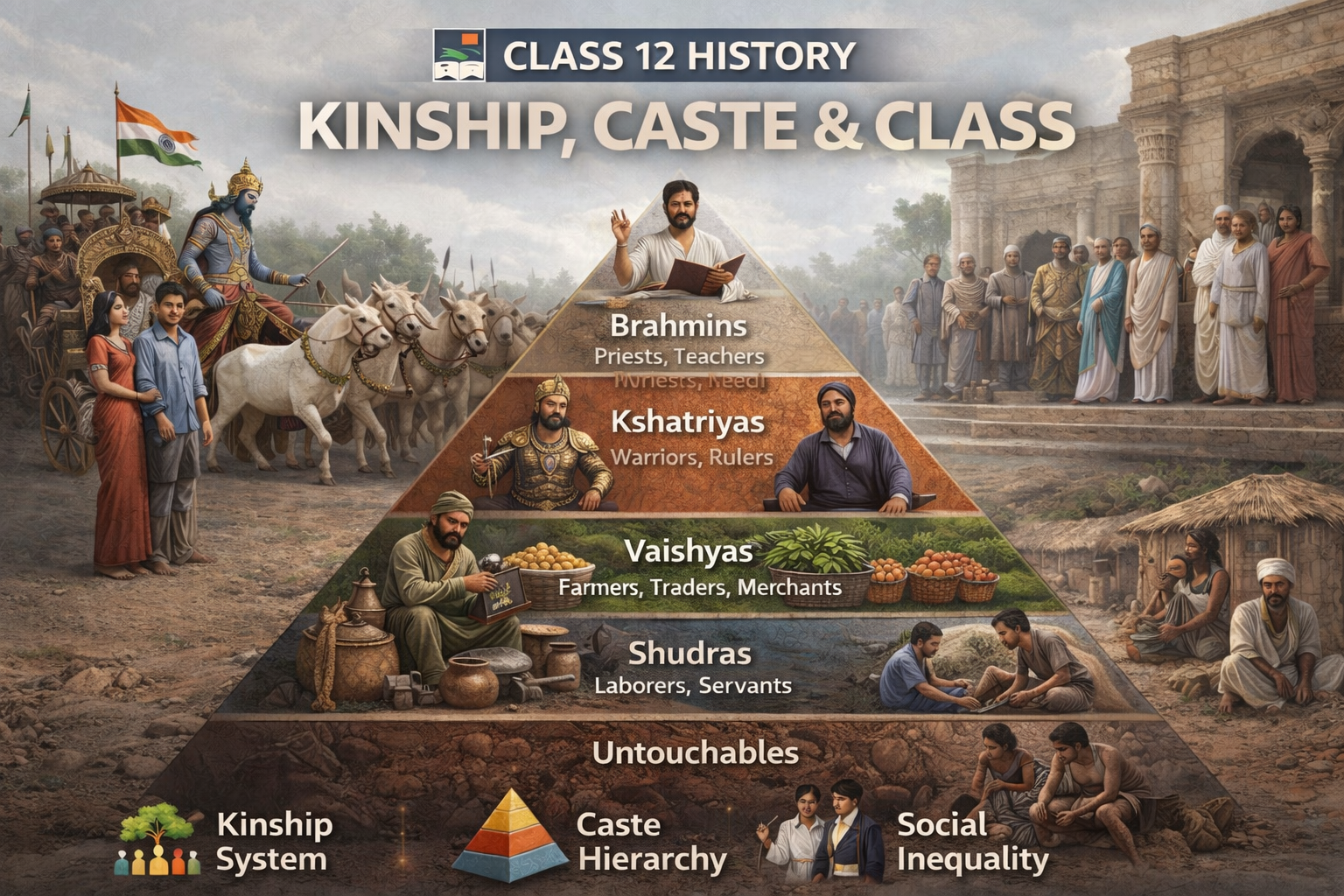
Caste refers to a set of hierarchically ordered social categories laid down in the Dharmasutras and Dharmashastras. The Brahmanas placed themselves at the top of this hierarchy and Shudras at the bottom, claiming this order was of divine origin. The Purusha Sukta of the Rigveda was cited to support this claim — it described the four varnas as having emerged from the body of the primeval man Purusha.
Ideal Occupations Under the Varna System
| Varna | Prescribed Occupation |
|---|---|
| Brahmanas | Study and teach the Vedas, perform sacrifices, give and receive gifts |
| Kshatriyas | Warfare, protecting people, administering justice, studying Vedas |
| Vaishyas | Agriculture, pastoralism, trade, gifting, sacrifices |
| Shudras | Serve the three “higher” varnas |
Strategies Used to Enforce the Varna System
The Brahmanas used three main strategies:
- They asserted that the varna order was of divine origin
- They advised kings to enforce the varna system within their kingdoms
- They tried to convince people that their social status was determined by birth, not by their own choices
Kings of Non-Kshatriya Origin
According to the Shastras, only Kshatriyas were supposed to be kings. Yet in practice, many powerful rulers came from other backgrounds. The Mauryas are described as Kshatriyas in Buddhist texts but as rulers of “low origin” in Brahmanical texts. The Shungas and Kanvas, who succeeded the Mauryas, were Brahmanas. The Satavahana king Gautamiputra Satakarni claimed to be a Brahman and destroyer of Kshatriya pride — yet he himself entered into marriage alliances with the Kshatriya kin of Rudradaman. This shows that integrating within the caste framework was often a complicated and contradictory process.
The Shaka and Kushan rulers from Central Asia were regarded as outsiders or Mlechchas (barbarians). Yet some of them were familiar with Sanskrit traditions, showing that cultural boundaries were not always rigid.
[Image: Chart showing four varnas and their prescribed occupations | Alt text: Kinship Caste and Class Class 12 CBSE – varna system diagram with prescribed occupations]
Jati, Guilds, and Groups Beyond the Four Varnas
Jati: A More Flexible Category
Jati was another social category, also based on birth like Varna, but far more numerous and flexible. While varnas were fixed at four, there was no limit to the number of jatis. Whenever Brahmanical authorities encountered new groups that did not fit neatly into the fourfold varna system, they classified them as jatis. For example, forest-dwelling communities like the Nishadas were classified as a jati.
Jatis that shared a common occupation were sometimes organized into shrenis (guilds). These guilds functioned as both professional associations and social communities.
The Mandasor Inscription: Evidence of Guild Life
The stone inscription found at Mandasor (Madhya Pradesh) is one of the most important pieces of evidence about guild life in early India. It records the story of a guild of silk weavers who originally lived in Lata (Gujarat) and migrated to Mandasor along with their families and kinfolk. Key details from this inscription:
- Guild membership was based on shared craft specialization
- Some members later adopted different occupations while remaining part of the guild
- Members collectively decided to invest their earnings from craft work
- They built a splendid temple in honour of the sun god
This inscription shows that jati and guild identities could be flexible — shared profession and shared community action were as important as birth.
Beyond the Four Varnas
There were large populations whose social practices were not shaped by Brahmanical ideas at all — nomadic pastoralists, forest communities like the Nishadas, and others. There was a sharing of ideas and beliefs between these groups and the Brahmanical world, showing that society was never simply divided into four neat boxes.
Untouchables: Chandalas and Evidence from Chinese Travellers
The Brahmanas considered certain social categories as “untouchable.” These groups were associated with activities considered ritually polluting, such as handling corpses and dead animals. People who performed such tasks were known as Chandalas.
Chandalas were placed at the very bottom of the social hierarchy. Touching them or even seeing them was considered polluting. The Manusmriti laid down strict rules for Chandalas:
- They had to live outside the village
- They were required to use discarded utensils
- They had to wear the clothes of the dead and ornaments made of iron
- They were not allowed to walk in villages or cities at night
- They had to dispose of unclaimed bodies and serve as executioners
Two Chinese Buddhist pilgrims recorded what they observed:
- Fa Xian (c. 5th century CE) wrote that “untouchables” sounded clappers when entering streets so that people could avoid seeing them
- Xuan Zang (c. 7th century CE) noted that executioners and scavengers were forced to live outside the city
Importantly, there were also instances of Chandalas who refused to accept the life of degradation prescribed in the Shastras — a reminder that social prescription and social reality were not always the same.
Gender, Property Rights, and Social Status
Social position in early India was shaped not just by birth but also by access to economic resources. Two main factors determined who had access to property:
1. Gendered Access to Property
- According to the Manusmriti, women were not eligible to claim a share in parental property
- After parents died, property was divided among sons, with the eldest receiving a special share
- Women could retain gifts received at the time of marriage as stridhana, which could be inherited by their children without any claim from the husband
- Women were not supposed to hoard family property or personal valuables without their husband’s permission
- Both textual and epigraphic evidence suggests that while upper-class women may have had access to some resources, land, cattle, and money were generally controlled by men
2. Varna and Access to Property
- Brahmanical texts prescribed only servitude as the occupation for Shudras
- Brahmanas and Kshatriyas would have been the wealthiest groups in society
- Buddhism recognized social divisions but did not consider them natural or fixed — and explicitly rejected the idea that higher status could be claimed on the basis of birth alone
Buddhist vs Brahmanical Views on Social Differences
This is a content gap that most competitors miss — and it is frequently asked in CBSE board exams.
The Brahmanical view held that the four-varna order was divinely ordained, described in the Purusha Sukta of the Rigveda. Social status was determined by birth, and Brahmanical texts like the Manusmriti prescribed rigid rules for each group.
The Buddhist view, found in the Sutta Pitaka, offered a very different explanation. It presented a “social contract” theory of society: kingship was not divinely ordained but based on human choice. People elected a ruler (called mahasammata, meaning “the great elect”) to maintain order, and taxes were the payment for this service. Since human beings created this social system, they could also change it in the future.
The Tamil Sangam anthologies described yet another alternative — a model where those who controlled resources were expected to share them with others. This suggests that alongside Brahmanical hierarchy, there were alternative social values focused on generosity and mutual support.
Historians and the Mahabharata: A Dynamic Text
Historians approach the Mahabharata as a complex, layered document rather than a simple story. When analyzing any historical text, they consider:
- The language — was it in the language of ordinary people or of priests and elites?
- The type of text — was it a mantra, a law code, or a story?
- The author’s perspective — who wrote it and why?
- The audience — who was it written for?
- The date of composition — when was it written or compiled?
- The place of composition
The Sanskrit of the Mahabharata is simpler than that of the Vedas or royal prashastis, suggesting it was intended to be understood more widely. The original stories were composed by chariot-bards known as sutas, who accompanied Kshatriya warriors and composed poems celebrating their victories. These compositions circulated orally before being written down.
The text grew over time through several phases:
- By c. 5th century BCE: Brahmanas began writing down oral compositions
- c. 200 BCE–200 CE: Worship of Vishnu grew and Krishna was identified with Vishnu; new material was added
- c. 200–400 CE: Didactic (instructional) sections resembling the Manusmriti were added
The text grew from fewer than 10,000 verses to 100,000 verses and is traditionally attributed to Sage Veda Vyasa. The final text is divided into two broad sections — narrative (stories) and didactic (social prescriptions containing stories).
The Mahabharata was also a dynamic text — versions were written in many regional languages, local stories were added, and its episodes were depicted in sculpture, painting, and performing arts like dance and drama.
Excavation of Hastinapura: Archaeological Evidence
This section is almost entirely absent from competitor articles — making it a valuable unique section for Nextoper.
Hastinapura in Meerut, Uttar Pradesh, is the legendary capital of the Kurus — the ruling family at the centre of the Mahabharata story. Excavations here were conducted in 1951–52 by B.B. Lal of the Archaeological Survey of India. Key findings:
- Houses were built using both mud brick and burnt brick
- Soakage jars and brick drains were used to drain away refuse water
- Terracotta ring wells served as both wells and drainage pits
These findings provide concrete material evidence about the kind of settlement described in the Mahabharata, grounding the literary story in archaeological reality.
Key Glossary: Terms from Kinship Caste and Class Class 12 CBSE
This glossary section is missing from all competitor articles — it fills an important gap for students preparing for board exams.
- Kula — The Sanskrit term used in texts to refer to families
- Kin — A group of people sharing a common lineage
- Patriliny — Tracing lineage from the father’s side
- Matriliny — Tracing lineage from the mother’s side
- Metronymics — The practice of naming individuals after their mother (e.g., Gautamiputra = son of Gautami); Satavahana rulers were frequently identified this way
- Purusha Sukta — A hymn from the Rigveda that described the four varnas as having emerged from the body of the primeval man Purusha (Brahmanas from the mouth, Kshatriyas from the arms, Vaishyas from the thighs, Shudras from the feet)
- Vanik — A Sanskrit term for merchants; in the play Mrichchakatika by Sudraka, the hero Charudatta was described as both a Brahmana and a merchant
- Gotra — A lineage group named after a Vedic seer, used to establish kinship and regulate marriage
- Stridhana — Property that a woman received as gifts at the time of marriage and could keep independently
- Shreni — A guild of people sharing a common occupation or profession
- Mahasammata — In Buddhist texts, the “great elect” — the first king chosen by the people under the social contract theory
Important Questions – Kinship Caste and Class Class 12 CBSE
1 Mark Question
Q. What is meant by “gotra” in the context of Kinship Caste and Class Class 12 CBSE?
A. Gotra refers to the lineage group named after a Vedic seer, which established kinship ties among a group of people and regulated marriage by prohibiting members of the same gotra from marrying each other.
3 Mark Questions
Q. Explain the three strategies used by Brahmanas to enforce the varna system.
A. The Brahmanas used three main strategies to enforce the varna system. First, they asserted that the varna order was divinely ordained, citing the Purusha Sukta of the Rigveda to claim that the four varnas emerged from the body of the primeval man Purusha. Second, they advised kings to use their political authority to ensure that the varna system was followed within their kingdoms. Third, they attempted to persuade ordinary people that their social status was determined by birth and was therefore natural and unchangeable. Together, these strategies helped maintain the Brahmanical social order across centuries.
Q. What does the Mandasor inscription tell us about jatis and guilds in early India?
A. The Mandasor inscription from Madhya Pradesh records the history of a guild of silk weavers who migrated from Lata (Gujarat) to Mandasor along with their families. It shows that jatis sharing a common occupation were organized into shrenis or guilds. Membership was based on shared craft specialization, though some members later adopted different occupations. The inscription also records that guild members collectively decided to invest their earnings and built a temple to the sun god. This shows that guilds functioned as both professional associations and community organizations, and that jati boundaries could be flexible in practice.
5 Mark Questions
Q. How did the position of women in early Indian society differ from that of men, according to textual and epigraphic evidence?
A. The position of women in early Indian society was significantly unequal compared to men, particularly in terms of access to economic resources. According to the Manusmriti, women were not eligible to claim a share in parental property, which was divided among sons after the death of parents, with the eldest receiving a special portion. Women could retain only the gifts they received at the time of marriage, known as stridhana, which could be inherited by their children. They were also forbidden from hoarding family property or personal valuables without their husband’s permission.
Both textual and epigraphic evidence suggest that while upper-class women may have had access to some resources, the overall control of land, cattle, and money rested with men. Politically, women exercising power was extremely exceptional — Prabhavati Gupta is one of the few documented cases of a woman holding political authority. The Mahabharata, through the story of Draupadi’s marriage to the five Pandavas, reflects the practice of polyandry, though historians debate whether this actually reflects a social reality or is a narrative device. Overall, gender was a key factor that determined social position and access to resources in early Indian society.
Q. Analyse how the Mahabharata serves as a source for reconstructing social history. What are the challenges historians face while using it?
A. The Mahabharata is one of the most important sources for reconstructing social history of early India. It depicts a wide range of social categories — from Brahmanas and Kshatriyas to forest-dwellers and Chandalas — and includes both narrative sections (stories) and didactic sections (prescriptions about social norms). As a text that grew from fewer than 10,000 to 100,000 verses over several centuries, it reflects changing social values through successive phases of composition.
The text was originally composed orally by chariot-bards called sutas, before being committed to writing by Brahmanas around the 5th century BCE. Further additions were made during the period of growing Vishnu worship (c. 200 BCE–200 CE), and didactic sections resembling the Manusmriti were added between c. 200–400 CE. The critical edition prepared by V.S. Sukthankar and his team of Sanskrit scholars demonstrated both the common elements across manuscripts and the enormous regional variations that accumulated over time.
The challenges historians face include determining who composed each section, for which audience, and at what period. The language of the Mahabharata is simpler Sanskrit than the Vedas, suggesting a wider audience, but it was still a text primarily in an elite language. Regional variations show that local traditions interacted with dominant narratives. Most importantly, the text prescribes how society should be organized, which may differ significantly from how society actually functioned — as shown by examples like the Satavahanas, who claimed to uphold Brahmanical norms while repeatedly violating them.
FAQ – Kinship Caste and Class Class 12 CBSE
Q1. What is the difference between varna and jati in Kinship Caste and Class Class 12 CBSE?
A. Varna refers to the four broad social categories prescribed by Brahmanical texts — Brahmana, Kshatriya, Vaishya, and Shudra. Jati, on the other hand, refers to a much larger and more flexible set of social groups also based on birth but unlimited in number. Whenever Brahmanical authorities encountered communities that did not fit neatly into the four-varna framework, they classified them as jatis. So while there were always exactly four varnas, the number of jatis could grow indefinitely to accommodate new communities.
Q2. Why is the Satavahana dynasty important in the context of gotra and marriage rules?
A. The Satavahanas are important because their inscriptions show that social rules laid down in Brahmanical texts were frequently violated in practice. Satavahana queens retained names derived from their father’s gotra instead of adopting their husband’s gotra as required. Some queens even belonged to the same gotra as their husbands — directly violating the rule of gotra exogamy. Meanwhile, Satavahana kings claimed to be Brahmanas even though Brahmanical texts said only Kshatriyas should rule. These contradictions reveal that the relationship between Brahmanical norms and actual social practice was complex and often inconsistent.
Q3. What is patriliny and why was it important for elite families in early India?
A. Patriliny is the system of tracing lineage through the father’s side. It was especially important for elite families — particularly ruling dynasties — because it determined who had the right to inherit property and succeed to the throne. Under patrilineal succession, a son inherited his father’s kingdom, and in the absence of a son, a brother or male kinsman would succeed. Elite families had a strong desire to have sons because daughters could not carry on the family lineage or inherit property. The proclamation of patrilineal succession at the end of the Mahabharata battle underscores how deeply this principle was valued in early Indian society.
Q4. What does the Sutta Pitaka tell us about the origins of kingship and social inequality?
A. The Sutta Pitaka, a Buddhist text, presents a “social contract” theory of kingship very different from the Brahmanical view. It argues that kingship was not divinely created but arose from human choice — people elected a ruler, called mahasammata (“the great elect”), to maintain order, and taxes were the payment for this service. This theory also implies that since human beings created the social system, they could change it in the future. Buddhism further rejected the Brahmanical claim that higher social status was determined by birth, arguing instead that such distinctions were human-made and not natural or fixed.
Q5. How did Chinese travellers Fa Xian and Xuan Zang describe the treatment of untouchables in early India?
A. The two Chinese Buddhist pilgrims offer valuable external evidence about the treatment of untouchables. Fa Xian, who visited India around the 5th century CE, wrote that “untouchables” had to sound clappers when they entered streets so that other people could avoid seeing them. Xuan Zang, who came in the 7th century CE, observed that executioners and scavengers were forced to live outside city limits. Both accounts confirm that the rules prescribed in texts like the Manusmriti were actually enforced in practice, at least in some regions. However, the chapter also notes instances of Chandalas who resisted the degraded life prescribed in the Shastras.
Quick Revision – Key Points to Remember
- Textual traditions include both texts that prescribe social norms (like Dharmasutras) and texts that describe social situations (like the Mahabharata); historians must read both critically.
- The Mahabharata is a composite text that grew from fewer than 10,000 to 100,000 verses over several centuries, reflecting changing social values through narrative and didactic sections.
- V.S. Sukthankar’s critical edition of the Mahabharata was compiled from manuscripts across India and runs to 13,000 published pages, revealing both common elements and regional variations.
- Patriliny — tracing lineage through the father’s side — was the preferred system for ruling families, as it determined inheritance of property and succession to the throne.
- The gotra system required women to give up their father’s gotra upon marriage; members of the same gotra could not marry each other, though the Satavahanas violated this rule.
- The varna system divided society into four categories (Brahman, Kshatriya, Vaishya, Shudra) with prescribed occupations; Brahmanas enforced this through claims of divine origin, royal authority, and birth-based status.
- Jati was a more flexible social category than varna; jatis sharing a common occupation were organized into shrenis (guilds), as seen in the Mandasor inscription of silk weavers.
- Chandalas were placed at the bottom of the social hierarchy, required to live outside villages, and described by both the Manusmriti and Chinese travellers Fa Xian and Xuan Zang.
- Women’s property rights under the Manusmriti were severely restricted — they could not inherit parental property and could only retain stridhana (marriage gifts) independently.
- Buddhism offered an alternative to the Brahmanical view by rejecting birth-based status and proposing a social contract theory of kingship through texts like the Sutta Pitaka.
Related Notes on Nextoper
Explore these related CBSE notes on Nextoper to strengthen your board exam preparation:
- Class 12 History Notes: Chapter 1 Bricks, Beads and Bones
- Class 12 History Notes Chapter 1 Bricks, Beads and Bones in Hindi
- Class 12th History Chapter 2 – Kings, Farmers and Towns Early States and Economies


Pingback: CBSE Solutions For Class 12 History Chapter 11 Rebels and the Raj The Revolt of 1857 and its Representations Notes | Nextoper - Nextoper
Pingback: CBSE Class 12 Bhakti Sufi Traditions Changes in Religious Beliefs and Devotional Texts Notes | Nextoper - Nextoper