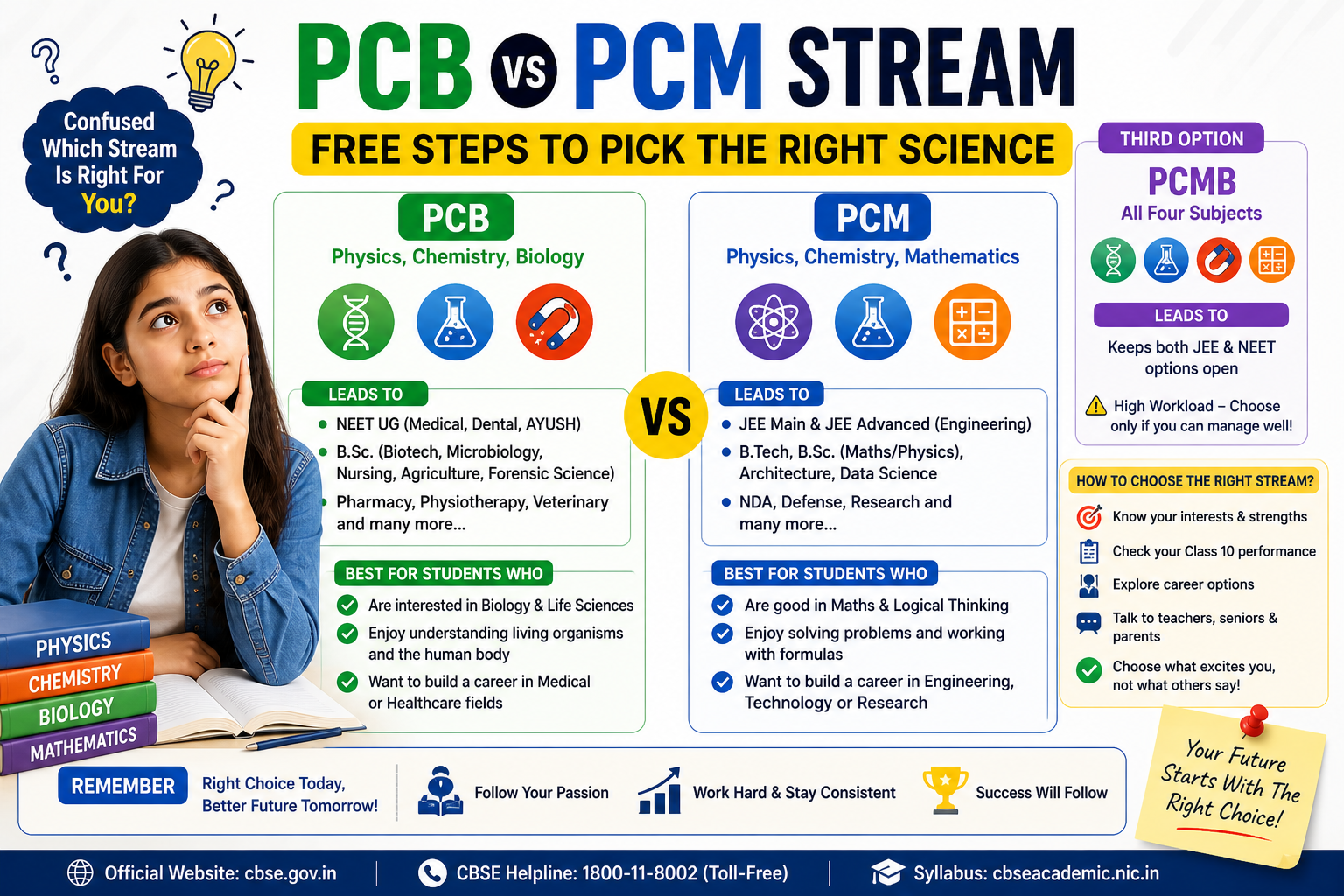
PCB vs PCM Stream: Free Steps to Pick the Right Science
| Field | Details |
|---|---|
| Applies To | CBSE Class 10 students choosing Class 11 Science |
| Two Main Paths | PCM (Physics, Chemistry, Maths) / PCB (Physics, Chemistry, Biology) |
| Third Option | PCMB — all four subjects combined |
| Key Exams | PCM → JEE Main / JEE Advanced; PCB → NEET UG |
| Helpline | CBSE: 1800-11-8002 (toll-free) |
| Official Syllabi | cbseacademic.nic.in |
The PCB vs PCM stream decision is one of the most searched — and most stressful — choices a Class 10 student faces, and this guide will walk you through it with real clarity. If you’re sitting with the admission form in front of you wondering whether to tick Biology or Maths, you are not alone. This is exactly the point where thousands of Indian students freeze every year, second-guessing themselves and listening to ten different opinions from parents, relatives, and that one aunty who insists engineering is the only option.
Both PCM and PCB are strong, legitimate paths with clear career futures. PCM opens doors to JEE and engineering; PCB opens doors to NEET and medicine — but that’s not the whole picture. There are significant career options after PCB that have nothing to do with NEET, and there are PCM graduates who never become engineers. The decision is about more than one exam.
Rahul from Nagpur was convinced he had to take PCM because his father is an engineer. Three months into Class 11, struggling through Maths and barely passing Physics, he realised his real interest had always been biology and life sciences. He switched to PCB at the end of Class 11 — and went on to complete a BSc in Biotechnology and now works in pharmaceutical research. Choosing correctly from the start would have saved him a year of unnecessary stress.
What’s in This Guide?
- What Exactly Are PCM and PCB? Subjects and Structure
- PCB vs PCM Stream: Which Career Paths Open Up?
- JEE vs NEET — What These Exams Demand From You
- What Your Class 10 Performance Tells You About Your Stream
- Should You Take PCMB? An Honest Reality Check
- How to Actually Decide: A Step-by-Step Framework
- PCB vs PCM Stream FAQ
- 6 Things to Do Before You Finalise Your Science Stream
- Explore More on Nextoper — Related Guides
- Official Resources That Can Help You
What Exactly Are PCM and PCB? Subjects and Structure
Both PCM and PCB belong to the Science stream under CBSE. The difference is in that fourth subject — Mathematics or Biology — which completely changes the direction of your Class 11–12 journey and your post-board options.
PCM: Physics, Chemistry, Mathematics
PCM students study Physics, Chemistry, and Mathematics as their three core science subjects, with English as the compulsory language subject. The fifth subject is typically an elective chosen from: Computer Science, Informatics Practices, Physical Education, or Economics.
The workload in PCM is considered intense, primarily because of Mathematics. CBSE Class 11 Maths introduces calculus, probability, coordinate geometry, and trigonometry at a level significantly harder than Class 10. Physics in Class 11 — especially mechanics and waves — is deeply tied to mathematical reasoning, which means weak Maths skills compound difficulties across two subjects at once.
PCB: Physics, Chemistry, Biology
PCB students study Physics, Chemistry, and Biology, with English as compulsory and an elective fifth subject — often Computer Science, Physical Education, or Biotechnology (where available). Biology in Class 11 covers cell biology, plant physiology, human physiology, and genetics — and it is a memory and understanding-heavy subject rather than a calculation-heavy one.
The common misconception is that PCB is “easier” than PCM. It is not easier — it is different. Biology at Class 11 level requires students to understand and retain complex diagrams, processes, and terminology in significant depth. NCERT Biology for Class 11 and 12 is notoriously detailed, and NEET questions test that detail rigorously.
The One Subject Both Streams Share
Both PCM and PCB include Physics and Chemistry. This matters because Class 11 Physics is where most students hit their first wall — it’s conceptual, mathematical, and requires consistent practice. If you’re strong in Chemistry and struggling with Physics, that concern applies equally to both streams. Physics is your shared challenge regardless of which path you pick.
PCB vs PCM Stream: Which Career Paths Open Up?
The most important table you’ll read before making this decision:
| Stream | Core Entrance Exam | Top Career Paths |
|---|---|---|
| PCM | JEE Main / JEE Advanced | Engineering (all branches), Architecture (with Maths), B.Sc. Maths/Physics/CS, NDA, Merchant Navy |
| PCB | NEET UG | MBBS, BDS, BAMS, BVSc (Veterinary), B.Pharm, B.Sc. Nursing, BSc Biotech, BSc Agriculture, Forensic Science |
| PCMB | JEE + NEET both | All of the above — but requires appearing for both entrance exams |
Careers After PCM Beyond Engineering
Not every PCM student becomes an engineer — nor should they. PCM also opens doors to:
- B.Sc. (Physics / Maths / Computer Science): Strong foundation for research, data science, and academia
- NDA (National Defence Academy): PCM is required for engineering wing entry
- Merchant Navy: Several programmes require PCM with Physics and Maths
- B.Sc. Statistics: Growing demand in analytics, insurance, and finance
- Actuarial Science: One of the highest-paying careers for Maths-strong students — rarely mentioned by career guides
Careers After PCB Beyond NEET
[GAP FILL] This is what every competitor missed. What if you take PCB and don’t crack NEET — or don’t even want to attempt it?
- B.Pharm (Bachelor of Pharmacy): Does not require NEET in most states. Good career in pharmaceutical companies, drug regulatory affairs, clinical research
- B.Sc. Biotechnology: Booming field — genetics, genomics, biopharma. Many private universities offer strong programmes
- B.Sc. Agriculture / B.Sc. Forestry: ICAR AIEEA entrance gives access to Central Agricultural University and state ag colleges
- B.Sc. Forensic Science: Growing demand in investigative agencies, labs, judiciary — requires PCB
- BVSc (Veterinary Science): NEET is required, but it’s a separate counselling process from MBBS — less competitive seats but strong career
- B.Sc. Nutrition and Dietetics: Healthcare adjacent, no entrance barrier in most states, excellent scope in corporate wellness and hospitals
- BSc Nursing / BSc Microbiology / BSc Zoology: All PCB-based, all with clear postgraduate and research paths
The point is simple: PCB does not mean “only NEET.” That framing is what causes unnecessary anxiety for students who are drawn to biology but unsure about a medical career.
JEE vs NEET — What These Exams Demand From You
Before picking a stream, understand what you’re working toward.
What JEE Requires
JEE Main is the gateway to NITs, IIITs, and GFTIs. JEE Advanced is for the IITs. Both require PCM — Mathematics is non-negotiable. JEE tests Physics, Chemistry, and Mathematics at a level significantly beyond the CBSE board syllabus. Preparation typically requires 2–3 years of consistent effort, coaching (though self-study is possible), and strong problem-solving aptitude in Maths.
JEE is not just hard — it’s structurally different from board exams. It rewards speed, accuracy, and deep conceptual understanding. Students who find Class 10 Maths genuinely engaging, who enjoy solving puzzles and logical problems, tend to do well. Students who found Maths a chore even at Class 10 level should be honest with themselves before committing to two years of it.
What NEET Requires
NEET UG is the single entrance for MBBS, BDS, and Ayush programmes across India. It tests Physics, Chemistry, and Biology — with Biology carrying the highest weightage (360 marks out of 720). NEET rewards students with strong retention, conceptual understanding, and the ability to handle a large volume of content across the full NCERT syllabus.
NEET preparation also requires 2–3 years of sustained effort. But the nature of the preparation is different from JEE. NEET is more about mastering breadth — knowing every corner of every NCERT chapter — while JEE is more about depth and problem-solving. Neither is “easier.” They suit different kinds of minds.
The Honest Bottom Line
If you genuinely love solving Maths problems and find equations exciting, PCM and JEE is where your energy should go. If you find the human body, living organisms, and biological processes genuinely fascinating, PCB and NEET preparation is the better fit. The worst outcome is choosing a stream for its prestige and then spending two years not connecting with what you’re studying.
What Your Class 10 Performance Tells You About Your Stream
Every competitor tells students to “follow their interest.” None of them tell students how to read their own Class 10 data as a signal. Here’s how.
Your Class 10 marks are not a verdict — but they are data. Use them honestly.
Signals That Point Toward PCM
- Maths score in Class 10 consistently above 80% — and you found it genuinely engaging, not just practised hard
- Science score strong, with clear pull toward Physics problems over Biology diagrams
- You enjoy logical puzzles, reasoning, and working through equations step by step
- When given a choice in Class 10 Science, you preferred the Physics and Chemistry chapters
Signals That Point Toward PCB
- Biology was your strongest or most enjoyed Class 10 Science unit — cells, ecosystems, human body fascinated you
- Maths score consistently below 65% — especially if trigonometry and algebra felt like a struggle even with effort
- You lean toward understanding how living systems work rather than how physical systems behave
- You can read and retain detailed information well — you have a memory for facts, processes, and mechanisms
What If Both Signals Are Mixed?
Many students score equally across all Class 10 Science units and like both Biology and Maths. In that case, the tiebreaker questions are:
- Which future career direction genuinely excites you more — engineering/tech/data or healthcare/life sciences/research?
- Which type of problem would you rather spend the next two years solving — mathematical or biological?
If you still can’t decide, PCMB is technically an option — but read the next section before going that route.
Should You Take PCMB? An Honest Reality Check
[GAP FILL] Competitors mention PCMB as a valid option but don’t describe what it actually means to study it. Here’s the truth.
PCMB means taking Physics, Chemistry, Mathematics, and Biology as your four science subjects in Class 11 and 12. It keeps both JEE and NEET options alive through Class 12 — which sounds perfect. But the reality is more complicated.
What PCMB Actually Looks Like
CBSE Class 11 Maths and Biology are both significant subjects in their own right. Combined with Physics and Chemistry, you are effectively carrying four heavy subjects with no elective to lighten the load. Your study time gets split. You can’t go as deep into either Maths or Biology as your PCM-only or PCB-only peers can. And both JEE and NEET require depth, not just coverage.
Most coaching institutes actually advise against PCMB unless the student is academically exceptional. Students in the 95th percentile or above — who are genuinely fast learners and have high retention — can manage it. For the average student, PCMB often leads to being underprepared for both exams rather than ready for either.
When PCMB Makes Sense
- You genuinely scored 90%+ across all Class 10 subjects, including both Maths and Science
- Your school or coaching institute has a structured PCMB programme — not just combining the two streams informally
- You plan to decide on JEE or NEET by the end of Class 11 and will then drop one subject for deeper focus
When PCMB Doesn’t Make Sense
- You’re choosing it to “keep options open” because you’re avoiding the decision — this is the most common reason and the least helpful one
- You already find either Maths or Biology challenging at Class 10 level
- Your school doesn’t have a dedicated PCMB batch with experienced faculty for both
📷 [Image: A student writing in a notebook with Physics, Chemistry, Maths, and Biology textbooks all open on the desk — looking overwhelmed] [Alt text: PCB vs PCM stream — student considering PCMB workload for Class 11 CBSE]
How to Actually Decide: A Step-by-Step Framework
Here is a concrete decision process — not just advice, but a sequence you can follow today.
Step 1: Write Down Your Three Best Class 10 Subjects (By Enjoyment, Not Marks)
Not what you scored highest in — what you most enjoyed studying. There is often a gap between the two, and enjoyment is a stronger predictor of two-year commitment than marks.
Step 2: Answer These Two Questions Honestly
Question A: “In 5 years, would I rather be solving equations and building systems — or understanding living organisms and working in health or life sciences?”
Question B: “Am I drawn to Maths because I genuinely find it satisfying — or because people tell me Maths students have better careers?”
Your answers to these two questions tell you more about your stream than any aptitude test.
Step 3: Look at Your Class 10 Maths Score
- If your Maths score is below 60% and you found it difficult even after studying: strongly reconsider PCM
- If your Maths score is 75%+ and problem-solving felt natural: PCM is a realistic choice
- Between 60–75%: look at which Maths topics you struggled with — if algebra and geometry felt fine but higher-order topics were hard, Class 11 Maths will amplify that gap
Step 4: Research One Real Career in Each Stream
Before finalising, find one actual working professional in a PCM career (engineer, data scientist, architect) and one in a PCB career (doctor, pharmacist, biotechnologist). Ask them: What does your day actually look like? Would you choose this path again? This 20-minute exercise cuts through more confusion than any article can.
Step 5: Make the Decision and Commit
Once you’ve followed Steps 1–4, make the call. Indecision costs you preparation time — whichever stream you choose, the earlier you commit, the more time you have to build momentum in that direction.
PCB vs PCM Stream FAQ
Q: I like both Biology and Maths equally — what should I do? A: This is genuinely common, and there’s no trick answer. The real tiebreaker is your career direction, not the subjects themselves. If healthcare, life sciences, or biological research excites you more than engineering or tech, go PCB — and keep Maths as your 5th elective. If engineering or data science pulls you more, go PCM — Biology isn’t going anywhere, and you can always pursue biology-adjacent interests as a hobby or minor.
Q: Can I switch from PCM to PCB after Class 11? A: Technically, yes — but practically, it’s very difficult. CBSE doesn’t bar you from appearing in Class 12 board exams in a changed subject set, but you’d need to cover the entire Class 11 Biology syllabus on your own, and most schools won’t accommodate a stream change after the first term. If you’re having serious doubts in the first few weeks of Class 11, act immediately — don’t wait for the semester to end.
Q: Is PCB really only for students who want to be doctors? A: Absolutely not. PCB students pursue Pharmacy, Biotechnology, Agriculture, Forensic Science, Veterinary Science, Nutrition, Environmental Science, Nursing, and many other fields — most of which don’t require NEET. The “PCB = doctor only” belief is outdated and causes students with biology aptitude to avoid the stream unnecessarily.
Q: Which stream has better job and salary prospects — PCM or PCB? A: Both streams have strong career paths with good earning potential. PCM-to-engineering is a well-established high-salary path, particularly in software and data. PCB-to-medicine takes longer (MBBS is 5.5 years) but doctor salaries, especially specialists, are high. Pharmacists, biotech researchers, and forensic scientists also earn competitive salaries. Comparing “which pays more” isn’t the right frame — the right stream is the one you’ll actually excel in, because excellence in any field pays better than mediocrity in a prestigious one.
Q: My parents want me to take PCM. I want PCB. What do I do? A: This is one of the most common situations in India, and it deserves a direct answer. Your parents’ concern usually comes from a place of wanting financial security for you — and that’s valid. The conversation to have with them is not “I want Biology” but rather “Here are the specific careers I’m considering after PCB, and here is what they pay.” Showing them the Pharmacy, Biotech, and NEET medicine pathways with real salary data is more persuasive than an argument about interest. If the conversation is still difficult, ask your school counsellor to facilitate a joint discussion.
6 Things to Do Before You Finalise Your Science Stream
- Download and skim one chapter each from NCERT Class 11 Maths and Class 11 Biology — spend 20 minutes with each. The one that feels more interesting, not easier, is your signal.
- Check your Class 10 subject-wise marks, not just the aggregate — look specifically at your performance in Algebra, Coordinate Geometry (signals for PCM) vs. Life Processes and Genetics (signals for PCB).
- Ask your Class 10 Maths teacher for an honest assessment of whether they think you have the aptitude for Class 11 Maths — a good teacher will tell you the truth if you ask directly.
- Research two specific colleges you’d like to attend after Class 12 and check which stream their programmes require — real data about your actual future is more useful than abstract advice.
- Talk to a Class 12 or recently passed student in each stream — not about whether it’s “worth it” but about what their daily study life actually looks like. Find someone who’s honest, not just someone who will validate your current thinking.
- Write your decision down with three reasons — if you can clearly articulate three honest reasons for your choice, you’ve thought it through enough. If you’re still writing vague justifications, go back to Steps 1–4 in the framework above.
Explore More on Nextoper — Related Guides
- CBSE All 10th Class Subject Notes 2026-27
- CBSE All 12th Class Subject Notes 2026-27
- Class 11 Subject Combination: Free Complete Guide for Students
Official Resources That Can Help You
1. CBSE Official Website — cbse.gov.in The CBSE portal publishes official subject codes, combination rules, and school-wise affiliation details — including which subjects each school is certified to offer. If you’re considering an unconventional combination like PCMB or PCM with Biology as a 5th elective, verify through this portal whether your school is approved to offer it before making assumptions.
2. CBSE Academic Website — cbseacademic.nic.in This is where you can download the official Class 11 syllabus for every subject — Physics, Chemistry, Maths, and Biology — completely free. Before committing to a stream, download the Biology and Maths syllabi and read the chapter list side by side. Seeing what you’ll actually study across two years is one of the most grounding exercises you can do before the decision.
3. NCERT — ncert.nic.in NCERT hosts free digital versions of all Class 11 textbooks. Reading even one chapter of Class 11 Maths (try the Sets or Trigonometry chapter) and one chapter of Class 11 Biology (try Chapter 8 on Cell Structure) will give you a genuine sense of what each stream’s daily reading and problem-solving actually feels like — far more useful than any comparison article.
Conclusion
The PCB vs PCM decision is hard precisely because both paths are real and both have genuine futures. There’s no wrong choice if it’s made honestly — the only wrong choice is the one made to impress someone else or avoid a difficult conversation. Students across India have gone on to extraordinary careers from both streams: engineers, doctors, researchers, pharmacists, scientists, and entrepreneurs. The one thing they had in common was that they chose based on where their genuine curiosity lay. Your next step is simple: go back to Step 1 of the decision framework in this guide, answer it honestly, and commit. Whenever you need the subject notes, syllabus breakdowns, or exam prep resources to back up that choice, Nextoper has everything you need — completely free.



Pingback: Best Courses After 12th: Complete Stream-Wise Guide for 2026 | Nextoper - Nextoper