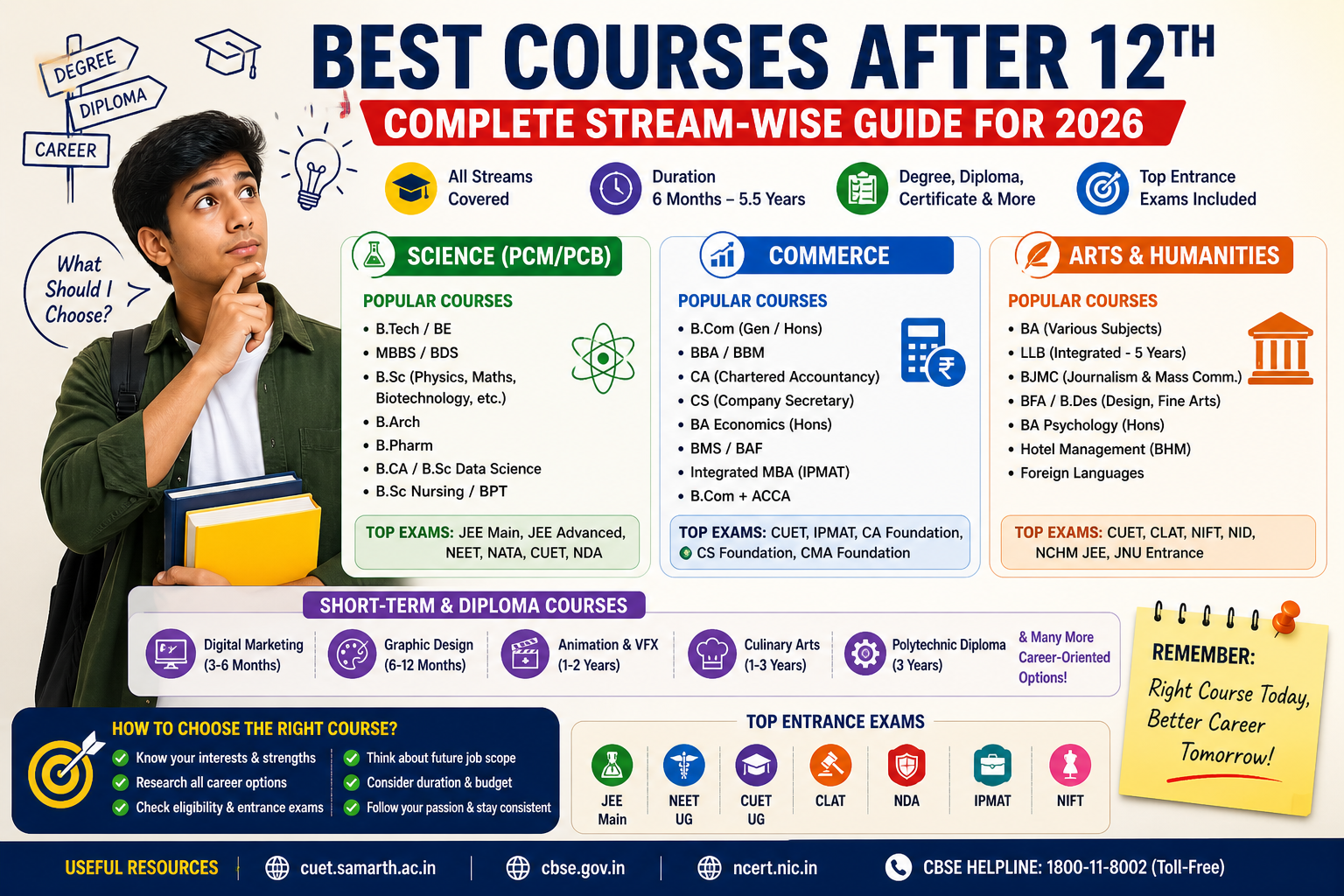
Best Courses After 12th: Complete Stream-Wise Guide for 2026
| Field | Details |
|---|---|
| Applies To | Class 12 students (all streams) |
| Streams Covered | Science (PCM/PCB) / Commerce / Arts & Humanities |
| Course Types | Degree / Diploma / Certificate / Vocational |
| Duration Range | 6 months – 5.5 years |
| Top Entrance Exams | JEE Main, NEET, CUET, CLAT, NDA, IPMAT, NIFT |
| Key Resources | cuet.samarth.ac.in / cbse.gov.in / ncert.nic.in |
The moment your Class 12 board results arrive, a familiar wave hits — relief, excitement, and then immediately, a quiet panic. “What now?” Every relative has an opinion, every friend is applying somewhere different, and Google returns hundreds of lists without telling you which one is actually right for you. If that confusion sounds familiar, this article gives you a clear, stream-wise breakdown of the best courses after 12th — along with how to actually choose one that fits your life.
Across Science, Commerce, and Arts, there are dozens of recognised degree programmes, diploma tracks, and short-term courses worth exploring — from the well-known (B.Tech, MBBS, B.Com) to options many students never hear about (B.Des, Integrated Law, B.Sc Agriculture). Each comes with different entrance exam requirements, timelines, and career paths. The key is matching them to what you’re genuinely interested in, not just what sounds impressive at a family gathering.
Every year, over 1.5 crore students appear for CBSE Class 12 exams in India. Most of them face exactly this moment of uncertainty. You are not behind, you are not alone, and there is no single “correct” course. There are only options — and this guide helps you navigate them honestly.
What’s in This Guide?
- Best Courses After 12th Science (PCM and PCB)
- Best Courses After 12th Commerce
- Best Courses After 12th Arts and Humanities
- Short-Term and Diploma Courses After 12th
- How to Choose the Right Course After 12th
- Entrance Exams You Should Prepare For
- Frequently Asked Questions
- 6 Things to Do Right Now If You’re Confused
- Explore More on Nextoper
- Official Resources
What Are the Best Courses After 12th Science (PCM and PCB)?
Science is the broadest stream at Class 12 — and it splits into two distinct paths after board exams: PCM (Physics, Chemistry, Maths) and PCB (Physics, Chemistry, Biology). The options available to you differ significantly depending on which combination you studied, though some programmes accept both. Understanding this split is the first step to building a realistic shortlist.
PCM Students: Engineering, Technology, and Beyond
If you studied Maths, your biggest entry point is engineering — but it’s far from your only option. B.Tech (4 years) remains the most popular route and requires clearing JEE Main (for NITs, IIITs, CFTIs) or JEE Advanced (for IITs). However, engineering isn’t the only destination for PCM students.
| Course | Duration | Key Entrance Exam |
|---|---|---|
| B.Tech / BE | 4 years | JEE Main / State CETs |
| B.Sc (Physics / Maths / Statistics) | 3 years | CUET / University-specific |
| BCA (Computer Applications) | 3 years | CUET / Direct |
| B.Arch | 5 years | JEE Paper 2 / NATA |
| B.Sc Data Science | 3 years | CUET / Direct |
| NDA (National Defence Academy) | 3 years | NDA Written + SSB |
| Integrated M.Sc | 5 years | IIT JAM / CUET |
| B.Sc Agriculture | 4 years | State Agricultural CET |
Consider Rahul’s case: he scored 78% in PCM but didn’t crack JEE Main in his first attempt. Rather than repeating a year, he enrolled in a B.Sc Data Science programme at a state university — a field with some of the fastest-growing salaries in India right now. Three years later, he’s working as a data analyst at a Bangalore-based startup. The “backup” turned out to be his best move.
For students interested in defence, NDA is a highly underrated option — one of the few government jobs where you can join at age 17–18, directly after 12th, with PCM as eligibility.
PCB Students: Medicine, Allied Health, and Life Sciences
PCB opens the door to healthcare and biological sciences — fields with some of the most stable and respected careers in India. MBBS (5.5 years) is the aspirational goal for many, but it requires qualifying NEET with a strong score. Competition is intense, with over 20 lakh students appearing for roughly 1 lakh MBBS seats nationally.
| Course | Duration | Key Entrance Exam |
|---|---|---|
| MBBS | 5.5 years | NEET (mandatory) |
| BDS (Dentistry) | 5 years | NEET |
| B.Pharm (Pharmacy) | 4 years | NEET / Direct |
| B.Sc Nursing | 4 years | State Nursing CET / AIIMS |
| BPT (Physiotherapy) | 4.5 years | Direct / State CET |
| BAMS (Ayurveda) | 5.5 years | NEET |
| B.Sc Biotechnology | 3 years | CUET / Direct |
| B.Sc Microbiology | 3 years | CUET / Direct |
Many PCB students fixate on MBBS and feel lost if NEET doesn’t go well. The reality is that B.Sc Nursing, BPT, and B.Pharm all lead to stable, well-paying healthcare careers — and in some specialisations (like ICU nursing or clinical pharmacy), are actually in higher demand than general MBBS practitioners in certain hospital settings.
Which Courses After 12th Commerce Should You Consider?
Commerce students have one of the most flexible post-12th landscapes in India. The stereotype that commerce only leads to “accounts and banking” couldn’t be further from the truth. From integrated MBA programmes to law, from data analytics to company secretaryship, the options have expanded dramatically — especially with CUET now providing access to central universities without needing a separate entrance for each.
Degree Programmes for Commerce Students
B.Com (3 years) remains the most straightforward path — available as a general degree or with Honours in Accounting, Finance, or Economics. For students who want a business-focused education, BBA (3 years) is often a better fit, with stronger placement cells at reputed institutions.
| Course | Duration | Entrance Exam |
|---|---|---|
| B.Com (General / Honours) | 3 years | CUET / Direct |
| BBA | 3 years | IPMAT / CUET / Direct |
| CA Foundation | 3–5 years | ICAI Foundation Exam |
| BA Economics (Hons) | 3 years | CUET |
| Integrated MBA (BBA + MBA) | 5 years | IPMAT (IIM Indore, IIM Rohtak) |
| Company Secretary (CS) | 3–4 years | ICSI Foundation |
| BMS (Business Management Studies) | 3 years | Mumbai University CET |
| B.Com + ACCA | 3 years | Direct (select colleges) |
The CA (Chartered Accountancy) route deserves special mention. It’s one of the few professional qualifications in India where your Class 12 stream matters less than your dedication — Arts and Science students can also pursue CA Foundation. The pass rate is low, but so is the competition at senior levels, making it one of the highest-returning professional investments available.
IPMAT — the Integrated Programme in Management Aptitude Test — is offered by IIM Indore, IIM Rohtak, and a few others. It lets you enter a 5-year integrated BBA+MBA programme directly after 12th, potentially completing your MBA by age 22–23. If you have strong aptitude scores and want to avoid the post-graduation MBA rat race, this is worth serious consideration.
For students who want economics-focused careers in policy, research, or banking, BA/B.Sc Economics Honours from Delhi University, Presidency University, or Loyola College is genuinely prestigious — and underrated compared to B.Com.
What Are the Top Courses After 12th Arts and Humanities?
Let’s address the elephant in the room first: Arts is not the “safe fallback” stream. It is not for students who “couldn’t make it” to Science. Arts students consistently enter some of the most dynamic, high-demand fields in India — law, design, journalism, psychology, and civil services. The myth that Arts has fewer options is outdated and simply wrong.
Degree Options for Arts and Humanities Students
BA (Bachelor of Arts) is the most common entry point and can be pursued in political science, history, economics, psychology, sociology, English, geography, and more. The best BA programmes in the country — DU’s SRCC, St. Stephen’s, Miranda House — are genuinely competitive and require high CUET scores.
| Course | Duration | Entrance Exam |
|---|---|---|
| BA (various subjects) | 3 years | CUET / Direct |
| Integrated LLB (BA-LLB / BBA-LLB) | 5 years | CLAT / AILET |
| BJMC (Journalism & Mass Communication) | 3 years | CUET / University CET |
| BFA (Fine Arts) | 4 years | Portfolio + CUET |
| B.Des (Design) | 4 years | NIFT / NID / UCEED |
| BA Psychology (Hons) | 3 years | CUET |
| Hotel Management (BHM) | 3–4 years | NCHM JEE |
| BA Foreign Languages | 3 years | JNU Entrance / CUET |
Integrated LLB (5-year programmes via CLAT) is one of the most prestigious routes from Arts. The National Law Universities — NLSIU Bangalore, NALSAR Hyderabad, NUJS Kolkata — are as competitive as the IITs for their stream, and law graduates have one of the widest range of career options: corporate law, civil services, judicial services, legal journalism, human rights work.
NIFT (National Institute of Fashion Technology) and NID (National Institute of Design) offer B.Des programmes that are fiercely competitive — but the design and fashion industries in India are growing rapidly, with starting salaries at top firms often exceeding those of mid-level engineering graduates.
For students inclined toward media, BJMC programmes at institutions like Symbiosis, IIMC (Post-graduation), or reputed state universities can lead to careers in digital journalism, content creation, public relations, and broadcasting — all of which are in heavy demand.
Short-Term and Diploma Courses After 12th — Are They Worth It?
This is the section that almost every competitor article skips — and that’s a problem, because a significant number of students after 12th are not in a position to commit to a 3 or 4-year degree programme. Financial constraints, family situations, wanting to enter the workforce quickly, or simply not being ready for a long academic commitment are all valid reasons to explore shorter routes.
The short answer: yes, diploma and certificate courses absolutely have career value — if chosen wisely.
Polytechnic and ITI Diplomas
Polytechnic diplomas (3 years) in engineering branches like Civil, Electrical, Mechanical, or Computer Science are offered by state polytechnic institutes and are approved by AICTE. After completing a polytechnic diploma, students can enter B.Tech directly in the second year through the Lateral Entry scheme — effectively shortcutting the typical 4-year B.Tech to 3 years, while also having a job-ready qualification after the diploma itself.
ITI (Industrial Training Institute) courses (6 months to 2 years) are vocational certifications in trades like electrician, fitter, plumber, welder, and IT technician. After 12th with Science, certain ITI trades offer significantly higher wages than unskilled work — especially in manufacturing, construction, and infrastructure sectors.
Creative and Digital Courses
These are some of the fastest-growing fields, and many excellent short-term programmes exist outside the traditional degree framework:
- Diploma in Animation and Multimedia (1–2 years) — institutions like Arena Animation, MAAC offer industry-recognised programmes; gaming and OTT platforms have created massive demand
- Digital Marketing Certificate (3–6 months) — Google, HubSpot, and Meta all offer globally recognised free certifications; several private institutes offer more structured paid programmes
- Diploma in Graphic Design (1 year) — increasingly viable with the rise of freelancing platforms; strong portfolio matters more than the degree
- Diploma in Interior Design (1–2 years) — real estate boom has created strong demand; can also be pursued alongside a degree
- Culinary Arts / Diploma in Hospitality (1–3 years) — India’s food service industry is growing at 9%+ annually; NCHM-affiliated institutes offer recognised programmes
Are These Enough for a Career?
Priya, a student from a small town in UP who couldn’t afford a full degree after 12th, completed a 1-year digital marketing diploma and built a freelance client base while completing an open university BA. By the time she graduated at 21, she had three years of real work experience — more than most fresh B.Com graduates. The point isn’t that degrees don’t matter; it’s that shorter courses, used strategically, are a legitimate and underrated path.
How Do You Choose the Right Course After 12th? A Step-by-Step Approach
This is the question every student is really asking, and yet no competitor article comes close to answering it. Listing courses is easy. Helping you choose is harder — and more valuable.
Step 1: Map Your Interests Honestly
Write down three things you genuinely enjoy doing — not what you’re good at because you studied for it, but what you’d do even without being asked. Notice whether those things involve people, systems, creativity, analysis, or physical skill. Most courses align naturally with one of these categories.
Step 2: Check Entrance Exam Requirements
Once you have a shortlist of 3–5 courses that interest you, check what entrance exams they require. Some require immediate preparation (JEE, NEET have annual cycles); others like CUET and CLAT have applications opening in January–February for June exams. Missing a deadline eliminates options for a full year. Check NTA’s official calendar at nta.ac.in.
Step 3: Analyse the Job Market Honestly
Look at what professionals in that field actually earn 5 years in — not the starting salary, and not the maximum possible salary. Government job portals, LinkedIn salary data, and AmbitionBox all provide realistic ranges. Some fields (like BFA or BJMC) have very high peaks but require building a strong portfolio or network. Others (like B.Pharm or B.Sc Nursing) have steady, reliable employment with less variability.
Step 4: Factor in Budget and Duration
A 5.5-year MBBS costs between ₹10 lakh (government college) and ₹80 lakh or more (private). A 3-year B.Sc can cost ₹80,000 to ₹3 lakh total. These are very different financial commitments with different risk profiles. Be realistic about your family’s capacity — and investigate scholarship options through the National Scholarship Portal (scholarships.gov.in).
Step 5: Make a Decision and Commit
Analysis paralysis is real. At some point — ideally before May ends — pick your top two or three options, apply to multiple programmes, and move forward. You can always transfer streams after the first year in many universities (check specific college policies). The worst decision is no decision, because application windows close.
Which Entrance Exams Should You Prepare for After 12th?
The entrance exam landscape changed significantly after CUET was introduced in 2022. Here’s a clear map of which exams lead where:
| Entrance Exam | Full Name | For Which Courses | Stream |
|---|---|---|---|
| JEE Main | Joint Entrance Exam | B.Tech at NITs, IIITs, CFTIs | PCM |
| JEE Advanced | — | B.Tech at IITs | PCM (top JEE Main scorers) |
| NEET UG | National Eligibility cum Entrance Test | MBBS, BDS, BAMS, B.Pharm, B.Sc Nursing | PCB |
| CUET UG | Common University Entrance Test | UG programmes at all central universities | All streams |
| CLAT | Common Law Admission Test | Integrated LLB at National Law Universities | All streams |
| NDA | National Defence Academy | Army/Navy/Air Force after 12th | PCM |
| IPMAT | Integrated Programme in Management Aptitude Test | 5-year BBA+MBA at IIMs | All (Maths required) |
| NIFT Entrance | — | B.Des at NIFT campuses | All streams |
| NCHM JEE | National Council for Hotel Management | BHM at central hotel management institutes | All streams |
| AILET | All India Law Entrance Test | BA LLB at NLU Delhi | All streams |
Key Dates to Watch
- JEE Main: January session (November applications) + April session (February applications) — check jeemain.nta.nic.in
- NEET UG: Usually April exam, applications in February — check neet.nta.nic.in
- CUET UG: February–March applications, May exam — check cuet.samarth.ac.in
- CLAT: December–January applications, May exam — check consortiumofnlus.ac.in
- NDA: Twice yearly (April + September exams) — check upsc.gov.in
One common mistake is assuming that CUET is mandatory for all colleges. It’s required for central universities (DU, JNU, BHU, etc.) but many private universities still run their own entrance tests or have merit-based admissions. Always check the specific college’s admissions page.
Courses After 12th — Frequently Asked Questions
Q: I got 60% in my Class 12 boards. Are the best courses still available to me? A: Yes — most degree programmes (B.Com, BA, BCA, B.Sc, BBA) have minimum eligibility of 45–50%, with some prestigious colleges requiring 60–75% for merit-based seats. Top government colleges like DU or JNU use CUET scores — not just Class 12 marks — so a strong CUET performance can open doors even if your boards weren’t exceptional. Focus on what you can still apply for rather than what’s out of reach.
Q: Can I switch streams after 12th? For example, I studied Commerce but want to do something in tech. A: Absolutely. Many professional courses after 12th are open to all streams — BCA, Animation, Digital Marketing diplomas, and even some B.Tech colleges (especially private ones) accept Commerce students with Maths. You can also do a Computer Science diploma or certificate while pursuing any degree. Stream switching is more common than you think.
Q: Is CUET compulsory if I want to get into a good college? A: CUET is mandatory for admissions to all 45+ central universities including Delhi University, JNU, BHU, and Jamia. However, it’s not required for state universities, most private colleges, IITs (which use JEE), or medical colleges (which use NEET). If your target colleges include any central university, register for CUET at cuet.samarth.ac.in — applications usually open in January.
Q: Which course has the best starting salary after 12th? A: Among 3-year programmes, B.Tech (if you land a good engineering college) averages ₹4–8 LPA starting, and BCA from reputed institutes can get ₹3–6 LPA in tech roles. Among 5-year courses, Integrated MBA (via IPMAT at IIMs) and MBBS (post-internship) offer strong long-term returns. Short-term high earners: CA Final qualifiers average ₹7–10 LPA at entry. But salary varies enormously by college, city, and specialisation — focus on the field you’ll actually work hard in.
Q: What if I don’t want a 3 or 4-year degree right now? A: Diploma and certificate courses in Animation, Digital Marketing, Graphic Design, Culinary Arts, and Polytechnic Engineering are all legitimate alternatives. ITI trades and hotel management diplomas also offer direct employment pathways. You can pursue a degree simultaneously through open universities (IGNOU, state open universities) which have flexible scheduling. Short-term courses after 12th have real career value — the key is pairing them with practical experience and a good portfolio.
6 Things to Do Right Now If You’re Confused About Courses After 12th
- Register for CUET immediately if you haven’t already — applications for CUET UG open in January/February each year at cuet.samarth.ac.in; missing this window closes central university admissions for a full year.
- Make a shortlist of exactly three courses that genuinely interest you — not what sounds impressive, but what you’d be comfortable studying every day; write them down and put them somewhere visible.
- Check the official NTA website (nta.ac.in) for entrance exam calendars — JEE Main, NEET, and CUET all have fixed application deadlines, and missing them has no workaround.
- Speak to one working professional in each field you’re considering — LinkedIn, alumni networks, or even a simple Google search for “day in the life of [profession] India” can give you more honest career insight than any brochure.
- Apply to at least five colleges per course — including at least two you’re confident about and at least one state government college or central university for cost reasons; relying on one or two applications is unnecessary risk.
- Create a free IGNOU or NIOS account if you’re considering non-traditional paths — both offer recognised open university degrees at low cost, which can be combined with vocational training or work experience for a flexible but legitimate qualification.
Explore More on Nextoper — Related Guides
Choosing a course is just the beginning — preparing well for the right exam is what gets you in. Here are more resources on Nextoper to help you move forward:
- PCB vs PCM Stream: Easy Steps to Choose the Right One
- Class 11 Subject Combination: Free Complete Guide for Students
Official Resources That Can Help You Choose
CBSE Official Website — cbse.gov.in Provides the most current information on CBSE-affiliated school policies, Class 12 marking schemes, and official notifications regarding board exams. Students who want clarity on how their Class 12 results are calculated or how to apply for re-evaluation should use this as the primary source.
NCERT Portal — ncert.nic.in Hosts free NCERT textbooks, exemplar problems, and model question papers for all Class 12 subjects. Students preparing for CUET or any entrance exam that tests 12th-level concepts should use NCERT materials as their baseline — most competitive exams are explicitly aligned to NCERT syllabi.
CBSE Academic Resources — cbseacademic.nic.in Contains official curriculum documents, sample question papers, marking schemes, and syllabus PDFs for each subject and class. Particularly useful for students who want to understand exactly what is tested in board exams, and for teachers and parents seeking clarification on current CBSE standards.
The Pressure Is Real — But the Path Forward Is Clearer Than It Feels
Choosing a course after 12th is genuinely hard. The weight of deciding something that feels permanent, with incomplete information, under family and peer pressure — that’s not something to dismiss. It’s real, and most students feel exactly the same way in May and June every year.
Here’s something worth holding onto: a student named Divya from Patna chose hotel management after 12th when everyone around her expected her to pursue B.Com. Five years later, she manages F&B operations at a five-star property in Hyderabad, earns well, travels frequently for work, and — more importantly — actually enjoys her career. She took an unconventional route. It worked, because she chose it for the right reasons.
Your next step is simple: pick three courses from this guide that genuinely appeal to you, check their eligibility requirements, and make a note of the nearest application deadline. Then visit nextoper.in for free resources to help you prepare. You don’t need to have everything figured out — you just need to take the next step.
The way you highlighted that there is no single ‘correct’ course but rather options depending on genuine interest really cuts through the noise of family pressure and generic lists. I particularly appreciate the inclusion of niche options like B.Des and Integrated Law, as these are often overlooked in favor of the standard Science or Commerce tracks. This guide feels like a much-needed reality check for students drowning in the ‘what now?’ panic after board results.
I really appreciate how this guide moves beyond just listing popular degrees to emphasize picking a path based on genuine interest rather than family pressure. The breakdown of specific entrance exams like CUET and IPMAT alongside the lesser-known options such as B.Des and Integrated Law is exactly the clarity students need after their board results. This structured, stream-wise approach truly helps turn that post-exam panic into a manageable decision-making process.
If you want to customize bereavement artwork, an online personalized virtual sympathy bouquet design simplifies picking calm color schemes and tailored text for digital condolence cards.
Designing detailed mosaic patterns using fuse beads requires careful color distribution, making an iron bead mosaic pattern designer ideal for testing different palette arrangements beforehand.
For fans reading imported digital volumes, using a free platform for translating raw manga accelerates text recognition work. Automated tools remove the friction of looking up unknown kanji stroke by stroke during reading.
Maximizing video output quality across various visual genres requires targeted techniques, which are highlighted in this guide on best ways to use minimax h3.
A versatile wan 3 AI text prompt video maker allows digital storytellers to experiment with cinematic styles, camera angles, and atmospheric lighting choices using only text input.