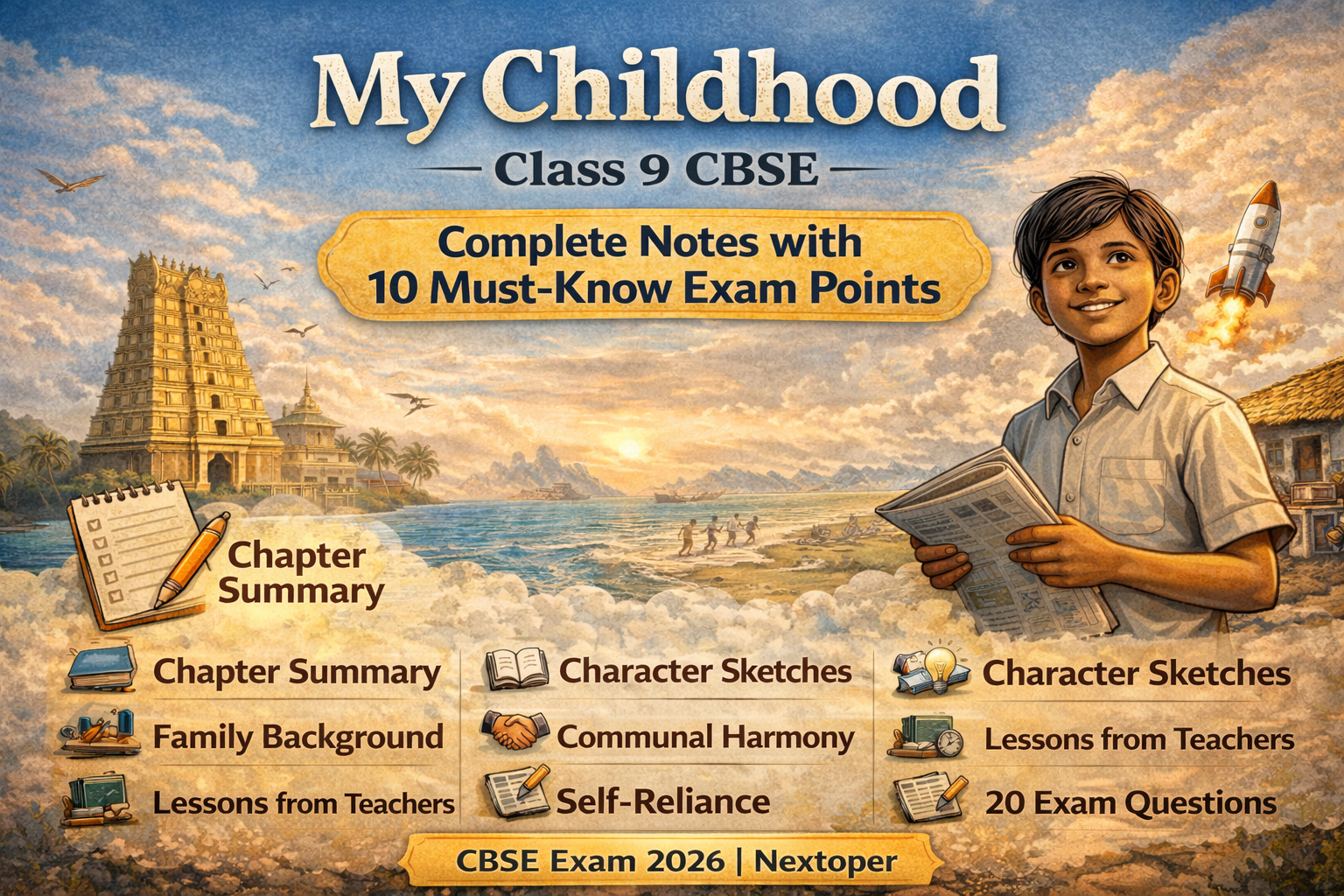
My Childhood Class 9 CBSE – Complete Notes with 10 Must-Know Exam Points
| Field | Detail |
|---|---|
| Chapter | 6 – My Childhood |
| Subject | English (Beehive) |
| Class | 9 |
| Board | CBSE |
| Exam Weightage | Check latest CBSE syllabus |
Table of Contents
- Introduction
- About the Author – Dr. A.P.J. Abdul Kalam
- Family Background and Early Life – My Childhood Class 9 CBSE
- Communal Harmony and School Days
- Lessons from Teachers – My Childhood Class 9 CBSE
- Self-Reliance and the Newspaper Job
- Character Sketches
- Themes and Moral of the Chapter – My Childhood Class 9 CBSE
- Literary Devices and Important Quotes
- Word Meanings
- Important Questions – My Childhood Class 9 CBSE
- Quick Revision – Key Points to Remember
- Related Notes on Nextoper – Internal Links
- Useful External Resources – Outbound Links
Introduction
My Childhood Class 9 CBSE is one of the most powerful and personally inspiring chapters in the entire Beehive textbook. It is an autobiographical excerpt from Wings of Fire, written by Dr. A.P.J. Abdul Kalam — scientist, visionary, and the 11th President of India. The chapter takes you back to his boyhood years in Rameswaram, Tamil Nadu, and shows how the values he absorbed at home, in school, and through his community quietly shaped one of India’s greatest minds.
From these notes, you will get a thorough section-wise summary, full character sketches of every key figure, theme analysis, literary devices, word meanings, and model answers to the most important board exam questions. Everything is laid out so you can revise the entire chapter efficiently without skipping anything that examiners tend to ask.
Here is something worth keeping in mind: Kalam’s story is not just a chapter to be read for marks — it is proof that where you start has no power over where you can go, as long as you carry the right values. That is also exactly the kind of insight examiners love to see in long-answer responses.
About the Author – Dr. A.P.J. Abdul Kalam
Dr. Avul Pakir Jainulabdeen Abdul Kalam was born on 15 October 1931 in Rameswaram, a small town in Tamil Nadu. He came from a modest family but went on to become one of India’s most decorated scientists and its most beloved President, serving from 2002 to 2007.
He played a key role in India’s space and defence programmes, working with both ISRO (Indian Space Research Organisation) and DRDO (Defence Research and Development Organisation). His contributions to India’s missile development earned him the popular title “Missile Man of India”.
Kalam wrote several books that have inspired generations of young Indians, with Wings of Fire being the most widely read. My Childhood is drawn directly from that memoir and covers his formative years — the people, places, and experiences that built his character long before he became famous.
[Image: Portrait of Dr. A.P.J. Abdul Kalam with Rameswaram temple in the background | Alt text: My Childhood Class 9 CBSE – author Dr. A.P.J. Abdul Kalam from Rameswaram]
Family Background and Early Life – My Childhood Class 9 CBSE
Kalam was raised in a Tamil Muslim family that was modest in material terms but extraordinarily rich in values. Understanding his family is essential for this chapter, because every major lesson he carries into adulthood traces back to his parents.
His Father – Jainulabdeen
Jainulabdeen, Kalam’s father, was not formally educated and did not accumulate wealth. Yet the chapter describes him as a man of deep wisdom, spiritual discipline, and unwavering integrity. He owned a boat and also served as an imam at the local mosque.
He believed in simple living and high thinking — a phrase that perfectly captures how the family operated. He avoided all unnecessary luxuries and taught his children that real contentment comes from within, not from possessions. Kalam credits his father with instilling in him the values of honesty and faith that stayed with him throughout his life.
His Mother – Ashiamma
Ashiamma was warm, deeply generous, and quietly strong. She regularly fed poor and hungry people who came to their door — sometimes even when the family’s own resources were limited. Her compassion was not performed for recognition; it was simply how she lived.
Kalam absorbed his mother’s kindness naturally, the way children absorb everything they see at home. Her example taught him that service to others is not a duty but a way of being.
The Home Environment
The family’s ancestral home in Rameswaram was simple but full of warmth. Daily prayers, community interaction, and a spirit of contentment created an atmosphere where a curious child could grow steadily. This environment is the root of everything Kalam later became.
Communal Harmony and School Days
Rameswaram in Kalam’s childhood was a town where Hindu and Muslim families lived side by side with genuine mutual respect — not just tolerance, but actual friendship and trust.
Kalam’s father, Jainulabdeen, regularly held conversations on spiritual matters with Pakshi Lakshmana Sastry, the head priest of the local Shiva temple. The two men came from entirely different religious traditions but regarded each other as genuine friends. For young Kalam, seeing this friendship modelled in real life was a profound lesson in secularism — the idea that faith belongs to the individual but humanity is shared.
The Classroom Incident
Kalam’s closest friend at school was Ramanadha Sastry, the priest’s son. They shared everything — books, ideas, and friendship — without any sense that religion should divide them.
One year, a new teacher came to the school. He was uncomfortable seeing a Hindu boy and a Muslim boy sitting together in class, so he asked Kalam to move to the back row. Both boys were quietly hurt by this.
When Ramanadha told his father about what had happened, the priest immediately called the teacher and spoke to him firmly about equality and dignity. The teacher, to his credit, reflected on the incident and changed his behaviour. This moment is one of the most frequently examined parts of My Childhood Class 9 CBSE — it shows that prejudice can exist anywhere, but it can also be corrected through courage and conversation.
[Image: Illustration of young Kalam and Ramanadha Sastry sitting together in a classroom | Alt text: My Childhood Class 9 CBSE – Kalam and Ramanadha friendship in school]
Lessons from Teachers – My Childhood Class 9 CBSE
Kalam was shaped not only by his parents but by teachers who saw his potential and made active choices to nurture it. The most memorable of these is Sivasubramania Iyer, his science teacher.
Iyer was a progressive thinker — a term meaning he believed in moving beyond outdated customs and prejudices. He wanted Kalam to expand his ambitions, and once invited him home for a meal as a gesture of welcome and encouragement.
The Meal That Changed Things
When Kalam arrived at his teacher’s home, Iyer’s wife initially refused to serve food to a Muslim boy. She was guided by a conservative attitude that Iyer himself did not share.
Rather than sending Kalam away or making excuses, Iyer quietly sat beside his student and served him the meal himself. He did not lecture his wife in front of Kalam. Instead, after the visit, he patiently talked with her and helped her examine her own assumptions.
The next time Kalam visited, she served him herself — warmly. This transformation is one of the chapter’s most quietly powerful moments. It shows that education changes people, not overnight, but steadily and surely. Iyer modelled for Kalam the idea that a good teacher does not just teach subjects; they teach how to live.
Self-Reliance and the Newspaper Job
During the Second World War, the disruption to train routes meant that newspapers had to be thrown out of moving trains at Rameswaram station and then distributed quickly. The demand for newspaper distributors suddenly rose.
Kalam, still a young boy, took this opportunity to work as a newspaper delivery boy and contribute to his family’s income. This small but significant decision introduced him to the dignity of labour — the idea that honest work, however humble it looks from the outside, builds character and self-respect from the inside.
This experience taught Kalam self-reliance — the ability to depend on your own effort rather than waiting for circumstances to improve. For a boy who would later lead some of India’s most ambitious scientific projects, this early habit of taking initiative mattered more than any single subject he studied in school.
Character Sketches
Dr. A.P.J. Abdul Kalam
Kalam is presented as a humble, curious, and determined child who never let his modest circumstances limit his imagination. He was an average student academically but made up for it with genuine curiosity and an openness to learning from everyone around him. His greatest strengths — empathy, integrity, and perseverance — were not taught in any classroom but absorbed from his family and community.
Jainulabdeen (Father)
A man of profound wisdom and spiritual depth despite having no formal education. He lived simply, prayed sincerely, and led by example. His relationship with people of other faiths showed his son that religion divides only when people allow it to.
Ashiamma (Mother)
Gentle, charitable, and quietly strong. She ran the household with love and gave generously to anyone who needed help. Her compassion was practical, not performative — she acted on her values every single day.
Sivasubramania Iyer
A rational, open-minded teacher who believed that the purpose of education is to free people from ignorance — including ignorance about other communities. His willingness to challenge his own wife’s prejudice, quietly and persistently, makes him one of the most admirable figures in the chapter.
Ramanadha Sastry
Kalam’s closest childhood friend, the son of the temple priest. His friendship with Kalam across religious lines is the chapter’s most direct symbol of communal harmony. His instinct to tell his father about the classroom incident — and his father’s response — shows that the values of equality were present in both families equally.
Themes and Moral of the Chapter – My Childhood Class 9 CBSE
My Childhood Class 9 CBSE carries several themes that examiners test regularly:
- Unity in diversity: Hindus and Muslims in Rameswaram lived as genuine neighbours and friends, not just tolerant strangers. Kalam’s childhood showed him that religion is a personal path, not a social wall.
- Simplicity and discipline: His father’s rejection of luxury was not poverty — it was a conscious choice. Kalam learned that clarity of values matters more than abundance of things.
- The power of education: Both the classroom incident and the episode with Iyer’s wife show that ignorance and prejudice are not permanent. Education — formal and informal — has the power to change minds.
- Self-reliance: The newspaper job planted in Kalam a lifelong habit of initiative. He did not wait for opportunity; he recognized it and acted.
- Compassion as a way of life: His mother’s daily generosity showed him that kindness is not an occasional act but a consistent practice.
Moral of the chapter: Background, religion, and financial status do not determine a person’s potential. Strong values, disciplined effort, and the guidance of good people are what shape a truly great life.
Literary Devices and Important Quotes
The chapter uses relatively simple, direct language — appropriate for an autobiography — but several literary techniques are worth noting for exam purposes:
- Anecdote: Kalam structures his account through small, specific stories — the classroom incident, the meal at Iyer’s house, the newspaper job. Each anecdote carries a lesson without explicitly stating it.
- Contrast: The contrast between the chaos of the outside world (World War II, social prejudice) and the peace of Kalam’s home environment is a recurring structural feature.
- Characterization through action: We learn about every character — Jainulabdeen, Ashiamma, Iyer — not through descriptions but through what they do. This is a mark of skilled autobiographical writing.
On the important quotes: examiners sometimes ask about the significance of specific lines. Focus on the ones related to prayer strengthening human bonds, and the idea that religion should create friendships rather than divisions — these reflect the chapter’s core philosophical message and appear regularly in board paper questions.
Word Meanings
| Word | Meaning |
|---|---|
| Ancestral | Belonging to or inherited from one’s ancestors |
| Austere | Severely simple; without unnecessary comfort or decoration |
| Integrity | The quality of being honest and having strong moral principles |
| Secularism | Respect for and fair treatment of all religions equally |
| Communal harmony | Peaceful coexistence among people of different religious communities |
| Self-reliant | Able to depend on one’s own capabilities and resources |
| Compassion | Deep sympathy and concern for others’ suffering, with a desire to help |
| Progressive | Open to new ideas; willing to move beyond outdated customs |
| Discrimination | Unjust treatment of people based on religion, caste, or other differences |
| Generosity | Willingness to give freely, whether time, money, or kindness |
Important Questions – My Childhood Class 9 CBSE
(1 Mark) Q. Where was Dr. A.P.J. Abdul Kalam born? He was born in Rameswaram, Tamil Nadu.
(1 Mark) Q. What job did Kalam take up during the Second World War? He worked as a newspaper delivery boy to help support his family financially.
(3 Marks) Q. What did Kalam learn from his father Jainulabdeen? Jainulabdeen was a man of deep wisdom despite having no formal education. He lived simply, avoided unnecessary luxuries, and believed that integrity and faith were more valuable than wealth. He also maintained a respectful friendship with people of other religions, including the local Hindu temple priest. Through his father’s daily example, Kalam absorbed the values of honesty, spiritual discipline, and communal respect — values that stayed with him through every stage of his life.
(3 Marks) Q. Describe the incident in the classroom involving the new teacher. When a new teacher joined Kalam’s school, he was uncomfortable with the seating arrangement that placed Kalam, a Muslim boy, next to Ramanadha Sastry, a Hindu boy. He asked Kalam to move to the back row, an act that hurt both boys deeply. Ramanadha told his father — the head temple priest — who immediately called the teacher and spoke to him about the importance of equality and dignity. The teacher reflected on the incident and corrected his behaviour. This episode teaches that prejudice can be overcome through the courage to speak up and the willingness to change.
(5 Marks) Q. How did Sivasubramania Iyer influence Kalam’s thinking and values? Sivasubramania Iyer was more than a science teacher to Kalam — he was a model of the kind of rational, open-minded person Kalam aspired to become. Iyer believed deeply that education’s purpose is to free people from ignorance, including the ignorance of social prejudice.
When he invited Kalam home for a meal, his wife initially refused to serve a Muslim boy in her kitchen. Rather than making an excuse or sending Kalam away, Iyer sat beside him and served the meal himself — a quiet but powerful act of solidarity. He did not make a scene or humiliate his wife. Instead, he spoke with her patiently afterward and helped her examine and overcome her own bias.
When Kalam visited the next time, she served him herself — with respect. This outcome shows that Iyer understood something important: real change in attitudes takes time and patience, not confrontation. For Kalam, the lesson was enormous. He saw that a good person does not simply hold the right values privately; they act on those values publicly, even when it is uncomfortable. Iyer’s influence reinforced Kalam’s belief that education — truly absorbed — makes people more human, not just more knowledgeable.
Quick Revision – Key Points to Remember
- My Childhood Class 9 CBSE is an autobiographical excerpt from Wings of Fire, written by Dr. A.P.J. Abdul Kalam.
- Kalam was born on 15 October 1931 in Rameswaram, Tamil Nadu, into a modest Tamil Muslim family.
- His father Jainulabdeen taught him simplicity, honesty, and faith through daily example, not lectures.
- His mother Ashiamma was known for her generosity — she regularly fed the poor who came to their door.
- Rameswaram was a town of communal harmony, where Hindu and Muslim families lived as genuine friends and neighbours.
- Kalam’s best friend was Ramanadha Sastry, the son of the local Hindu temple priest — a friendship that crossed all religious boundaries.
- A new teacher’s attempt to separate Kalam from Ramanadha by caste was challenged by the priest, showing that equality must be actively defended.
- Science teacher Sivasubramania Iyer invited Kalam home for a meal and, when his wife initially refused to serve him, calmly served Kalam himself — then later helped his wife change her attitude.
- During World War II, Kalam worked as a newspaper delivery boy, learning self-reliance and the dignity of honest labour.
- The chapter’s core moral is that values, effort, and good guidance matter far more than wealth, caste, or religion in determining what a person can achieve.
Related Notes on Nextoper
Explore these related CBSE notes on Nextoper to strengthen your preparation:
- Class 9 English Beehive Chapter 5 Notes – The Snake and the Mirro
- Class 9 English Beehive Chapter 4 Notes – A Truly Beautiful Mind
- Class 9 English Beehive Chapter 3 Notes – The Little Girl
These notes cover everything you need for My Childhood Class 9 CBSE — from the full summary and character analysis to themes, literary devices, and model board exam answers. Bookmark this page and use it the day before your test for a focused, complete revision..



Pingback: Class 9 English Beehive Chapter 11 Notes If I Were You – Summary, Word Meanings, Q&A | Nextoper - Nextoper
Pingback: Class 9 English Beehive Chapter 10 Notes – Kathmandu Summary, Word Meanings, Q&A (Nextoper) - Nextoper