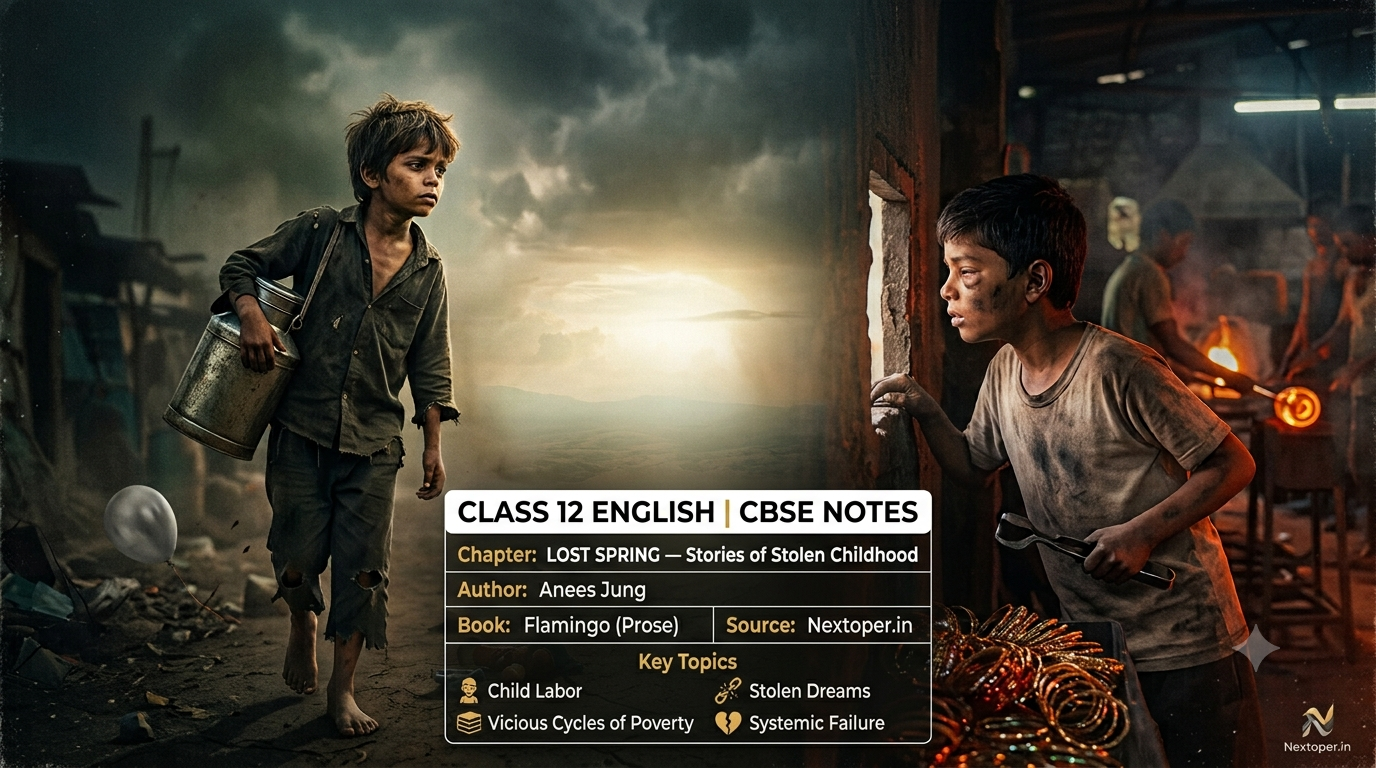
Class 12 English Flamingo Chapter 2 Notes | NCERT Lost Spring Free PDF Notes
Class 12 English Flamingo Chapter 2 Notes are exactly what you need to score well in your CBSE board exam. This chapter, “Lost Spring — Stories of Stolen Childhood,” is written by Anees Jung. It is taken from the NCERT official textbook, Flamingo. In this blog, you will get the full summary, character analysis, themes, glossary, important questions, MCQs, PYQs, and FAQs — all in one place. Everything is written in simple English. You will be exam-ready by the end!
📥 Save Free Notes PDF — No Signup Needed! 👉 Click Here to Save from Nextoper.in
📋 Table of Contents
- Chapter Overview
- Chapter Summary — Lost Spring
- Character Analysis
- Themes and Values
- Literary Devices Used
- Key Definitions and Glossary
- Important Questions and Answers
- MCQs with Answers
- Quick Revision Points
- Previous Year Questions (PYQs)
- Featured Snippet Answer
- People Also Ask — FAQs
- Conclusion
- More Notes from This Subject
Chapter Overview — Class 12 English Flamingo Chapter 2 Notes
Here is a quick snapshot of everything you need to know about this chapter before you begin reading.
| Detail | Information |
|---|---|
| Chapter Name | Lost Spring — Stories of Stolen Childhood |
| Subject | English — Flamingo (Core) |
| Class | Class 12 |
| Board | CBSE |
| Session | 2025-26 |
| Author | Anees Jung |
| Textbook | Flamingo — NCERT |
| Type | Prose (Non-fiction / Reportage) |
| Chapter Number | Chapter 2 |
Chapter Summary — Lost Spring (Class 12 English Flamingo Chapter 2 Notes)
This chapter has two separate but related stories. Both stories show how poverty steals childhood from young boys in India. The author, Anees Jung, is the narrator in both stories.
Part I — “Sometimes I Find a Rupee in the Garbage”
This part is about Saheb, a young ragpicker. The author meets him every morning near her home. Saheb came from Dhaka, Bangladesh. Storms destroyed his family’s fields and home. So his family left and came to Delhi. Now they live in Seemapuri, a slum on the outskirts of Delhi.
Saheb collects garbage every day. He searches for anything useful — coins, food, bottles. The author asks him why he does not go to school. Saheb says there is no school nearby. The author half-jokingly says she will start a school. Saheb takes the promise seriously. A few days later, he comes running to ask if the school is ready. The author feels embarrassed. She realises that empty promises are made to poor children all the time.
The author then notices the barefoot children around Saheb. Some say it is tradition to stay barefoot. The author wonders if it is just an excuse to hide perpetual poverty. She recalls a story from a man in Udipi who prayed for shoes as a child. Thirty years later, the priest’s son wore proper school shoes. But many children like Saheb still go barefoot.
We learn that Seemapuri is home to 10,000 ragpickers. Most are Bangladeshi migrants who came in 1971. They have no identity papers. They have only ration cards to buy grain. For them, garbage is not waste. It is their daily bread. For Saheb, finding a ten-rupee note in the garbage is a moment of pure joy. The author beautifully contrasts this — for children, garbage is full of wonder; for adults, it is only survival.
One day, Saheb starts working at a tea stall. He is paid ₹800 per month. But his face no longer has a carefree look. The steel canister in his hand seems heavier than the plastic garbage bag he used to carry freely. The bag was his own. The canister belongs to the tea stall owner. Saheb has lost his freedom. He is no longer his own master.
Part II — “I Want to Drive a Car”
This part is about Mukesh, a boy from Firozabad. Firozabad is the centre of India’s glass-bangle industry. Almost every family there makes bangles for a living. Children work in dark rooms called dark hutments, next to oil lamps and furnaces. The heat and dust damage their eyesight. Many go blind before they reach adulthood.
Mukesh lives in a half-built shack in a stinking lane. His grandmother has accepted poverty as karam — fate given by God. His family has made bangles for generations. His grandfather went blind from bangle dust. His father failed to send his sons to school.
But Mukesh is different. He has a dream — to become a motor mechanic. He says he will learn to drive a car. The author is moved by his spirit. She asks if he also dreams of flying a plane. Mukesh goes silent and stares at the ground. He says no. He can dream only as far as the cars he sees on the streets of Firozabad. Planes never fly over his town.
The author introduces Savita, a young girl who solders bangles alongside an old woman. Savita does not understand the meaning of the bangles she makes. The author reflects that one day, when red bangles are placed on Savita’s wrists on her wedding day, she will understand their significance.
The author explains the two vicious circles that trap these children. The first is the family web — caste, poverty, and tradition. The second is the external system — middlemen, moneylenders (sahukars), corrupt police, bureaucrats, and politicians. Both circles prevent the children from escaping their fate.
Character Analysis
Here is a clear breakdown of the key characters in this chapter.
Saheb-e-Alam
- Name means “lord of the universe.” This is deeply ironic — he is one of the poorest children in Delhi.
- He is a young ragpicker who came from Dhaka, Bangladesh, after floods destroyed his home.
- He lives in Seemapuri and picks garbage every morning to survive.
- He is innocent and hopeful. He genuinely believes the author’s promise of starting a school.
- After joining a tea stall, he loses his carefree spirit. He becomes a wage slave.
Mukesh
- A boy from Firozabad who belongs to the bangle-making caste.
- Unlike his family, he dares to dream. He wants to become a motor mechanic.
- He is the only character in the story who shows a spark of rebellion against fate.
- He is willing to walk far every day to learn his new skill — showing determination.
Mukesh’s Grandmother
- She represents complete acceptance of fate. She believes their poverty is God’s will (karam).
- She watched her husband go blind from bangle dust but sees no way out.
- Her voice echoes generations of hopelessness.
Savita
- A young girl who solders bangles mechanically, like a machine.
- She represents girls robbed of both childhood and future choices.
- She does not yet understand the cultural meaning of the bangles she makes.
Anees Jung (The Author/Narrator)
- She is an educated, empathetic observer from the outside world.
- She feels guilt for making a promise she cannot keep.
- Her tone is both journalistic and poetic — she reports facts but also reflects deeply on what she sees.
Themes and Values in Lost Spring
Understanding the themes will help you write excellent long-answer responses in your CBSE board exam.
- Child Labour and Stolen Childhood: The chapter’s title itself says it all. Spring symbolises youth, joy, and growth. When children must work instead of play, their spring — their childhood — is stolen from them.
- Poverty as a Trap: Both Saheb and Mukesh are caught in cycles of poverty. Each time they try to move forward, the system pulls them back.
- Caste and Tradition as Chains: The bangle makers of Firozabad are trapped not just by poverty but by the belief that their caste is their destiny. Mukesh’s grandmother voices this — “Can a god-given lineage ever be broken?”
- The Failure of Society and the State: The author shows how middlemen, police, bureaucrats, and politicians all benefit from keeping these families poor. No one in power helps them.
- Dreams vs. Reality: Mukesh wants to be a mechanic. Saheb wanted to go to school. Their dreams are modest. But even these small dreams are hard to reach. The gap between their hopes and their reality is the central irony of the chapter.
- Irony and Paradox: Bangles are a symbol of a woman’s happiness in marriage. But the people who make them live in misery. The beauty of the product contrasts sharply with the ugliness of the lives that produce it.
- Gender and Patriarchy: Saheb’s story focuses on male child labour. Savita’s brief appearance shows that girls face double exploitation — child labour and the weight of patriarchal tradition.
Literary Devices Used in Lost Spring
The author uses poetic language to make her reportage feel like literature. These devices are frequently asked in CBSE exams.
| Device | Example from Text | Explanation |
|---|---|---|
| Irony | “Saheb-e-Alam” means lord of the universe | A ragpicker with the most powerful name — total contrast |
| Metaphor | “Garbage to them is gold” | Garbage = source of life and income; gold = most valuable thing |
| Simile | “Her hands move mechanically like the tongs of a machine” | Savita’s robotic movements compared to a machine |
| Metaphor | “Web of poverty” | Poverty as a spider’s web — inescapable trap |
| Metaphor | “Drowned in an air of desolation” | The temple’s sadness described as if sinking underwater |
| Contrast/Paradox | Beauty of bangles vs. misery of bangle makers | The prettiest product made in the worst conditions |
| Personification | “Few airplanes fly over Firozabad” | Shows how limited the world of Firozabad’s poor children is |
| Hyperbole | “Scrounging for gold in the garbage” | Exaggeration to show how precious every find is for Saheb |
Key Definitions and Glossary
These words appear in the chapter. Knowing them will help you in reading comprehension and vocabulary questions.
| Word/Phrase | Meaning in Simple English |
|---|---|
| Scrounging | Searching through rubbish to find useful things |
| Perpetual | Continuing forever without stopping |
| Squatters | People who live on land without legal permission |
| Dark hutments | Small, dark, cramped shelters without proper light |
| Sahukars | Moneylenders who lend money at very high interest |
| Karam | Hindi/Urdu word meaning fate or one’s duty/destiny |
| Suhaag | Auspiciousness or good fortune in a woman’s marriage |
| Hovels | Very small, poor, and dirty houses |
| Bahu | Daughter-in-law in a Hindi-speaking household |
| Cooperative | A group of people who work together for shared benefit |
| Middlemen | Traders who buy from producers and sell at higher prices |
| Lineage | The family line passed down through generations |
Important Questions and Answers
These questions are based on the NCERT textbook exercises and common board exam patterns.
2-Mark Questions
Q1: What is Saheb looking for in the garbage dumps? A: Saheb is looking for anything valuable — coins, food, or useful items. He hopes to find money, even a ten-rupee note. For him, garbage holds the possibility of a better day.
Q2: Why are the children in Seemapuri not wearing footwear? A: The author gives two reasons. First, it is called a tradition to walk barefoot. Second, and more honestly, she believes it is simply because they cannot afford shoes. It is poverty disguised as custom.
Q3: Is Saheb happy working at the tea stall? A: No, Saheb is not happy. He has lost his carefree attitude. The steel canister feels heavier than his old plastic bag. Working for someone else means he has lost his freedom and is no longer his own master.
Q4: What makes the city of Firozabad famous? A: Firozabad is famous for its glass bangle industry. It is the centre of India’s glass-blowing trade. Almost every family there is involved in making bangles for women across the country.
5-Mark Questions
Q5: What forces keep the workers of Firozabad’s bangle industry trapped in poverty? A: The workers of Firozabad are trapped by two powerful systems working together. The first is the family web — caste tradition, acceptance of fate (karam), and the belief that their identity is fixed at birth. Generations of bangle makers have passed this belief to their children.
The second system is external — sahukars (moneylenders) trap them in debt, middlemen take most of their profits, policemen threaten to arrest them if they organise, bureaucrats ignore them, and politicians use them only as voters. Together, these forces leave the workers with no money, no leader, no voice, and no escape.
Q6: What is the significance of the title “Lost Spring”? A: The title “Lost Spring” is deeply symbolic. Spring represents youth, growth, joy, and new beginnings. For the children in this chapter — Saheb, Mukesh, Savita — spring never truly arrives. Their childhood is lost to poverty, hard labour, and a system that exploits them. They cannot play, study, or dream freely. The title captures the tragedy of stolen childhood in two simple words.
Q7: How is Mukesh different from the other characters in the Firozabad section? A: Mukesh is the only character who actively dares to dream of a different life. His grandmother accepts poverty as fate. His father is resigned to making bangles. The other young men are afraid of the police and have given up.
But Mukesh says, “I will be a motor mechanic.” He is willing to walk a long distance daily to learn. He looks straight into the author’s eyes when he speaks. His determination represents a tiny flash of hope in an otherwise hopeless situation. The author is “cheered” by this spirit, even though the odds against him are enormous.
📚 Want More Free Notes? Visit Nextoper.in — All Class 12 CBSE Notes. 100% Free!
MCQs — Lost Spring (Class 12 English Flamingo Chapter 2) with Answers
Test yourself with these 10 MCQs. These are based on common CBSE exam patterns.
Q1. Who is the author of “Lost Spring — Stories of Stolen Childhood”? (A) Ruskin Bond (B) Anees Jung (C) A.R. Barton (D) Kamala Das ✅ Answer: (B) — Anees Jung wrote the book from which this NCERT chapter is taken.
Q2. Saheb originally came from which country? (A) Pakistan (B) Nepal (C) Bangladesh (D) Sri Lanka ✅ Answer: (C) — Saheb’s family fled from Dhaka, Bangladesh, after floods.
Q3. What does “Saheb-e-Alam” mean? (A) Child of the streets (B) Lord of the universe (C) Son of the earth (D) King of hearts ✅ Answer: (B) — The name means “lord of the universe,” which is deeply ironic given his condition.
Q4. Seemapuri is located on the periphery of which city? (A) Mumbai (B) Kolkata (C) Hyderabad (D) Delhi ✅ Answer: (D) — Seemapuri is a slum on the outskirts of Delhi.
Q5. How much is Saheb paid at the tea stall? (A) ₹500 per month (B) ₹800 per month (C) ₹1,000 per month (D) ₹600 per month ✅ Answer: (B) — Saheb earns ₹800 per month plus all his meals at the tea stall.
Q6. What is Mukesh’s dream in life? (A) To become a doctor (B) To open a shop (C) To be a motor mechanic (D) To play cricket ✅ Answer: (C) — Mukesh says clearly, “I will be a motor mechanic.”
Q7. What does Mukesh’s grandmother call their fate? (A) Dharma (B) Karam (C) Kripa (D) Karma ✅ Answer: (B) — She uses the word “karam,” meaning destiny or God-given fate.
Q8. What do bangles symbolise in Indian culture as mentioned in the chapter? (A) Wealth (B) Education (C) Suhaag (auspiciousness in marriage) (D) Religious faith ✅ Answer: (C) — The author says bangles symbolise a woman’s suhaag — her marital auspiciousness.
Q9. Which literary device is used in “Garbage to them is gold”? (A) Simile (B) Alliteration (C) Metaphor (D) Personification ✅ Answer: (C) — This is a metaphor comparing garbage to gold to show its value for ragpickers.
Q10. Why does the author feel the steel canister is heavier than Saheb’s old plastic bag? (A) The canister is actually larger (B) It represents the loss of Saheb’s freedom (C) Saheb is sick (D) The bag was empty ✅ Answer: (B) — The canister is a symbol of wage labour. The bag was Saheb’s own. The canister belongs to the employer. Saheb has lost his independence.
Quick Revision Points
Scan these before your exam. Each point is a potential short-answer question.
- Saheb is a ragpicker from Dhaka, Bangladesh, now living in Seemapuri, Delhi.
- Seemapuri has about 10,000 ragpickers who came from Bangladesh in 1971.
- Ragpickers in Seemapuri have no identity papers — only ration cards.
- The author’s promise to start a school for Saheb is never kept — represents broken promises to the poor.
- Saheb working at the tea stall at ₹800/month shows child labour disguised as employment.
- Firozabad is the centre of India’s glass bangle industry.
- Children in Firozabad work in dark hutments near furnaces — risking loss of eyesight.
- It is illegal for children to work in glass furnaces, but the law is never enforced.
- Mukesh’s grandmother accepts poverty as karam (divine fate).
- Mukesh is unique — he dares to dream of becoming a motor mechanic.
- Savita solders bangles like a machine — her childhood is already lost.
- The two circles of oppression: (1) Family/caste tradition; (2) Sahukars, middlemen, police, bureaucrats, politicians.
- The title “Lost Spring” = metaphor for stolen childhood.
- The beauty of bangles vs. the misery of bangle makers = central paradox/irony of the chapter.
- Author Anees Jung (born 1944) is a journalist, editor, and columnist.
Previous Year Questions (PYQs)
Questions from CBSE board exams asked on this chapter:
| Year | Question | Marks |
|---|---|---|
| 2023 | What forces conspire to keep the workers in the bangle industry of Firozabad in poverty? | 5 |
| 2022 | How does the author use the image of the steel canister to show Saheb’s loss of freedom? | 3 |
| 2020 | Would you agree that promises made to poor children are rarely kept? Explain with examples from the text. | 5 |
| 2019 | What is the significance of the title “Lost Spring”? | 3 |
| 2018 | Mention the hazards of working in the glass bangle industry. | 3 |
Model Answer — 2023 (5-mark): The workers of Firozabad’s bangle industry are trapped by two powerful systems. Inside the family, caste tradition and the belief that their fate (karam) is unchangeable prevent them from dreaming of better lives. Outside, sahukars keep them in debt, middlemen take most profits, and police threaten arrest for any attempt to organise. Bureaucrats and politicians ignore their plight. Together, these forces have killed all initiative and the will to dream. Even young men who want to change repeat the same lament as their fathers.
Model Answer — 2019 (3-mark): The title “Lost Spring” is a metaphor. Spring represents youth, joy, and possibility. For Saheb, Mukesh, Savita, and thousands of children like them, this spring never comes. Their childhood is stolen by poverty, child labour, and a system that traps them from birth. The title is Anees Jung’s tribute to all the children who are robbed of the chance to simply be children.
Featured Snippet Answer
What is Lost Spring about? (Class 12 English Flamingo Chapter 2)
“Lost Spring” by Anees Jung tells the stories of two poor children — Saheb, a ragpicker in Delhi, and Mukesh, a bangle maker’s son in Firozabad. The chapter shows how poverty, caste, and a corrupt system rob children of their childhood, education, and dreams. It is a powerful report on child labour in India.
People Also Ask — FAQs
Short, direct answers to the most searched questions about this chapter.
❓ Q: What is the summary of Lost Spring Class 12? 💡 A: “Lost Spring” is a CBSE Class 12 English chapter by Anees Jung. It tells the story of Saheb, a ragpicker from Dhaka living in Delhi’s Seemapuri slum, and Mukesh, a bangle maker’s son from Firozabad. Both boys have dreams but are trapped by poverty and a system that exploits them. The chapter shows how thousands of Indian children are denied their right to childhood.
❓ Q: Who are the main characters in Lost Spring? 💡 A: The main characters are Saheb-e-Alam, a young ragpicker from Bangladesh who lives in Seemapuri, Delhi, and Mukesh, a boy from Firozabad who dreams of becoming a motor mechanic. Minor characters include Mukesh’s grandmother, Savita (a young bangle worker), and the narrator/author Anees Jung herself.
❓ Q: What is the significance of the title “Lost Spring”? 💡 A: “Spring” symbolises youth, joy, and new beginnings. The title means that poor children like Saheb and Mukesh never experience this spring — their childhood is stolen by poverty, labour, and social exploitation. Anees Jung uses the title to protest the injustice of child labour in India.
❓ Q: What are the themes of Lost Spring by Anees Jung? 💡 A: The major themes of Lost Spring are: (1) child labour and stolen childhood, (2) poverty as a vicious cycle, (3) caste and tradition as chains, (4) the failure of the state and society to protect poor children, (5) dreams vs. harsh reality, and (6) the irony between the beauty of products and the misery of their makers.
❓ Q: Why is Saheb unhappy working at the tea stall? 💡 A: Saheb is unhappy because working at the tea stall has taken away his freedom. When he was a ragpicker, the garbage bag was his own — he was his own master. Now the steel canister belongs to the shop owner. Saheb is a wage worker. His carefree spirit is gone. The author uses this change to show how even low-paying employment can trap a child.
Conclusion
In this blog, you covered everything from the full Class 12 English Flamingo Chapter 2 Notes on “Lost Spring.” You read the complete summary of Saheb’s and Mukesh’s stories. You studied the characters, themes, literary devices, and glossary. You also practised MCQs, important questions, and PYQs. All of this comes directly from the NCERT textbook. Bookmark this page for quick revision before your board exam. And remember — Nextoper.in is always here with free Class 12 English Flamingo Chapter 2 Notes and more, at no cost!
More Notes from This Subject
Find all your Class 12 English study material on Nextoper.in — completely free.
- Class 12 English Flamingo Chapter 1 Notes — The Last Lesson PDF Notes
- All Class 12 English Flamingo Chapter Notes — Nextoper.in
👤 About the Author This article is written by the Nextoper Editorial Team. We provide 100% free CBSE study notes for Class 9 to 12 students. All our notes follow the latest NCERT syllabus 2025-26. No signup needed. No cost. Just free notes for every student.


I like that the notes bring together the summary, character analysis, themes, MCQs, and previous year questions in one place because it makes revision much more organizedBlog Comment Writing Guide. One suggestion would be to include a short comparison between Saheb and Mukesh in the summary section, since understanding how their stories reflect different aspects of lost childhood can help students answer long-form exam questions more effectively.
Pingback: CBSE Class 12 English Flamingo Chapter 4 Notes The Rattrap PDF 2025-26 - Nextoper
Pingback: NCERT Class 12 English Flamingo Chapter 5 Indigo Notes | Free CBSE Notes 2025-26 - Nextoper
Pingback: CBSE Class 12 English Flamingo Chapter 6 Notes | Poets and Pancakes PDF Notes | Nextoper Notes - Nextoper