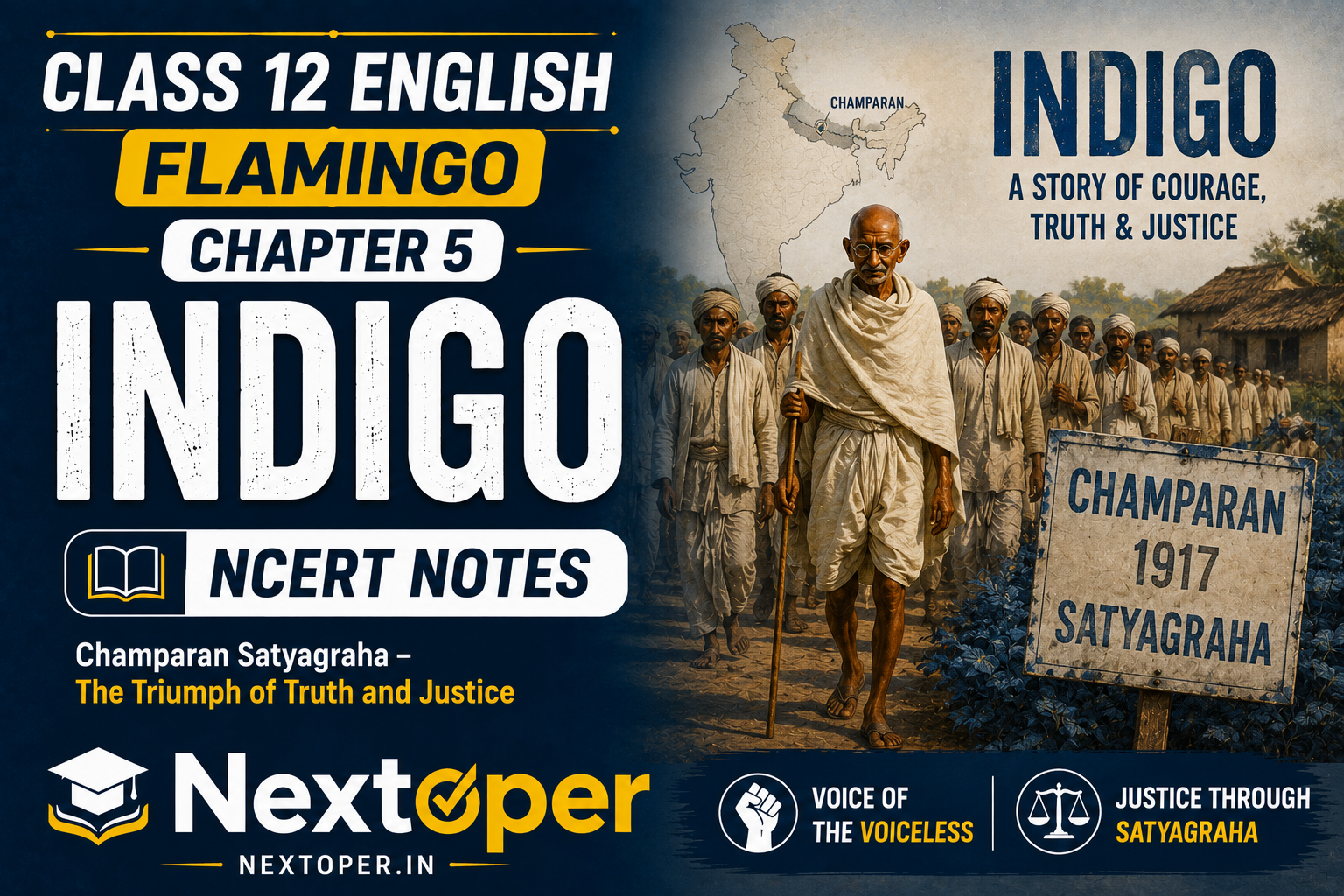
Class 12 English Flamingo Chapter 5 Indigo Notes | Free CBSE Notes 2025-26
⏱ Reading Time: 16 minutes
📥 Download Free Notes PDF — No Signup Needed! 👉 Click Here to Download from Nextoper.in
📋 Table of Contents
- Chapter Overview
- Chapter Summary
- Character Analysis
- Themes and Values
- Key Definitions and Glossary
- Important Questions and Answers
- MCQs with Answers
- Quick Revision Points
- Previous Year Questions (PYQs)
- People Also Ask (FAQs)
- Conclusion
Chapter Overview — Class 12 English Flamingo Chapter 5 Indigo Notes
These Class 12 English Flamingo Chapter 5 Indigo Notes cover every exam-ready detail from the NCERT textbook.
| Detail | Information |
|---|---|
| Chapter Name | Indigo |
| Subject | English (Flamingo — Prose) |
| Class | Class 12 |
| Board | CBSE |
| Session | 2025-26 |
| Author | Louis Fischer |
| Textbook | Flamingo |
| Type | Biographical extract |
Chapter Summary — Indigo
This section of the Class 12 English Flamingo Chapter 5 Indigo Notes breaks the story into short, simple parts.
Gandhi Meets Rajkumar Shukla
In 1917, Gandhi was at the Congress session in Lucknow. A peasant named Rajkumar Shukla found him there. Shukla was poor and illiterate. But he was very determined.
Shukla wanted Gandhi to visit Champaran in Bihar. He wanted Gandhi to see the suffering of indigo farmers. Gandhi had never even heard of Champaran before.
Shukla did not give up. He followed Gandhi to Cawnpore. He followed him to his ashram near Ahmedabad. He waited for weeks. Finally, Gandhi agreed to meet him later in Calcutta.
The Journey to Champaran
Months passed. Shukla waited faithfully at the meeting spot in Calcutta. When Gandhi arrived, they travelled together to Patna. There they went to lawyer Rajendra Prasad’s house.
Prasad was away. His servants did not know Gandhi. They thought he was just another poor peasant like Shukla. They did not even let Gandhi draw water from the well.
Gandhi then decided to go to Muzaffarpur first. He wanted more facts before reaching Champaran. He sent a telegram to Professor J.B. Kripalani. Kripalani welcomed him warmly with a group of students.
The Indigo Problem
Most farmland in Champaran belonged to British landlords. Indian tenants worked this land. The main crop was indigo.
Landlords forced farmers to grow indigo on 15% of their land. Farmers had to give the entire indigo harvest as rent. This was an old, unfair system.
Then Germany invented synthetic indigo. Natural indigo became less valuable. Landlords wanted to end the 15% arrangement. But they demanded compensation money from the farmers first.
Some farmers signed the new agreement. Others resisted and hired lawyers. When farmers learned about synthetic indigo, they wanted their money back too.
Gandhi Confronts the British Officials
Gandhi reached Champaran and began collecting facts. The landlords’ secretary refused to help him. He called Gandhi an “outsider.” Gandhi disagreed strongly.
Next, Gandhi met the British commissioner of Tirhut. The commissioner bullied Gandhi. He told Gandhi to leave immediately.
Gandhi refused to leave. He travelled to Motihari instead. A huge crowd of peasants welcomed him there. Gandhi wanted to visit a mistreated peasant in a nearby village.
On the way, police stopped Gandhi. They ordered him back to town. Officials then handed him a notice to leave Champaran. Gandhi signed it but wrote that he would disobey the order.
The Court Case and Victory
Gandhi was summoned to court the next day. That morning, thousands of peasants gathered outside the courthouse. They did not know much about Gandhi. They only knew he wanted to help them.
The government felt powerless. The judge postponed the trial. Gandhi refused to pay bail. Later, the case against Gandhi was dropped completely.
This was a huge moment. Civil disobedience had won for the first time in India.
The Inquiry and Settlement
Gandhi and his lawyer friends began a detailed inquiry. They collected depositions from nearly 10,000 peasants. The landlords protested loudly.
The Lieutenant-Governor set up an official commission. It included landlords, officials, and Gandhi. This commission found strong evidence against the landlords.
The landlords agreed to refund some money. Gandhi asked for 50%. The landlords offered 25%. Gandhi surprised everyone by accepting 25% immediately.
For Gandhi, the amount did not matter much. What mattered was that landlords had to give up money and pride. Peasants finally saw that they had rights.
Social Reform in Champaran
Gandhi did not stop at legal victory. He cared about education, health, and hygiene too. He opened primary schools in six villages.
His wife Kasturba taught women about cleanliness. A doctor volunteered basic medical care. Gandhi personally managed the ashram from a distance through letters.
Self-Reliance and the Lesson of Champaran
An English pacifist named C.F. Andrews wanted to help Gandhi in Champaran. Gandhi refused his help. He said Indians must fight their own battles.
This taught everyone a valuable lesson in self-reliance. Self-reliance, freedom, and justice for farmers were all connected for Gandhi.
The Champaran episode became a turning point in Gandhi’s life. It was his first major act of civil disobedience in India.
Character Analysis
Understanding each character helps you answer character-based questions confidently in these Class 12 English Flamingo Chapter 5 Indigo Notes.
Mahatma Gandhi
- Calm, patient, and deeply committed to justice for the poor.
- Believed strongly in non-violence and truthful methods.
- Practical leader — cared about legal rights and daily problems like health and hygiene.
- Taught self-reliance by refusing outside (English) help.
Rajkumar Shukla
- A poor, illiterate but resolute sharecropper from Champaran.
- Extremely persistent — followed Gandhi across several cities for weeks.
- Represents the courage of ordinary, uneducated people in the freedom struggle.
Rajendra Prasad
- A respected lawyer who later became President of India.
- Initially uncertain, but became a loyal supporter of Gandhi’s cause.
- His servants mistaking Gandhi for a peasant shows Gandhi’s simple lifestyle.
The British Landlords and Officials
- Represent colonial exploitation and arrogance.
- Tried to intimidate Gandhi through threats and legal notices.
- Eventually forced to compromise, showing the power of organised resistance.
The Peasants of Champaran
- Initially fearful and passive due to years of oppression.
- Gained courage through Gandhi’s presence and leadership.
- Their mass demonstration outside the courthouse was a turning point.
Themes and Values in the Chapter
This part of the Class 12 English Flamingo Chapter 5 Indigo Notes lists the key themes examiners often test.
- Justice for the oppressed: The chapter shows how organised, peaceful effort can secure justice even against powerful landlords.
- Non-violence and moral authority: Gandhi never used force, yet he successfully challenged British power through truth and conscience.
- Freedom from fear: Gandhi believed real relief for the poor meant freeing them from fear, not just winning court cases.
- Self-reliance: Refusing C.F. Andrews’s help taught Indians to trust their own strength, not foreign support.
- Leadership rooted in empathy: Gandhi combined political strategy with genuine care for peasants’ health, education, and dignity.
- Power of ordinary people: Rajkumar Shukla and thousands of nameless peasants show that history is shaped by common people too.
Key Definitions and Glossary
A quick-reference glossary table — a gap most competitor sites skip entirely.
| Word | Meaning in Simple English |
|---|---|
| Emaciated | Very thin from hunger or illness |
| Sharecropper | A farmer who gives part of the crop as rent |
| Resolute | Firm and determined |
| Tenacity | Strong persistence, refusal to give up |
| Deposition | A written statement given as evidence |
| Prop | A support or crutch |
| Chided | Scolded mildly |
| Baffled | Confused, unable to understand |
| Irksome | Annoying or tiresome |
| Upshot | The final result or outcome |
Important Questions and Answers
2-Mark Questions
Q: Why is Rajkumar Shukla called “resolute”? A: He followed Gandhi across many cities for weeks. He never gave up until Gandhi agreed to visit Champaran. His firm determination earns him this description.
Q: Why did the servants think Gandhi was another peasant? A: Gandhi wore a simple dhoti, like Shukla. He arrived with Shukla, who was known as a poor peasant. His humble appearance misled the servants.
Q: What was the “conflict of duties” Gandhi mentioned in court? A: Gandhi did not want to be seen as a lawbreaker. But he also felt duty-bound to serve the peasants. This created his inner conflict of duties.
Q: Why did Gandhi refuse C.F. Andrews’s help? A: Gandhi believed Indians must win their own battles. Accepting help from an Englishman would show weakness and dependence, not strength.
5-Mark Questions
Q: How did Gandhi secure justice for the Champaran peasants? A: Gandhi first gathered facts by meeting officials and lawyers. He then defied the order to leave Champaran. His court case created massive peasant support. This pressure led to an official inquiry. The commission gathered strong evidence against landlords. Gandhi negotiated a 25% refund, restoring peasants’ rights and dignity.
Q: Explain the significance of the Champaran episode in Gandhi’s life. A: It was Gandhi’s first major struggle inside India. He applied non-violent resistance directly for the first time. The movement proved that British power could be challenged peacefully. It also taught Gandhi the value of connecting politics with everyday peasant problems. This is why he called it a turning point.
Q: How did Gandhi work for social reform beyond the legal battle? A: Gandhi opened primary schools in six villages for poor children. Kasturba taught women cleanliness and hygiene practices. A doctor volunteered medical care using basic medicines. Gandhi personally monitored the ashram through regular letters. These actions show his holistic vision of freedom.
📚 Want More Free Notes? Visit Nextoper.in — All Class 9 to 12 CBSE Notes. 100% Free!
MCQs — Indigo Class 12 with Answers
Q1. Who wrote the chapter “Indigo”? (A) Louis Fischer (B) Mahatma Gandhi (C) Rajendra Prasad (D) J.B. Kripalani ✅ Answer: (A) — Louis Fischer wrote this extract from his biography of Gandhi.
Q2. Where did Gandhi first meet Rajkumar Shukla? (A) Champaran (B) Lucknow (C) Patna (D) Muzaffarpur ✅ Answer: (B) — They met at the Congress session in Lucknow in 1916.
Q3. What percentage of land did farmers have to grow indigo on? (A) 10% (B) 15% (C) 20% (D) 25% ✅ Answer: (B) — Landlords forced tenants to plant indigo on 15% of their land.
Q4. Who developed synthetic indigo? (A) Britain (B) France (C) Germany (D) America ✅ Answer: (C) — Germany’s synthetic indigo reduced the value of natural indigo.
Q5. What refund percentage did Gandhi finally accept from the landlords? (A) 15% (B) 25% (C) 50% (D) 75% ✅ Answer: (B) — Gandhi accepted the landlords’ offer of 25%, breaking the deadlock.
Q6. Who was Rajendra Prasad? (A) A British officer (B) A lawyer who later became President of India (C) A farmer (D) A journalist ✅ Answer: (B) — He hosted Gandhi in Patna and later supported him fully.
Q7. Why did Gandhi refuse C.F. Andrews’s help? (A) Andrews was busy (B) Andrews disliked Gandhi (C) Gandhi wanted Indians to be self-reliant (D) Andrews left India ✅ Answer: (C) — Gandhi taught a lesson in self-reliance by refusing English support.
Q8. Where was Gandhi ordered to appear in court? (A) Lucknow (B) Motihari (C) Ahmedabad (D) Calcutta ✅ Answer: (B) — Motihari, the capital of Champaran district.
Q9. What subject did Kasturba teach the village women? (A) Reading (B) Cleanliness and hygiene (C) Farming (D) Sewing ✅ Answer: (B) — Kasturba taught ashram rules on personal cleanliness and sanitation.
Q10. What did Gandhi call the real relief for the fear-stricken peasants? (A) Money (B) Freedom from fear (C) Legal justice (D) Education ✅ Answer: (B) — Gandhi believed freedom from fear mattered more than legal victories alone.
Quick Revision Points
- Louis Fischer wrote “Indigo” as part of his book The Life of Mahatma Gandhi.
- Rajkumar Shukla brought Gandhi to Champaran in 1917.
- Farmers grew indigo on 15% of their land as rent under an old contract.
- Germany’s synthetic indigo made natural indigo less profitable for landlords.
- Gandhi visited Muzaffarpur before Champaran to gather facts first.
- Gandhi disobeyed the order to leave and was summoned to court.
- Thousands of peasants gathered outside the court, and the case was dropped.
- An official commission of inquiry was formed with landlords and Gandhi.
- Landlords agreed to a 25% refund settlement.
- Gandhi opened primary schools and improved health and hygiene in villages.
- He refused help from C.F. Andrews, teaching a lesson in self-reliance.
- Champaran was Gandhi’s first major civil disobedience movement in India.
Previous Year Questions (PYQs)
| Year | Question | Marks |
|---|---|---|
| 2023 | Why did Gandhi consider the Champaran episode a turning point in his life? | 5 |
| 2022 | How was Gandhi able to influence the lawyers in Champaran? Give instances. | 5 |
| 2020 | What was the attitude of the average Indian towards advocates of “home rule”? | 3 |
| 2019 | Why is Rajkumar Shukla described as “resolute”? | 2 |
Model Answers for 3 Important PYQs:
2023 — Why was Champaran a turning point? Gandhi applied non-violent resistance directly inside India for the first time here. He earned massive peasant support without using force. This success shaped his future freedom-movement strategy, making Champaran a defining moment in his life.
2022 — How did Gandhi influence the lawyers? Gandhi asked the lawyers what they would do if he was jailed. They initially said they would go home. When Gandhi questioned their loyalty to the peasants, they felt ashamed and agreed to court arrest alongside him.
2020 — Attitude towards “home rule” advocates? Average Indians in smaller towns feared British authorities deeply. They avoided openly supporting home-rule leaders. Even a government professor sheltering Gandhi was seen as an extraordinary, risky act at the time.
Featured Snippet Answer
Indigo by Louis Fischer describes Mahatma Gandhi’s 1917 struggle in Champaran, Bihar. Gandhi investigated the exploitation of indigo sharecroppers by British landlords, defied orders to leave, and won a 25% refund settlement through peaceful civil disobedience — marking his first major non-violent movement inside India.
People Also Ask — FAQs
❓ Q: What is the summary of Indigo class 12 in short? 💡 A: Class 12 English Flamingo Chapter 5 Indigo Notes summarise how Gandhi helped Champaran’s indigo farmers in 1917. He investigated their exploitation by British landlords, defied government orders, and secured a 25% refund settlement through non-violent resistance and civil disobedience.
❓ Q: Why is the Champaran episode considered a turning point in Gandhi’s life? 💡 A: It was Gandhi’s first active struggle inside India, not South Africa. He proved that non-violent civil disobedience could challenge British power. This success shaped every future movement he led in India’s freedom struggle.
❓ Q: Who was Rajkumar Shukla in the chapter Indigo? 💡 A: Rajkumar Shukla was a poor, illiterate but resolute peasant from Champaran. He persistently followed Gandhi across several cities until Gandhi agreed to visit Champaran and address the injustice faced by indigo sharecroppers.
❓ Q: Why did Gandhi refuse help from C.F. Andrews? 💡 A: Gandhi believed accepting help from an Englishman would show weakness and dependence. He wanted Indians to win their own battles through self-reliance, teaching this lesson to his lawyer friends in Champaran.
❓ Q: What lesson does the chapter Indigo teach us? 💡 A: Indigo teaches courage, justice, and self-reliance. It shows how one determined individual, guided by truth and non-violence, can inspire collective action and bring meaningful social change against powerful oppression.
🔔 Found this helpful? Share with your classmates! 📲 Instagram Help your friends score better marks — for free!
Conclusion
These Class 12 English Flamingo Chapter 5 Indigo Notes cover Gandhi’s fight for Champaran’s peasants in complete detail. You learned about Rajkumar Shukla’s persistence, the unfair indigo system, and Gandhi’s peaceful victory. The chapter teaches courage, justice, and self-reliance through real history.
Keep revising with the MCQs, PYQs, and FAQs above before your exam. For more free, exam-ready material, explore Nextoper.in’s complete collection of Class 12 English Flamingo Chapter 5 Indigo Notes and other chapters, updated for CBSE 2025-26.
More Notes from This Subject
Continue your Flamingo revision with these related chapter notes from Nextoper.in.
- Class 12 English Flamingo Chapter 2 Notes — Lost Spring PDF Notes
- Class 12 English Flamingo Chapter 3 Notes — Deep Water PDF Notes
- Class 12 English Flamingo Chapter 4 Notes — The Rattrap Notes
- All Class 12 English Flamingo Notes — Nextoper.in
👤 About the Author This article is written by the Nextoper Editorial Team. We provide 100% free CBSE study notes for Class 9 to 12 students. All our notes follow the latest NCERT syllabus 2025-26. No signup needed. No cost. Just free notes for every student.
🔄 Last Reviewed: July 2026 This blog was reviewed and updated to match the latest NCERT textbook and CBSE syllabus 2025-26 guidelines.

I like how the chapter is broken into simple sections,Blog Comment Creation Guide especially the step-by-step summary of Rajkumar Shukla’s persistence and Gandhi’s journey to Champaran, because it makes the sequence of events much easier to remember. It would also be helpful to include a short comparison between the Indigo chapter and previous CBSE exam questions so students can see which themes and character traits are tested most often.
Pingback: NCERT Class 12 English Going Places PDF Notes | Full Chapter Summary, Q&N, MCQs, Notes - Nextoper