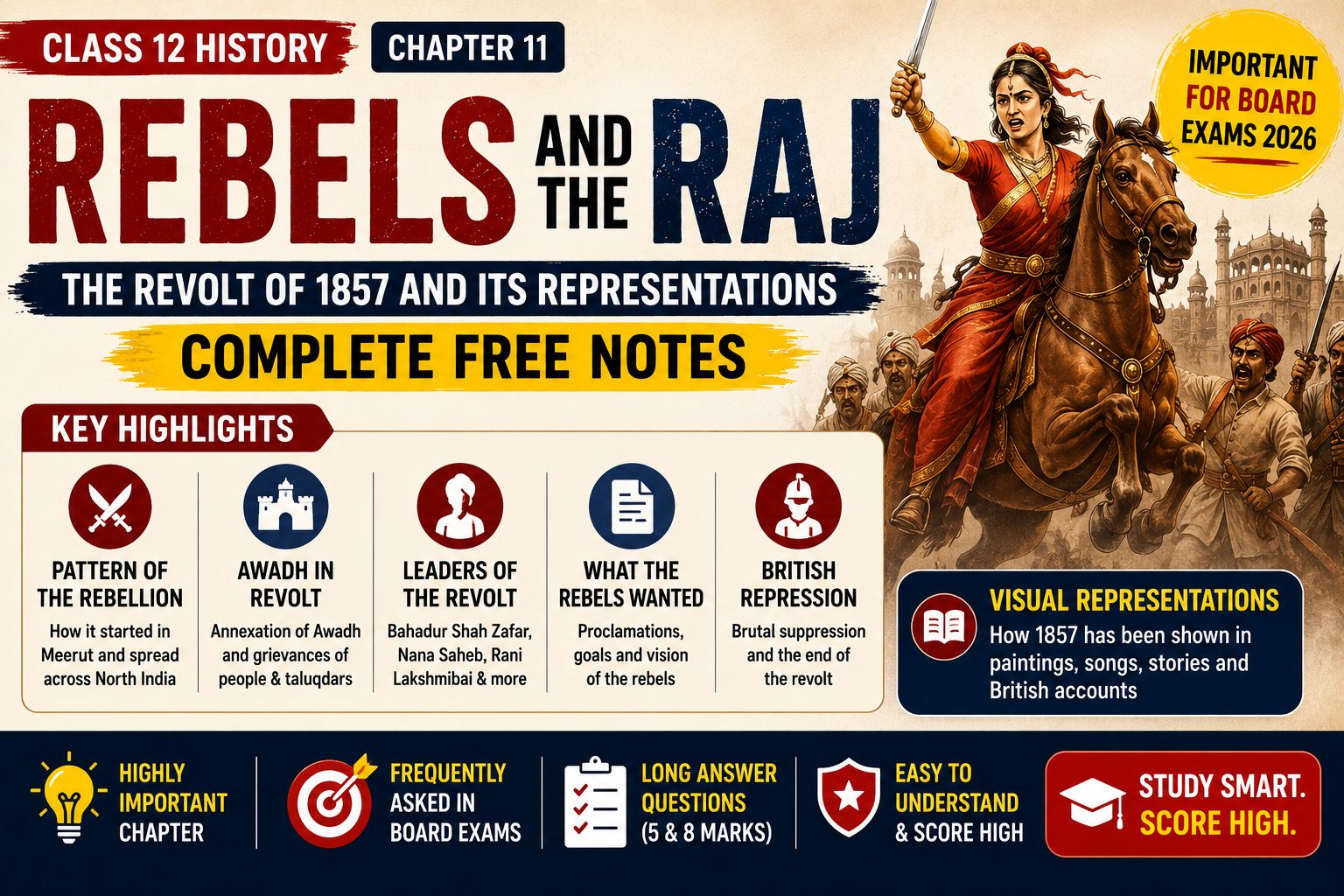
Class 12 CBSE Rebels and the Raj – Complete handwriting Notes
| Field | Detail |
|---|---|
| Chapter | Chapter 11 – Rebels and the Raj: The Revolt of 1857 and Its Representations |
| Subject | History (Themes in Indian History – Part III) |
| Class | 12 |
| Board | CBSE |
| Exam Marks | See latest syllabus |
| Difficulty | Important |
Rebels and the Raj Class 12 CBSE covers one of the most dramatic events in Indian history — the uprising of 1857 that began in the cantonment of Meerut and spread across North India within weeks. The chapter traces the rebellion’s causes, its spread, the leaders who emerged, and what the rebels actually wanted.
This chapter carries significant weight in board exams. Long-answer questions (5 marks and 8 marks) frequently come from the Awadh annexation, the role of taluqdars, the Azamgarh Proclamation, and the visual representations section — making a thorough reading essential, not optional. Students who only skim this chapter for dates and names miss the analytical depth examiners look for.
The revolt of 1857 still resonates in India today. The story of Rani Lakshmibai is taught in schools from UP to Tamil Nadu. Lucknow’s Residency still stands as a monument. The question of whether 1857 was a sepoy mutiny or India’s first war of independence continues to generate debate among historians — which is exactly why NCERT treats “representations” as seriously as the events themselves.
What’s in These Notes?
- Pattern of the Rebellion — How It Spread
- Awadh in Revolt — Causes and Grievances
- Leaders of the Revolt — Rebels and the Raj Class 12 CBSE
- What the Rebels Wanted — Proclamations and Goals
- British Repression and the End of the Revolt
- Visual Representations of 1857
- Mutiny vs Revolt — A Distinction Most Students Get Wrong
- Important Questions — Rebels and the Raj Class 12 CBSE
- FAQ — Rebels and the Raj Class 12 CBSE
- Quick Revision — Key Points to Remember
- Explore More CBSE Notes on Nextoper
- Trusted Resources for Deeper Study
Pattern of the Rebellion — How It Spread
The revolt began on the afternoon of 10 May 1857 in the cantonment of Meerut. It started among native infantry soldiers, spread rapidly to the cavalry, and then pulled in ordinary townspeople and villagers. The sepoys seized the bell of arms (the weapons storeroom), attacked government buildings, cut the telegraph line to Delhi, and rode toward the Mughal capital overnight.
By 11 May, the sepoys had reached the Red Fort. It was the month of Ramzan. The aged emperor Bahadur Shah Zafar, initially horrified, was left with little choice but to accept nominal leadership when the rebels entered the Fort without observing court etiquette. This gave the revolt a crucial layer of legitimacy — it could now be conducted in the name of the Mughal emperor.
How Each Cantonment Rose
The pattern was strikingly similar across cantonments. Once news from one town reached the next, sepoys followed the same sequence:
- A signal was given — often the firing of the evening gun or the sound of a bugle
- The bell of arms was seized and the treasury plundered
- Government buildings were attacked and records burned
- Proclamations in Hindi, Urdu, and Persian called on both Hindus and Muslims to unite against the firangis
When ordinary people joined, the revolt widened. In Lucknow, Kanpur, and Bareilly, moneylenders and the wealthy also became targets — the peasants saw them as both oppressors and allies of the British. What began as a military mutiny became a popular uprising.
Planning and Coordination
The similarity in events across cantonments was not accidental. Sepoys or their representatives (emissaries) moved between stations to communicate plans. The 7th Awadh Irregular Cavalry, after refusing the new cartridges, wrote to the 48th Native Infantry that they “had acted for the faith and awaited the 48th’s orders.” At Kanpur, panchayats of native officers met nightly to make collective decisions — the sepoys were, as the NCERT puts it, “the makers of their own rebellion.”
A telling example of how messages moved: François Sisten, a Christian police inspector from Sitapur, was mistaken for a rebel sympathiser by a Muslim tahsildar from Bijnor who casually asked him, “What news from Awadh? How does the work progress, brother?” The tahsildar was later identified as a principal rebel leader — proof that planning ran deep and wide.
Think of it like a WhatsApp group before WhatsApp existed: word travelled through trusted networks of caste, regiment, and religion, faster than the British could track it.
Awadh in Revolt — Causes and Grievances
Awadh was at the heart of the 1857 uprising, and for good reason. The entire structure of the kingdom — from its royal court to its peasant fields — had been dismantled by British policy over half a century.
The Annexation
In 1801 the British imposed the Subsidiary Alliance on Awadh under Lord Wellesley. By its terms, the Nawab had to disband his own military, host British troops, and act on advice from the British Resident. This made the Nawab progressively dependent on the British to maintain order, and he could no longer assert authority over rebellious chiefs.
By the early 1850s, Lord Dalhousie described Awadh as “a cherry that will drop into our mouth one day.” In 1856 it formally did — Nawab Wajid Ali Shah was dethroned and exiled to Calcutta, falsely labelled an incompetent ruler. He was, in fact, deeply loved. When he left Lucknow, people followed him all the way to Kanpur, singing songs of grief.
What the Annexation Destroyed
The removal of the Nawab cascaded through every layer of Awadh society:
- Taluqdars (large landholders) were disarmed, their forts destroyed, and their land redistributed under the Summary Settlement of 1856. In pre-British times they held 67% of Awadh’s villages; after the Settlement, this fell to 38%.
- Peasants lost the informal safety net the taluqdar had provided — loans during crop failure, reduced revenue in hard times. Under British direct rule, revenue demands increased 30–70% in some areas.
- Urban artisans and court employees — musicians, dancers, poets, cooks — lost their livelihoods when the court culture dissolved.
- Sepoys — most of the Bengal Army came from Awadh’s villages. The anxieties of their families at home fed directly into the sepoy lines.
The relationship between Awadh’s sepoys and their white British officers had also deteriorated. In the 1820s, officers had wrestled with sepoys, learned Hindustani, and observed Indian customs. By the 1840s, they had grown racially arrogant, abusive, and distant. The greased cartridge episode — where sepoys were asked to bite Enfield rifle cartridges supposedly greased with cow and pig fat — became the spark in this already explosive atmosphere.
Imagine inheriting a house your family built over generations, only to be told it belongs to someone else who then charges you rent to live in it. That is roughly what Awadh’s taluqdars experienced — and why they joined the revolt.
Leaders of the Revolt — Rebels and the Raj Class 12 CBSE
The rebels needed leadership, and in most places they turned to those who had held authority before British conquest. But the important point — which NCERT emphasises — is that in many cases these leaders did not volunteer. They were pushed into it.
Leaders Who Were Reluctant
- Bahadur Shah Zafar — his first reaction was “horror and rejection.” He agreed only after sepoys entered the Red Fort ignoring court etiquette, making refusal impossible.
- Nana Sahib (Kanpur) — successor to Peshwa Baji Rao II, given no choice by the sepoys and townspeople who insisted he lead them.
- Rani Lakshmibai (Jhansi) — “forced by the popular pressure around her to assume the leadership.”
- Kunwar Singh — a local zamindar in Arrah, Bihar, similarly pressured into leadership.
- Birjis Qadr — the young son of Nawab Wajid Ali Shah, hailed as leader in Lucknow after the British were driven out.
Leaders Who Were Not From Courts
Not all leadership came from royal families:
- Shah Mal — a Jat cultivator from pargana Barout, UP, who mobilised headmen and farmers of 84 villages, set up an intelligence network, and ran a “hall of justice” in a British officer’s bungalow. He was killed in battle in July 1857.
- Maulvi Ahmadullah Shah (Danka Shah) — educated in Hyderabad, he preached jehad (holy war) village by village from 1856 onward and was elected leader by the 22nd Native Infantry. Many believed he had magical powers and was invincible.
- Local religious leaders, self-styled prophets, and fakirs also spread the message of rebellion.
This variety in leadership is an important board exam point: the 1857 revolt was not just an elite uprising — it had roots among zamindars, tribals, villagers, and the urban poor.
What the Rebels Wanted — Proclamations and Goals
One of this chapter’s most important — and most neglected — themes is what the rebels themselves wanted. Since most rebels were not literate, we have very few documents from their side. The main sources are proclamations (ishtahars) issued by rebel leaders, and a few arzis (petitions) from sepoys.
The Vision of Unity
Rebel proclamations repeatedly appealed to Hindus and Muslims alike. The British tried to sow communal division — in Bareilly in December 1857 they spent ₹50,000 to incite Hindus against Muslims. The attempt failed. The proclamation issued in Bahadur Shah’s name called people to fight under the standards of both Muhammad and Mahavir.
The Azamgarh Proclamation (25 August 1857)
This is the single most important rebel document for board exams, and almost no study resource explains it clearly. The Azamgarh Proclamation was structured in five sections, each addressing a different social group. Here is what each section promised and why it matters:
| Section | Social Group | Grievance Highlighted | Promise of the Badshahi (Imperial) Government |
|---|---|---|---|
| I | Zamindars | Exorbitant revenue, public humiliation in courts | Light revenue, dignity restored |
| II | Merchants | British monopoly on trade of indigo, cloth; heavy taxation | Open trade by land and water |
| III | Public servants | Low pay, no promotion, all senior posts given to Englishmen | Higher salaries and positions |
| IV | Artisans | Weavers, carpenters, blacksmiths thrown out of work by British goods | Exclusive employment under Indian rulers |
| V | Pundits and Fakirs | Religion under threat from the British | Called to join the holy war |
What this tells us: the rebel vision was not just military — it was a comprehensive rejection of British economic and social domination across every class of Indian society.
Against Symbols of Oppression
The rebels burned account books, looted moneylenders, and destroyed bridges and roads — not randomly, but deliberately targeting everything they associated with British rule. The chapter notes they wanted to “restore that world” — the pre-British 18th-century order of the Mughal empire.
British Repression and the End of the Revolt
The British did not suppress the revolt easily. By May–June 1857, one British officer said their rule had “collapsed like a house made of cards.” Individual Britons were saving their own lives, not governing a country.
Before sending troops, the British passed special Acts in May–June 1857 that put all of North India under martial law. Ordinary processes of law were suspended. The only punishment for suspected rebellion was death. Military officers and even private Britons were given the power to try and punish Indians.
The reconquest was a two-pronged operation: one force moved from Calcutta into North India, another came from Punjab (which had stayed largely peaceful) to retake Delhi. Delhi was attacked from early June 1857 but fell only in late September — rebels from across North India had gathered to defend it. The Gangetic plain was retaken village by village. In Awadh, a British official named Forsyth estimated that three-fourths of the adult male population was in rebellion. Awadh came under control only in March 1858.
How the British Broke Resistance
Military power alone was not enough. In Uttar Pradesh, where taluqdars and peasants had united, the British deliberately broke their alliance by promising to restore estates to landholders who submitted. Rebels were dispossessed; the loyal were rewarded. Many rebel landholders fled to Nepal, where they died of illness or starvation.
The British also used public spectacle as a weapon. Rebels were blown from cannons or hanged publicly. These executions were deliberately performed in the open — not just punishment, but theatre designed to terrify those watching into submission.
Visual Representations of 1857
Section 5 of the NCERT chapter is unique — it’s not about events but about how those events were depicted, and why that matters. This section produces analytical questions in board exams that most students are unprepared for.
The Key Argument
Images and paintings did not just reflect the emotions of their time — they shaped them. British paintings of 1857 inflamed public opinion and made ordinary British citizens demand brutal repression. Nationalist Indian paintings later shaped the freedom movement.
British Representations — Four Types
Celebrating heroes: Thomas Jones Barker’s 1859 painting “Relief of Lucknow” placed British commanders Campbell, Outram, and Havelock at the centre — lit, triumphant, with injured soldiers and damaged buildings in the background. The message: British power is restored, the trouble is over.
Victimised women: Joseph Noel Paton’s “In Memoriam” (1859) showed English women and children huddled helplessly, waiting for violence. The rebels are invisible — but the suggestion of their brutishness is powerful. The painting provoked demands for revenge without showing any evidence.
Heroic women: Another set of images showed English women fighting back — like the image of Miss Wheeler in Kanpur single-handedly killing sepoys. These representations framed the revolt as an attack on Christianity itself (note the Bible on the floor in the image).
Justice and retribution: Cartoons like “Justice” from Punch (September 1857) showed an allegorical female figure trampling sepoys, expressing the British public’s demand for violent reprisal.
Indian/Nationalist Representations
After 1857, nationalist artists and poets remade the story. Rani Lakshmibai became a symbol of resistance — always shown in battle armour, sword in hand, on horseback. Subhadra Kumari Chauhan’s poem “Khoob lari mardani woh to Jhansi wali rani thi” is taught across India. These images did not record history — they created a usable past for the nationalist movement.
Board exam tip: When answering questions on visual representations, always explain whose perspective the image represents and what effect it was designed to produce on its audience.
Mutiny vs Revolt — A Distinction Most Students Get Wrong
The NCERT defines these terms clearly, but students routinely confuse them in board answers. Here is the exact distinction you need:
| Term | Definition | Who It Refers To in 1857 |
|---|---|---|
| Mutiny | Collective disobedience of rules and regulations within the armed forces | The sepoys — soldiers of the Bengal Army |
| Revolt / Rebellion | Uprising of people against established authority and power | The civilian population — peasants, zamindars, rajas, jagirdars |
The 1857 uprising was both. It began as a military mutiny in Meerut and quickly became a popular revolt as taluqdars, peasants, and artisans joined. This distinction matters because the British for a long time called it only a “mutiny” — implying it was merely a military discipline problem, not a genuine popular uprising against colonial rule.
Indian nationalists later called it the First War of Independence — the opposite extreme. The chapter asks you to hold both realities together: it was a mutiny that became something much larger.
Important Questions — Rebels and the Raj Class 12 CBSE
1 Mark
Q: What was the Azamgarh Proclamation? A: The Azamgarh Proclamation (25 August 1857) was a rebel document issued in the name of the Mughal emperor that appealed to zamindars, merchants, artisans, public servants, and religious leaders to join the revolt against British rule.
3 Marks
Q: Explain the role of rumours and prophecies in the 1857 revolt.
Rumours and prophecies acted as powerful mobilisers because they resonated with the fears and suspicions people already held. The most dangerous rumour was that the new Enfield rifle cartridges were greased with cow and pig fat, which would corrupt the caste and religion of Hindu and Muslim sepoys alike. This rumour likely originated at Dum Dum cantonment in January 1857, when a low-caste khalasi reportedly told a Brahmin sepoy, “You will soon lose your caste, as you will have to bite cartridges covered with the fat of cows and pigs.” No assurances from British officers could stop its spread. Another rumour said the British had mixed bone dust of cows and pigs into flour sold in markets. The prophecy that British rule would end on the centenary of the Battle of Plassey — 23 June 1857 — added a sense of divine timing to the resistance. These rumours worked because British policies since the 1820s had already made people fear their religion and way of life was under attack.
Q: Why did the revolt spread with particular intensity in Awadh? Give three reasons.
Awadh was the most intense centre of the revolt for reasons that touched every section of society. First, the annexation of Awadh in 1856 under the Doctrine of Lapse was deeply resented — Nawab Wajid Ali Shah was widely loved, and his forced exile to Calcutta was seen as a personal and collective humiliation. Second, the taluqdars (large landholders) were directly dispossessed: under the Summary Settlement of 1856, their share of Awadh’s villages fell from 67% to 38%, and they lost their forts, retainers, and local authority. Third, most sepoys of the Bengal Army were recruited from Awadh’s villages, so military grievances and village grievances were tightly linked — when sepoys mutinied, their families and neighbours in the countryside joined almost immediately. The result was a unified resistance of prince, taluqdar, peasant, and sepoy that lasted longer in Awadh than anywhere else in North India.
5 Marks
Q: What did the rebels of 1857 want? Discuss the vision and goals expressed in their proclamations.
Reconstructing the rebel perspective is difficult because most rebels were not literate, and the British who won the war controlled most of the written record. What we do have are a handful of rebel proclamations, ishtahars, and petitions (arzis) — and these reveal a coherent, multi-layered set of demands.
The rebel proclamations consistently appealed to all communities regardless of caste and religion. The Azamgarh Proclamation (25 August 1857) is the clearest statement of rebel goals. It addressed five social groups: zamindars were promised relief from exorbitant revenue and restored dignity; merchants were promised freedom of trade after British monopolies had destroyed local commerce; public servants were promised higher pay and promotion; artisans were promised employment, since British manufactured goods had ruined weavers, carpenters, and blacksmiths; and religious figures were called to a holy war to save Hinduism and Islam from a British government they believed was determined to convert India to Christianity. Every aspect of British rule — annexations, land settlements, trading policy, racial discrimination — was condemned as part of the same project of destruction.
The rebels also wanted to restore the pre-British world. Once they took control of cities like Delhi, Lucknow, and Kanpur, they set up structures of authority modelled on 18th-century Mughal administration — appointing officials, collecting revenue, organising armies. These structures were short-lived, but they show that the rebellion was not simply destructive. The rebels had a vision of an alternative order, one in which Indian kings, merchants, cultivators, and soldiers could live with dignity. This vision united very different social groups — taluqdars and peasants, Hindus and Muslims, soldiers and artisans — against a common enemy.
Q: What do the visual representations of the 1857 revolt tell us about how the events were understood by the British and by Indian nationalists?
The visual representations of 1857 are as important as the events themselves for understanding how the revolt was remembered and used. The British produced a vast body of paintings, cartoons, and etchings, and these images were not neutral records — they were political tools designed to produce specific emotional reactions.
British paintings served several functions. Works like “Relief of Lucknow” by Thomas Jones Barker (1859) celebrated British heroes and reassured the British public that order had been restored. “In Memoriam” by Joseph Noel Paton showed English women and children as helpless victims, provoking outrage and demands for revenge — even though no rebels appeared in the picture. Cartoons from Punch magazine, like “Justice,” showed allegorical female figures trampling sepoys, validating brutal repression. Execution scenes circulated widely, serving as what the NCERT calls “the performance of terror” — public punishment meant to frighten the colonised population into submission. Taken together, British visual representations demonised the rebels, heroised British soldiers, and created a public culture in Britain that supported the harshest possible response to the uprising.
Indian nationalist representations in the 20th century built a completely opposite visual language. Leaders like Rani Lakshmibai were depicted as masculine warriors — sword in hand, armoured, on horseback — symbols of defiance and courage. Subhadra Kumari Chauhan’s poem celebrated the Rani as fighting “like a man.” These images helped build a nationalist identity by rooting it in the memory of resistance to British rule. The same events, seen through different eyes, produced entirely different stories — which is why the NCERT chapter treats “representations” as a historical theme in its own right.
FAQ — Rebels and the Raj Class 12 CBSE
Q: What is the difference between the mutiny and the revolt in the context of 1857? A: The mutiny refers specifically to the collective disobedience of the sepoys — armed soldiers breaking military discipline. The revolt refers to the broader uprising of civilians: peasants, zamindars, rajas, and traders who rebelled against British authority. In 1857, both happened together. It began as a military mutiny in Meerut on 10 May, but within weeks it had become a popular revolt across North India. The British called the entire thing a “mutiny” to downplay it; Indian nationalists later called it the First War of Independence to elevate it. The NCERT chapter asks you to recognise that it was both, at different times and in different places.
Q: Why did Bahadur Shah Zafar accept leadership of the revolt if he didn’t want to? A: Bahadur Shah’s first reaction to the sepoys arriving at the Red Fort was “horror and rejection.” He was an old man with no real army or power, living under British supervision. But the sepoys who arrived from Meerut entered the Red Fort in defiance of court etiquette, demanding his blessing — and physically surrounded him. Faced with that situation, he had no real choice. His acceptance gave the revolt legitimacy because it could now be fought in the name of the Mughal emperor — a symbol that still commanded emotional loyalty across North India, particularly among Hindus and Muslims alike.
Q: What was the role of taluqdars in the Awadh revolt? A: The taluqdars were central to the 1857 revolt in Awadh because they had the most to lose from British rule. The Summary Settlement of 1856 reduced their share of Awadh villages from 67% to 38%, disarmed them, and destroyed their forts. Many taluqdars, like Hanwant Singh of Kalakankar, explicitly stated they were fighting to reclaim lands that had been in their families for generations. They brought their peasants with them, since their old bonds of loyalty — however unequal — were stronger than the impersonal British revenue system. The taluqdars fought alongside Begum Hazrat Mahal (the Nawab’s wife) in Lucknow, and some remained loyal to her even in defeat.
Q: How do we know what the rebels wanted if most of them were illiterate? A: This is one of the chapter’s most important historiographical points. We know very little directly from the rebels themselves. The main primary sources from the rebel side are: the Azamgarh Proclamation (25 August 1857), a few other ishtahars (notifications), and rare arzis (petitions) from sepoys. Most of what we know about 1857 comes from British sources — letters, diaries, official reports, newspapers — which naturally tell us more about the British experience than the rebel perspective. This is a major challenge for historians trying to reconstruct the revolt fairly.
Q: What is the Subsidiary Alliance, and how did it weaken Awadh before 1857? A: The Subsidiary Alliance was a system introduced by Lord Wellesley in 1798. Under it, an Indian ruler had to accept a permanent British military force in their territory, pay for its upkeep, and act on the advice of a British Resident. In return, the British promised protection. The Nawab of Awadh accepted this alliance in 1801. Over time it hollowed out his real power: he had to disband his own army, became dependent on the British to control his own chiefs, and could not make any independent political decisions. This made Awadh easy to annex in 1856 — the Nawab had no military force to resist and no alliances to call on. The Subsidiary Alliance was, in effect, a slow takeover in slow motion.
Quick Revision — Key Points to Remember
- Mutiny is the military disobedience of the sepoys; revolt is the civilian uprising — in 1857 both happened together, and the NCERT treats them as distinct but connected.
- Bahadur Shah Zafar became the nominal leader of the revolt not by choice but because sepoys gave him no other option, entering the Red Fort and demanding his blessing.
- The Subsidiary Alliance (1801) made Awadh’s Nawab dependent on the British by forcing him to disband his army and host British troops at his own expense.
- The Summary Settlement of 1856 reduced taluqdars’ share of Awadh villages from 67% to 38% and increased revenue demand on peasants by 30–70% in some areas.
- The Azamgarh Proclamation (25 August 1857) had five sections addressing zamindars, merchants, public servants, artisans, and religious leaders — each with a specific list of grievances and promises.
- Shah Mal and Maulvi Ahmadullah Shah (Danka Shah) were non-elite rebel leaders who mobilised ordinary people — an important board exam point showing the revolt was not just an elite uprising.
- British paintings of 1857 — like “Relief of Lucknow” and “In Memoriam” — were designed to produce specific emotional reactions in the British public, not to record events neutrally.
- Nationalist visual representations, like popular images of Rani Lakshmibai, were created to inspire the freedom movement and are a different kind of historical evidence from British paintings.
- Students often write that the British “easily” suppressed the revolt — this is wrong. Delhi was recovered only in late September 1857 and Awadh not until March 1858.
- The most common board exam mistake is treating the greased cartridges as the only cause of the revolt — the NCERT explicitly says rumours spread because they resonated with existing fears created by British land, religious, and economic policies.
Explore More CBSE Notes on Nextoper
These related chapters will help you build a broader understanding of colonial India and its resistance:
CBSE Class 12th Kinship, Caste and Class Early Societies Notes
CBSE Class 12th Through the Eyes of Travellers Perceptions of Society
CBSE Class 12th Colonialism and the Countryside: Exploring Official Archives
Trusted Resources for Deeper Study
For students who want to go beyond the notes and check the original textbook for this chapter:
The official NCERT PDF for Themes in Indian History Part III gives you the full chapter text including all primary sources — the Azamgarh Proclamation, the arzi of rebel sepoys, and the Delhi Urdu Akhbar reports — which sometimes differ slightly from summaries found online. Any student writing a source-based board answer should read these directly.
The CBSE Academic website hosts the latest Class 12 History syllabus, showing you exactly which sections of this chapter are examined, how many marks they carry, and what types of questions CBSE asks in board exams.
Khan Academy offers contextual video explanations on Indian history and colonial resistance that help students who find the NCERT’s dense prose difficult to absorb — a useful supplement for visual or auditory learners preparing for board exams.


Pingback: NCERT Class 12 History Chapter 12 Colonial Cities Notes | Nextoper - Nextoper
Pingback: CBSE Class 12 History Chapter 14 PDF Notes | Understanding Partition Politics, Memories, Experiences Notes - Nextoper
Pingback: NCERT Class 12 History Chapter 15 Framing the Constitution PDF Notes | Nextoper Notes - Nextoper