Colonialism and the Countryside Class 12 CBSE – Complete Notes with 10 Must-Know Concepts
| Field | Detail |
|---|---|
| Chapter | 10 – Colonialism and the Countryside: Exploring Official Archives |
| Subject | History |
| Class | 12 |
| Board | CBSE |
| Exam Weightage | Check latest CBSE syllabus |
Colonialism and the Countryside Class 12 CBSE is a chapter that shows you how deeply British rule reshaped the lives of ordinary Indian farmers, hill communities, and village economies. Chapter 10 of History Part 3 goes beyond kings and battles — it tells the story of rural India under colonial pressure, through land revenue systems, peasant uprisings, and the displacement of indigenous communities.
In these notes, you’ll get a clear understanding of every major topic: the Permanent Settlement and its impact on Zamindars and farmers, the Ryotwari and Mahalwadi systems, the rise of the Jotedars, the Santhal and Deccan rebellions, and the role of colonial archives in recording all of this. Each concept is explained in plain language with board exam answers in mind.
British colonial policy wasn’t just a distant government decision — it changed who owned land, who paid taxes, who went into debt, and who ultimately rebelled. Understanding these agrarian changes helps you see how colonialism worked on the ground, and it gives you strong material for 3-mark and 5-mark answers in your board exam.
Table of Contents
- What Is Colonialism and Why Did It Change the Countryside?
- The Battle of Plassey and the Beginning of British Control
- Revenue Systems Under British Rule – Colonialism and the Countryside Class 12 CBSE
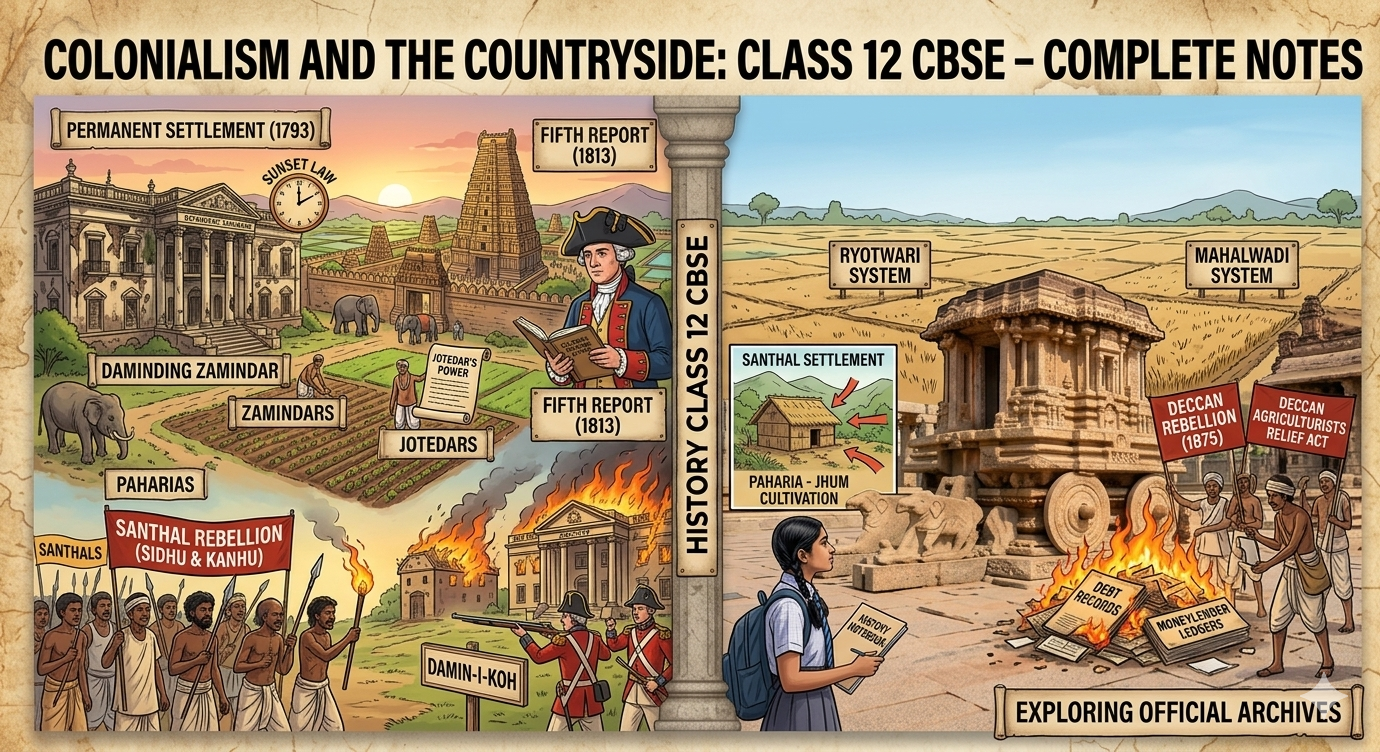
- The Permanent Settlement: Zamindars, Farmers, and the Sunset Law
- Rise of the Jotedars and the Fifth Report
- Ryotwari and Mahalwadi Systems
- Hill Communities: The Paharias and the Santhals
- The Santhal Rebellion (1855–1856) – Colonialism and the Countryside Class 12 CBSE
- The Deccan Rebellion (1875)
- Important Questions – Colonialism and the Countryside Class 12 CBSE
- Quick Revision – Key Points to Remember
- Related Notes on Nextoper – Internal Links
- Useful External Resources – Outbound Links
What Is Colonialism and Why Did It Change the Countryside?
Colonialism refers to a system where a foreign power controls another country’s land, economy, and people — primarily for its own benefit. In India’s case, the British East India Company gradually took control of Indian territories and reshaped existing systems to generate maximum revenue.
The word dehat means villages or rural areas in Hindi and Urdu. When we talk about colonialism and the countryside together, we’re asking: how did British policies affect India’s farmers, villages, and rural communities? The answer is — profoundly and painfully.
Before the British arrived, land revenue systems varied by region and ruler, but they generally allowed some flexibility. The British replaced this with rigid, often extractive systems designed to feed the Company’s treasury. The countryside was never the same again.
[Image: Illustration showing a British revenue collector and Indian farmers in a colonial Bengal village | Alt text: Colonialism and the Countryside Class 12 CBSE – colonial revenue collection in rural Bengal]
The Battle of Plassey and the Beginning of British Control
The Battle of Plassey was fought on 29 June 1757 on the banks of the Ganga River in Nadia district, about 22 kilometres south of Murshidabad. The British East India Company, led by Robert Clive, defeated Siraj-ud-Daulah, the Nawab of Bengal.
This victory was a turning point. Bengal became the first major Indian region to come under direct British rule. From here, the Company built the administrative and revenue machinery that would eventually spread across India.
The defeat wasn’t just military — it was economic. Bengal’s rich agricultural base now became the foundation for British revenue extraction. Understanding Plassey helps you understand why Bengal became the testing ground for every land revenue experiment that followed.
Revenue Systems Under British Rule – Colonialism and the Countryside Class 12 CBSE
After taking control, the British introduced three major land revenue systems across different parts of India. Together, these systems covered almost the entire subcontinent and transformed agrarian relations in each region they touched.
The Permanent Settlement (1793)
Introduced by Lord Cornwallis on 22 March 1793, the Permanent Settlement fixed land revenue permanently. It operated in Bengal, Bihar, Orissa, parts of Uttar Pradesh, Banaras, and North Karnataka — covering about 19% of colonial India’s land.
Under this system, Zamindars (landlords) were recognized as owners of the land and were made responsible for paying a fixed annual tax to the British. The revenue amount was set permanently, meaning it would never increase — which sounded attractive to Zamindars but came with a brutal condition.
The Sunset Law
The Sunset Law was one of the most feared provisions of the Permanent Settlement. If a Zamindar failed to pay the fixed revenue by the set date each year, his land would be auctioned immediately — no extensions, no exceptions. The sun could not set on an unpaid revenue demand.
The consequences were severe. More than 75% of estates changed hands in the early years as Zamindars defaulted and lost their properties. This caused major social disruption in Bengal’s countryside.
Objectives of the Permanent Settlement
The British had clear goals when they designed this system:
- Generate a stable, predictable revenue stream for the Company
- Revive Bengal’s rural economy, which had been devastated by the Famine of 1770
- Encourage investment in agriculture by giving Zamindars a guaranteed stake in the land
- Create a loyal class of landowners who would support British rule politically
These goals were partly achieved. However, they came at a heavy cost to the actual farmers who worked the land.
Impact on Farmers
Under the Permanent Settlement, farmers had no legal rights over the land they cultivated. Zamindars could raise rents freely, and farmers who couldn’t pay faced eviction. High rents pushed most peasants into chronic debt, widening the gap between landlords and cultivators.
The Permanent Settlement: Zamindars, Farmers, and the Sunset Law
The Auction Incident in Burdwan (1797) offers a revealing window into how the Permanent Settlement actually worked in practice. When the King of Burdwan’s property was auctioned for non-payment of revenue, nearly 95% of the bidders turned out to be his own agents — effectively buying back the property in his name. This widespread practice of fake auctions exposed how easily the system could be gamed.
However, not every Zamindar survived. Many who lacked the connections or cash flow to manage fake auctions genuinely lost their estates. A new group of buyers — often merchants and moneylenders — stepped in, creating a reshuffled landed elite with no traditional ties to the villages they now controlled.
Benefits that Zamindars did receive (when the system worked in their favor):
- Hereditary ownership of land, secured legally under British law
- A guaranteed income from tenant rents, as long as they met revenue targets
- Increased political leverage as a British-recognized class of landlords
Rise of the Jotedars and the Fifth Report
As some Zamindars struggled, a new class quietly grew powerful in rural Bengal. Jotedars were wealthy peasants who owned significant amounts of land, engaged in trade, and lent money to struggling farmers. They were rooted in the villages — unlike absentee Zamindars who lived in cities — which gave them far more practical control over local agriculture.
Jotedars often deliberately delayed or withheld revenue payments on behalf of peasants to undermine Zamindari authority. Over time, they became the real power brokers in many Bengali villages.
The Fifth Report (1813) was a document submitted to the British Parliament that exposed serious corruption in the East India Company’s revenue administration. It highlighted how the Permanent Settlement had created problems rather than solved them, and it led to tighter parliamentary oversight of Company operations in India. For your board exam, remember that the Fifth Report is a key primary source historians use to study this period — it’s directly connected to the chapter’s theme of exploring official archives.
Ryotwari and Mahalwadi Systems
Ryotwari System (1792, expanded 1820)
The Ryotwari System established a direct relationship between individual farmers (ryots) and the government — cutting out intermediaries like Zamindars entirely. First introduced in Madras and later expanded by Captain Munro in 1820, it eventually covered Bombay and Assam as well — about 51% of colonial India’s land.
On paper, this seemed fairer. In practice, revenue demands were extremely high and reassessed periodically. Farmers who couldn’t pay had their land confiscated. The results were devastating: nearly 18 million acres of agricultural land in Madras were left uncultivated as farmers abandoned fields they could no longer afford to work.
Mahalwadi System (1822)
Introduced by Lord Wellesley and applied in Central Provinces, Uttar Pradesh, and Punjab, the Mahalwadi System made village headmen (mahaldars) responsible for collecting and submitting the village’s total revenue. This covered roughly 30% of India’s land.
The burden fell on entire village communities rather than individuals. Heavy tax demands caused widespread poverty and land loss. Historians connect the Mahalwadi System’s harsh impact in central and northern India to the growing resentment that contributed to the Revolt of 1857.
Hill Communities: The Paharias and the Santhals
The British didn’t just reshape agricultural plains — they also disrupted the lives of hill and forest communities who had lived outside mainstream agricultural systems for centuries.
Francis Buchanan, a Scottish doctor and surveyor who studied Indian agriculture and society between 1794 and 1815, described the Rajmahal Hills as a remote and challenging terrain. The people living there — the Paharias — practiced jhum cultivation (also called shifting agriculture), moving between plots seasonally. They also gathered forest produce, hunted, and reared silkworms.
British policies promoting the clearing of forests for permanent farming directly threatened the Paharia way of life. New settlers — especially Santhals — were encouraged to move into these hills and establish permanent villages, pushing Paharias further into marginal land.
[Image: Map showing the Rajmahal Hills and Damin-i-Koh region in Bengal | Alt text: Colonialism and the Countryside Class 12 CBSE – Rajmahal Hills Santhal settlement map]
The Santhals began settling in the Rajmahal Hills in the early 1800s with British encouragement. They were skilled farmers who cleared dense forest, established villages, and brought land under cultivation. By 1851, the Damin-i-Koh region had over 1,400 Santhal villages and a population of around 82,000. As Santhals prospered, Paharias were systematically displaced.
The Santhal Rebellion (1855–1856) – Colonialism and the Countryside Class 12 CBSE
Despite their initial prosperity, the Santhals soon found themselves trapped in the same cycle of debt and exploitation that affected peasants across India. Landlords, moneylenders, and Company officials extracted whatever the Santhals earned, leaving them with little. The breaking point came in 1855.
Led by brothers Sidhu and Kanhu, the Santhal Rebellion of 1855–56 was a direct uprising against British authority, landlords, and moneylenders. The Santhals declared their territory independent and called on all Santhals to stop paying rent and revenue. At its peak, the rebellion involved tens of thousands of participants.
The British suppressed the revolt militarily, but they could not ignore its message. The aftermath led to the creation of the Santhal Pargana as a separate administrative district, with special laws designed to protect Santhal land rights and govern their communities differently from the rest of Bengal. For board exams, note that this rebellion is an important example of peasant resistance under colonial rule.
The Deccan Rebellion (1875)
The Deccan Rebellion began on 12 May 1875 in Supa village, Pune district, when farmers rose against moneylenders — burning debt records and looting shops. The movement spread rapidly through the Deccan region of Maharashtra.
Causes
Several pressures combined to ignite this uprising:
- High land taxes under the Ryotwari system left farmers with almost nothing after paying the government
- Exploitation by Marwari and Gujarati moneylenders who charged extreme interest rates and seized land as collateral
- The American Civil War (1861–65) had temporarily boosted Indian cotton exports; when the war ended, cotton prices collapsed, wiping out farmers who had taken loans based on those high prices
Leadership and Outcome
The rebellion was associated with reformers including Vasudev Balwant Phadke and received moral support from figures like Justice M.G. Ranade. The British responded by forming the Deccan Riots Commission to investigate the causes. This eventually led to the Deccan Agriculturists Relief Act of 1879, which gave farmers some legal protection against moneylender exploitation and helped restore lands that had been seized unfairly.
Important Questions – Colonialism and the Countryside Class 12 CBSE
Q1. What was the Sunset Law under the Permanent Settlement? (1 Mark) The Sunset Law required Zamindars to pay their fixed annual land revenue by a set date; failure meant immediate auction of their estate.
Q2. What were the main causes of the Santhal Rebellion of 1855–56? (3 Marks) The Santhals had initially prospered as settlers in the Rajmahal Hills, but gradually fell into debt traps set by moneylenders and faced exploitation by landlords and Company officials. Their earnings were extracted through high rents and unfair interest rates, leaving them in poverty despite their labor. Brothers Sidhu and Kanhu led the rebellion against British authority, landlords, and moneylenders, demanding land rights and an end to exploitation. Though the revolt was suppressed, it resulted in the creation of the Santhal Pargana with special protective legislation for Santhal communities.
Q3. Explain the objectives and consequences of the Permanent Settlement of 1793. (5 Marks) The Permanent Settlement was introduced by Lord Cornwallis on 22 March 1793 with several goals: to create a stable revenue source for the Company, revive Bengal’s rural economy after the devastating Famine of 1770, encourage Zamindars to invest in agriculture, and build a loyal class of landowners who would support British rule. Under the system, Zamindars were recognized as hereditary landowners and asked to pay a fixed revenue permanently. The Sunset Law ensured that failure to pay by the deadline led to immediate auction of the estate. While Zamindars benefited from legal ownership and guaranteed income, the system devastated ordinary farmers, who lost land rights, faced rising rents, and fell into debt. More than 75% of estates changed hands in early years, causing social disruption. A new class of Jotedars — wealthy peasants who were locally present — emerged to fill the power vacuum left by absentee Zamindars, further complicating rural power structures.
Q4. Who were the Jotedars and what role did they play in rural Bengal? (3 Marks) Jotedars were a class of prosperous peasants who emerged in Bengal during the late 18th century. They owned substantial land, engaged in trade, and lent money to poorer farmers, giving them economic dominance in their villages. Unlike Zamindars, who often lived in towns, Jotedars were based in the villages and had direct control over local agriculture. They sometimes deliberately delayed revenue payments to undermine Zamindari authority. Over time, they became the most influential group at the village level in rural Bengal.
Q5. What was the significance of the Fifth Report of 1813? (1 Mark) The Fifth Report, submitted to the British Parliament in 1813, exposed corruption in the East India Company’s revenue administration and led to stricter parliamentary oversight of Company operations in India.
Quick Revision – Key Points to Remember
- The Battle of Plassey (1757) gave the British control over Bengal, making it the first region under direct British colonial rule.
- The Permanent Settlement (1793) fixed land revenue permanently and recognized Zamindars as hereditary landowners under Lord Cornwallis.
- The Sunset Law required Zamindars to pay revenue by a fixed date or face immediate auction of their land.
- Over 75% of estates changed hands in early years of the Permanent Settlement due to defaults and the Sunset Law.
- Jotedars were wealthy village-based peasants who emerged as a new power class in rural Bengal, often at the expense of absentee Zamindars.
- The Fifth Report (1813) is a crucial primary source that exposed Company corruption and is central to the chapter’s theme of official archives.
- The Ryotwari System created a direct government-farmer revenue link and covered 51% of colonial India; the Mahalwadi System covered 30% through village headmen.
- The Paharias practiced shifting agriculture in the Rajmahal Hills and were displaced by Santhal settlers encouraged by the British.
- The Santhal Rebellion (1855–56), led by Sidhu and Kanhu, resulted in the creation of the Santhal Pargana with special protective laws.
- The Deccan Rebellion (1875) began in Supa village, Pune and led to the Deccan Agriculturists Relief Act (1879), protecting farmers from moneylender exploitation.
Related Notes on Nextoper
Explore these related CBSE notes on Nextoper to strengthen your board exam preparation:
- Class 12 History Notes: Chapter 1 Bricks, Beads and Bones
- Class 12 History Notes Chapter 1 Bricks, Beads and Bones in Hindi
- Class 12th History Part2 Chapter 7 – An Imperial Capital: Vijayanagara
These Colonialism and the Countryside Class 12 CBSE notes cover every topic from Chapter 10, Part 3 of your History textbook. Read through once to understand the big picture, then use the Quick Revision section before your exam to lock in the key facts. All the best for your boards!


Pingback: Class 12th History Chapter 7 Part 2– Vijayanagara Notes
Keep functioning ,remarkable job!
Pingback: NCERT Class 12 History Chapter 15 Framing the Constitution PDF Notes | Nextoper Notes - Nextoper
Pingback: CBSE Class 12 History Chapter 14 PDF Notes | Understanding Partition Politics, Memories, Experiences Notes - Nextoper
More on our website sapreqot.com
Outstanding post, you have pointed out some good points, I also think this s a very good website.
Choose secure payment gateway for igaming for a gaming project. Gateway helps organize automating payment transactions. As part of the integration provided local payment methods. Connection is carried out using ready-made tools. When comparing solutions it is recommended to consider terms of service. Receive connection terms taking into account the platform features. Contact our specialists online and learn the integration procedure.
Удобно через браузер эфир радио дача онлайн без регистрации. В эфире собраны современные композиции. Запускайте эфир в дороге. Включайте любимые композиции на любом устройстве в несколько кликов.
An informative online resource healthfare restaurants covering health, balanced nutrition, and daily wellness. Readers can find practical guides on food choices, along with useful recommendations. The site also offers product reviews. Special attention is given to healthier routines, diet and nutrition, daily activity, personal care, and a healthier lifestyle.
Получить сопровождение услуги по охране труда аутсорсинг для малого бизнеса. Профессиональные консультанты осуществляют комплекс обязательных мероприятий. При комплексном обслуживании включается проведение инструктажей. Необходимая документация актуализируются в соответствии с поставленными задачами. При возникновении задачи часть функций передается на сопровождение. Передача функций на аутсорсинг обеспечивает условия для снизить нагрузку на сотрудников. Работодателю не придется самостоятельно заниматься всеми вопросами. Запросите индивидуальный расчет исходя из задач компании. Оставьте заявку онлайн и выберите подходящий формат сопровождения.
The use of dye a flag, lighting and empty space can completely exchange how a arcane visual spot is perceived. I ground this article particularly inviting because it examines a few reasonable draft choices and explains how they mastery mood and attention. The powwow about designing ambiguity pigment moonlight negative space provides a functional vantage point on contemporary digital aesthetics. Thanks in place of publishing it.
Check out new https://www.hoshi-uranai.org for your sign. Learn forecast communication. Plan your day taking into account the forecast.