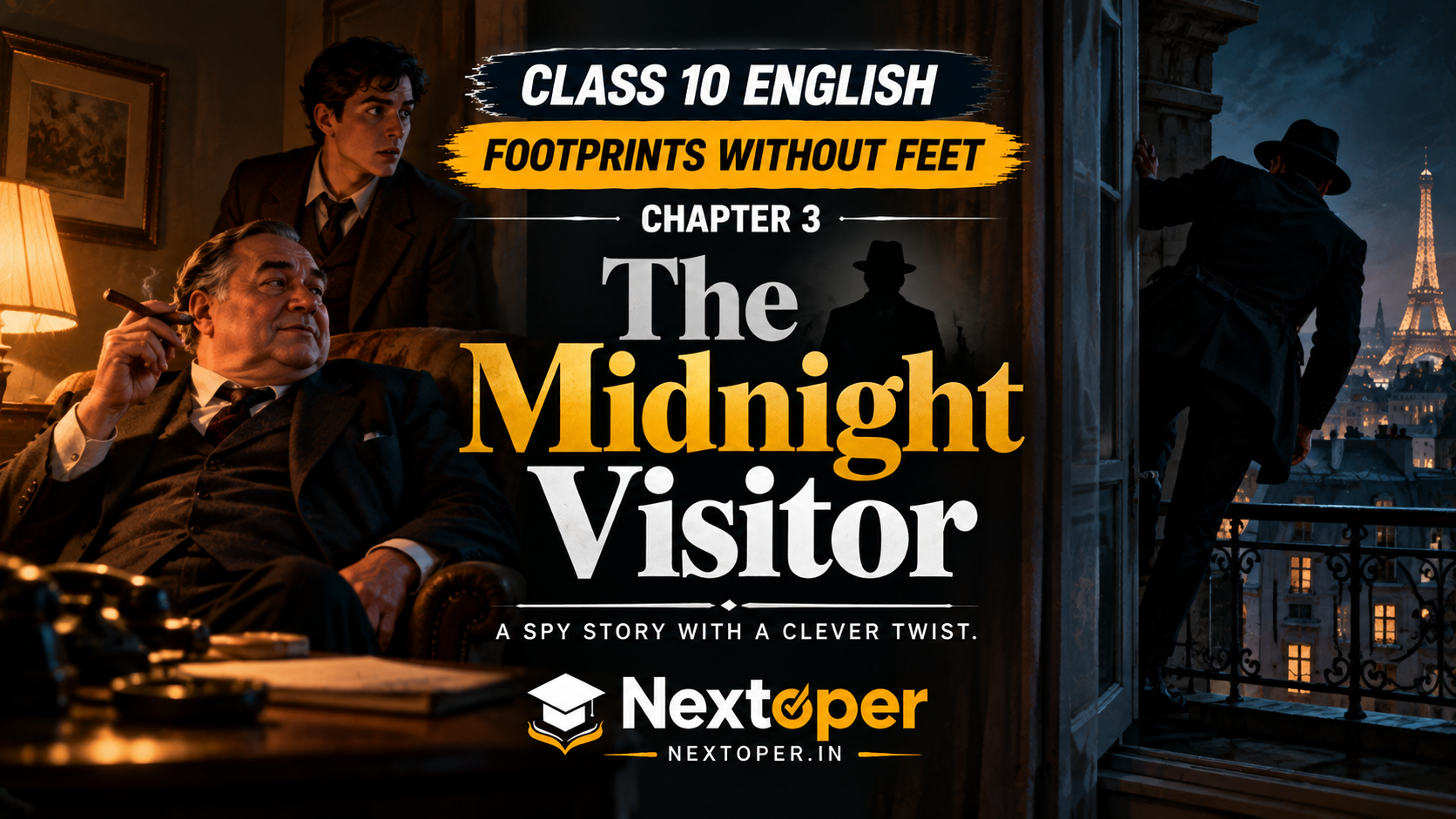
CBSE Class 10 English Chapter 3 PDF Notes: The Midnight Visitor Summary, Characters, Themes and Questions | Nextoper Notes
Class 10 English Chapter 3 Overview
The Midnight Visitor is a short spy story by Robert Arthur. It is Chapter 3 of Footprints without Feet. The whole story happens in one small hotel room in Paris.
The story is told through Fowler’s eyes. So you learn the truth only when he does. That is why the ending feels like a surprise.
| Item | Detail |
|---|---|
| Chapter | 3 – The Midnight Visitor |
| Book | Footprints without Feet (Class 10 English) |
| Author | Robert Arthur |
| Genre | Spy story with a twist ending |
| Setting | Ausable’s room, sixth floor of a French hotel |
| Time | Night. The report is due at twelve-thirty |
| Main characters | Ausable, Fowler, Max |
| Small role | Henry, the waiter |
| Core idea | Presence of mind beats a pistol |
In one line: a fat, unglamorous spy beats an armed rival using only words. No fight happens. No shot is fired.
Class 10 English Chapter 3 Summary, Step by Step
Read the story in five short stages. Each stage ends with a small shift in power. By stage five, the weakest-looking man is in charge.
Stage 1: A disappointing spy
Fowler is a young writer. He wants to meet a real secret agent. He expects danger, pistols and mystery.
Ausable disappoints him. He is very fat. He has a Boston accent, even after twenty years in Paris. His room is small, on the sixth and top floor of a gloomy hotel.
Ausable reads Fowler’s mind. He says Fowler spent a dull evening in a music hall. Then he promises a paper that may change the course of history.
Stage 2: The man with a pistol
Ausable closes the door and switches on the light. A man stands halfway across the room. He holds a small automatic pistol.
Ausable knows him. He is Max, a rival agent. Ausable thought Max was in Berlin.
Max is slender, with a face like a sharp-nosed fox. He wants the report about new missiles. It will arrive that night.
Stage 3: The balcony story
Ausable sits down heavily in an armchair. He grumbles about the hotel management. He says someone entered through a balcony. It is the second time this month.
Max says he used a passkey instead. He did not know about any balcony. Ausable then explains the balcony in detail.
His room was once part of a large unit. The next room was the living room. The balcony belongs to that room and runs under his window. A person can reach it from an empty room two doors down.
Max orders Fowler to sit. They must wait half an hour. Ausable corrects him: thirty-one minutes.
Stage 4: The knock
Someone knocks at the door. Ausable stays calm. He says it must be the police. He claims he asked them to check on him, as the report is so important.
Ausable then turns the pressure on Max. The door is unlocked. If he does not answer, the police will enter. They will not hesitate to shoot.
Max backs towards the window. He swings a leg over the sill. He plans to wait on the balcony and orders Ausable to send the police away.
Stage 5: The twist
The knocking grows louder. Someone calls, “Mr Ausable!” The doorknob turns. Max pushes off from the sill and drops. He screams once, shrilly.
The door opens. A waiter enters with a tray, a bottle and two glasses. He says the drink was ordered for when Ausable returned. He uncorks the bottle and leaves.
Fowler stammers about the police. Ausable says there were no police. It was only Henry, whom he was expecting.
Fowler asks about the man on the balcony. Ausable replies that he will not return. There is no balcony.
The text never describes Max’s fate. But the room is on the sixth floor. The fall was clearly serious.
Ausable’s Plan: Two Lies and One Truth
Here is a memory trick you will not find in most notes. Think of B-P-W: Balcony, Police, Waiter. The balcony is a lie. The police are a lie. The waiter is the truth.
Ausable mixes real events with false ones. That is why the plan works. The table shows how each move affects Max.
| Ausable’s move | True or false? | Effect on Max |
|---|---|---|
| A balcony under the window | False | Gives Max a hiding place |
| “Second time this month” | False | Sounds like a routine complaint |
| Police told to check on him | False | Max fears arrest and shooting |
| The knock at the door | True (Henry) | Max reads it as the police |
| A drink ordered “for when you returned” | True | Shows Ausable expected the waiter |
Why does the balcony story sound true?
Four things make the lie work. Learn them for any “convincing story” question.
- Detail. He names the next apartment and the old large unit. He adds the empty room two doors down.
- Acting. He sounds irritated with the management, not scared. Annoyance feels real.
- Timing. The knock comes right after the police claim. Max has no time to think.
- Max’s own gap. Max admits he did not know about the balcony. So he cannot check the story.
Planned or improvised?
NCERT asks when Ausable made his plan. The best answer says both. He had a safety habit: a drink ordered, a waiter expected. But he could not know Max would be in his room.
So he improvised the balcony and police lies. Then he used the waiter’s real arrival as the final trigger. Write both views in your answer and you cover the whole question.
Character Sketches
Every character in this story is built on a contrast. Looks and reality do not match. Keep a proof line ready for each trait.
Ausable
Ausable is an American secret agent in Paris. He came from Boston twenty years ago. He is very fat and breathes wheezily.
- Calm. He sits down heavily in an armchair with a gun pointed at him.
- Observant. He notices Max’s gaps in knowledge and uses them.
- Quick-witted. He invents a full balcony story in seconds.
- Humorous. He corrects “half an hour” to “thirty-one minutes”.
- Prepared. He has ordered a drink and expects his waiter.
Max
Max is a rival agent. He is slender, with a fox-like face. Apart from the gun, nothing about him looks menacing.
- Dangerous but hasty. He arrives armed but does not check the building.
- Overconfident. He breaks in with a passkey and expects an easy win.
- Nervous. He bites his lip at the first knock.
- Gullible under stress. He believes a story he cannot verify.
Fowler
Fowler is a young, romantic writer. He wants adventure for his stories. He gets it, but not the way he imagined.
- Naive. He judges Ausable by his looks.
- Nervous. He jumps at the knock and turns white-faced.
- The reader’s stand-in. He is as confused as you are until the end.
Henry, the waiter
Henry appears for a few lines. He knows nothing about the plot. Yet his arrival ends it. He is the one true event in Ausable’s plan.

Themes and Message
The chapter carries a few clear ideas. Each one can become a value-based answer.
Brain over brawn
Max has the pistol. Ausable has the mind. The mind wins without any violence.
Presence of mind
The NCERT page defines it as thinking quickly and acting calmly in danger. Ausable never loses his calm. Max loses his in a few seconds.
Appearances deceive
Fowler expects a glamorous spy. He gets a fat, wheezing man. The least impressive person in the room is the cleverest.
Panic makes people careless
Max never checks the window. He never asks to see the balcony. Fear makes him jump first and think later.
Preparation helps
The Talk about it task says presence of mind comes from mental preparation. Ausable had thought about danger before it arrived. That is why he looked so calm.
Literary Devices and the Title
Examiners like short, precise points on style. Use these with one example each.
- Irony. The dull, fat man is the sharpest spy in the room.
- Suspense. The thirty-one-minute wait and the knock keep you tense.
- Twist ending. The last line reveals that the balcony never existed.
- Foreshadowing. Ausable promises “drama” just before Max appears.
- Humour. Max says the report will be “safer in my hands”.
- Dialogue-driven plot. Almost everything happens through talk.
A note on dramatic irony. Many websites label this story as dramatic irony. That is not quite right. The reader does not know the balcony is a lie. You learn it with Fowler. A safer label is “twist ending”.
Why is the story called The Midnight Visitor?
The visitor is Max. He enters the room uninvited at night. His visit drives the whole plot. The title also hints at danger and secrecy.
Glossary: Word Meanings
These words come from the NCERT glossary and the story. Learn them as pairs. They help in vocabulary and extract questions.
| Word | Meaning |
|---|---|
| romantic | fond of adventure and fantasy |
| passably | well enough, but not perfectly |
| espionage | spying |
| sloppy | untidy in dress |
| prosaic | plain and dull |
| chuckled | laughed softly |
| wheezed | spoke with noisy, heavy breath |
| missiles | weapons that are guided or fired automatically |
| shrilly | in a sharp, high voice |
| musty | smelling stale and damp |
| disillusioned | let down after losing a false hope |
| countenance | face or expression |
| passkey | a key that opens many doors |
| sill | the ledge at the bottom of a window |
| deftly | with quick, skilled movements |
NCERT Questions and Answers
These answers follow the textbook questions in order. Each one is short enough for the exam. Write them in your own words as well.
Read and Find Out
1. How is Ausable different from other secret agents?
Ausable looks nothing like a story-book spy. He is very fat and has a Boston accent. He lives in a small room in a gloomy hotel.
His work is dull too. He gets only a plain phone call, not secret messages from beautiful strangers. His real weapon is his mind.
2. Who is Fowler, and what is his first authentic thrill of the day?
Fowler is a young, romantic writer. He wants to meet a real secret agent. His first real thrill comes when the light goes on. A man with a small pistol stands in the room.
3. How has Max got in?
Max says he got in with a passkey. He admits he did not know about any balcony. That admission helps Ausable’s plan.
4. How does Ausable say he got in?
Ausable says Max must have used the balcony. He claims it belongs to the next apartment. He adds that someone entered the same way last month. None of this is true.
Think about it
1. What do secret agents in books and films look like?
Fictional spies are usually tall, handsome and stylish. They use gadgets and take daring risks. James Bond is the best-known example.
Some detectives break the mould. Feluda, created by Satyajit Ray, looks like an ordinary gentleman. Ausable goes even further. He looks like the opposite of a hero.
2. How does Ausable make Max believe in the balcony? What makes it convincing?
Ausable gives a detailed history of the room. He says it was once part of a large unit. He names the next apartment and the empty room two doors down.
He also sounds annoyed, not afraid. And Max has no way to check. The police claim then adds fear, which stops Max from thinking.
3. When did Ausable think up his plan? Was it detailed from the start?
The plan was partly prepared and partly improvised. Ausable had ordered a drink and expected his waiter. That was his safety net.
But he could not know Max would be waiting. So he made up the balcony and police lies on the spot. He used each event as it came.
Talk about it
1. Give an example of presence of mind.
Sample answer: A boy sees oil in a pan catch fire. He switches off the gas at once. He covers the pan with a lid and does not pour water. His calm action stops the fire from spreading.
2. What would you do in these situations?
NCERT asks you to discuss six situations. Use these safe first steps as a base. Add your own points in class.
| Situation | First action |
|---|---|
| Small fire in the kitchen | Switch off the gas. Cover the pan with a lid. Never pour water on an oil fire. |
| Child chokes on food | Call for adult help and an ambulance at once. Use first-aid steps if you have learned them. |
| Appliance hisses and sparks | Switch off the main power. Stay away. Call an electrician. |
| Bicycle hits a pedestrian | Stop and help them up. Check for injuries. Call for help if needed. |
| Rain for over 24 hours | Stay indoors. Avoid flooded roads. Keep phones charged and follow local alerts. |
| Family member is late | Phone them first. Then call friends or the place they visited. Tell an elder. |
Beyond the story: Haiku and suggested reading
The 2026-27 reprint adds two extras after the questions. One is a Haiku box featuring Matsuo Basho and Issa. A haiku is a Japanese poem of three short lines. Its themes are nature, feelings or experiences.
The other is a Suggested reading list. It names “After Twenty Years” by O. Henry, “The Stolen Bacillus” by H.G. Wells and “The Face on the Wall” by E.V. Lucas. These are not exam topics. But they make good weekend reading.
MCQs with Answers
Try each question first. Then tap to check the answer.
Q1. Where is Ausable’s room?
a) Ground floor b) Third floor c) Sixth and top floor d) Basement
Show answer
c) Sixth and top floor
Q2. Which city did Ausable come from in America?
a) New York b) Boston c) Chicago d) Washington
Show answer
b) Boston
Q3. How long has Ausable lived in Paris?
a) Two years b) Ten years c) Twenty years d) Thirty years
Show answer
c) Twenty years
Q4. What is Fowler’s profession?
a) Police officer b) Writer c) Waiter d) Doctor
Show answer
b) Writer
Q5. Where did Ausable think Max was?
a) Berlin b) London c) Rome d) Boston
Show answer
a) Berlin
Q6. How does Max say he entered the room?
a) Through the balcony b) With a passkey c) Through the roof d) Through the window
Show answer
b) With a passkey
Q7. What is the report about?
a) New missiles b) Hotel bills c) A bank robbery d) A lost painting
Show answer
a) New missiles
Q8. At what time was the appointment?
a) Midnight b) Twelve-thirty c) One o’clock d) Eleven o’clock
Show answer
b) Twelve-thirty
Q9. Who knocked at the door?
a) The police b) The hotel manager c) Henry, the waiter d) Fowler’s friend
Show answer
c) Henry, the waiter
Q10. What does Ausable finally say about the balcony?
a) It is broken b) It belongs to Max c) It is very old d) There is no balcony
Show answer
d) There is no balcony
Quick Revision: Last-Minute Notes
This is your two-minute scan. Read the facts first. Then the memory trick. Then the character table.
Ten facts to remember
- Author: Robert Arthur. Book: Footprints without Feet.
- Ausable is American, from Boston, and fat.
- He has lived in Paris for twenty years.
- His room is on the sixth and top floor.
- Fowler is a young, romantic writer.
- Max is slender and fox-faced. He holds a small automatic pistol.
- Max wants a report about new missiles.
- Max entered with a passkey.
- The appointment is at twelve-thirty. Ausable says thirty-one minutes remain.
- The knock is Henry the waiter. There is no balcony.
Memory trick
B-P-W: Balcony (lie), Police (lie), Waiter (truth). Say it before the exam.
Character snapshot
| Character | Key trait | Proof |
|---|---|---|
| Ausable | Calm and clever | Invents the balcony under a gun |
| Max | Hasty and gullible | Jumps without checking |
| Fowler | Naive and romantic | Judges Ausable by his looks |

One-line theme
Calm thinking beats force, and looks can fool you.
Board-Style Practice Questions
These questions follow the style of board papers. They are practice questions written by us. Check the latest CBSE sample paper for the exact marks and word limits.
Short answers (about 30–40 words)
- Why did Fowler feel let down at the start of the story?
- How does Ausable explain the balcony to Max?
- Why did Max choose to leave through the window?
- Who was at the door, and why does it matter?
Hints for the short answers
1. He expected a glamorous spy. He found a fat man in a dull hotel room.
2. He says it belongs to the next apartment. He adds that someone used it last month.
3. He thought the police were at the door. He wanted to hide on the balcony.
4. It was Henry the waiter. His arrival was real. Max wrongly took him for the police.
Long answers (about 100–120 words)
- Write a character sketch of Ausable.
- “Presence of mind is stronger than a pistol.” Discuss with reference to the story.
- Was Ausable’s plan prepared or improvised? Give reasons.
Model answer: How did Ausable outwit Max?
Ausable faced an armed rival. He did not panic. He invented a balcony outside his window. He gave real-sounding details about the next apartment.
Then a knock came at the door. Ausable said it was the police. He warned that they would shoot. Max feared arrest and climbed out to hide on the balcony.
The knock was only Henry, the waiter. There was no balcony. Ausable beat Max with calm, clear thinking and perfect timing.
The Midnight Visitor in Plain Words
The Midnight Visitor is a short story by Robert Arthur. It is about a secret agent named Ausable. A rival spy called Max breaks into his Paris room. Max demands a secret report. Ausable invents a balcony and a police visit. Max panics and jumps from the sixth-floor window. The story shows that calm thinking beats force.
Frequently Asked Questions
Who is Ausable in The Midnight Visitor?
Ausable is an American secret agent living in Paris. He is very fat, speaks with a Boston accent and looks nothing like a movie spy. Yet he is calm, observant and quick-witted. He defeats an armed rival named Max using only clever lies and perfect timing.
How did Ausable outwit Max?
Ausable invented a balcony outside his window and said the police had been told to check on him. When a knock came, Max panicked and climbed out to hide on the balcony. The knock was only a waiter named Henry. There was no balcony, so Max dropped from the sixth floor.
Is there really a balcony in The Midnight Visitor?
No. Ausable invents the balcony to fool Max. He says it belongs to the next apartment and that someone used it last month. The room has only an ordinary window. Ausable reveals the truth at the end when he tells Fowler there is no balcony.
Who knocked at the door in The Midnight Visitor?
The knock came from Henry, a hotel waiter. He brought the drink Ausable had ordered for when he returned. Ausable was expecting him. Max wrongly believed the visitor was the police, because Ausable had just said they would check on him. This misunderstanding made Max panic and flee.
What is the theme of The Midnight Visitor?
The main theme is that presence of mind beats force. Ausable stays calm under a gun and thinks faster than Max. The story also warns against judging people by looks, as Fowler does. It shows that panic makes even armed people careless.
To Sum Up
These Class 10 English Chapter 3 notes give you the story and the plan behind it. They also give you exam-ready points. Remember B-P-W. Remember that Ausable’s weapon is his mind.
Max had the gun. Ausable had calm and timing. That is why the fat, wheezing man wins.
More Class 10 English Notes
- Class 10 English Chapter 2 Notes: The Thief’s Story (previous chapter)
- Class 10 English A Triumph of Surgery PDF Notes (previous chapter)
- Footprints without Feet: all chapter notes
About the Author
Nextoper Editorial Team. We write free CBSE study notes for Classes 9 to 12. Each note is checked line by line against the NCERT textbook. If you spot a mistake, tell us and we will fix it.
Last updated: 2 October 2026. Checked against the NCERT Reprint 2026-27 edition of Footprints without Feet. Board exam rules can change, so always confirm with the latest CBSE circulars.