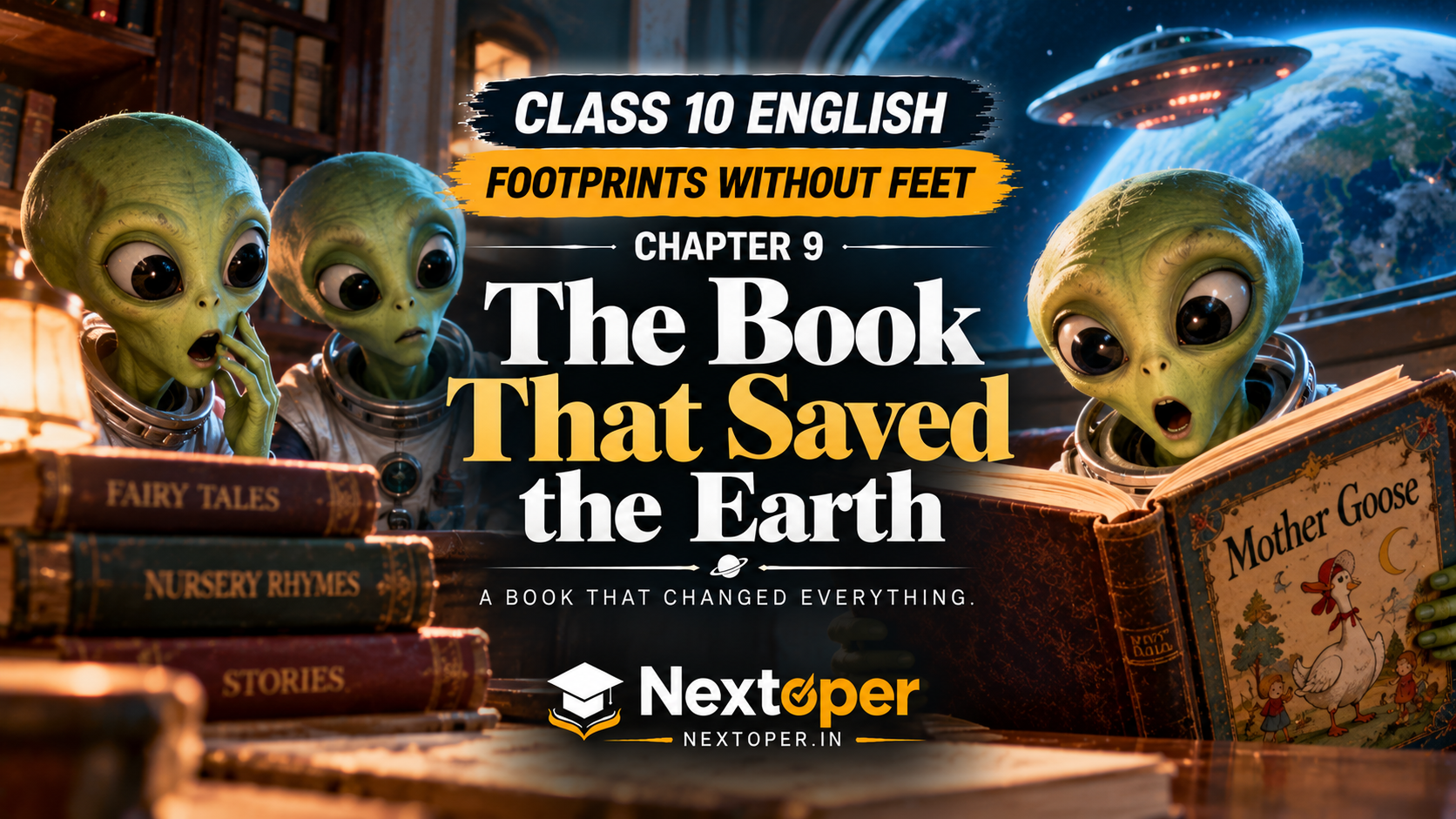
CBSE Class 10 English Chapter 9 PDF Notes The Book That Saved the Earth Notes 2026-27 | Nextoper Notes
Short on time? The quick revision box has the five facts and two memory tricks you need.
What is Chapter 9 of Class 10 English Footprints without Feet about?
Chapter 9 of Footprints without Feet is the play The Book That Saved the Earth. This comic science-fiction play, by Claire Boiko, runs from page 56 to 67. Martians plan to invade Earth in 2040, but a book of rhymes stops them.
Save Free Notes PDF – No Signup Needed! Click Here to Save
Footprints without Feet is the NCERT supplementary reader for Class 10 English. The Book That Saved the Earth is its ninth and last chapter. Older notes call it Chapter 10, because the old edition had ten chapters.
| Detail | Fact |
|---|---|
| Chapter name | The Book That Saved the Earth |
| Chapter number | 9 (2026-27 NCERT edition, pages 56 to 67) |
| Book | Footprints without Feet (supplementary reader) |
| Author | Claire Boiko |
| Type | Play with two scenes and a Historian who frames the story |
| Characters | Historian, Think-Tank, Noodle, Omega, Iota, Oop, Offstage Voice |
| Frame time | The twenty-fifth century, in the Museum of Ancient History |
| Story time | The year 2040 |
| Key book | Mother Goose, a well-known book of nursery rhymes in English |
| Central idea | Pride without knowledge fails; books carry power |
What is the summary of Class 10 English Chapter 9 The Book That Saved the Earth?
A Historian in the twenty-fifth century shows how a book stopped the 2040 invasion. Martian leader Think-Tank sends a crew to Earth, and they misread books in a library. A Humpty Dumpty picture scares Think-Tank, and he orders every Martian to flee.
Scene 1: The Historian and Mars Space Control
The Historian welcomes you to the Museum of Ancient History, Department of the Twentieth Century. She calls the twentieth century the Era of the Book. Books then covered every subject, from anteaters to Zulus.
She switches on her historiscope to show the invasion of 2040. The scene shifts to Mars Space Control. There, Think-Tank sits like a king, and Noodle serves him at a switchboard.
Think-Tank demands a full salutation. He then asks his mirror who is the most gifted being. The mirror says it is him, and he smacks it for being slow.
Next, he orders Noodle to contact the space probe. He wants to invade Earth before lunch.
Scene 2: The crew in the Centerville Public Library
Captain Omega, Lieutenant Iota and Sergeant Oop reach Earth in Probe One. They shelter in the Centerville Public Library. Iota counts two thousand strange items, and Oop wonders if they are hats.
Think-Tank studies a book through his goggles. He declares the room a refreshment stand and the books sandwiches. He orders the crew to eat one.
Omega passes the order to Iota. Iota passes it to Oop, who bites a corner and pretends to chew. He reports that it is as dry as Martian dust.
Noodle then recalls surveyor films. Earthlings did not eat these things; they used them to communicate.
Think-Tank claims this was his next point. He tells the crew to listen to the books.
Nobody hears a thing. Noodle remembers that Earthlings opened the books and watched them. Think-Tank announces that this is eye communication.
The rhymes and the panic
Omega picks up a large volume of Mother Goose. The crew sees pictures and a strange code of lines, squiggles and dots. Think-Tank tells them to swallow their intelligence vitamins and decipher it.
Omega reads Mistress Mary. Think-Tank decides that Earthlings can grow silver and shells. He thinks they can grow explosives too.
Iota reads Hey Diddle Diddle. Think-Tank fears trained animals and a space attack by millions of cows.
Oop reads Humpty Dumpty and turns the picture around. Think-Tank screams that it looks like him. He sees the great fall as a plan to capture him and Mars Central Control.
He orders the crew to leave Earth and remove every trace. He then orders the whole planet of Mars evacuated. They will head for Alpha Centauri.
The ending
The Historian returns, chuckling. She says contact resumed in the twenty-fifth century, and Earthlings and Martians became friends. Think-Tank had been replaced by Noodle.
Earthlings taught the Martians the difference between sandwiches and books. They also taught them to read and built a model library in Marsopolis. Still, one book the Martians cannot bring themselves to read is Mother Goose.
Who are the characters in The Book That Saved the Earth?
Seven characters appear: the Historian, Think-Tank, Noodle, Omega, Iota, Oop and an Offstage Voice. Think-Tank is the proud commander of Mars, and Noodle is his clever helper. Omega, Iota and Oop are the crew who land on Earth in Probe One.
| Character | Role | Key traits and proof |
|---|---|---|
| Historian | Narrator in the twenty-fifth century | Humorous and proud of history; she opens and closes the play |
| Great and Mighty Think-Tank | Commander-in-Chief of Mars Space Control | Vain and bossy; consults a mirror and insists he is never wrong |
| Apprentice Noodle | Think-Tank’s helper at the switchboard | Observant and tactful; corrects his boss with soft hints |
| Captain Omega | Leader of the Probe One crew | Obedient; passes the order to eat the book down the ranks |
| Lieutenant Iota | Second in the crew | Quick to dodge a risk; hands the book to Oop |
| Sergeant Oop | Lowest in rank | Funny and honest; wears a book as a hat and reports the taste |
| Offstage Voice | The voice in Think-Tank’s mirror | Flatters him; answers “You, sir” |
Character sketch of Think-Tank
Think-Tank is the proud Commander-in-Chief of Mars Space Control. He loves his huge egg-shaped head and calls it his balloon brain. He admires himself in a mirror and insists he is never wrong.
His pride makes him guess wildly. His fear makes him run. He is funny because he is sure he is clever while he makes mistakes.
Character sketch of Noodle
Noodle is Think-Tank’s apprentice. He watches closely and remembers the surveyor films. He is also tactful, because he fixes his boss’s mistakes without hurting his pride.
By the twenty-fifth century, Noodle has replaced Think-Tank as ruler of Mars. The Historian calls him a very clever Martian.
What are the themes of The Book That Saved the Earth?
The main theme of this play is that pride without real knowledge is dangerous. The play also shows how misreading information leads people to the wrong conclusions. It praises reading as real power and shows how fear silences the truth.
Pride without knowledge
Think-Tank says he is never wrong, yet he makes a new mistake every few lines. His crew repeat his slogan on command. So nobody stops him.
Misreading and jumping to conclusions
The Martians read the words but ignore the meaning. Silver bells become mined metal, and a cow over the moon becomes a cow army. Context decides meaning.
The power of books and reading
The Historian calls the twentieth century the Era of the Book. One book saves a whole planet. At the end, Earthlings teach the Martians to read, which hints that reading builds peace.
Fear of the boss
The crew says “It shall be done, sir” even when they are confused. Noodle finds a safe way to speak up. The play shows how fear can stop good advice.
What are the difficult words in The Book That Saved the Earth?
The chapter glossary lists eleven words, from easel and Zulus to haberdashery and levity. Learn each word together with the line in the play where it appears. This table gives a simple meaning and shows how the play uses every word.
| Word | Meaning | How the play uses it |
|---|---|---|
| easel | A wooden stand that holds a board or picture | A sign on an easel names the museum department |
| Zulus | An ethnic group of South Africa | The Historian says there were books about everything, even Zulus |
| apprentice | A learner who works for a trainer in return for teaching | Noodle is Think-Tank’s apprentice |
| peevishly | In an irritable way | Think-Tank scolds Noodle about the salutation |
| riffling | Flipping through pages quickly | Oop riffles the pages of a book and shakes his head |
| barn | A covered building for storing hay | Iota thinks the library is a storage barn |
| haberdashery | A shop that sells small clothing items such as pins and cotton | Oop jokes the library is a haberdashery after wearing a book as a hat |
| squiggles | Wavy or scribbled marks | Oop describes the printed code as lines, squiggles and dots |
| decipher | To work out the meaning of something puzzling | Think-Tank orders the crew to decipher the code |
| transcribe | To write out in full | Think-Tank asks each crew member to transcribe a rhyme |
| levity | Lack of seriousness about serious matters | Think-Tank scolds the crew for laughing at the rhymes |
How did Think-Tank get it wrong at each step?
In the play, Think-Tank guessed that books were food, then sound devices, then eye devices. Noodle corrected the first two guesses with soft, tactful hints about Earthlings. After that nobody corrected him, so his pride and fear took over the play.

| Step | What Think-Tank says | What is true | Who puts him right |
|---|---|---|---|
| 1 | Books are sandwiches in a refreshment stand | Books are for reading, and Oop’s taste test fails | Oop’s report and Noodle’s film memory |
| 2 | They are communication sandwiches you listen to | Books make no sound | Noodle recalls Earthlings opened and watched them |
| 3 | They are for eye communication | Closer to the truth, because books are read | Noodle’s hint leads him there |
| 4 | Mistress Mary proves Earthlings grow metals and explosives | It is a simple garden rhyme | Nobody |
| 5 | Hey Diddle Diddle proves trained animals and a cow attack | It is a nonsense rhyme for children | Nobody |
| 6 | Humpty Dumpty is me, and a great fall means an attack | It is a rhyme about an egg | Nobody |
Two memory tricks
ELLC gives the order of the guesses: Eat, Listen, Look, Crack the code. Think “Every Little Lesson Counts”.
MHH gives the three rhymes: Mary means Metals, Hey Diddle means Hooves, Humpty means Head.
Why these lines matter
- “Think-Tank is never wrong.” The crew repeats it on command. It shows that fear, not belief, rules the Martians.
- “Era of the Book.” This phrase sets up the theme. Books are power, and the Martians do not have them.
- “An insignificant bit of data.” This is how Noodle shrinks his own idea. The trick lets Think-Tank accept the fact.
- “Dry as Martian dust.” Oop’s honest joke is the first real test result. Truth comes from the lowest-ranked person.
- The last line about Mother Goose. The Martians learn to read but still fear one book. The joke closes the circle of the play.
What are the NCERT solutions for The Book That Saved the Earth?
NCERT gives nine questions for this chapter, split into three groups of different types. These answers are in our own words and fit on one exam page. Opinion questions have model answers that you can adapt to your own views.
Question wording follows the NCERT chapter text (2026-27 reprint).
Read and Find Out
1. Why was the twentieth century called the ‘Era of the Book’?
The Historian says the twentieth century had books on every subject. There were books on anteaters and on Zulus. Books taught people how, when, where and why to do things.
They also illustrated, educated and decorated. So she calls it the Era of the Book.
2. Who tried to invade the earth in the twenty-first century?
The Martians tried to invade Earth in 2040. Their leader, Think-Tank, sent the crew of Probe One to prepare the way. The invasion never happened.
Think-Tank panicked after the crew read Mother Goose, and he ordered a retreat.
3. What guesses are made by Think-Tank about the books found on earth?
Think-Tank made several guesses. First, he called the books sandwiches and the library a refreshment stand. Next, he called them communication sandwiches that you listen to.
Then, after Noodle’s hint, he said they were for eye communication. Last, he treated the printed lines as a code to break.
Think about It
1. Noodle avoids offending Think-Tank but at the same time he corrects his mistakes. How does he manage to do that?
Noodle never says Think-Tank is wrong. He opens with a flattering title, such as your Brilliance. He then calls his own idea tiny, like an insignificant bit of data.
Think-Tank listens and repeats the fact as his own point. The mistake is fixed, and his pride stays safe.
Exam tip: remember the formula flatter, shrink, hand over.
2. If you were in Noodle’s place, how would you handle Think-Tank’s mistakes?
I would copy Noodle’s gentle style but add facts. First, I would praise the leader’s goal. Next, I would show proof, like the surveyor films.
If a mistake could cause harm, I would speak up clearly and in private. A leader who feels respected listens better.
3. Do you think books are being replaced by the electronic media? Can we do away with books altogether?
Electronic media has changed how we read, but it has not replaced books. E-books and audio are easy to carry and share. Yet printed books need no battery and cause fewer distractions.
They also build quiet reading habits. In the play, one printed book defeats a whole fleet. So we can add new media, but we cannot do away with books.
4. Why are books referred to as a man’s best companion? Which is your favourite book and why? Write a paragraph about that book.
Books are called a best companion because they never leave you. They teach, comfort and entertain at any hour. They also share ideas from wise people across time.
Model paragraph: My favourite book is Wings of Fire by A.P.J. Abdul Kalam. It tells how a boy from Rameswaram became a scientist. He later became the President of India.
I like it because hard work and good teachers can change a life. When I feel unsure, I read a few pages and feel brave again.
Replace the model paragraph with your own favourite book.
Talk about It
1. In what ways does Think-Tank misinterpret innocent nursery rhymes as threats to the Martians? Can you think of any incidents where you misinterpreted a word or an action? How did you resolve the misunderstanding?
Think-Tank reads every rhyme as a military clue. He takes Mistress Mary literally and thinks Earthlings grow silver and explosives.
He treats Hey Diddle Diddle as proof of trained animals and a cow attack. He sees Humpty Dumpty as a threat to himself.
For your own example, write about misreading a friend’s joke as an insult. Then explain how you asked politely and cleared it up.
2. The aliens in this play speak English. Do you think this is their language? What could be the language of the aliens?
The Martians speak English so the audience can follow the play. It is probably not their own language. They speak it but cannot read it, so speaking is not the same as understanding.
Their own language may be a Martian tongue. Either way, knowing words is not the same as knowing meaning.
The Book That Saved the Earth MCQs: can you score 8 out of 10?
These 10 MCQs test the facts and the reasoning behind the events of the play. Pick an option, then open the answer to see the one-line reason. Aim for 8 out of 10, and reread the matching scene if you miss one.
- Who wrote The Book That Saved the Earth?
- A. Isaac Asimov
- B. Claire Boiko
- C. J.H. Parker
- D. Kenneth Lillington
Show answer
Answer: B. NCERT credits Claire Boiko; the other names appear only in the suggested reading list.
- What did the Historian call the twentieth century?
- A. Age of Machines
- B. Era of the Book
- C. Time of Rhymes
- D. Century of Space
Show answer
Answer: B. She says books covered every subject in those days.
- Where does the Historian tell the story?
- A. Mars Space Control
- B. Centerville Public Library
- C. Museum of Ancient History
- D. Marsopolis
Show answer
Answer: C. She speaks from the Department of the Twentieth Century in that museum.
- What did Think-Tank first say the books were?
- A. Hats
- B. Sandwiches
- C. Maps
- D. Weapons
Show answer
Answer: B. Oop guessed hats, but Think-Tank called them sandwiches.
- Who actually bit the book?
- A. Captain Omega
- B. Lieutenant Iota
- C. Sergeant Oop
- D. Noodle
Show answer
Answer: C. The order slid down the ranks until it reached Oop.
- What did Noodle remember about how Earthlings treated books?
- A. They ate them
- B. They opened and watched them
- C. They burned them
- D. They threw them away
Show answer
Answer: B. This memory led to the idea of eye communication.
- Why did the crew take vitamins?
- A. To cure hunger
- B. To increase their intelligence and decipher the code
- C. To sleep
- D. To fly
Show answer
Answer: B. The Mars chemical department had given them vitamins to boost intelligence.
- Which rhyme made Think-Tank believe Earthlings could grow metals and explosives?
- A. Hey Diddle Diddle
- B. Humpty Dumpty
- C. Mistress Mary
- D. Jack and Jill
Show answer
Answer: C. He took the silver bells and cockle shells literally.
- Why did Think-Tank panic at the Humpty Dumpty picture?
- A. He thought it looked like him
- B. He thought it was a Martian weapon
- C. He was hungry
- D. The book was torn
Show answer
Answer: A. The egg-shaped figure matched his own head, and he feared a plan against him.
- Where did Think-Tank say the Martians would head?
- A. Earth’s moon
- B. Alpha Centauri
- C. Marsopolis
- D. Venus
Show answer
Answer: B. He ordered the whole planet of Mars evacuated towards Alpha Centauri.
What should you revise the night before the exam?
Remember five facts: Boiko wrote the play, and the invasion was set in 2040. The crew landed in a library, Mother Goose scared Think-Tank, and Noodle later replaced him. Two memory tricks, ELLC and MHH, help you recall the order of events.

- Frame and story: The Historian speaks in the twenty-fifth century. The invasion she shows is set in 2040.
- Order of guesses (ELLC): Eat, Listen, Look, Crack the code.
- Three rhymes (MHH): Mary means Metals, Hey Diddle means Hooves, Humpty means Head.
- Chain of command: Omega orders Iota, and Iota orders Oop. The order slides down the ranks.
- Moral: Pride without knowledge fails. Books and reading are power.
- Ending: Noodle replaces Think-Tank. A model library opens in Marsopolis. The Martians still avoid Mother Goose.
Test yourself in one line
1. Who thought the books were hats?
Sergeant Oop.
2. In which year was the invasion planned?
2040.
3. Which rhyme looked like Think-Tank?
Humpty Dumpty.
4. Who is the Offstage Voice?
The voice in Think-Tank’s mirror.
5. What did Earthlings build in Marsopolis?
A model library.
What practice questions can you try for this chapter?
These six practice questions were written by Nextoper.in to help you revise. They are not from any past paper, and we do not predict exam questions. Write each answer in your notebook first, then open the hint to check yourself.
For the real paper pattern, check the CBSE Academic sample papers and syllabus.
- (2 marks) Why did Omega pass the eating order to Iota?
Show hint
Omega did not want to eat it herself. She said Iota had missed breakfast, and Iota then passed the order to Oop.
- (2 marks) What did Iota and Oop think the library was?
Show hint
Iota thought it was a storage barn. Oop thought the books were hats and the place a haberdashery.
- (about 100 words) How does Think-Tank misread the three nursery rhymes?
Show hint
Use MHH. Mistress Mary becomes farming plus mining. Hey Diddle Diddle and Humpty Dumpty become a cow attack and a plot against him.
- (about 100 words) How does the play show that pride can make a leader foolish?
Show hint
Mention the salutation, the mirror and the slogan about never being wrong. Then show how his panic ends the invasion.
- (extract) Read this line: “Great and Mighty Think-Tank is never wrong.”
- (a) Who says this, and to whom?
- (b) Why do they say it?
- (c) What does it show about the speakers?
- (d) Find a word in the play that means irritably.
Show hint
- (a) All the Martians say it to Think-Tank.
- (b) He demands it.
- (c) They are afraid of him.
- (d) Peevishly.
- (value-based) Why is reading important? Link your answer to the play.
Show hint
The Martians could not read, so they guessed and panicked. Reading gives understanding. It also helps you check facts before you act.
What mistakes do students make in this chapter?
Students most often lose marks by mixing up times, names and events in this play. Each of these six points is a small fact that is easy to get wrong. Each correction below follows the NCERT text exactly, so you can trust it.
- Mixing up the two times. The Historian speaks in the twenty-fifth century. The invasion she shows is set in 2040, which is the twenty-first century.
- Saying the Martians ate the book. Only Oop bit a corner and pretended to chew. He then said it was not delicious.
- Misnaming the leader. His title is Great and Mighty Think-Tank, Commander-in-Chief. It is not “Mighty Chief”.
- Misspelling the author. Some websites write Bioko. NCERT writes Boiko.
- Saying humans fought the Martians. No human appears in the play except the Historian. The Martians scare themselves.
- Using the old chapter number. Older notes say Chapter 10. The 2026-27 NCERT edition numbers it Chapter 9.
Short answer: what is The Book That Saved the Earth about?
The Book That Saved the Earth is a comic play by Claire Boiko. Martians plan to invade Earth in 2040. Their crew lands in a library and misreads books as sandwiches. They read Mother Goose rhymes and take them as serious clues. A Humpty Dumpty picture looks like Think-Tank, so he panics and the Martians flee.
Frequently asked questions about Chapter 9
These five questions cover what students and parents ask most often about this chapter. Each answer is short, and each one can stand on its own. For the full story, read the summary; for exam answers, use the NCERT solutions.
Who wrote The Book That Saved the Earth?
Claire Boiko wrote The Book That Saved the Earth for the NCERT Class 10 reader. Some websites misspell her surname as Bioko, but NCERT spells it Boiko. Use the NCERT spelling in your board answers and in every class test.
How did a book save the Earth from the Martians?
The Martians read Mother Goose in a library and took its rhymes as serious clues. A Humpty Dumpty picture looked like Think-Tank, so he panicked and ordered a full retreat. So one old book saved Earth without a single fight or weapon.
What did Think-Tank think the books were?
Think-Tank first said the books were sandwiches, and the library a refreshment stand. He then said they were communication sandwiches that you must listen to. After Noodle’s hint, he called them eye devices and treated the print as a code.
What is the moral of The Book That Saved the Earth?
The moral is that pride without knowledge leads to foolish and costly mistakes. Think-Tank never admits he can be wrong, so he reads simple rhymes as threats. The play also shows that reading is power and wise helpers deserve a hearing.
Which rhyme made Think-Tank run away?
Humpty Dumpty made Think-Tank run away, because Oop’s egg-shaped picture looked just like him. He read the line about a great fall as a plan to capture him. He ordered all the Martians to flee before the Earthlings could act.
Keep going. Read the notes for the other chapters of this reader.
What should you take away from this chapter?
Pride, fear and bad reading nearly started a war, but one old book stopped it. Keep the theme, the character traits and the two memory tricks ready for any question. Revise with these Class 10 English Chapter 9 The Book That Saved the Earth notes.
Related notes
- Class 10 English Chapter 8 Bholi notes (previous chapter)
- Footprints without Feet: all chapter notes (subject hub)
This is the last chapter of the reader, so no next chapter exists.
Sources
- NCERT, Footprints without Feet, Chapter 9 “The Book That Saved the Earth”, 2026-27 reprint: ncert.nic.in
- CBSE Academic, official syllabus and sample papers: cbseacademic.nic.in
Last updated: 11 October 2026