CBSE Class 10 English Chapter 6 The Making of a Scientist Notes 2026-27
What is The Making of a Scientist about?
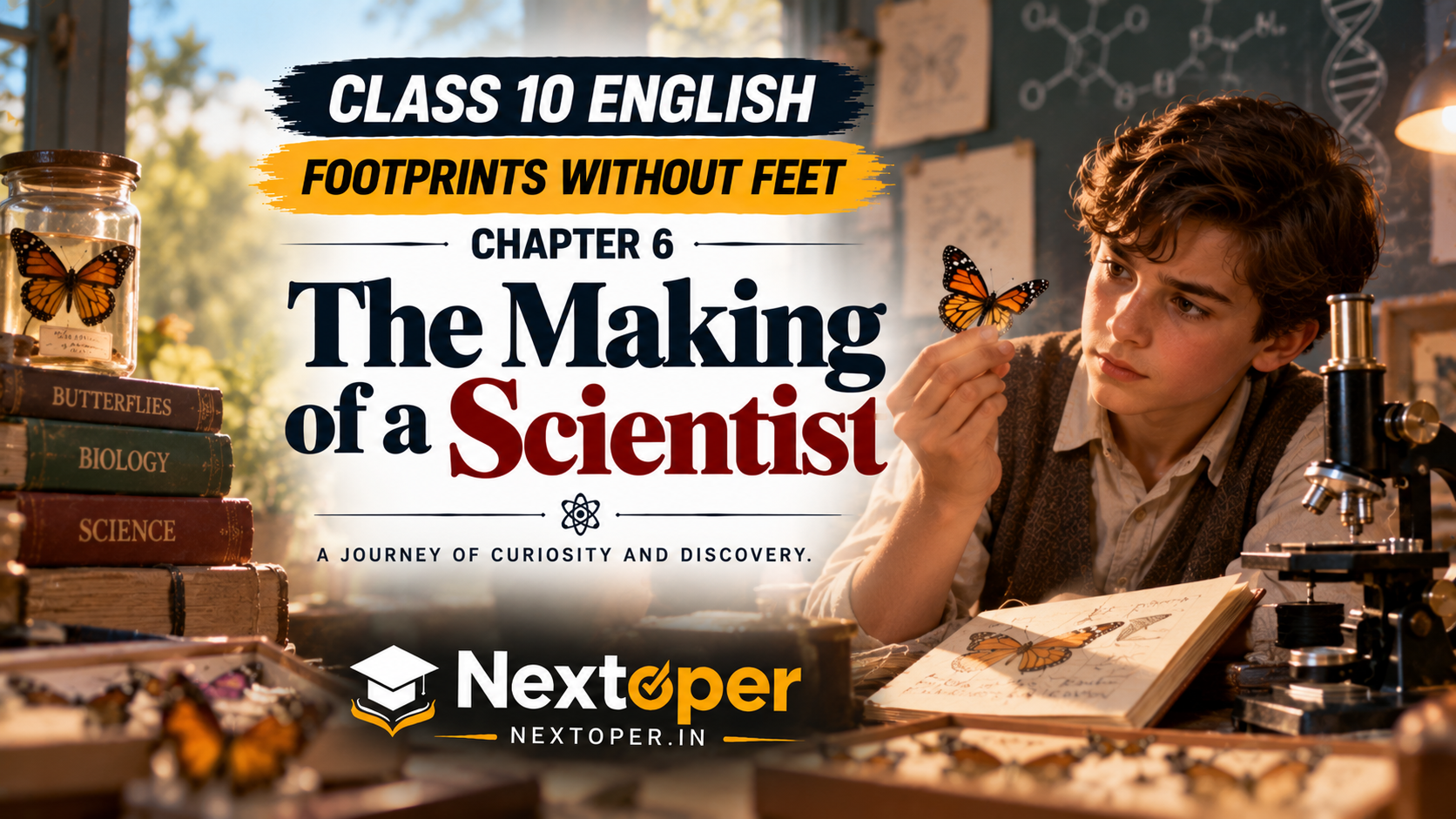
Chapter 6 of Footprints without Feet, the Class 10 English reader, is this lesson. Robert W. Peterson wrote this short biography of the scientist Richard H. Ebright. It follows Ebright from collecting butterflies as a child to research at Harvard Medical School.
Save Free Notes PDF – No Signup Needed! Click Here to Save
The story answers one question. How does a curious child become a scientist? The answer is a mix of curiosity, support, failure and hard work.
| Detail | Fact |
|---|---|
| Chapter | The Making of a Scientist (Chapter 6) |
| Book | Footprints without Feet, NCERT Class 10 English supplementary reader (Reprint 2026-27) |
| Author | Robert W. Peterson |
| Type of text | Biographical profile (non-fiction) |
| Main person | Richard H. Ebright, American scientist |
| Places | Reading (Pennsylvania), Harvard University, Harvard Medical School |
| Textbook pages | Pages 32 to 38, including the exercises |
| Key idea | A first-rate mind, curiosity and the will to win for the right reasons make a scientist |
What is the summary of The Making of a Scientist?
Richard Ebright collects butterflies as a boy. His mother gives him books and equipment. At 22, he and a room-mate publish a theory on how cells read DNA.
Between those two points lie many experiments. Some fail, and some win prizes. Each step grows from the one before it.
Step-by-step summary
The achievement first. The chapter opens at age twenty-two. Ebright and his college room-mate explain a new theory on how cells work. A top scientific journal publishes it, which is rare for college students.
A lonely childhood, a busy mind. Ebright is an only child near Reading, Pennsylvania. He cannot play team sports alone, so he collects things. He gathers butterflies, rocks, fossils and coins, and he stargazes at night.
A mother who finds learning work. His mother takes him on trips and buys telescopes and microscopes. His father dies when he is in third grade. She fills the evenings with learning tasks, and he enjoys them.
The book that changes everything. By second grade, he owns all twenty-five local butterfly species. Then his mother gets him The Travels of Monarch X. The book explains how monarchs migrate to Central America.
Tagging and the basement. The book asks readers to tag butterflies for Dr Frederick A. Urquhart. Ebright raises monarchs in his basement from egg to adult. He tags them, but only two are ever recaptured, so he loses interest.
A loss that teaches. In seventh grade, he shows frog-tissue slides at a county science fair. He wins nothing. He learns that winners ran real experiments, not neat displays.
Real experiments begin. He writes to Dr Urquhart and gets many ideas. In eighth grade, he tests whether a beetle spreads a monarch disease. He finds no result, but he shows his effort and wins.
The viceroy test. Next, he tests whether viceroy butterflies copy monarchs. A starling refuses ordinary bird food but eats monarchs. The project wins first place in zoology.
The gold spots. In high school, he studies twelve gold spots on a monarch pupa. He and another student build a device that shows the spots make a hormone. The hormone is needed for full development.
From school fairs to labs. Prizes at international fairs bring summer work in army and agriculture laboratories. After his first year at Harvard, he identifies the hormone’s chemical structure.
The DNA idea. In his junior year, X-ray photos of a hormone give him an idea. He believes it explains how a cell reads its DNA blueprint. He and James R. Wong build molecule models all night.
Beyond science. Ebright graduates second in a class of 1,510. He also excels at debate, canoeing and photography. His teacher says he wins for the right reasons.
Timeline: Ebright’s journey at a glance
| Stage | What Ebright did | Result |
|---|---|---|
| Kindergarten | Started collecting butterflies, rocks, fossils, coins | Habit of collecting begins |
| Second grade | Collected all 25 local butterfly species | Hobby seems finished |
| After the book | Tagged monarchs, raised them in his basement | Only two tagged butterflies recaptured |
| Seventh grade | Showed frog-tissue slides at a county fair | Won nothing; learned about real experiments |
| Eighth grade | Tested a beetle as the carrier of a caterpillar disease | No real result, but he won |
| Next year | Tested if viceroys copy monarchs using a starling | First in zoology, third overall |
| High school, year two | Studied the twelve gold spots on a monarch pupa | First in county; third in zoology at the international fair |
| High school, junior year | Continued advanced pupa experiments | First place at the international fair |
| High school, senior year | Grew wing cells in culture and fed them the hormone | First in zoology at the international fair |
| Harvard, after year one | Worked in a government laboratory | Identified the hormone’s chemical structure |
| Harvard, junior year | Studied X-ray photos of a hormone | New idea on how cells read DNA |
| Graduation | Finished Harvard with highest honours | Second in a class of 1,510 |
Who are the key people in the chapter?
The chapter has one hero and a small support team. Richard Ebright is the hero. His mother, Dr Urquhart, James R. Wong and Mr Weiherer each help him grow.
| Person | Role | Why they matter |
|---|---|---|
| Richard H. Ebright | Young scientist, the subject | Shows how curiosity grows into discovery |
| Ebright’s mother | Parent and first teacher | Gives equipment, the key book and daily learning tasks |
| Dr Frederick A. Urquhart | Butterfly researcher, University of Toronto | Sends experiment ideas and doubts the spots are only decoration |
| James R. Wong | College room-mate | Builds molecule models with Ebright and co-writes the paper |
| Richard A. Weiherer | Social studies teacher and club adviser | Opens Ebright’s mind and describes his healthy competitiveness |
| Robert W. Peterson | Author | Writes the profile |
Character sketch of Richard Ebright
A character sketch needs a trait and proof. Use this table to write one fast.
| Trait | Proof from the chapter |
|---|---|
| Curious | Studies the twelve gold spots when others call them ornamental |
| Determined | Raises thousands of monarchs and works through every summer |
| Resilient | Loses the seventh-grade fair, then plans a real experiment |
| Hardworking | Does three or four hours of debate research at night |
| All-round | Debater, canoeist, outdoors person and photographer |
| Honest competitor | Wants to be the best, not just win prizes |
Character sketch of Ebright’s mother
She is loving, practical and supportive. She buys equipment and writes to Dr Urquhart. After her husband dies, she gives her son her evenings.
What are the themes and lessons of The Making of a Scientist?
The main theme is that scientists are made through curiosity and effort. Support from family and teachers helps. Failure is a teacher, and real experiments matter more than neat displays.
| Theme | How the chapter shows it |
|---|---|
| Curiosity drives discovery | A butterfly hobby leads to a hormone and a cell theory |
| Support shapes success | His mother, Dr Urquhart and Mr Weiherer all guide him |
| Failure teaches | The lost fair pushes him toward real experiments |
| Science needs experiments | Winners at the fair tested ideas, not just displayed them |
| Compete for the right reasons | He wants to do the best job, not collect prizes |
| Balance in life | Science, debate, sport and photography fill his days |
Why this line matters: the baseball comparison
The author compares Ebright’s paper to a home run on a first turn at bat. A home run is a hit that clears the field. Peterson uses it to show how rare it is for college students to appear in that journal.
Why this line matters: no “Eureka!”
Ebright does not shout when the idea arrives. The author shows real discovery as quiet and slow. It builds on years of work with hormones.
Why this line matters: “for the right reasons”
Mr Weiherer says Ebright is competitive, but not in a bad sense. He wants to do his best work. This is the third ingredient of a scientist.
What do the difficult words in The Making of a Scientist mean?
The NCERT glossary lists six words. This table adds a few more that students often miss. Meanings below are in simple words.
| Word | Simple meaning | In the chapter |
|---|---|---|
| leagues (NCERT) | Groups of sports teams that play each other | “Big leagues” in the baseball comparison |
| county (NCERT) | A region | The county science fair |
| starling (NCERT) | A common bird that copies sounds | The bird in the viceroy test |
| entomology (NCERT) | The study of insects | Army laboratory where he worked |
| eureka (NCERT) | A cry of joy at a discovery | What Ebright did not shout |
| canoeist (NCERT) | A person who paddles a light boat | One of his hobbies |
| tag | A small label stuck on an animal | Light tags on monarch wings |
| pupa | The resting stage between caterpillar and butterfly | The gold spots appear on it |
| hormone | A body chemical that controls growth | Made by the gold spots |
| heredity | Passing of traits from parents to children | DNA controls it |
| tedious | Boring and tiring | Why he quit tagging |
| ornamental | Only for decoration | What people thought of the spots |
What are the NCERT question answers for The Making of a Scientist?
These are model answers in our own words. Each one is short and exam-ready. Match the length to the marks.
Read and Find Out (page 32)
Q1. How did a book become a turning point in Richard Ebright’s life?
His mother gave him The Travels of Monarch X when his collecting seemed finished. The book showed how monarchs migrate and asked readers to tag them. This opened the world of science to him and began his research.
Q2. How did his mother help him?
She took him on trips and bought telescopes, microscopes and cameras. She found learning tasks for him every evening. She also wrote to Dr Urquhart so he could join the tagging study.
Read and Find Out (page 34)
Q1. What lesson does Ebright learn when he does not win anything at a science fair?
He learns that science needs real experiments, not neat displays. The winners had tested ideas. He decides to do a real experiment the next year.
Q2. What experiments and projects does he then undertake?
He tests whether a beetle spreads a disease in monarch caterpillars. He tests whether viceroys copy monarchs. He then studies the gold spots on the monarch pupa and finds a hormone.
Q3. What are the qualities that go into the making of a scientist?
The author names three: a first-rate mind, curiosity, and the will to win for the right reasons. Ebright has all three.
Think about it (page 38)
Q1. How can one become a scientist, an economist, a historian…? Does it simply involve reading many books on the subject? Does it involve observing, thinking and doing experiments?
Reading helps, but it is not enough. You must observe, ask questions and test your ideas. Ebright read, watched butterflies and ran experiments. That mix of study and practice builds an expert in any field.
Q2. Discuss Richard Ebright’s work in the light of what you have studied about cells and DNA. Which field would you like to work on and why?
DNA in the cell nucleus controls heredity and the cell’s form and function. Ebright asked how a cell reads this blueprint. His idea may help us understand life and some diseases. Your own choice may differ. For example: “I would study cancer, because better understanding of cells could help prevent illness.”
Talk about it (page 38)
Q1(i). What is DNA fingerprinting? What are its uses?
DNA fingerprinting identifies a person from the pattern in their DNA. Police use it in crime investigation. It also helps settle questions about who a child’s parents are.
Q1(ii). How do honeybees identify their own honeycombs?
Bees use smell, mainly chemical signals unique to their colony. NCERT’s own answer is in Discovered Questions (page 75). Check it against your answer.
Q1(iii). Why does rain fall in drops?
Water vapour condenses into tiny droplets, often around dust particles. Droplets join and grow heavy. Surface tension pulls each one into a round drop as it falls.
Q2. Share your own questions with the class.
This is an open activity. Write two or three questions you wonder about, such as why stars twinkle. Then try to answer them with a book or your teacher.
Which MCQs should you practise for The Making of a Scientist?
Try these ten questions without looking at the answers. Each answer has a one-line reason. They are practice questions written by Nextoper.
| # | Question and options | Answer and reason |
|---|---|---|
| 1 | Who wrote The Making of a Scientist? (a) Yash Pal (b) Robert W. Peterson (c) Tom Brown (d) Norah Burke | (b). The chapter ends with Peterson’s name. |
| 2 | At what age did Ebright excite the scientific world with a new theory? (a) 15 (b) 18 (c) 22 (d) 30 | (c). The chapter opens at age twenty-two. |
| 3 | Which book opened the world of science to Ebright? (a) The Travels of Monarch X (b) Discovered Questions (c) School Days (d) Journey by Night | (a). It told how monarchs migrate to Central America. |
| 4 | How many local butterfly species had he collected by second grade? (a) 12 (b) 20 (c) 25 (d) 75 | (c). He had all twenty-five species of his hometown. |
| 5 | Which scientist asked readers to tag monarchs? (a) Dr Urquhart (b) Mr Weiherer (c) James Wong (d) Yash Pal | (a). Dr Frederick A. Urquhart worked at the University of Toronto. |
| 6 | What did Ebright show at the seventh-grade science fair? (a) Butterfly tags (b) Frog-tissue slides (c) A telescope (d) A coin set | (b). He showed slides under a microscope and won nothing. |
| 7 | Which insect did Ebright suspect of carrying the caterpillar disease? (a) Ant (b) Bee (c) Beetle (d) Wasp | (c). He raised caterpillars in the presence of beetles. |
| 8 | Which bird ate monarchs in his viceroy test? (a) Crow (b) Starling (c) Sparrow (d) Parrot | (b). The starling refused ordinary food but ate monarchs. |
| 9 | How many gold spots are on a monarch pupa in the chapter? (a) 6 (b) 8 (c) 12 (d) 25 | (c). The question was their purpose, and they made a hormone. |
| 10 | What was Ebright’s rank in his Harvard class of 1,510? (a) First (b) Second (c) Tenth (d) Fiftieth | (b). He graduated with highest honours, second in the class. |
What should you revise the night before the exam?
Revise the order of events, the three qualities and the key names. Then practise one short and one long answer. This box lists what to memorise.
Quick revision box
- Author and book: Robert W. Peterson; Footprints without Feet, Chapter 6.
- Hero: Richard H. Ebright, only child, from near Reading, Pennsylvania.
- Turning point: The book The Travels of Monarch X, given by his mother.
- Mentor: Dr Frederick A. Urquhart, University of Toronto.
- Big failure: Frog-tissue slides in seventh grade; no prize.
- Big discovery: A hormone made by twelve gold spots on a monarch pupa.
- College idea: How a cell reads its DNA; co-worker James R. Wong.
- Three qualities: first-rate mind, curiosity, will to win for the right reasons.
Memory trick (ours): Remember eight steps with the sentence “Cats Bring Big Lizards; Beetles Vanish, Gold Dazzles.” It stands for Collect, Book, Basement, Loss, Beetle, Viceroy, Gold spots, DNA.
Which practice questions can you try?
These questions are written by Nextoper for practice. They are not copied from any board paper. We do not claim they will appear in an exam.
- Short (3 to 4 lines): Why did Ebright lose interest in tagging butterflies?
- Short: How did Dr Urquhart help Ebright?
- Short: Why does the author compare Ebright’s paper to a home run?
- Long (100 to 120 words): “Success comes from effort and the right attitude.” Explain this using Ebright’s life.
- Long: Describe how Ebright moved from a butterfly hobby to a theory about cells.
- Value-based: What can you learn from the way Ebright handled his first defeat?
For official patterns, check the current CBSE Academic website for the syllabus and sample papers.
What mistakes do students make in this chapter?
Students mix up dates, ages and school levels. They also add facts the chapter never states. Avoid these slips to protect your marks.
| Common mistake | What the chapter says |
|---|---|
| Writing that he collected 25 species “at age two” | He had collected all twenty-five by the second grade |
| Saying he found the DNA idea in high school | The idea came in his college junior year, from X-ray photos |
| Writing “messenger RNA” as his discovery | The chapter does not mention RNA; it says how a cell reads its DNA blueprint |
| Saying he won the seventh-grade fair | He lost it with frog-tissue slides |
| Calling the eighth-grade project a success | He got no real results, but he showed his effort and won |
| Spelling the teacher as “Welherer” | The name is Richard A. Weiherer |
| Calling the county fair “state level” | The text says county science fair |
How is a scientist made? (Short answer)
In this chapter, a scientist is made, not born. Richard Ebright starts with a hobby, collecting butterflies. His mother feeds his curiosity with books and equipment. A lost science fair teaches him to run real experiments. Years of work on monarch pupae lead him to a theory about DNA. The author says a first-rate mind, curiosity and the will to win for the right reasons make a scientist.
Frequently asked questions about The Making of a Scientist
Who is Richard Ebright in Class 10 English Chapter 6?
Richard H. Ebright is an American scientist and the subject of the chapter. He collected butterflies as a child. He later proposed a theory on how cells read DNA.
What is the main message of The Making of a Scientist?
The chapter says scientists grow through curiosity, effort and support. A first-rate mind alone is not enough. You also need curiosity and the will to win for the right reasons.
How did Ebright’s mother help him become a scientist?
She bought him telescopes, microscopes and cameras. She also gave him learning tasks each evening. She wrote to Dr Urquhart and gave him the book that began his research.
What lesson did Ebright learn from losing the science fair?
He learned that science needs real experiments, not neat displays. The winners had tested ideas. The loss made him plan a proper experiment for the next year.
What qualities make a scientist according to the chapter?
The author lists a first-rate mind, curiosity and the will to win for the right reasons. He says Ebright has all three. Hard work and good teachers also appear throughout the story.
Wrap-up: what to remember from these notes
Ebright’s story proves that a small hobby can grow into real science. Use these Class 10 English Chapter 6 The Making of a Scientist notes to revise the timeline, the qualities and the common mistakes. Then test yourself with the MCQs.
Related notes
- Class 10 English Chapter 4: Question of Trust Notes
- Class 10 English Chapter 5: Footprints without Feet notes
- All Class 10 English Footprints without Feet notes
Sources