CBSE Class 11 English The Voice of the Rain Poem Notes 2026-27: Summary, Themes and NCERT Answers | Nextoper Notes
Looking for The Voice of the Rain Class 11 notes? This page explains the poem line by line. You get the summary, the water cycle, themes and NCERT answers. You also get 10 MCQs, a mistakes table and a revision box.
What is the poem The Voice of the Rain about?
Walt Whitman wrote The Voice of the Rain, a Class 11 Hornbill poem. It is a dialogue between the poet and the rain. The rain calls itself the Poem of Earth. It explains how it rises, falls to give life, and returns, just like a song.
The poem is calm, wise and full of wonder. Use this table for quick facts.
| Fact | Detail |
|---|---|
| Book | Hornbill, NCERT Class 11 English Core |
| Place in book | Poem after The Laburnum Top, in the Discovering Tut unit |
| Poet | Walt Whitman, an American poet |
| Form | Ten lines of free verse, written as a dialogue |
| Speakers | The poet and the rain |
| Key device | Personification: the rain speaks |
| Central idea | Rain and poetry both rise, give life and return to their source |
You can read the poem free on the official NCERT Hornbill chapter PDF.
What happens in The Voice of the Rain? (Summary)
In this Class 11 Hornbill poem, the poet asks a soft shower who it is. Strangely, the rain replies. It says it is the Poem of Earth. It rises unseen, changes in the sky, and falls to nourish the land. In brackets, the poet adds that a song follows the same path.
Lines 1-2: the question
The poet asks the soft-falling shower, “who art thou?” This means “who are you?” To his surprise, the rain answers. He calls this “strange to tell.” He says he will translate the reply for us.
Line 3: the answer
The rain says, “I am the Poem of Earth.” It sees itself as the earth’s own poem. Like a poem, it is beautiful and gives joy.
Lines 4-5: rising to the sky
The rain rises “impalpable,” which means it cannot be touched or seen. It comes from the land and the bottomless sea. This is evaporation.
In the sky, it takes a vague shape. It is “altogether changed, and yet the same.” It becomes clouds, but it is still water.
Lines 6-7: falling to the earth
Then it comes down to wash the dry lands and the dust. Without rain, seeds would stay hidden and unborn. Rain makes them grow.
Line 8: the endless cycle
Day and night, rain gives life back to its own origin. It makes the earth pure and beautiful. The cycle never stops.
Lines 9-10: the song (in brackets)
Now the poet speaks again, in brackets. He says a song also rises from its birthplace. It travels and fulfils its purpose. Whether noticed or not, it returns with love.
Who are the two voices in The Voice of the Rain?
The Voice of the Rain, from Class 11 English Hornbill, has two voices. One is the poet, who asks the question and adds the bracketed lines. The other is the rain, which answers and describes itself. This dialogue makes the poem feel like a calm conversation with nature.
| Voice | Lines | What it says |
|---|---|---|
| The poet | Lines 1-2 | Asks the shower who it is; notes the reply is strange |
| The rain | Lines 3-8 | Calls itself the Poem of Earth; describes its cycle |
| The poet | Lines 9-10 (in brackets) | Compares the rain’s journey to a song’s journey |
What is the rain like as a speaker?
The rain speaks calmly and proudly. It knows its purpose. It gives without asking for anything. It is both changing and unchanging, like nature itself.
How is the rain like a song in The Voice of the Rain?
In this Class 11 Hornbill poem, Whitman links rain and music. Rain rises from the earth and returns to give it life. A song rises from the heart and returns to people. Both travel, fulfil their purpose and come back, noticed or not.
| Stage | Rain | Song |
|---|---|---|
| Origin | Land and bottomless sea | The poet’s heart, its “birth-place” |
| Rising | Rises unseen as vapour | Is sung or written |
| Journey | Changes form in the sky | Wanders among listeners |
| Purpose | Waters the land; makes seeds grow | Brings joy and meaning |
| Return | Gives life back to its origin | “duly with love returns” |
What are the main themes of The Voice of the Rain?
The Voice of the Rain, a Class 11 English Hornbill poem, has four main themes. They are the water cycle, rain as life-giver, nature and poetry, and selfless giving. The poem shows that true art, like rain, gives freely and returns to its source.
| Theme | Where you see it |
|---|---|
| Water cycle | Rises from sea and land, changes, falls, and returns |
| Rain gives life | Seeds stay “latent, unborn” without it |
| Nature and art | Rain calls itself the “Poem of Earth” |
| Selfless giving | It gives “by day and night,” noticed or not |
| Change and permanence | “altogether changed, and yet the same” |
Why is the poem called The Voice of the Rain?
The rain actually speaks in the poem. Most of the lines are its own words. The title tells us to listen to nature’s voice.
Which poetic devices are used in The Voice of the Rain?
This Class 11 Hornbill poem uses personification, metaphor, antithesis and a parenthesis. The rain speaks like a person. It calls itself a poem. Pairs of opposites, like day and night, show its endless cycle. NCERT asks you to list these opposites, so learn them.
| Device | Example | Effect |
|---|---|---|
| Personification | The rain speaks and answers | Makes nature feel alive |
| Metaphor | “I am the Poem of Earth” | Links rain to poetry |
| Antithesis (opposites) | “day and night,” “Reck’d or unreck’d” | Shows the cycle never stops |
| Parenthesis | Last two lines in brackets | Separates the poet’s own comment |
| Free verse | Long, flowing lines | Feels like natural speech |
Pairs of opposites in the poem
| Pair | Meaning |
|---|---|
| Earth and heaven | Where rain begins and where it rises to |
| Rise and descend | Going up as vapour, coming down as rain |
| Day and night | Rain works all the time |
| Changed and the same | New form, same water |
| Reck’d and unreck’d | Noticed and not noticed |
What do the difficult words in The Voice of the Rain mean?
The Voice of the Rain, a Class 11 Hornbill poem, uses some old-fashioned words. “Art thou” means “are you.” Impalpable means cannot be touched. To lave means to wash. Drouths means droughts. Reck’d means noticed. Learning these few words makes the poem easy to follow.
| Word | Simple meaning |
|---|---|
| Art thou | Are you (old English) |
| Strange to tell | Surprisingly |
| Eternal | Lasting forever |
| Impalpable | Cannot be touched or felt |
| Bottomless | Very deep |
| Whence | From where |
| Lave | Wash |
| Drouths | Droughts; dry lands |
| Atomies | Tiny particles |
| Latent | Hidden, not yet active |
| Fulfilment | Completing its purpose |
| Reck’d or unreck’d | Noticed or not noticed |
| Duly | As expected; properly |
What are the NCERT answers for The Voice of the Rain?
The NCERT “Think it out” exercise for this Class 11 Hornbill poem has six questions. They ask about the two voices and “strange to tell.” Others cover the rain-music parallel, the water cycle, the brackets and the opposites. Our model answers follow. Check exact wording in your book.
Questions follow the NCERT exercise; check your textbook for exact wording. Answers are written by Nextoper.
Q1. There are two voices in the poem. Who do they belong to? Which lines indicate this?
The voices belong to the poet and the rain. “Said I to the soft-falling shower” shows the poet speaking. “Said the voice of the rain” shows the rain replying.
Q2. What does the phrase “strange to tell” mean?
It means “surprisingly.” The poet is amazed that the rain answers him. Rain does not usually speak.
Q3. There is a parallel drawn between rain and music. Which words indicate this? Explain the similarity between the two.
The rain calls itself the “Poem of Earth.” The last lines compare it to a “song.” Both rise from a source. Both travel and give joy or life. Both return to where they began.
Q4. How is the cycle of water described in the poem?
Water rises unseen from land and sea. It changes form in the sky. Then it falls as rain to wash dry land and wake seeds. It gives life back to its origin, day and night.
Q5. Why are the last two lines put within brackets?
They are the poet’s own comment, not the rain’s words. The brackets separate his voice. They add his reflection comparing rain to a song.
Q6. List the pairs of opposites found in the poem.
Earth and heaven. Rise and descend. Day and night. Changed and the same. Reck’d and unreck’d.
What MCQs come from The Voice of the Rain?
Here are 10 practice MCQs on The Voice of the Rain, Class 11 English Hornbill. Nextoper wrote them. Each answer has a one-line reason from the poem. They test facts, devices and meaning. Cover the answers and try each question. Then check how you did.
Q1. Who wrote The Voice of the Rain?
(a) Ted Hughes (b) Walt Whitman (c) Elizabeth Jennings (d) Shirley Toulson
Answer: (b) Walt Whitman.
Q2. What does the rain call itself?
(a) Song of Sky (b) Poem of Earth (c) Gift of God (d) Voice of Clouds
Answer: (b) “I am the Poem of Earth.”
Q3. “Who art thou?” means
(a) Where are you? (b) Who are you? (c) Why are you here? (d) How are you?
Answer: (b) Who are you?
Q4. “Impalpable” means
(a) very heavy (b) cannot be touched (c) very cold (d) colourful
Answer: (b) Cannot be touched or felt.
Q5. From where does the rain rise?
(a) The sky (b) The land and the bottomless sea (c) The mountains (d) The clouds only
Answer: (b) Land and the bottomless sea.
Q6. Without rain, seeds would remain
(a) dry and dead (b) latent and unborn (c) green (d) blown away
Answer: (b) “seeds only, latent, unborn.”
Q7. The rain is compared to a
(a) river (b) song (c) bird (d) mother
Answer: (b) A song, in the bracketed lines.
Q8. Why are the last two lines in brackets?
(a) They are less important (b) They are the poet’s comment (c) They are a quote (d) They are a title
Answer: (b) They are the poet’s own words.
Q9. “Reck’d or unreck’d” means
(a) wet or dry (b) noticed or not noticed (c) right or wrong (d) loud or soft
Answer: (b) Noticed or not noticed.
Q10. The main device in the poem is
(a) simile (b) personification (c) alliteration (d) hyperbole
Answer: (b) Personification; the rain speaks.
What should you revise the night before the exam?
To revise this poem fast, learn the four-step rain cycle and the two voices. Then remember one big idea. The big idea is that rain and poetry are alike. Both rise from a source, give life or joy, and return with love.
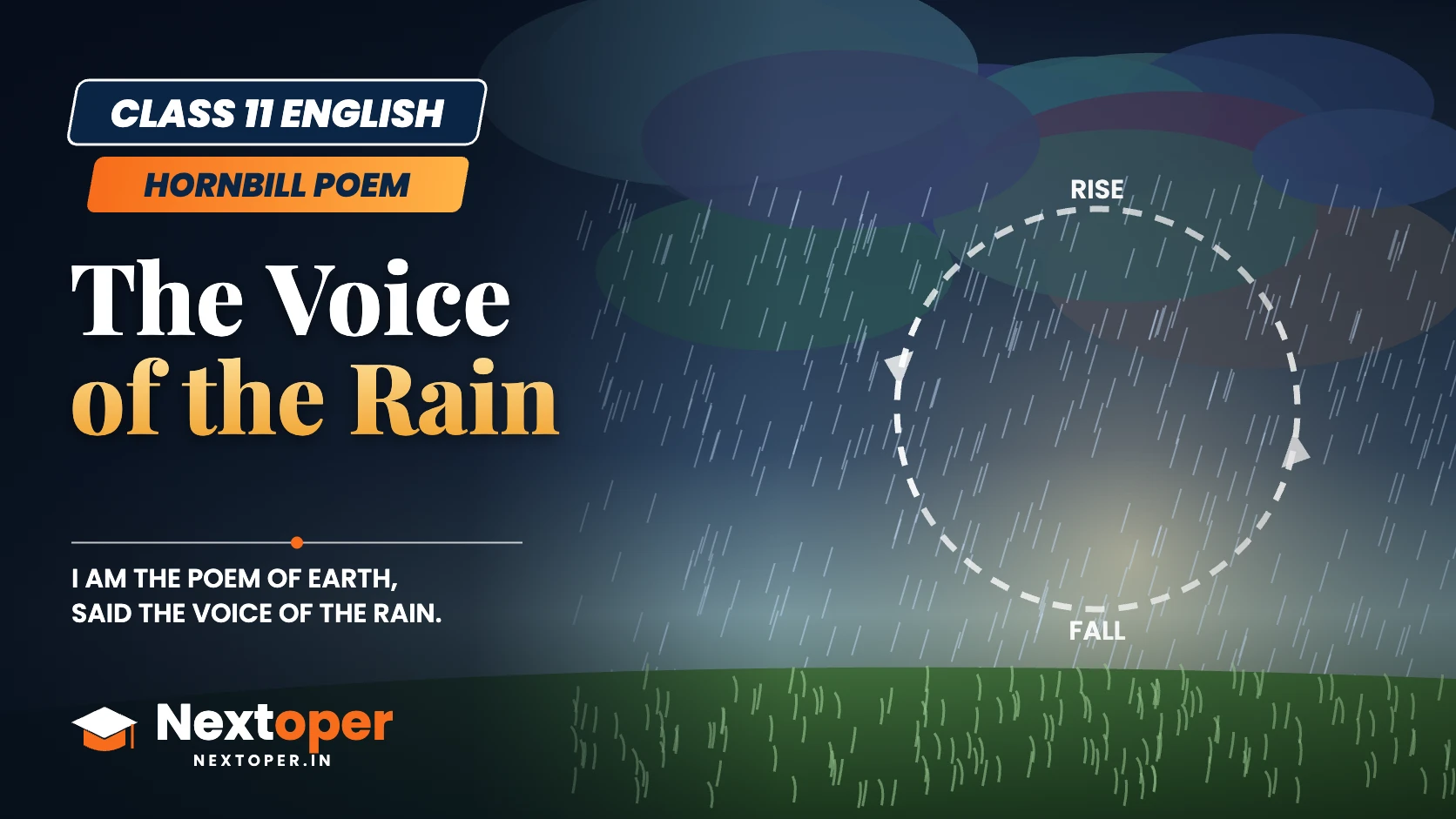
Rain cycle: “Rise, Change, Fall, Return”
- Rise – unseen, from land and bottomless sea
- Change – in the sky, “altogether changed, and yet the same”
- Fall – to wash dry lands and wake seeds
- Return – gives life back to its origin, day and night
Two voices
Poet asks (lines 1-2). Rain answers (lines 3-8). Poet reflects in brackets (lines 9-10).
One big idea: Rain is the Poem of Earth; a song is the rain of the heart.
Self-check: can you answer these in one line?
| Question | Tick when you can answer |
|---|---|
| What question does the poet ask? | [ ] |
| What does “strange to tell” mean? | [ ] |
| Why is rain the Poem of Earth? | [ ] |
| Describe the water cycle in the poem. | [ ] |
| Why are the last two lines bracketed? | [ ] |
| Name three pairs of opposites. | [ ] |
| How is a song like rain? | [ ] |
What practice questions can you try on The Voice of the Rain?
These are Nextoper practice questions on The Voice of the Rain, Class 11 English Hornbill. They are not previous-year board questions. They follow the usual short-answer, long-answer and extract formats. Write full answers first. Then compare them with the summary, cycle table and devices on this page.
Practice questions: These questions are written by Nextoper for practice. They are not previous-year board questions.
Short answer (about 40-50 words)
- What does “altogether changed, and yet the same” mean?
- How does rain help seeds?
- What does “give back life to my own origin” mean?
- Why does the poet say he is “translating” the rain’s answer?
- How does a song return “with love”?
Long answer (about 120-150 words)
- Explain how Whitman links science and poetry in this poem.
- Compare The Voice of the Rain with The Laburnum Top as nature poems.
- Write a short poem or paragraph in which the sun describes itself.
Extract-based practice
Read: “(For song, issuing from its birth-place, after fulfilment, wandering, / Reck’d or unreck’d, duly with love returns.)”
- Who speaks these lines?
- What is the “birth-place” of a song?
- How is the song like the rain?
What mistakes do students make in The Voice of the Rain?
Students often lose marks on this Class 11 Hornbill poem through small slips. Some say the rain speaks the bracketed lines. Others call it the “Song of Earth.” Another is mixing up its poet. Check each fact below against the poem before you write.
These are common slips in student answers. Each correction is based on the poem’s text.
| Common mistake | What the poem says |
|---|---|
| “The rain calls itself the Song of Earth” | It says, “I am the Poem of Earth.” |
| “The rain speaks the last two lines” | The poet speaks them, in brackets. |
| “The rain rises only from the sea” | It rises “out of the land and the bottomless sea.” |
| “The rain changes completely” | It is “altogether changed, and yet the same.” |
| “Unreck’d” means “unwrecked” | It means unnoticed. |
| Saying Ted Hughes wrote it | Walt Whitman wrote it. |
What is the short answer on The Voice of the Rain?
Short answer
The Voice of the Rain is a Walt Whitman poem in Class 11 Hornbill. The poet asks a shower who it is. The rain says it is the Poem of Earth. It rises unseen, falls to nourish dry land and seeds, and returns. The poet adds that a song does the same.
What do students ask about The Voice of the Rain?
Students most often ask who wrote this poem and why rain is the Poem of Earth. They also ask about the brackets and the two voices. One more common question is about the poem’s theme. Short, exam-ready answers to all five follow below.
Who wrote The Voice of the Rain?
Walt Whitman, the American poet, wrote it. It is the third poem in Hornbill, the NCERT Class 11 English textbook.
Why does the rain call itself the Poem of Earth?
Like a poem, rain rises from a source and returns to give life and joy. It is the earth’s own creation and gift.
Who are the two voices in the poem?
The poet and the rain. The poet asks the question and adds the bracketed lines. The rain answers in between.
Why are the last two lines in brackets?
They are the poet’s own comment, not the rain’s. They compare the rain’s cycle to the journey of a song.
What is the theme of The Voice of the Rain?
The theme is the endless, life-giving cycle of rain. The poem links this cycle to poetry and music, which also give and return.
What is the key takeaway from The Voice of the Rain?
This Class 11 Hornbill poem teaches you to see beauty in a simple shower. Rain gives life without asking for thanks. Real poetry does the same. The poem joins science and art in just ten lines. It invites you to listen to nature’s voice.
Revise “Rise, Change, Fall, Return” and the two voices. With those, you can answer almost any question.
Next poem: From nature’s cycle, Hornbill turns inward to the cycle of growing up. Read Childhood notes next.
Found a mistake?
Report an error and we will fix it.
Related notes
Read these notes next to keep your Class 11 English Hornbill revision in book order. The hub page lists every chapter and poem in one place.
About the author and reviewer
How we prepared this: These notes are based on NCERT Hornbill (2026-27 reprint). We wrote every explanation in our own words and updated the page on 2 November 2026.