CBSE Class 11 English A Photograph Poem Notes 2026-27: Summary, Themes and NCERT Answers | Nextoper Notes
These A Photograph Class 11 notes explain the poem stanza by stanza. You get the summary, themes, devices and NCERT answers. You also get 10 MCQs, a mistakes table and a revision box.
What is the poem A Photograph about?
A Photograph is a short poem by Shirley Toulson in Class 11 English Hornbill. The speaker studies an old photo of her mother, aged about twelve, at the beach. It moves from that happy day to her mother’s laugh. Then it ends in the silence after her death.
The poem is quiet and sad. It shows how time takes people away. Use this table for quick facts.
| Fact | Detail (from the NCERT text) |
|---|---|
| Book | Hornbill, NCERT Class 11 English Core |
| Place in book | Poem after Chapter 1, The Portrait of a Lady |
| Poet | Shirley Toulson |
| Form | Three stanzas in free verse |
| Speaker | A grown daughter whose mother has died |
| People in the photo | The mother (about twelve) and two girl cousins, Betty and Dolly |
| Photographer | An uncle |
| Setting of the photo | A beach, with the girls paddling in the sea |
| Central idea | Time passes, people die, but memories and nature remain |
You can read the poem free on the official NCERT Hornbill chapter PDF.
What happens in A Photograph? (Stanza-wise summary)
In this Class 11 Hornbill poem, stanza 1 describes a beach photo. It shows the mother and two cousins. Stanza 2 shows the mother, years later, laughing at it. Stanza 3 shows the speaker in the present. Her mother has died, and she feels a deep, wordless silence.
Stanza 1: the beach day
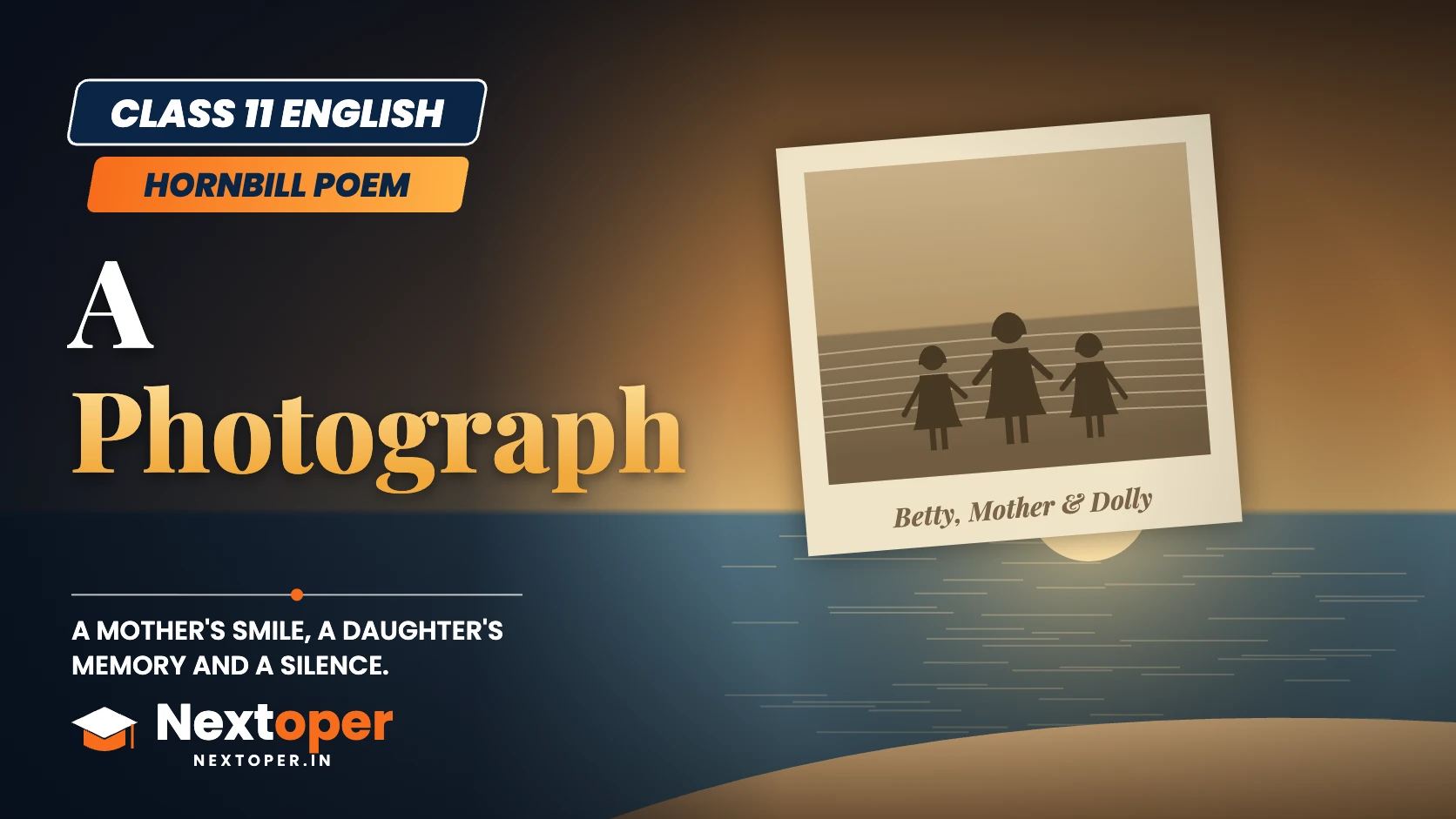
The speaker looks at an old photo mounted on cardboard. It shows her mother as a girl of about twelve. Two younger girl cousins hold her hands. They are paddling in the sea.
All three stand still and smile through their hair. An uncle is taking the picture. The mother has a sweet face. This was long before the speaker was born.
The speaker notes that the sea has changed less than the people. Its waves washed their “terribly transient” feet. The girls were young only for a short time.
Stanza 2: the mother laughs
Twenty or thirty years later, the mother looks at the photo. She laughs. She points out her cousins, Betty and Dolly. She jokes about the clothes they wore to the beach.
The speaker sees a pattern. The beach holiday was her mother’s past. Now her mother’s laughter is the speaker’s past.
Both feel a gentle, wry sadness. Each has lost something. Each bears it calmly, but with effort.
Stanza 3: the silence
The mother has now died. She has been dead almost as long as the photo girl had lived. That makes roughly twelve years.
The speaker says there is nothing at all to say about this. “Its silence silences.” Death leaves her without words.
Who are the people in A Photograph?
A Photograph, the first Class 11 English Hornbill poem, has five people. The speaker is the mother’s grown daughter. The mother appears as a girl of twelve. Betty and Dolly are her younger cousins. An uncle takes the photo. Only the speaker and her mother really matter in the poem.
| Person | Who they are | Role in the poem |
|---|---|---|
| The speaker | The mother’s daughter, now grown | Looks at the photo and remembers. Grieves her mother. |
| The mother | “The big girl,” about twelve in the photo | Sweet-faced girl; later laughs at the photo; now dead. |
| Betty and Dolly | The mother’s two girl cousins | Hold her hands while paddling; named in stanza 2. |
| The uncle | A family member | Takes the photo with his camera. |
What kind of person was the mother?
As a girl, she was sweet and caring. She held her younger cousins’ hands in the sea. As an adult, she had a sense of humour. She laughed fondly at her old beach clothes.
What does the speaker feel?
The speaker feels love and deep grief. She treasures the photo and her mother’s laughter. But she cannot find words for her loss.
What are the three phases in A Photograph?
This Class 11 Hornbill poem shows three phases of time, one per stanza. First comes the mother’s childhood at the beach. Then comes the middle phase, when she laughs at the photo. Last is the present, after her death. This table helps you answer NCERT Question 7.
| Stanza | Phase | Mood | Key image |
|---|---|---|---|
| 1 | The mother’s childhood (before the speaker’s birth) | Happy, carefree | Girls paddling and smiling at the camera |
| 2 | Twenty or thirty years later | Fond, gently sad | The mother laughing at the snapshot |
| 3 | The present, after the mother’s death | Grief, silence | “Its silence silences” |
What are the main themes of A Photograph?
A Photograph, from Class 11 English Hornbill, has four main themes. They are passing time, loss, memory and nature’s permanence. The poem contrasts the lasting sea with short human lives. It shows how a photo can hold a moment that time has taken away.
| Theme | Where you see it in the poem |
|---|---|
| Passing of time | Three stanzas move through decades, from childhood to death. |
| Loss and grief | The mother loses her childhood; the speaker loses her mother. |
| Memory | The photo and the laughter keep the past alive. |
| Nature vs humans | The sea “appears to have changed less” than the people. |
| Silence of death | “There is nothing to say at all.” |
Why does A Photograph follow The Portrait of a Lady?
The NCERT notes say it is placed there for its theme. Both remember an older woman who has died. Both begin with a picture. Both end in quiet loss. This makes a strong comparison question. Read our The Portrait of a Lady notes to compare them.
Which poetic devices are used in A Photograph?
A Photograph, a Class 11 English Hornbill poem, uses simple but powerful devices. They include alliteration, contrast, irony and transferred epithet. The most famous is “Its silence silences.” These devices make a quiet poem feel deep. Learn the examples below for literary-device questions in your exam.
| Device | Example | Effect |
|---|---|---|
| Alliteration | “Its silence silences” | Repeated “s” sounds feel hushed and still |
| Contrast | Lasting sea vs “transient” feet | Shows nature outlives people |
| Synecdoche | “cardboard” for the photo | A part stands for the whole picture |
| Irony | “laboured ease of loss” | Calmness that is actually hard work |
| Parallel structure | “Was her past, mine is her laughter” | Links mother’s loss to daughter’s loss |
| Free verse | No regular rhyme or metre | Feels like natural, private thought |
Which lines in A Photograph matter most for exams?
A few short lines carry most of this Class 11 Hornbill poem’s meaning. They show the contrast with the sea, the chain of loss, and the final silence. If you can explain these lines, you can answer most questions. Use this table as your quote bank.
| Line | What it means | Use it to answer |
|---|---|---|
| “The cardboard shows me how it was” | The old photo shows the past | Meaning of “cardboard” |
| “terribly transient feet” | Human life is very short | What has not changed |
| “Was her past, mine is her laughter” | Each generation loses something | Theme of loss |
| “the laboured ease of loss” | Calm on the outside, hurting inside | Meaning of “wry” |
| “Its silence silences” | Death leaves the speaker speechless | Ending and mood |
What do the difficult words in A Photograph mean?
A Photograph, a Class 11 English Hornbill poem, has only a few hard words. Paddling means walking in shallow water. Transient means short-lived. Wry means mildly and sadly amused. NCERT asks you to guess two of them from context. Learn this short list and the poem becomes easy.
| Word | Simple meaning |
|---|---|
| Cardboard | Stiff paper; here, the old photo mounted on it |
| Paddling | Walking barefoot in shallow water (NCERT word task) |
| Transient | Lasting only a short time (NCERT word task) |
| Snapshot | An informal photograph |
| Wry | Showing mild, sad or mocking amusement |
| Laboured | Done with effort |
| Circumstance | A situation or fact; here, the mother’s death |
What are the NCERT answers for A Photograph?
The NCERT “Think it out” exercise for this Class 11 Hornbill poem has seven questions. They ask about the cardboard, the camera, the unchanged sea and the mother’s laugh. They also ask about two key lines and the three stanzas. Our own model answers follow below.
Questions are from the NCERT text. Answers are written by Nextoper.
Q1. What does the word ‘cardboard’ denote in the poem? Why has this word been used?
“Cardboard” means the photograph, which is mounted on stiff card. The word shows the photo is old. It also suggests something flat and lifeless. The happy moment survives only as a picture.
Q2. What has the camera captured?
The camera captured a happy beach moment. The mother, about twelve, stands with two cousins holding her hands. They are paddling. All three smile at the uncle with the camera.
Q3. What has not changed over the years? Does this suggest something to you?
The sea has hardly changed. This suggests that nature is lasting. Human life, in contrast, is brief. People grow old and die, but the sea goes on.
Q4. The poet’s mother laughed at the snapshot. What did this laugh indicate?
The laugh showed fond memories of a happy childhood. She enjoyed recalling her cousins and their clothes. But it also held a little sadness. That carefree time was gone for good.
Q5. What is the meaning of the line “Both wry with the laboured ease of loss”?
“Both” refers to the mother’s past and the speaker’s memory of her laugh. Each is a loss. The mother missed her childhood. The speaker misses her mother. Each bears it with a sad smile that takes effort.
Q6. What does “this circumstance” refer to?
It refers to the mother’s death. She has been dead nearly as long as the girl in the photo had lived. The speaker finds no words for it.
Q7. The three stanzas depict three different phases. What are they?
Stanza 1 shows the mother’s childhood at the beach. Stanza 2 shows her as an adult, laughing at the photo. Stanza 3 shows the present, after her death. The speaker is left in silence.
What MCQs come from A Photograph?
Here are 10 practice MCQs on A Photograph, Class 11 English Hornbill. Nextoper wrote them. Each answer has a one-line reason from the NCERT text. They test facts, devices and meaning. Cover the answers and try each question. Then check how you did.
Q1. Who wrote A Photograph?
(a) Ted Hughes (b) Shirley Toulson (c) Elizabeth Jennings (d) Walt Whitman
Answer: (b) Shirley Toulson.
Q2. How old was the mother in the photograph?
(a) About eight (b) About ten (c) About twelve (d) About fifteen
Answer: (c) “Some twelve years or so.”
Q3. Who took the photograph?
(a) The father (b) An uncle (c) The speaker (d) A stranger
Answer: (b) “The uncle with the camera.”
Q4. What were the girls doing?
(a) Swimming (b) Paddling (c) Building sandcastles (d) Fishing
Answer: (b) Paddling in the sea.
Q5. What are the cousins’ names?
(a) Mary and Jane (b) Betty and Dolly (c) Lucy and Rose (d) Ann and Kate
Answer: (b) Betty and Dolly, named by the mother.
Q6. What has changed least over the years?
(a) The uncle (b) The beach clothes (c) The sea (d) The photo
Answer: (c) The sea “appears to have changed less.”
Q7. “Transient” means
(a) clean (b) short-lived (c) wet (d) tired
Answer: (b) Short-lived, showing life is brief.
Q8. What did the mother do with the snapshot years later?
(a) Tore it (b) Cried (c) Laughed at it (d) Framed it
Answer: (c) She laughed at it.
Q9. “Its silence silences” is an example of
(a) simile (b) alliteration (c) metaphor (d) rhyme
Answer: (b) Alliteration, with repeated “s” sounds.
Q10. What does “this circumstance” refer to?
(a) The holiday (b) The mother’s death (c) The photo (d) The sea
Answer: (b) The mother’s death.
What should you revise the night before the exam?
To revise A Photograph, Class 11 English Hornbill, fast, learn three numbers and three phases. Then remember one big idea. The big idea is a chain of loss. The mother lost her childhood. The daughter lost her mother. The sea remains, but people do not.
Number trick: 12 – 2 – 3
- 12 – the mother’s age in the photo, and roughly the years since her death
- 2 – girl cousins, Betty and Dolly
- 3 – stanzas, three phases of time
Three phases: “Smile, Laugh, Silence”
- Smile – stanza 1, the beach day
- Laugh – stanza 2, the mother laughs at the photo
- Silence – stanza 3, after her death
One big idea: The sea stays; people pass; memory remains.
Self-check: can you answer these in one line?
| Question | Tick when you can answer |
|---|---|
| What does “cardboard” stand for? | [ ] |
| Who are Betty and Dolly? | [ ] |
| Why are the girls’ feet “transient”? | [ ] |
| Why did the mother laugh? | [ ] |
| What is the speaker’s own “loss”? | [ ] |
| What does “Its silence silences” mean? | [ ] |
| Why does this poem follow The Portrait of a Lady? | [ ] |
What practice questions can you try on A Photograph?
These are Nextoper practice questions on A Photograph, Class 11 English Hornbill. They are not previous-year board questions. They follow the usual short-answer, long-answer and extract formats. Write full answers first. Then compare them with the summary, phases and themes on this page.
Short answer (about 40-50 words)
- Describe the scene captured in the photograph.
- How does the poet contrast the sea with the people?
- Why does the speaker call the mother’s laughter her own past?
- How does the poem’s mood change from stanza 1 to stanza 3?
- What does the photograph mean to the speaker now?
Long answer (about 120-150 words)
- Compare A Photograph with The Portrait of a Lady.
- A Photograph is about the passing of time. Discuss with examples.
- Describe an old family photo and the memories it holds for you.
Extract-based practice
Read: “And the sea, which appears to have changed less, / Washed their terribly transient feet.”
- Whose feet are being described?
- Why are the feet called “transient”?
- What contrast does the poet draw?
What mistakes do students make in A Photograph?
Students often lose marks on A Photograph, Class 11 English Hornbill, through small slips. Common errors include calling the cousins sisters and saying the mother laughs in stanza 1. Another is claiming the sea never changed. Check each fact below against the NCERT text before you write.
| Common mistake | What the NCERT text says |
|---|---|
| “Betty and Dolly are her sisters” | They are “the two girl cousins.” |
| “The mother laughs in the photo” | In the photo, they smile. She laughs at it years later. |
| “The sea has not changed at all” | It “appears to have changed less.” |
| “The speaker took the photo” | An uncle took it, before the speaker was born. |
| “The speaker is the mother” | The speaker is the mother’s daughter. |
| Calling it Chapter 2 of Hornbill | It is a poem placed after Chapter 1. |
| Writing “Shirley Toulsen” | The poet is Shirley Toulson. |
What is the short answer on A Photograph?
Short answer
A Photograph is a poem by Shirley Toulson in Class 11 English Hornbill. The speaker looks at a beach photo of her mother at about twelve. Years later, her mother laughed at it. Now her mother has died. The sea has barely changed, but people pass. The speaker is left in silent grief.
What do students ask about A Photograph?
Students most often ask who wrote A Photograph and what its theme is. They also ask what the three stanzas show. Two more ask what “Its silence silences” means. They also ask about the poem’s place in the book. Short, exam-ready answers to all five follow below.
Who wrote A Photograph?
Shirley Toulson wrote A Photograph. It is the first poem in Hornbill, the NCERT Class 11 English textbook.
What is the theme of A Photograph?
The theme is loss and the passing of time. A photo brings back a dead mother. Nature lasts, but human life is short.
What do the three stanzas of A Photograph show?
Stanza 1 shows the mother’s childhood. Stanza 2 shows her laughing at the photo as an adult. Stanza 3 shows the speaker’s grief after her death.
What does “Its silence silences” mean?
The silence of death leaves the speaker with nothing to say. Her grief is too deep for words.
Why is A Photograph placed after The Portrait of a Lady?
NCERT places them together because of their shared theme. Both remember a loved woman through a picture and memory, and both end in loss.
Found a mistake? Report an error and we will fix it.
What is the key takeaway from A Photograph?
A Photograph, from Class 11 English Hornbill, teaches one key lesson. Moments pass, but memories stay. A single photo holds a girl’s smile, a mother’s laugh and a daughter’s grief. The poem asks you to value people while they are here.
Revise the 12-2-3 trick and the “Smile, Laugh, Silence” phases. With those, you can answer almost any question on this poem.
Next poem: From human loss, Hornbill turns to a small moment in nature. Read The Laburnum Top notes next.
Related notes
Read these notes next to keep your Class 11 English Hornbill revision in book order. The hub page lists every chapter and poem in one place.
About the author and reviewer
How we prepared this: These notes are based on NCERT Hornbill (2026-27 reprint). We wrote every explanation in our own words and updated the page on 2 November 2026.



Pingback: Father to Son Class 11 Notes: Summary & Q&A | Nextoper
Pingback: CBSE Class 11 English Chapter 1 The Portrait of a Lady Notes 2026-27 - Summary, Themes and NCERT Answers | Nextoper Notes - Nextoper