CBSE Class 12 History Chapter 14 Notes
Introduction
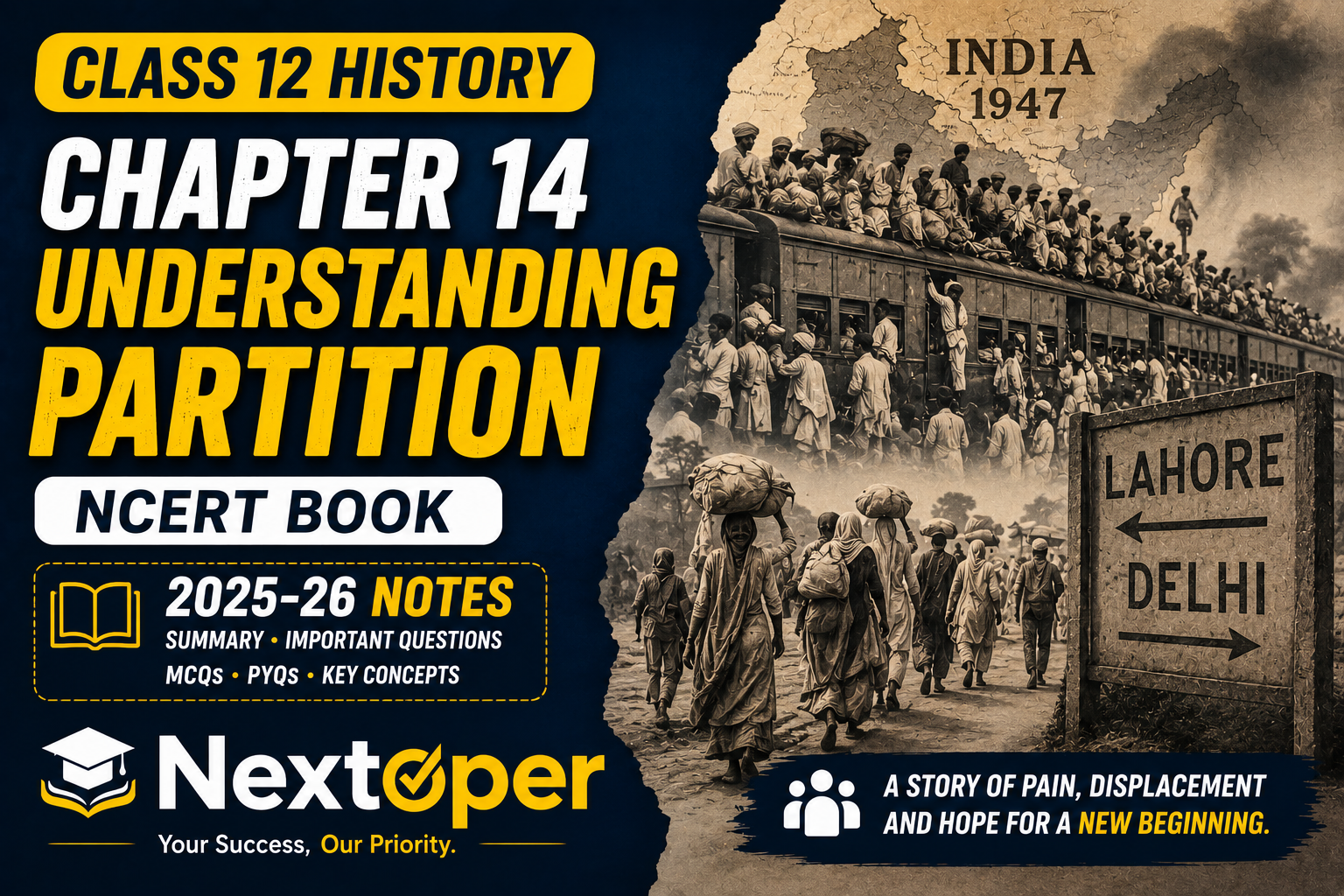
Class 12 History Chapter 14 Notes on Understanding Partition are here to help you score better in your CBSE board exam. This chapter is from your NCERT textbook, Themes in Indian History – Part III. It covers one of the most painful events in Indian history — the Partition of 1947. In this blog, you will get a full chapter summary, important questions and answers, 10 MCQs, previous year questions, and a glossary. Everything you need for your exam is here, free of cost.
You can do this. Let’s get started.
📥 Save Free Notes PDF — No Signup Needed! 👉 Click Here to Save from Nextoper.in
Table of Contents
- Chapter Overview
- Chapter Summary — Class 12 History Chapter 14 Notes
- Themes and Key Ideas
- Key Definitions and Glossary
- Important Questions and Answers
- MCQs — Understanding Partition with Answers
- Quick Revision Points
- Previous Year Questions (PYQs)
- Featured Snippet Answer
- People Also Ask — FAQs
- Conclusion
Chapter Overview — Class 12 History Chapter 14 Notes
This chapter is one of the most important chapters for your CBSE board exam. It carries significant weight in source-based and long-answer questions.
| Detail | Information |
|---|---|
| Chapter Name | Understanding Partition: Politics, Memories, Experiences |
| Subject | History (Themes in Indian History) |
| Class | Class 12 |
| Board | CBSE |
| Session | 2025-26 |
| Textbook | Themes in Indian History – Part III |
| Theme Number | Theme 14 |
| Type | Political History / Oral History / Social History |
| Source Used | NCERT Official Textbook |
Chapter Summary — Class 12 History Chapter 14 Notes
This section gives you a complete summary of the chapter. Read it carefully before your exam.
What Is This Chapter About?
India gained independence from British rule on 15 August 1947. But that joy came with great pain. The British divided India into two countries — India and Pakistan. This event is called the Partition of 1947. It changed millions of lives forever.
This chapter in your NCERT textbook looks at three big questions. Why did Partition happen? How did it happen? And what did ordinary people experience during those terrible times?
Section 1: Partition Experiences — Real Stories
The chapter begins with three real stories. These were told by Pakistani citizens to an Indian researcher in 1993.
Story 1 — “I am returning my father’s karz”
Abdul Latif was a librarian in Lahore. He helped the researcher a great deal. He explained why. His father had survived the 1947 massacres in Jammu. A kind Hindu woman had hidden his father among dead bodies to save his life. Abdul Latif helped the researcher to repay that debt of kindness. This story shows that human kindness existed even during the worst violence.
Story 2 — “I have not met a Punjabi Musalman”
A Pakistani clerk in Delhi went to deliver a note to a Lahori friend’s neighbour. He met a Sikh cyclist and asked for directions. The Sikh stopped and hugged him. He said he had not met a Punjabi Muslim in years. He missed that connection. This story shows that Partition created a deep longing for lost friendships.
Story 3 — “You can never be ours”
A man in Lahore liked an Indian researcher. But when he learned the researcher was Indian, his tone changed completely. He said his entire village had been wiped out in 1947. He saw the researcher as an enemy forever. This story shows the deep scars that Partition left on people’s minds.
These three stories show us different kinds of memories. Kindness, longing, and hatred — all born from the same violent event.
Section 2: Was It a Partition or a Holocaust?
The chapter asks a very important question. Was the Partition of 1947 just a political division? Or was it something much worse?
The facts are shocking. Between 200,000 and 500,000 people were killed. About 15 million people were displaced. Women were raped, abducted, and sold. Entire villages were destroyed. People lost their homes, their land, and their families.
The word “holocaust” has sometimes been used. This word usually refers to the mass killing of Jews by Nazi Germany. Scholars use it for Partition too, because the scale of violence was similar. But there is one key difference. In Nazi Germany, the state organised the killing using modern technology. In India, the violence was carried out by religious groups, not the government directly.
The Partition also created stereotypes that still exist today. Some Indians see all Pakistanis as enemies. Some Pakistanis see all Hindus as oppressors. These stereotypes are not true. But they keep the wounds of 1947 open.
Section 3: Why and How Did Partition Happen?
This is the most important section for your board exam. The causes of Partition are complex.
The Two-Nation Theory
Muhammad Ali Jinnah argued that Hindus and Muslims were two separate nations. They could not live together in one country. This idea is called the Two-Nation Theory. Some historians disagree. They point out that Hindus and Muslims had lived together for centuries. They shared culture, language, and food.
Separate Electorates (1909 and 1919)
The British colonial government created separate electorates for Muslims in 1909 and expanded them in 1919. This meant Muslims voted separately for Muslim representatives. This system pushed politicians to focus on religion to win votes. It deepened the divide between communities.
Congress Ministries (1937–39)
Elections were held in 1937. The Congress won in 7 out of 11 provinces. The Muslim League did very badly. It won only 4.4% of Muslim votes. In the United Provinces, the Congress rejected the League’s offer to form a joint government. This convinced the League that Muslims needed a separate country to have political power.
The Lahore Resolution (1940)
On 23 March 1940, the Muslim League passed a resolution at Lahore. It demanded autonomy for Muslim-majority areas of the subcontinent. Importantly, this resolution did not use the word “Pakistan.” The demand for a separate country came later.
Direct Action Day (16 August 1946)
When talks failed, the Muslim League called for “Direct Action.” On 16 August 1946, terrible riots broke out in Calcutta. Thousands of people died in just a few days. Violence then spread across northern India through 1947.
Cabinet Mission Plan (1946)
The British sent a three-member Cabinet Mission to India in March 1946. It proposed a loose confederation. India would remain one country with three sections. The Congress and the League both accepted the plan at first. But they soon disagreed on how it would work. The plan failed. After this, Partition became almost certain.
Only Mahatma Gandhi and Khan Abdul Ghaffar Khan continued to oppose Partition till the very end.
Section 4: The Collapse of Law and Order
The violence during Partition lasted about one year, from March 1947 onwards. The main reason was that the government stopped working. British officials did not know what to do. They were busy preparing to leave India.
Police and soldiers began acting on the basis of their religion. They helped their own communities and attacked others. In Amritsar, mobs were allowed to burn and kill for 24 hours without a single shot being fired by police.
Gandhi’s Role — The One-Man Army
Mahatma Gandhi, aged 77, travelled alone to the most violent areas. He went to Noakhali in East Bengal, to Bihar, to Calcutta, and to Delhi. He walked from village to village. He used fasts and prayers to stop the killing. His arrival in Delhi on 9 September 1947 was described by one Muslim as “the arrival of rains after a long summer.” Gandhi’s fasts had an “electric” effect. People stopped the violence. Only his assassination in January 1948 finally ended Delhi’s communal violence completely.
Section 5: Gendering Partition — Women’s Experiences
Women suffered in very specific and terrible ways during Partition. This section is important for your board exam.
Women were raped, abducted, and sold. They were forced to marry strangers. They were taken to unknown places. About 30,000 women were “recovered” by governments after Partition — 22,000 Muslim women in India and 8,000 Hindu and Sikh women in Pakistan. But the governments did not ask these women what they wanted. They were simply moved from one side of the border to the other. This recovery operation continued until 1954.
A deeply troubling idea called “honour” also played a role. In North Indian peasant societies, a man’s honour was linked to protecting his women and his land (zan and zamin). When men feared their women would be captured, they sometimes killed them instead. In the village of Thoa Khalsa in Rawalpindi, ninety Sikh women are said to have jumped into a well to avoid capture. The community today calls this “martyrdom.” But scholars like Urvashi Butalia, in her book The Other Side of Silence, point out that many women did not want to die.
Section 6: Regional Variations
Partition was most violent in the Punjab. Almost all Hindus and Sikhs moved from West Punjab to India. Almost all Punjabi Muslims moved to Pakistan. This happened in just two years, between 1946 and 1948.
In Bengal, the migration was more spread out and slower. The border was porous. Many Bengali Hindus stayed in East Pakistan. Many Bengali Muslims stayed in West Bengal. Eventually, in 1971, East Pakistanis broke away from Pakistan and created Bangladesh. This showed that religion alone could not keep a country united.
In both Punjab and Bengal, women’s bodies became targets of violence. Attackers used the dishonour of women to dishonour entire communities.
Section 7: Help, Humanity, Harmony
Not everyone acted with violence. Many people showed extraordinary kindness during Partition.
Dr. Khushdeva Singh, a Sikh doctor in Dharampur (present-day Himachal Pradesh), provided food, shelter, and medical care to thousands of refugees — Hindu, Muslim, and Sikh alike. His memoir is called Love is Stronger than Hate: A Remembrance of 1947.
These stories show that humanity survived even in the darkest times.
Section 8: Oral History and Its Importance
The chapter explains how historians have studied Partition. Oral history — interviews with ordinary people — is the main source. It tells us things that government documents cannot.
Strengths of oral history:
- It captures the personal experiences of ordinary people.
- It gives a voice to the poor, women, and the powerless.
- It fills gaps that official records leave empty.
Limitations of oral history:
- Memory can be inaccurate after many years.
- People may not want to share painful experiences.
- Stories can be shaped by later events and feelings.
- One person’s story may not represent everyone’s experience.
Despite these limits, oral history is essential for understanding Partition fully.
Themes and Key Ideas
Every H2 board exam topic connects to a larger theme. Here are the main themes of CBSE Class 12 History Chapter 14.
- Communalism: Politics that creates conflict between religious communities. The chapter explains how communal politics grew in the 1920s and 1930s and led to Partition.
- Oral History as a Historical Method: The chapter is itself an example of how personal testimonies help us understand events that official records cannot capture.
- Gendering of Violence: Women’s experiences during Partition were unique and uniquely terrible. The “honour” concept shows how patriarchal values shaped violence.
- Memory and Identity: Partition memories still shape how Indians and Pakistanis see each other. Stereotypes born in 1947 persist today.
- Humanity Amidst Violence: Despite massive violence, many individuals showed compassion and humanity. This is an important counter-narrative.
Key Definitions and Glossary
These key terms appear in your CBSE exam questions. Learn them well.
| Word | Meaning in Simple English |
|---|---|
| Partition | Division of British India into India and Pakistan in 1947 |
| Communalism | Politics that uses religion to create conflict between communities |
| Two-Nation Theory | Jinnah’s idea that Hindus and Muslims are two separate nations |
| Separate Electorates | System where Muslims voted only for Muslim candidates (1909) |
| Holocaust | Mass destruction of a people; used for Nazi Germany and sometimes Partition |
| Oral History | History built from interviews and personal testimonies |
| Karz | Urdu/Hindi word meaning debt or obligation |
| Muhajir | Urdu word meaning migrant; used for Urdu-speaking people who moved to Pakistan |
| Zan and Zamin | Women and land; two “possessions” linked to male honour in North Indian societies |
| Direct Action Day | 16 August 1946; Muslim League’s call for action that triggered Calcutta riots |
| Cabinet Mission | Three-member British team that proposed a confederation plan in 1946 |
| Shuddhi | Arya Samaj campaign to bring back converts to Hinduism |
| Tabligh and Tanzim | Muslim campaigns for religious propagation and organisation after 1923 |
Important Questions and Answers
These questions are based on your NCERT textbook and are important for CBSE board exams 2025-26.
2-Mark Questions
Q1. What was Direct Action Day? A: Direct Action Day was called by the Muslim League on 16 August 1946. On this day, terrible riots broke out in Calcutta. Thousands of people were killed in just a few days. The violence then spread across northern India.
Q2. What does “karz” mean in the chapter? A: “Karz” is a Hindi/Urdu word meaning debt. In the chapter, Abdul Latif uses it to explain why he helped an Indian researcher. A Hindu woman had saved his father’s life during Partition. By helping the researcher, he was returning that debt of kindness.
Q3. Who were muhajirs? A: Muhajirs were Urdu-speaking Muslim migrants who moved from India to Pakistan after Partition. Most of them settled in the Karachi-Hyderabad region of Sind in Pakistan.
Q4. What is the significance of Thoa Khalsa? A: Thoa Khalsa is a village in Rawalpindi district. During Partition, about ninety Sikh women are said to have jumped into a well to avoid capture by enemy groups. The community remembers this as martyrdom. Scholars see it as evidence of how “honour” ideology led to women’s deaths.
5-Mark Questions
Q1. Why is Partition viewed as a significant marker in South Asian history?
A: Partition is considered a momentous event for several reasons.
First, the scale of violence was enormous. Between 200,000 and 500,000 people were killed. About 15 million people were displaced — one of the largest human migrations in history.
Second, Partition created two separate nations — India and Pakistan — changing the political map of Asia permanently.
Third, Partition left deep psychological scars. It created stereotypes and hatreds that still shape India-Pakistan relations today.
Fourth, Partition is remembered not just as a political event but as a human tragedy. The experiences of ordinary people — especially women — show the personal cost of political decisions.
Finally, Partition led to ongoing conflicts over Kashmir and other issues that remain unresolved.
Q2. Examine the strengths and limitations of oral history as a source for understanding Partition.
A: Oral history is a powerful but imperfect tool for understanding Partition.
Strengths: Oral history captures the personal experiences of ordinary people. Government documents focus on policy and politics. They tell us little about how common people felt and suffered. Interviews with survivors fill this gap. They give voice to women, the poor, and the powerless — groups normally ignored in mainstream history.
Limitations: Memory is not always accurate. People interviewed decades after Partition may remember things differently. Their memories are shaped by events that happened between 1947 and the time of the interview. Also, some people do not want to share traumatic experiences. Interviewers may get incomplete information. One person’s story cannot represent all experiences.
Despite these limitations, oral history remains essential for understanding Partition. It should be used alongside government records, newspapers, and memoirs to build a complete picture.
Q3. What were Mahatma Gandhi’s arguments against Partition?
A: Mahatma Gandhi opposed Partition strongly and consistently.
He argued that Hindus and Muslims were born from the same soil. They shared the same blood, food, water, and language. To divide them would be to tear apart what nature had made one.
He believed the Two-Nation Theory was un-Islamic. Islam stood for the unity and brotherhood of all mankind, not division.
He thought Partition would create permanent enemies where there had been neighbours. He feared it would lead to endless cycles of violence.
Gandhi chose to act on his beliefs. He toured riot-affected areas alone, used fasts to stop violence, and tried to build trust between communities. He was a “voice in the wilderness” — but he never stopped speaking.
📚 Want More Free Notes? Visit Nextoper.in — All Class 9 to 12 CBSE Notes. 100% Free!
MCQs — Understanding Partition with Answers
These MCQs will help you prepare for your CBSE board exam 2025-26. Each question is based on your NCERT textbook.
Q1. In which year did the Muslim League pass the Lahore Resolution? (A) 1937 (B) 1940 (C) 1942 (D) 1946 ✅ Answer: (B) 1940 — The League moved this resolution on 23 March 1940, demanding autonomy for Muslim-majority areas.
Q2. How many people are estimated to have been displaced during Partition? (A) 5 million (B) 10 million (C) 15 million (D) 20 million ✅ Answer: (C) 15 million — About 15 million people crossed newly created borders between India and Pakistan.
Q3. What does “zan and zamin” refer to in the chapter? (A) Two provinces of Pakistan (B) Two sections of the Cabinet Mission plan (C) Women and land, linked to male honour (D) Two political parties ✅ Answer: (C) — In North Indian peasant societies, male honour was tied to protecting women (zan) and land (zamin).
Q4. Which event triggered the widespread communal violence in August 1946? (A) Quit India Movement (B) Direct Action Day (C) Lahore Resolution (D) Cabinet Mission failure ✅ Answer: (B) Direct Action Day — Called by the Muslim League on 16 August 1946, it led to major riots in Calcutta.
Q5. Who wrote the memoir “Love is Stronger than Hate: A Remembrance of 1947”? (A) Mahatma Gandhi (B) Khushdeva Singh (C) Abdul Latif (D) Maulana Azad ✅ Answer: (B) Khushdeva Singh — He was a Sikh doctor who cared for thousands of refugees during Partition.
Q6. In which village did about ninety Sikh women jump into a well during Partition? (A) Noakhali (B) Amritsar (C) Thoa Khalsa (D) Jalandhar ✅ Answer: (C) Thoa Khalsa — This village is in Rawalpindi district. The incident is remembered annually as martyrdom.
Q7. What is the name of Urvashi Butalia’s famous book on Partition? (A) The Other Side of Silence (B) Partition Memories (C) Garm Hawa (D) Love is Stronger than Hate ✅ Answer: (A) The Other Side of Silence — It focuses on women’s experiences during Partition.
Q8. The Cabinet Mission of 1946 was sent by which country? (A) United States (B) France (C) Britain (D) United Nations ✅ Answer: (C) Britain — The British Cabinet sent a three-member mission to Delhi in March 1946 to find a solution.
Q9. The name “Pakistan” was coined by whom? (A) Muhammad Ali Jinnah (B) Mohammad Iqbal (C) Choudhry Rehmat Ali (D) Liaquat Ali Khan ✅ Answer: (C) Choudhry Rehmat Ali — He was a Punjabi Muslim student at Cambridge who coined the term in 1933.
Q10. What is a key limitation of oral history according to this chapter? (A) It is too expensive to collect (B) Memory can be imprecise and shaped by later events (C) It only covers political history (D) It cannot be verified at all ✅ Answer: (B) — Memory may be imprecise after decades. Later experiences can also reshape what people remember about 1947.
Quick Revision Points
These are the most important facts for your CBSE 2025-26 board exam. Read them the night before your exam.
- August 1947: India and Pakistan became independent. Partition happened simultaneously.
- 15 million people were displaced — the largest migration in history at the time.
- 200,000–500,000 people were killed during Partition violence.
- The Lahore Resolution (1940) demanded autonomy for Muslim-majority areas — it did NOT use the word “Pakistan.”
- Separate Electorates (1909, 1919) pushed politicians to use religious slogans to win votes.
- Congress rejected the Muslim League’s coalition proposal in United Provinces (1937). This pushed the League toward demanding Pakistan.
- Direct Action Day — 16 August 1946 — triggered Calcutta riots. Thousands died.
- The Cabinet Mission Plan (1946) proposed a three-tier confederation. Both Congress and League rejected it. Partition became inevitable after this.
- Gandhi alone and Khan Abdul Ghaffar Khan continued opposing Partition to the end.
- 30,000 women were “recovered” by both governments. The recovery operation ended in 1954.
- Thoa Khalsa: 90 Sikh women jumped into a well. Remembered as martyrdom.
- Dr. Khushdeva Singh: Sikh doctor who helped all refugees regardless of religion.
- Oral history captures experiences of ordinary people that official documents miss.
- Garm Hawa (1974) by M.S. Sathyu is a famous Partition film from NCERT’s recommended list.
- Saadat Hasan Manto was a great Urdu writer who wrote about Partition in his collection Siyah Hashiye.
Previous Year Questions (PYQs)
These questions have appeared in CBSE board exams. They are directly from the Class 12 History Chapter 14 syllabus.
| Year | Question | Marks |
|---|---|---|
| 2023 | Explain the main causes of Partition of India in 1947. | 8 |
| 2022 | How did women experience Partition? Explain with examples. | 8 |
| 2022 | What was the Cabinet Mission Plan? Why did it fail? | 5 |
| 2021 | Examine the strengths and limitations of oral history. | 5 |
| 2020 | What were Mahatma Gandhi’s arguments against Partition? | 5 |
| 2019 | Why is 1947 considered an important marker in South Asian history? | 5 |
Model Answer — PYQ 2022: How did women experience Partition?
Women’s experiences during Partition were marked by extreme violence and loss of agency.
First, thousands of women were raped, abducted, and sold. They were forced into new lives with strangers in unknown places.
Second, both the Indian and Pakistani governments carried out “recovery” operations. About 30,000 women were taken from one country and sent to the other. But the governments did not ask these women what they wanted. Their right to make decisions about their own lives was ignored.
Third, the idea of “honour” (zan and zamin) led men to kill their own wives, daughters, and sisters rather than let them be captured by the “enemy.” In Thoa Khalsa, ninety women are said to have jumped into a well voluntarily to protect community honour.
Women in both Punjab and Bengal were treated as “territory” by attackers. Dishonouring a community’s women meant dishonouring the community itself.
Featured Snippet Answer
“Understanding Partition” (Class 12 History Chapter 14) examines why and how British India was divided into India and Pakistan in 1947. The chapter covers the Lahore Resolution (1940), Direct Action Day (1946), the Cabinet Mission Plan, the gendered violence of Partition, oral history as a historical method, and stories of both humanity and horror from ordinary people.
People Also Ask — FAQs
Short intro: Here are the five most commonly asked questions about this chapter, answered directly for your exam preparation.
Q: What is Understanding Partition about in Class 12 History? 💡 A: Class 12 History Chapter 14 on Understanding Partition covers the division of British India into India and Pakistan in 1947. It examines the causes, the violence, the experiences of ordinary people, the gendering of Partition, oral history as a historical method, and stories of both help and hatred from those who lived through those times.
Q: What was the Muslim League’s demand in 1940? 💡 A: The Muslim League’s Lahore Resolution of 1940 demanded that Muslim-majority areas of the subcontinent be grouped into autonomous and sovereign “Independent States.” Importantly, the resolution did not use the word “Pakistan.” The demand for a separate sovereign country evolved over the next few years.
Q: How did women experience Partition violence in 1947? 💡 A: Women were raped, abducted, and sold during Partition. About 30,000 women were later “recovered” by both governments without consulting them. The notion of “honour” led some men to kill their own women. In Thoa Khalsa, ninety Sikh women jumped into a well to avoid capture.
Q: What is the role of oral history in understanding Partition? 💡 A: Oral history — interviews with Partition survivors — captures personal experiences that government documents miss. It gives voice to ordinary people, especially women and the poor. Its limitations include imprecise memory and people’s reluctance to share trauma. Despite this, oral history is essential for understanding Partition’s human impact.
Q: Why is Partition considered a significant marker in South Asian history? 💡 A: Partition is a significant marker because it displaced 15 million people, killed up to 500,000, created two nations, and left deep wounds of memory, stereotype, and hatred. Its legacy continues to shape India-Pakistan relations. It is remembered not just as a political division but as a massive human tragedy that changed lives forever.
Conclusion
You have now covered everything important in Class 12 History Chapter 14. You understand why Partition happened. You know the key events, the real stories of ordinary people, and the terrible price that millions paid in 1947. You also know how oral history helps us understand what official records cannot tell us.
Keep revising the MCQs, PYQs, and glossary regularly. These will help you write sharp, direct answers in your CBSE board exam. Remember — your exam answers should be clear, structured, and to the point. Use dates and names confidently.
For more free CBSE notes, visit Nextoper.in. These Class 12 History Chapter 14 Notes on Understanding Partition are your best exam companion for 2025-26. Best of luck!
More Notes from This Subject
Looking for more Class 12 History notes? Here are the related chapters on Nextoper.in.
- Class 12 History Chapter 11 Notes — Rebels and the Raj
- Class 12 History Chapter 10 Notes — Colonialism and the Countryside
- Class 12 History Chapter 12Notes — Colonial Cities
- All Class 12 History Chapter Notes — Nextoper.in
About the Author This article is written by the Nextoper Editorial Team. We provide 100% free CBSE study notes for Class 9 to 12 students. All our notes follow the latest NCERT syllabus 2025-26. No signup needed. No cost. Just free notes for every student.