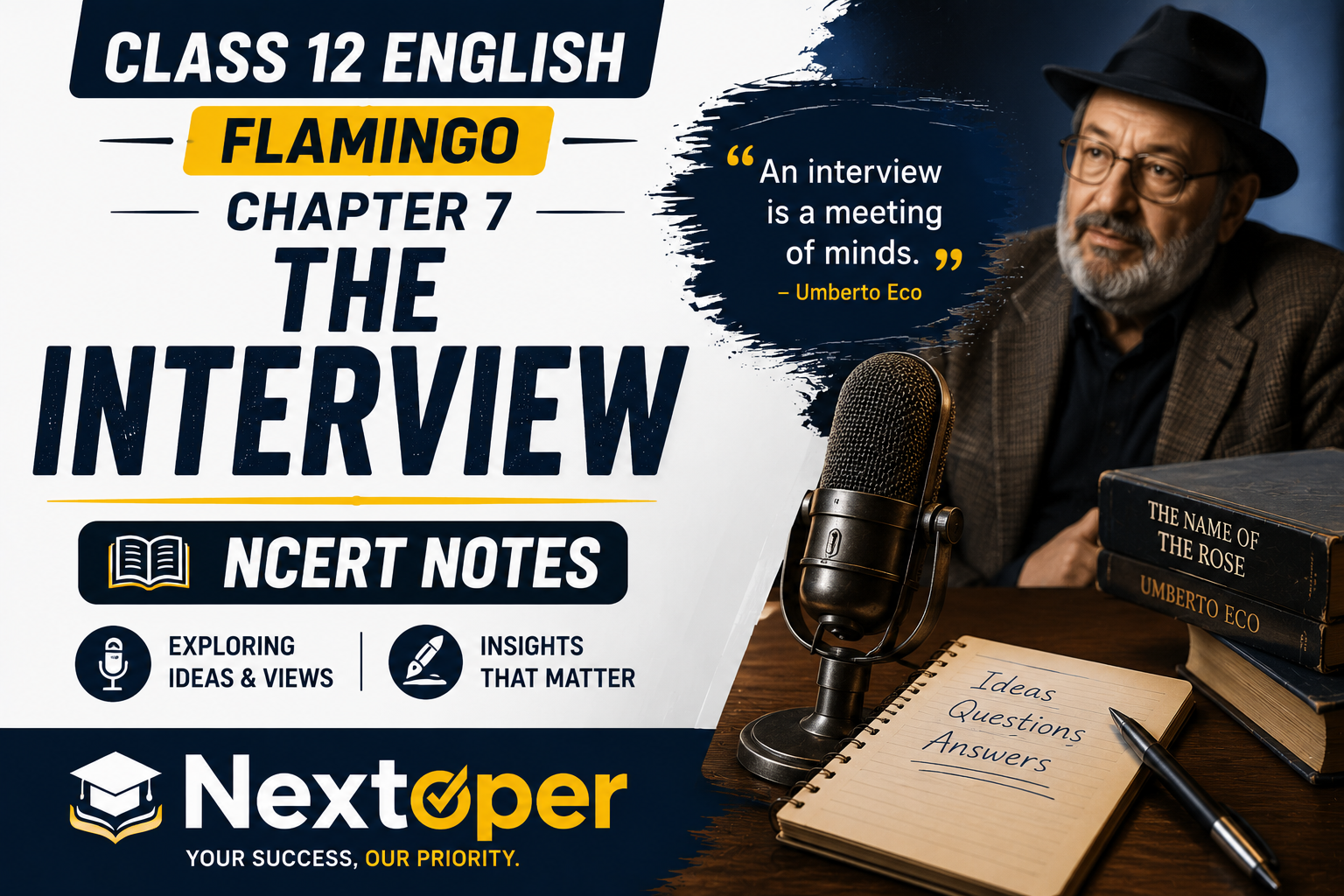
Free CBSE Class 12 English Flamingo Chapter 7 Notes |The Interview PDF notes
Welcome to your complete Class 12 English Flamingo Chapter 7 Notes for “The Interview.” This guide covers everything from NCERT. You will get the full summary, characters, and themes. We also add MCQs, PYQs, and a glossary. Everything follows the CBSE 2025-26 syllabus. This chapter is short but scores well in exams. It has two parts — a general essay and a real interview. You don’t need any other book. Let’s understand this chapter step by step. You’ve got this!
📥 Ssve Free Notes PDF — No Signup Needed! 👉 Click Here to Download Save Nextoper.in
📋 Table of Contents
- Chapter Overview
- Chapter Summary
- Character Analysis
- Themes & Values
- Key Definitions & Glossary
- Important Questions & Answers
- MCQs with Answers
- Quick Revision Points
- Previous Year Questions (PYQs)
- People Also Ask (FAQs)
- Conclusion
Chapter Overview
These Class 12 English Flamingo Chapter 7 Notes start with the basic facts of the chapter. Use this table for quick reference.
| Detail | Information |
|---|---|
| Chapter Name | The Interview |
| Subject | English Core (Flamingo) |
| Class | Class 12 |
| Board | CBSE |
| Session | 2025-26 |
| Author | Christopher Silvester (Part I); Mukund Padmanabhan interviews Umberto Eco (Part II) |
| Textbook | Flamingo (Prose, Chapter 7) |
| Type | Non-fiction essay + interview transcript |
Chapter Summary — The Interview
These Class 12 English Flamingo Chapter 7 Notes break the chapter into its two clear parts. Read each part slowly.
Part I: The History and Views on Interviews
The interview was invented about 130 years ago. Today, it is common in journalism. Almost every literate person has read one. Thousands of celebrities have been interviewed. So opinions about interviews vary a lot.
Some people praise interviews highly. They call it a source of truth. They also call it a form of art. It shows a person’s real thoughts and feelings.
Other people, mostly celebrities, hate interviews. They feel it invades their privacy. Some primitive cultures believed a photograph steals a person’s soul. Silvester compares this fear to how celebrities view interviews.
Author V. S. Naipaul said some people get “wounded” by interviews. They lose a part of themselves. Lewis Carroll, who wrote Alice in Wonderland, refused all interviews. He feared being praised too much in public.
Rudyard Kipling hated interviews even more. His wife wrote that reporters “wrecked” their day. Kipling called interviews immoral. He compared it to an assault on a person. But Kipling himself had once interviewed Mark Twain. This shows a contradiction in his views.
H. G. Wells called interviews an “ordeal.” Yet he gave many interviews himself. He even interviewed the Russian leader Joseph Stalin later in life.
Saul Bellow agreed to be interviewed many times. But he still compared interviews to “thumbprints on his windpipe.” This shows discomfort, even from willing interviewees.
Despite the criticism, interviews remain powerful. Journalist Denis Brian says our best impressions of people come from interviews. This gives the interviewer great power and influence in society.
Part II: The Interview with Umberto Eco
Part II is a real interview. Mukund Padmanabhan of The Hindu spoke with Umberto Eco. Eco was a professor at the University of Bologna, Italy. He was famous for his work on semiotics, which is the study of signs.
Eco wrote academic books and also novels. In 1980, his novel The Name of the Rose made him world-famous. It sold over 10 million copies.
On doing many things: Eco says he feels like he does many jobs. But he believes he is always doing the “same thing.” His novels, essays, and children’s books all share the same theme. They explore ethics, peace, and philosophy.
On empty spaces (interstices): Eco explains a unique idea. He calls small gaps of time “interstices.” For example, waiting for an elevator is an interstice. He uses these small moments to write. He once wrote a full article while waiting for an elevator to reach the third floor.
On his writing style: Eco’s academic writing is different from others. Most scholars write in a dry, formal way. Eco tells the “story” of his research instead. He includes his mistakes and discoveries. This narrative style later helped him write novels.
On his identity: Eco calls himself “a professor who writes novels on Sundays.” He values his academic identity more than his fame as a novelist. He attends academic conferences, not writer’s meetings. But he admits novels help him reach more readers than academic books ever could.
On the success of The Name of the Rose: The novel mixes crime fiction with medieval history and theology. Publishers expected it to sell only a few thousand copies. Instead, it sold millions worldwide, especially in the U.S. Eco says the reason for this success is a “mystery.” He believes timing plays a huge role. The same book published ten years earlier or later might have failed.
Character Analysis
These Class 12 English Flamingo Chapter 7 Notes cover the two key figures in the chapter.
Christopher Silvester
- He is the narrator and essayist of Part I, not a fictional character.
- He presents both sides of the interview debate fairly.
- He supports his arguments with real historical examples.
- His tone remains balanced and analytical throughout.
Umberto Eco
- A brilliant and humble scholar, professor, and novelist.
- Extremely disciplined — he uses even tiny gaps of time productively.
- He has a playful and narrative style, unlike typical dry academics.
- He stays grounded, identifying as a teacher first, despite worldwide fame.
Themes and Values in the Chapter
These Class 12 English Flamingo Chapter 7 Notes highlight the core themes tested in exams.
- The Dual Nature of Interviews: Interviews can reveal truth and connect people. But they can also feel intrusive to the person being questioned.
- Media Power and Responsibility: The interviewer holds real influence over public opinion. This power must be used carefully and ethically.
- Privacy vs. Public Interest: Famous people have a right to privacy. Yet the public has a natural curiosity about their lives.
- Discipline and Time Management: Eco’s idea of “interstices” teaches students to use small moments wisely.
- Unpredictability of Success: Even great work, like Eco’s novel, succeeds due to timing and circumstance, not talent alone.
Key Definitions and Glossary
These Class 12 English Flamingo Chapter 7 Notes explain tough words in simple English.
| Word | Meaning in Simple English |
|---|---|
| Commonplace | Very common; ordinary |
| Extravagant | Going beyond normal limits |
| Lionized | Treated as very important or famous |
| Interstices | Small gaps or empty spaces of time |
| Semiotics | The study of signs and symbols |
| Depersonalised | Written without personal feeling |
| Formidable | Very impressive and respected |
| Staggeringly | Extremely; in a shocking amount |
| Perpetrated | Carried out an act (usually bad) |
| Condemnatory | Showing strong disapproval |
Important Questions and Answers
These Class 12 English Flamingo Chapter 7 Notes include exam-style questions with model answers.
2-Mark Questions
Q: Why did Lewis Carroll refuse to give interviews? A: Lewis Carroll had a deep fear of being “lionized.” He did not want excessive public attention or fame. He always successfully avoided interviewers and autograph seekers.
Q: What is meant by “thumbprints on his windpipe”? A: Saul Bellow used this phrase to describe interviews. It means interviews felt suffocating and uncomfortable to him. This happened even though he agreed to give them.
Q: What contradiction do we see in Rudyard Kipling’s behaviour? A: Kipling called interviews immoral and compared them to an assault. Yet, he himself had interviewed Mark Twain a few years earlier. This shows he did not follow his own principle.
Q: What does Umberto Eco mean by “interstices”? A: Eco calls small, empty pockets of time “interstices.” He gives the example of waiting for an elevator. He uses these moments to write and think creatively.
5-Mark Questions
Q: Discuss the different views people hold about interviews, as presented in Part I. A: Christopher Silvester shows two opposing views on interviews.
- Some people consider interviews an art form and a true source of information.
- Others, mostly celebrities, feel interviews are intrusive and painful.
- V. S. Naipaul believed interviews could hurt a person’s identity.
- Lewis Carroll and Rudyard Kipling avoided interviews strongly.
- H. G. Wells and Saul Bellow accepted interviews but still found them uncomfortable.
- Despite the criticism, Denis Brian notes that interviews remain our main window into other people’s lives.
Q: How does Umberto Eco manage to write so much despite his busy academic life? A: Umberto Eco is extremely disciplined with his time.
- He uses “interstices,” or small unused gaps of time, very productively.
- He wrote an entire article once while simply waiting for an elevator.
- His academic writing follows a narrative, story-telling style, which makes it faster and more natural to produce.
- He treats all his work — novels, essays, and academic texts — as one continuous exploration of the same philosophical ideas.
- This focused mindset lets him produce over 40 non-fiction works and five novels.
Q: What reasons does Eco give for the huge success of The Name of the Rose? A: Eco gives an honest and thoughtful answer about his novel’s success.
- The book blended a detective story with theology and medieval history.
- His American publisher expected only 3,000 copies to sell, but it sold millions.
- Eco believes readers do enjoy difficult, intellectual reading, not just easy “trash.”
- He argues that timing was crucial to the book’s success.
- He admits that the exact reason for the success remains a mystery, even to him.
📚 Want More Free Notes? Visit Nextoper.in — All Class 9 to 12 CBSE Notes. 100% Free!
MCQs — The Interview with Answers
These Class 12 English Flamingo Chapter 7 Notes MCQs help with quick self-testing before exams.
Q1. Who is the author of Part I of “The Interview”? (A) Umberto Eco (B) Mukund Padmanabhan (C) Christopher Silvester (D) Denis Brian ✅ Answer: (C) — Christopher Silvester wrote the introduction excerpted in Part I.
Q2. How long ago was the interview invented, according to the chapter? (A) 100 years (B) 130 years (C) 150 years (D) 200 years ✅ Answer: (B) — The chapter states the interview began a little over 130 years ago.
Q3. Who compared interviews to “thumbprints on his windpipe”? (A) H. G. Wells (B) Saul Bellow (C) Lewis Carroll (D) V. S. Naipaul ✅ Answer: (B) — Saul Bellow used this striking comparison.
Q4. Which celebrity later interviewed Joseph Stalin? (A) Rudyard Kipling (B) H. G. Wells (C) Lewis Carroll (D) Denis Brian ✅ Answer: (B) — H. G. Wells interviewed Stalin decades after calling interviews an “ordeal.”
Q5. What is Umberto Eco’s profession besides being a novelist? (A) Journalist (B) Lawyer (C) University Professor (D) Politician ✅ Answer: (C) — Eco taught semiotics at the University of Bologna.
Q6. What does Umberto Eco call small gaps of time? (A) Fragments (B) Interstices (C) Intervals (D) Pauses ✅ Answer: (B) — He calls these productive empty spaces “interstices.”
Q7. Which novel made Umberto Eco world-famous? (A) Foucault’s Pendulum (B) The Name of the Rose (C) Baudolino (D) The Island of the Day Before ✅ Answer: (B) — Published in 1980, it sold over 10 million copies.
Q8. Who interviewed Umberto Eco for the chapter? (A) Denis Brian (B) Christopher Silvester (C) Mukund Padmanabhan (D) Caroline Kipling ✅ Answer: (C) — Mukund Padmanabhan of The Hindu conducted the interview.
Q9. How does Eco describe himself professionally? (A) A novelist who teaches on Sundays (B) A professor who writes novels on Sundays (C) A journalist first (D) A full-time author ✅ Answer: (B) — This is Eco’s own famous self-description in the chapter.
Q10. According to Eco, what decides whether a book succeeds? (A) Marketing budget alone (B) Timing and audience, partly a mystery (C) The publisher’s advance (D) The author’s fame before publishing ✅ Answer: (B) — Eco calls the reason for his novel’s success a “mystery” tied to timing.
Quick Revision Points
These Class 12 English Flamingo Chapter 7 Notes revision points are perfect for last-minute study.
- The chapter has two parts: a general essay and an actual interview.
- Part I author is Christopher Silvester, a former Private Eye reporter.
- Interviews have existed for over 130 years.
- Lewis Carroll and Rudyard Kipling strongly disliked interviews.
- Saul Bellow called interviews “thumbprints on his windpipe.”
- H. G. Wells interviewed Joseph Stalin despite calling interviews an “ordeal.”
- Part II features Umberto Eco, interviewed by Mukund Padmanabhan.
- Eco taught semiotics at the University of Bologna, Italy.
- His novel The Name of the Rose sold over 10 million copies.
- Eco calls small gaps of time “interstices.”
- He calls himself “a professor who writes novels on Sundays.”
- Eco has written over 40 non-fiction works and five novels.
- The success of his novel remains, in Eco’s own words, a “mystery.”
- The chapter’s central theme is the dual nature of interviews — truth vs. intrusion.
Previous Year Questions (PYQs)
These Class 12 English Flamingo Chapter 7 Notes PYQs are based on common CBSE board exam patterns for this chapter.
| Year | Question | Marks |
|---|---|---|
| 2023 | Why do celebrities often dislike being interviewed? Explain with examples. | 3 |
| 2022 | What does Umberto Eco mean by “interstices”? How does he use them? | 3 |
| 2020 | Discuss the power and influence an interviewer holds in society. | 5 |
| 2019 | Describe Umberto Eco’s views on his own identity as a scholar and novelist. | 5 |
Model Answer (2023): Celebrities often dislike interviews because they feel it invades their privacy. Some, like V. S. Naipaul, believe interviews can “wound” a person and take away part of their identity. Lewis Carroll refused interviews entirely, fearing excessive public attention. Rudyard Kipling went further, calling interviews immoral and comparing them to an assault. Even willing interviewees like Saul Bellow found the process uncomfortable, describing it as suffocating.
Model Answer (2022): Umberto Eco uses the word “interstices” to describe small, empty gaps of time in daily life. He compares this to the empty spaces found inside atoms. As an example, he mentions writing a full article while simply waiting for an elevator to reach the third floor. This shows his remarkable discipline and his ability to turn unused time into productive work.
Model Answer (2020): According to journalist Denis Brian, most of our impressions of other people come through interviews. This gives interviewers enormous influence over how the public views celebrities, leaders, and thinkers. A single question or answer can shape public opinion for years. This power comes with a responsibility to be fair, honest, and respectful toward the person being interviewed.
Featured Snippet Answer
The Interview is a Class 12 Flamingo chapter in two parts. Part I, by Christopher Silvester, explores mixed opinions on interviews — some see them as art, others as intrusive. Part II features Umberto Eco’s real interview with Mukund Padmanabhan, discussing his writing discipline, his “interstices” concept, and the surprising success of his novel The Name of the Rose.
People Also Ask — FAQs
These Class 12 English Flamingo Chapter 7 Notes FAQs answer common student doubts quickly.
❓ Q: What is the chapter The Interview Class 12 about? 💡 A: Class 12 English Flamingo Chapter 7 explores the nature and impact of interviews as a communication tool. Part I discusses varied opinions on interviews from history. Part II is a real interview with scholar-novelist Umberto Eco, covering his writing habits and philosophy.
❓ Q: Why did Umberto Eco call himself “a professor who writes novels on Sundays”? 💡 A: Eco identified primarily as an academic scholar, not a novelist. He attended academic conferences over literary events and valued his research work highly. Novels were his way to reach a wider public audience, but his true identity remained rooted in scholarship.
❓ Q: What does Umberto Eco mean by “interstices”? 💡 A: Interstices are small, empty gaps of time in a person’s daily life, like waiting for an elevator. Eco explains that he uses these tiny moments productively for writing and thinking, which explains his massive creative output across decades.
❓ Q: Who is the author of The Interview chapter in Flamingo? 💡 A: Christopher Silvester wrote Part I, taken from his introduction to The Penguin Book of Interviews. Part II is an excerpt of an actual interview conducted by Mukund Padmanabhan of The Hindu with Italian scholar Umberto Eco.
❓ Q: Why was The Name of the Rose so successful, according to Eco? 💡 A: Eco believes the novel’s success came from blending detective fiction with theology and medieval history. However, he admits the true reason remains a mystery to him, crediting timing and audience readiness as major, unpredictable factors.
🔔 Found this helpful? Share with your classmates! 📲 WhatsApp | Telegram | Instagram Help your friends score better marks — for free!
Conclusion
These Class 12 English Flamingo Chapter 7 Notes covered the full chapter in simple language. You learned about differing views on interviews in Part I. You also explored Umberto Eco’s fascinating mindset in Part II. Practice the MCQs and PYQs above for exam confidence. Keep revising the glossary and quick points regularly. Nextoper.in offers all this completely free, with no signup required. Bookmark these Class 12 English Flamingo Chapter 7 Notes for quick, reliable revision anytime.
More Notes from This Subject
Continue your Flamingo revision with these related chapters from Nextoper.in.
- Class 12 English Flamingo Chapter 4 Notes — The Rattrap Notes
- Class 12 English Flamingo Chapter 5 – Indigo Notes
- Class 12 English Flamingo Chapter 6 – Poets and Pancakes Notes
- All Class 12 English Flamingo Notes — Nextoper.in
👤 About the Author This article is written by the Nextoper Editorial Team. We provide 100% free CBSE study notes for Class 9 to 12 students. All our notes follow the latest NCERT syllabus 2025-26. No signup needed. No cost. Just free notes for every student.
🔄 Last Reviewed: July 2026 This blog was reviewed and updated to match the latest NCERT textbook and CBSE syllabus 2025-26 guidelines.


I like that the notes separate the chapter into its two parts, since it makes it easier to understand both the discussion about interviews and the actual interview with Umberto Eco. ItBlog Comment Writing Guide could also be helpful to include a short comparison table highlighting the main ideas and tone of each part, as that would make last-minute revision even quicker.
Pingback: Class 12 English Chapter An Elementary School Classroom in a Slum PDF Notes