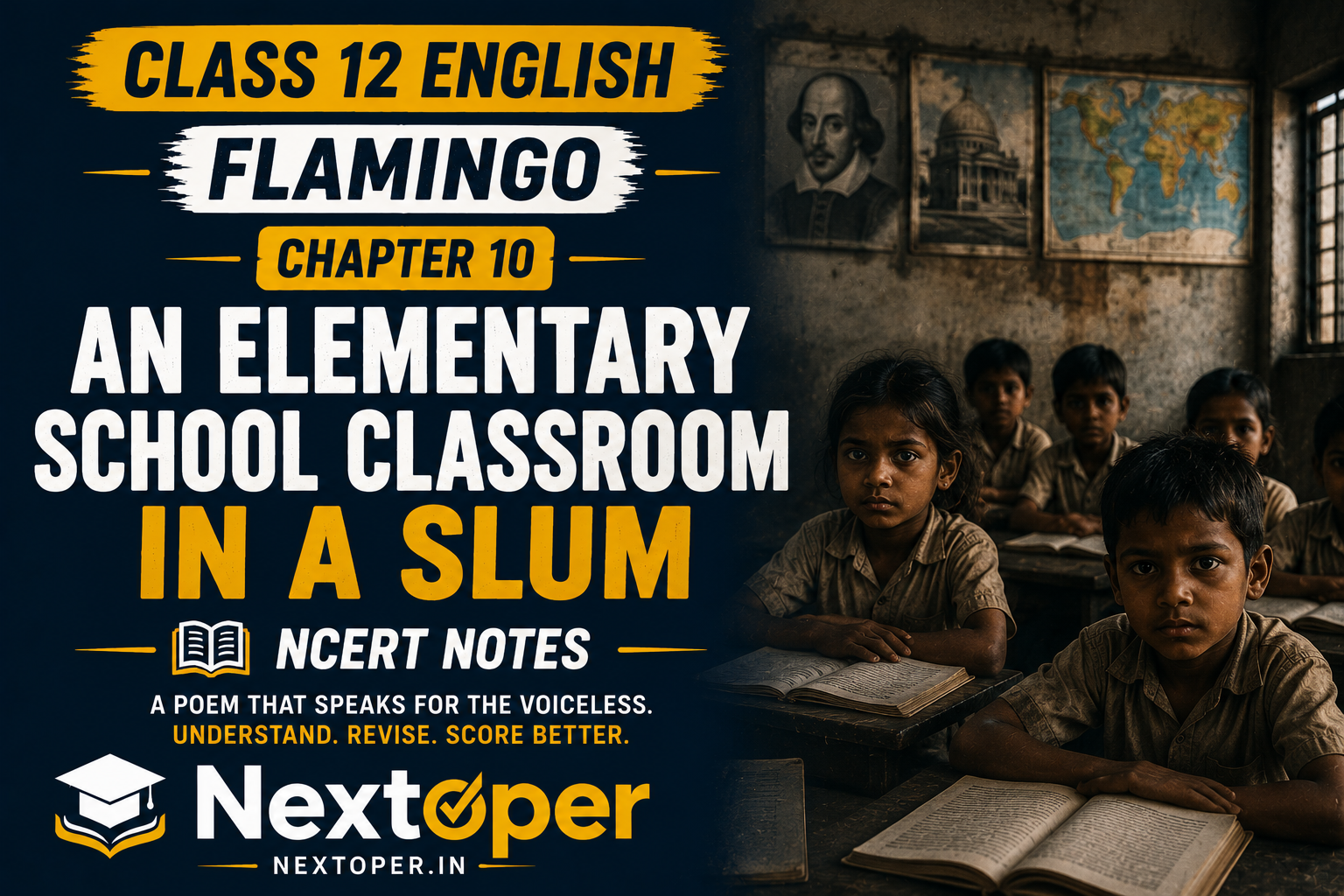
CBSE Class 12 English An Elementary School Classroom in a Slum PDF Notes | Class 12th Chapter 10 PDF notes
Introduction
These Class 12 English An Elementary School Classroom in a Slum Notes cover everything you need. You get the full summary, poet’s message, and glossary. You also get MCQs, important questions, and PYQs. This poem is by Stephen Spender. It is part of the NCERT Flamingo textbook. It shows the pain of children living in poverty. Read this guide before your exam. It is simple, fast, and 100% free. Let’s begin your revision now!
Get free NCERT PDFs and more Class 12 English notes
📋 Table of Contents
- Chapter Overview
- Chapter Summary
- Poetic Devices Used
- Themes and Values
- Key Definitions and Glossary
- Important Questions and Answers
- MCQs with Answers
- Quick Revision Points
- Previous Year Questions (PYQs)
- People Also Ask (FAQs)
- Conclusion
Chapter Overview
This Class 12 English poem is short but powerful. Here are the key facts before you start reading.
| Detail | Information |
|---|---|
| Poem Name | An Elementary School Classroom in a Slum |
| Subject | English (Flamingo — Poetry) |
| Class | 12 |
| Board | CBSE |
| Session | 2025-26 |
| Poet | Stephen Spender (1909–1995) |
| Textbook | Flamingo |
| Type | Free verse, social-realist poem |
Chapter Summary — An Elementary School Classroom in a Slum
These Class 12 English notes explain the poem stanza by stanza. Read each part slowly. It will help you remember faster.
Stanza 1 — The Children’s Faces
The poet describes tired, sickly children. Their hair looks like rootless weeds. A tall girl sits with her head bent down. A thin boy has “rat’s eyes” from hunger. One boy has inherited his father’s illness. A young boy at the back dreams of squirrels in trees. He escapes his sad classroom through daydreams.
Stanza 2 — The Classroom Walls
The walls are the colour of sour cream. This shows years of neglect. Donation slips are pinned on the wall. A picture of Shakespeare hangs there too. There are also pictures of domed buildings. A map of the Tyrolese valley hangs nearby. These images promise a beautiful world. But that world is not real for these children.
Stanza 3 — The Broken Promise
The poet says Shakespeare is “wicked” for these children. The map shows ships, sun, and love. But these things are out of reach. This makes the children want to steal. Their real world is a “slag heap.” Their clothes are torn. Their glasses are broken and mended. Fog and darkness cover their future.
Stanza 4 — The Poet’s Appeal
The poet calls out to governors and inspectors. He wants them to open up the children’s world. He wants real green fields for these kids. He wants them to see golden beaches. He wants their voices to be heard freely. Only then can these children shape their own history.
Poetic Devices Used
A quick line-by-line device table helps you score full marks in poetic technique questions.
| Device | Example from Poem |
|---|---|
| Simile | “Like rootless weeds” — comparing hair to weeds |
| Metaphor | “Slag heap” for the children’s living condition |
| Imagery | “Spectacles of steel / With mended glass” |
| Alliteration | “Far far from” / “Break O break” |
| Symbolism | Shakespeare’s head symbolises unreachable civilisation |
| Contrast | Map’s bright world vs. the children’s foggy slum |
Themes and Values in the Chapter
These are the core ideas your examiner expects you to discuss.
- Social inequality: The poem shows the gap between rich and poor children in society.
- False hope of education: Wall decorations promise a world the children can never access.
- Loss of childhood: Poverty steals the innocence and dreams of these children.
- Call for reform: The poet urges leaders to bring real, lasting change.
- Power of language: The final line says true history is written by free voices.
Key Definitions and Glossary
Use this table for quick word meanings during revision.
| Word | Meaning in Simple English |
|---|---|
| Gusty | Windy and forceful |
| Pallor | Pale, unhealthy skin colour |
| Gnarled | Twisted, deformed |
| Tyrolese valley | A scenic valley in Austria |
| Catacombs | Underground tunnels used as graves |
| Slag heap | A pile of waste from mining or industry |
| Azure | Bright blue, like the sky |
| Doom | A terrible, fixed fate |
| Belfry/Belled | Related to bells and their sound |
| Foggy slum | A dull, hopeless, poor area |
📚
Want More Free Notes? Visit Nextoper.in — All Class 9 to 12 CBSE Notes. 100% Free!
Important Questions and Answers
Practise these before your board exam.
2-Mark Questions
Q: Why does the poet compare the children’s hair to “rootless weeds”? A: It shows the children have no proper care or nourishment. Like weeds, they grow wild and unwanted.
Q: What does the “sour cream” wall colour suggest? A: It suggests years of dirt and neglect. The school has no money for repairs.
Q: Why is the map called a “bad example” for the children? A: It shows a world of ships, sun, and freedom. This tempts the poor children to steal what they cannot afford.
Q: What does the young boy at the back of the class dream about? A: He dreams of squirrels playing in trees. This shows he wants to escape his dull, sad classroom.
5-Mark Questions
Q: Explain the contrast between the classroom decorations and the children’s real world. A: The classroom walls show Shakespeare, domes, and a world map.
- These images represent culture, learning, and freedom.
- But the children’s real world is a slum with narrow streets.
- Their sky is described as “lead,” not open and blue.
- This contrast shows how false hope can feel cruel.
- The poet wants this gap to be closed through real action.
Q: What change does the poet want for the slum children? How can this be achieved? A: The poet wants a complete transformation of their lives.
- He wants leaders like governors and inspectors to act.
- He wants children to see real green fields and golden sands.
- He wants their windows to show hope, not more slums.
- He wants them to read freely and speak their own truth.
- Only real reform, not empty pictures, can achieve this change.
Q: How does Stephen Spender use imagery to show poverty in the poem? A: Spender uses strong visual imagery throughout the poem.
- Children’s bodies are compared to a “slag heap.”
- Their glasses are “mended,” showing they cannot afford new ones.
- The sky is “lead,” a heavy and suffocating image.
- Their world is called a “foggy slum,” full of confusion.
- These images make the reader feel the children’s daily struggle.
MCQs — An Elementary School Classroom in a Slum with Answers
Try these Class 12 English MCQs for quick self-testing.
Q1. Who wrote “An Elementary School Classroom in a Slum”? (A) William Wordsworth (B) Stephen Spender (C) John Keats (D) Robert Frost ✅ Answer: (B) — Stephen Spender wrote this poem in 1939.
Q2. The children’s faces are compared to which of these? (A) Bright flowers (B) Rootless weeds (C) Ocean waves (D) Autumn leaves ✅ Answer: (B) — Their hair is “like rootless weeds,” showing neglect.
Q3. What colour are the classroom walls compared to? (A) Fresh milk (B) Sour cream (C) Golden sand (D) Grey stone ✅ Answer: (B) — “Sour cream walls” shows years without repainting.
Q4. Whose picture hangs on the classroom wall? (A) Newton (B) Shakespeare (C) Gandhi (D) Darwin ✅ Answer: (B) — Shakespeare’s head is shown as a symbol of civilisation.
Q5. What does the young boy at the back dream about? (A) A football match (B) A squirrel’s game in trees (C) His mother (D) A birthday cake ✅ Answer: (B) — He escapes reality through this peaceful daydream.
Q6. The children’s world is described as being far from all EXCEPT: (A) Rivers (B) Capes (C) Stars (D) Slums ✅ Answer: (D) — Slums are their only reality, not something distant.
Q7. What does “catacombs” refer to in the poem? (A) School bags (B) Underground burial tunnels (C) Broken windows (D) Old books ✅ Answer: (B) — Catacombs are underground tunnels used for burial.
Q8. What does the poet want the map to become for these children? (A) A toy (B) A window to a better world (C) A punishment (D) A gift ✅ Answer: (B) — He wants it to open real opportunities, not remain a lie.
Q9. In which collection was this poem first published? (A) The Still Centre (B) World Within World (C) Poems of Dedication (D) The Edge of Being ✅ Answer: (A) — It appeared in Spender’s 1939 collection, The Still Centre.
Q10. What does the poet urge governors and inspectors to do? (A) Ignore the slums (B) Break open the children’s shut-in world (C) Build more walls (D) Close the school ✅ Answer: (B) — He demands real, active change for these children’s future.
Quick Revision Points
Scan these before your exam for a fast recap.
- Poem by Stephen Spender, first published in The Still Centre (1939).
- Describes children in a slum school classroom.
- Hair compared to “rootless weeds” — a simile for neglect.
- Walls are “sour cream” coloured — signs of poverty.
- Shakespeare’s picture symbolises unreachable civilisation.
- Map on the wall shows a world these children cannot access.
- Their real world is called a “slag heap” and “foggy slum.”
- Poet criticises false hope given through classroom decorations.
- He appeals to governors and inspectors to bring real change.
- Final message: true history is made by those who speak freely.
- Poem highlights themes of poverty, inequality, and hope.
- Uses strong imagery, simile, and contrast throughout.
- Based likely on a school visit in East London.
- A key poem for CBSE topics on social realism in poetry.
Previous Year Questions (PYQs)
| Year | Question | Marks |
|---|---|---|
| 2023 | Explain the significance of the map in the poem. | 5 |
| 2022 | How does the poet describe the children’s physical condition? | 3 |
| 2020 | What message does the poet give to the authorities? | 5 |
| 2019 | Why does the poet call Shakespeare “wicked”? | 3 |
Model Answer (2023 — Significance of the map): The map shows ships, rivers, and a colourful world. For rich children, it teaches geography. For slum children, it feels cruel. It shows a life they cannot have. The poet wants the map to become their real window, not a false picture.
Model Answer (2022 — Physical condition): The children look weak and pale. Their hair looks like rootless weeds. One boy has “rat’s eyes” from hunger. Another has inherited disease. Their glasses are broken and mended with steel.
Model Answer (2020 — Message to authorities): The poet asks leaders to act, not just observe. He wants real green fields and open beaches for these children. He wants their voices to be free. Only then can real change happen in their lives.
Featured Snippet Answer
An Elementary School Classroom in a Slum is a poem by Stephen Spender. It shows the sad lives of children studying in a slum school. Their classroom has false, hopeful pictures like Shakespeare and a world map. But their real world is poor and hopeless. The poet asks leaders to bring true change and freedom for these children.
People Also Ask — FAQs
Here are direct answers to common exam-related questions.
❓ Q: What is the theme of An Elementary School Classroom in a Slum? 💡 A: Class 12 English notes highlight the theme of poverty and social inequality. The poem shows how slum children are denied real opportunities. It contrasts false classroom hope with harsh reality. Spender calls for genuine reform, not empty symbols of a better world.
❓ Q: Why are the classroom walls compared to sour cream? 💡 A: The walls are called “sour cream” to show years of neglect. This colour suggests dirt, poverty, and a lack of school funding. It sets the tone for the entire poem’s depressing atmosphere in the slum classroom.
❓ Q: What does the poet want for the slum children? 💡 A: The poet wants slum children to access real opportunities. He wants leaders to break open their limited world. He wants them to see green fields, golden beaches, and free education, not just pictures on a wall.
❓ Q: Who wrote An Elementary School Classroom in a Slum? 💡 A: Stephen Spender, a British poet and essayist, wrote this poem. He lived from 1909 to 1995. He was known for his socialist views and focus on social injustice in his writing career.
❓ Q: What is the meaning of “catacombs” in the poem? 💡 A: Catacombs are underground tunnels historically used for burial. The poet uses this word to describe the children’s shut-in lives. Their world feels closed and lifeless, just like an underground tomb.
🔔 Found this helpful? Share with your classmates! 📲 | Instagram Help your friends score better marks — for free!
Conclusion
These Class 12 English An Elementary School Classroom in a Slum Notes cover the full poem. You learned the summary, themes, and poetic devices. You also practised MCQs, important questions, and PYQs. This poem teaches us about poverty and hope. Keep visiting Nextoper.in for more free CBSE notes. Revise these Class 12 English An Elementary School Classroom in a Slum Notes daily. Good luck for your board exam!
More Notes from This Subject
Explore more Flamingo poetry and prose notes for your board prep.
- Class 12 English Flamingo Chapter 7 Notes — The Interview Notes
- Class 12 English Flamingo Chapter 8 – Going Places Notes
- Class 12 English Flamingo Chapter 9 –Mother at Sixty-Six
- All Class 12 English Flamingo Notes — Nextoper.in
👤 About the Author This article is written by the Nextoper Editorial Team. We provide 100% free CBSE study notes for Class 9 to 12 students. All our notes follow the latest NCERT syllabus 2025-26. No signup needed. No cost. Just free notes for every student.
🔄 Last Reviewed: July 2026 This blog was reviewed and updated to match the latest NCERT textbook and CBSE syllabus 2025-26 guidelines.