CBSE Class 11 English Chapter 3 PDF Notes Discovering Tut: The Saga Continues Notes 2026-27 | Nextoper Notes
What is Discovering Tut: The Saga Continues about?
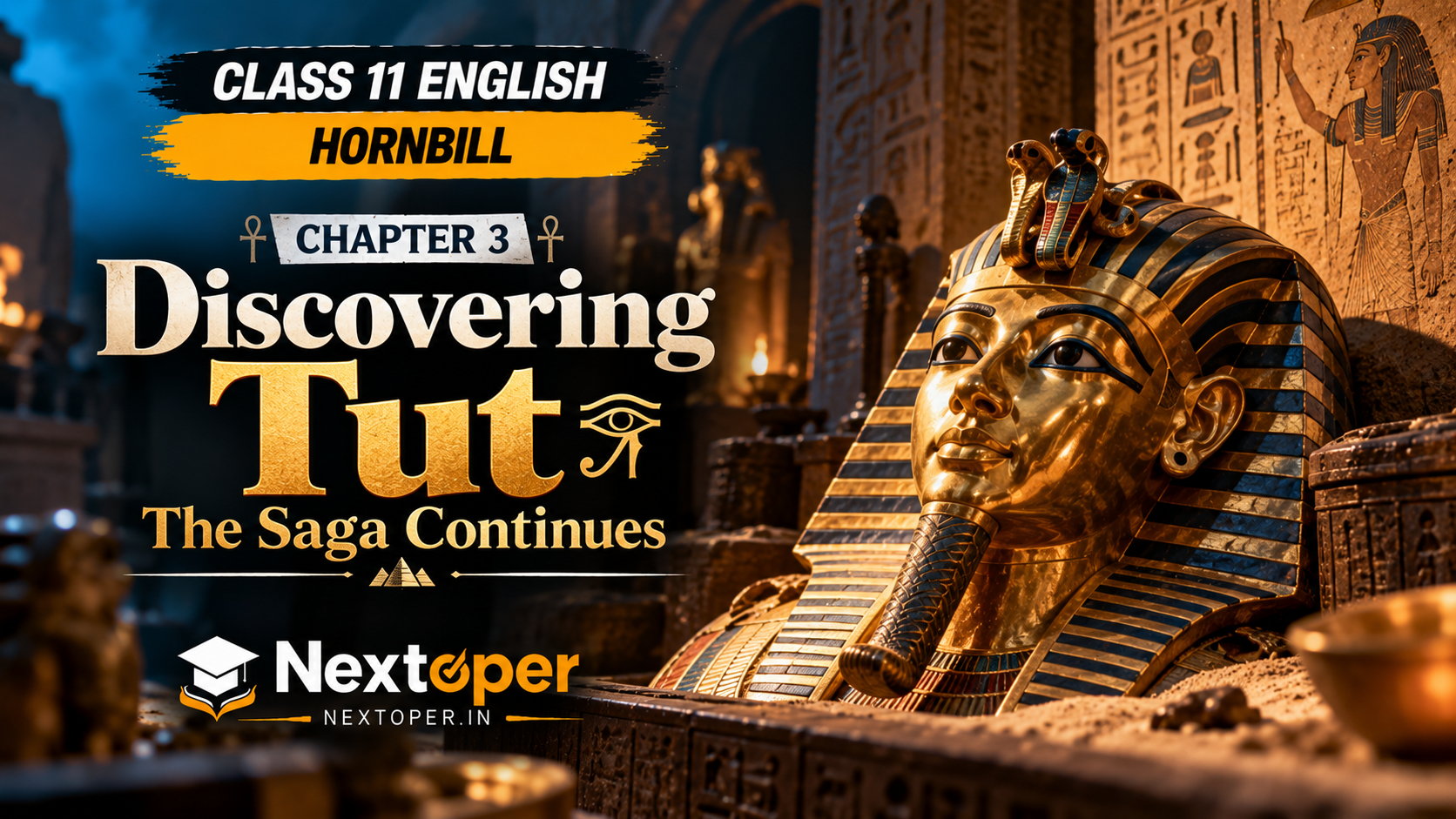
Discovering Tut: The Saga Continues is a non-fiction lesson in Class 11 English Hornbill, Chapter 3. It is credited to A. R. Williams. The lesson reports the CT scan of King Tutankhamun’s mummy in January 2005. It also recalls Howard Carter’s damaging work in the 1920s and Tut’s troubled royal family.
Save Free Notes PDF – Class 11 English Chapter 3 PDF Notes | Click Here to Save
Here is the chapter at a glance. Each fact below comes from the NCERT lesson.
| Item | Detail |
|---|---|
| Chapter | 3. Discovering Tut: the Saga Continues |
| Book | Hornbill, NCERT English for Class 11 (reprint 2026-27) |
| Author credit | A. R. Williams |
| Original source | National Geographic, Vol 207, No. 6 |
| Text type | Non-fiction report |
| Place | Valley of the Kings, Egypt |
| Main event | CT scan of Tut’s mummy, evening of 5 January 2005 |
| Main people | Tut, Howard Carter, Zahi Hawass, Ray Johnson, Akhenaten |
| Exercises | Understanding the text, Talking about the text, Thinking about language, Working with words, Things to do |
Tutankhamun (King Tut) is a young pharaoh of ancient Egypt who died in his late teens. A pharaoh is a king of ancient Egypt. A CT scan is a test that joins hundreds of X-ray slices into a 3D picture. The Valley of the Kings is the old Egyptian cemetery where Tut’s tomb lies.
What is the summary of Discovering Tut: The Saga Continues?
On 5 January 2005, scientists scanned King Tut’s mummy in a CT machine inside the Valley of the Kings. They hoped to learn how he died and how old he was. The lesson also tells of Carter’s damage in the 1920s, Tut’s family history and a quiet ending under Orion.
The night of the scan
The scene opens in the Valley of the Kings. An angry wind stirs dust, and dark clouds hide the stars. At 6 p.m., Tut’s mummy glides into a CT scanner brought there for the job.
Tut died more than 3,300 years ago. All afternoon, tourists had visited his tomb. Some wondered if the pharaoh’s curse was real.
What Howard Carter did in the 1920s
Zahi Hawass says the mummy is in bad shape because of Carter. Carter was the British archaeologist who found the tomb in 1922. The tomb held the richest royal collection ever found.
Hardened resins had cemented Tut to his gold coffin. Carter set the mummy in the sun, and it heated to 149 degrees Fahrenheit. Nothing budged.
So his men chiselled the resins away. They removed the head and cut nearly every major joint. Then they rebuilt the body on sand in a padded wooden box to hide the damage.
The lesson also gives Carter a defence. Without cutting Tut free, thieves would have torn the mummy apart for the gold.
From treasure hunting to science
Archaeology has changed since Carter’s day. Experts now care less about treasure and more about life and death in the past. They also use medical tools.
In 1968, an anatomy professor X-rayed Tut. He found that the breast-bone and front ribs were missing. CT goes further, because it builds a 3D virtual body from hundreds of cross-section X-rays.
Tut’s family: a dynasty in trouble
Amenhotep III was a powerful pharaoh. He ruled for almost four decades. The lesson calls him Tut’s father or grandfather.
His son, Amenhotep IV, shook Egypt. He promoted the Aten, the sun disk, and renamed himself Akhenaten. He moved the religious capital from Thebes to Akhetaten, now called Amarna.
He also attacked the god Amun. His men smashed Amun’s images and closed his temples. Ray Johnson says Akhenaten went “a little wacky”.
A mysterious ruler named Smenkhkare appeared briefly after Akhenaten. Then young Tutankhaten took the throne. He changed his name to Tutankhamun and restored the old ways. He ruled about nine years and died unexpectedly.
How the scan was done
The Egyptian Mummy Project began counting mummies in late 2003. It has recorded almost 600. Its next phase was scanning them with a portable CT machine.
Tut was among the first mummies scanned. The machine made 1,700 digital X-ray images. His head was scanned in 0.62 millimetre slices.
Workmen carried Tut to the trailer in his box. Twenty minutes later, the scanner quit because of sand in a cooler fan. Two men fetched plastic fans, and the scan finished.
A guard joked nervously about the “Curse of the pharaoh”. Tut was back in his tomb less than three hours after leaving his coffin.
The quiet ending
A technician pulled up images on a screen. A grey head took shape from pixels. Neck bones, a hand, the rib cage and a skull section appeared.
Hawass smiled with relief. He had not slept the night before. Outside, the wind had stopped, and Orion stood above the tomb. The ancient Egyptians knew Orion as the soul of Osiris, god of the afterlife.
Exam alert: This lesson does not report what the scan found about Tut’s cause of death or exact age. It leaves those two questions open. Write only what the text says.
Which events happen in Discovering Tut, and when?
The lesson jumps between centuries, so students often mix the dates. Tut died over 3,300 years ago, Carter found the tomb in 1922, and an X-ray followed in 1968. The Egyptian Mummy Project began in late 2003. The CT scan took place on 5 January 2005.
| When | What happened |
|---|---|
| More than 3,300 years ago | Tut dies in his late teens after ruling about nine years |
| 1922 | Howard Carter discovers Tut’s tomb |
| 1920s | Carter’s men free the mummy and chisel away the resins |
| 1968 | An anatomy professor X-rays the mummy and finds the breast-bone and front ribs missing |
| Late 2003 | The Egyptian Mummy Project starts its inventory |
| 5 January 2005 | Tut’s mummy is CT-scanned in the Valley of the Kings |
Who are the key figures in Discovering Tut?
The key figures are King Tutankhamun, Howard Carter, Zahi Hawass, Ray Johnson and the royal family of Amenhotep III and Akhenaten. Tut is the subject, Carter is the damaging archaeologist, and Hawass leads the scan. The lesson has no single hero. It is a report, not a story.
| Name | Who they are | Role in the chapter |
|---|---|---|
| Tutankhamun (Tut) | Young pharaoh, last of his family line | Subject of the scan and the mystery |
| Howard Carter | British archaeologist | Found the tomb in 1922 and damaged the mummy |
| Zahi Hawass | Secretary General, Supreme Council of Antiquities | Oversees the scan and feels great relief |
| Ray Johnson | Director, University of Chicago research centre in Luxor | Calls Akhenaten “a little wacky” |
| Amenhotep III | Powerful pharaoh of the eighteenth dynasty | Tut’s father or grandfather |
| Akhenaten (Amenhotep IV) | Pharaoh who worshipped the Aten | Upsets Egypt by attacking Amun |
| Smenkhkare | Mysterious short-lived ruler | Appears briefly before Tut |
Hawass is the human face of the scan. His worry and relief give the lesson its emotion. Carter is the shadow over the story, because his actions caused the damage.
What are the main themes of Discovering Tut?
The main themes are science helping history, the changing aims of archaeology, belief in the afterlife and respect for the dead. The lesson also shows how fame keeps a person’s story alive for thousands of years. Use the table below to pick a theme and support it with one example.
| Theme | Where you see it | How to use it in an answer |
|---|---|---|
| Science helps history | CT scan builds a 3D virtual body | Say technology reaches what old methods could not |
| Archaeology has changed | Less focus on treasure, more on life and death | Contrast Carter’s era with 2005 |
| Belief in the afterlife | Gold, food, wine and games buried with Tut | Link gifts to the hope of resurrection |
| Respect for the dead | The mummy is returned to its tomb within three hours | Compare with Carter’s rough cutting |
| Fame and legend | The pharaoh’s curse and the world’s “most famous mummy” | Show why Tut is studied again and again |
Which lines in Discovering Tut matter most, and why?
A handful of short phrases carry the lesson’s meaning. Each one points to a theme, a character trait or a tone. Learn these phrases and you can write sharper answers. Examiners reward answers that explain why a line matters, not just what it says.
| Phrase from the text | Why it matters |
|---|---|
| “death rattle of a dynasty” | Shows that Tut’s funeral ended his family’s rule |
| “scientific detachment” | Describes Carter’s calm tone while reporting the chiselling |
| “little choice” | Gives a fair view of Carter, who feared thieves |
| “in death, as in life” | Links Tut’s royal rank to being among the first scanned |
| “Curse of the pharaoh” | A nervous joke that adds humour and tension |
| Orion above the tomb | Joins modern science with ancient belief in Osiris |
What do the difficult words in Discovering Tut mean?
Hard words in this lesson come from archaeology, medicine and Egyptian religion. The textbook lists eight expressions to infer from context. The table below explains those eight and a few more. Read each meaning once, then look at the sentence where the word appears.
| Word or phrase | Simple meaning |
|---|---|
| forensic reconstruction | Rebuilding how someone looked or died, using scientific evidence |
| scudded across | Moved fast across the sky |
| casket grey | The dull grey colour of a coffin |
| resurrection | Coming back to life after death |
| funerary treasures | Valuable objects buried with the dead |
| circumvented | Got around an obstacle or rule |
| computed tomography | CT, a scan that stacks X-ray slices into a 3D image |
| eerie detail | Strange, slightly scary clarity |
| mummy | A dead body preserved for a very long time |
| resin | A sticky tree substance that hardens |
| Aten | The sun disk worshipped under Akhenaten |
| Amun | A major Egyptian god whose temples Akhenaten closed |
| Osiris | The Egyptian god of the afterlife |
What are the NCERT question answers for Discovering Tut?
The NCERT exercises for Chapter 3 have five parts: Understanding the text, Talking about the text, Thinking about language, Working with words and Things to do. Below, each question is given as printed, followed by our own model answer. Rewrite the answers in your words before the exam.
Understanding the text
Q1. Give reasons for the following.
(i) King Tut’s body has been subjected to repeated scrutiny.
Tut’s tomb held the richest royal collection ever found, so the world watches him closely. His death also remains unclear. People still ask how he died and how old he was. New tools keep offering new ways to look.
(ii) Howard Carter’s investigation was resented.
Carter’s work left the mummy in very bad condition. His men removed the head and cut nearly every major joint to free the gold. Hawass blames the damage on Carter. The text also notes that Carter had little choice.
(iii) Carter had to chisel away the solidified resins to raise the king’s remains.
The ritual resins had hardened and cemented Tut to his gold coffin. Strong force could not move them. Even heating the mummy in the sun did nothing. Chiselling was the only way left.
(iv) Tut’s body was buried along with gilded treasures.
Royals in Tut’s time were very rich. They hoped to take their riches into the next world. The gold’s eternal brilliance was meant to guarantee resurrection. Tut also received everyday items such as board games and food.
(v) The boy king changed his name from Tutankhaten to Tutankhamun.
Tutankhamun means “living image of Amun”. Akhenaten had attacked Amun and closed his temples. Tut restored the old ways, so his new name honoured the god his predecessor had rejected.
Q2. (i) List the deeds that led Ray Johnson to describe Akhenaten as “wacky”.
Akhenaten promoted the worship of the Aten, the sun disk. He changed his name from Amenhotep IV. He moved the religious capital from Thebes to Akhetaten. He attacked Amun, smashed his images and closed his temples.
(ii) What were the results of the CT scan?
The scan produced 1,700 digital X-ray images from head to toe. The head was scanned in 0.62 millimetre slices. The images showed neck vertebrae, a hand, the rib cage and a skull section. The text does not state any cause of death.
(iii) List the advances in technology that have improved forensic analysis.
X-rays, used on Tut in 1968, were an early step. CT scanning now joins hundreds of cross-section X-rays into a 3D virtual body. A portable CT machine can be taken to the tomb. Teams of radiology, forensics and anatomy experts then study the images.
(iv) Explain the statement, “King Tut is one of the first mummies to be scanned — in death, as in life…”
In life, Tut was a pharaoh and stood above his countrymen. In death, he was again at the front of the line. Among the many mummies in Egypt, he was one of the first chosen for the new CT scan.
Talking about the text
These are debate topics, so use both sides. Here are quick points for each.
| Topic | For | Against |
|---|---|---|
| Scientific intervention is necessary to unearth buried mysteries. | Scans find facts that rituals and legends cannot | Science can damage remains, as Carter’s work did |
| Advanced technology gives us conclusive evidence of past events. | CT gives precise data and clear images | The lesson’s scan still leaves Tut’s death unanswered |
| Traditions, rituals and funerary practices must be respected. | Burial rites carry deep belief and meaning | Study can add to human knowledge if done with care |
| Knowledge about the past is useful to complete our knowledge of the world we live in. | The past explains how today’s world formed | Some argue present problems matter more |
Thinking about language
The textbook first gives a short passage from The Encyclopedia of Language by David Crystal. It says Egyptian is now extinct and later developed into Coptic. Then it asks three questions.
Q2. What do you think are the reasons for the extinction of languages?
Languages fade when fewer people speak them at home. Schools, jobs and media often favour a few big languages. Migration and the loss of written records also push small languages towards extinction.
Q3. Do you think it is important to preserve languages?
Yes. A language carries a community’s stories, songs and ways of thinking. When it dies, that knowledge is lost. Preserving languages keeps cultural variety alive.
Q4. In what ways could we help prevent the extinction of languages and dialects?
Speak them at home and teach them to children. Record stories, songs and words. Publish books and online content in them. Schools and governments can add them to lessons.
Working with words
Q1. Explain why these word combinations have been used together.
| Combination | Why the writer used it |
|---|---|
| ghostly dust devils | Swirling dust looks like spirits and sets a spooky mood |
| desert sky | Places the scene over dry, empty land |
| stunning artefacts | Shows the gold objects amazed everyone |
| funerary treasures | Treasures made for a burial and the afterlife |
| scientific detachment | Carter wrote calmly, without showing feeling |
| dark-bellied clouds | Heavy clouds hang low like a belly and warn of gloom |
| casket grey | Links the colour of the sky to a coffin |
| eternal brilliance | Gold never fades, like the hoped-for afterlife |
| ritual resins | Resins used in burial rites |
| virtual body | A computer-made 3D body, not a real one |
Q2. Find out the meanings of these medical terms.
| Term | Meaning |
|---|---|
| CT scan | A scan that joins many X-ray slices into a 3D image |
| MRI | A scan that uses magnets and radio waves to image the body |
| tomography | Imaging a body in thin cross-section slices |
| autopsy | A medical examination of a dead body to find the cause of death |
| dialysis | Cleaning the blood with a machine when kidneys fail |
| ECG | A graph that records the heart’s electrical activity |
| post mortem | Another name for an autopsy |
| angiography | An imaging test that shows blood vessels |
| biopsy | Removing a small piece of tissue for testing |
Things to do
Q1. Find out the astronomical descriptions and legends linked to these.
| Star or constellation | Quick note |
|---|---|
| Ursa Major (Saptarishi mandala) | The Great Bear. In India, its seven bright stars are linked to the seven sages |
| Polaris (Dhruva tara) | The pole star, which seems to stay fixed in the northern sky. Indian legend links it to the child Dhruva |
| Pegasus (Winged horse) | A Greek constellation named after a winged horse of myth |
| Sirius (Dog star) | The brightest star in the night sky, found in Canis Major, “the greater dog” |
| Gemini (Mithuna) | The Twins, linked in Greek myth to Castor and Pollux |
Check one more source for each legend before you write it in class. Myths vary by culture.
Q2. Which of willow, olive, celery, lotus and cornflower are common in our country?
The lotus is the most familiar and is our national flower. Celery is grown as a vegetable, and willow trees grow in cooler regions such as Kashmir. Cornflower is a garden flower. Olive is grown only in limited areas.
Q3. Name some leaves and flowers used as adornments in our country.
Marigold, rose and jasmine flowers are common in garlands and hair. Mango leaves decorate doorways at festivals. Banana leaves and lotus flowers are used in many rituals.
What MCQs can you solve for Discovering Tut?
These ten MCQs test facts, names and numbers from the lesson. Each answer has a one-line reason from the text. Try them without looking at the answers. If you score below eight, read the summary again.
- On which date was Tut’s mummy CT-scanned?
(a) 5 January 2005 (b) 5 January 1922 (c) 5 January 1968 (d) 5 January 2003
Answer: (a). The lesson gives the date as 5 January 2005. - Who discovered Tut’s tomb in 1922?
(a) Zahi Hawass (b) Ray Johnson (c) Howard Carter (d) Amenhotep III
Answer: (c). Carter was the British archaeologist who found it. - How many digital X-ray images did the CT machine create?
(a) 600 (b) 1,700 (c) 3,300 (d) 149
Answer: (b). The scan made 1,700 cross-section images. - What is Zahi Hawass’s position in the lesson?
(a) Director of a Chicago research centre (b) British archaeologist (c) Secretary General of Egypt’s Supreme Council of Antiquities (d) Anatomy professor
Answer: (c). The text names this post when he is first quoted. - Why did the scanner stop for a while?
(a) Power cut (b) Sand in a cooler fan (c) A broken screen (d) A storm warning
Answer: (b). Two men fetched plastic fans to fix it. - What does “Tutankhamun” mean?
(a) Servant of the Aten (b) Boy king (c) Living image of Amun (d) Lord of the Nile
Answer: (c). The lesson translates the name this way. - To what temperature did the sun heat the mummy?
(a) 26 degrees (b) 100 degrees (c) 149 degrees Fahrenheit (d) 1,700 degrees
Answer: (c). Carter hoped the heat would loosen the resins. - What did the 1968 X-ray reveal?
(a) A broken skull (b) Missing breast-bone and front ribs (c) A hidden coin (d) A second mummy
Answer: (b). The anatomy professor found these bones missing. - Which constellation stood above Tut’s tomb at the end?
(a) Ursa Major (b) Gemini (c) Pegasus (d) Orion
Answer: (d). Egyptians knew Orion as the soul of Osiris. - Who said Akhenaten “went a little wacky”?
(a) Ray Johnson (b) Zahi Hawass (c) Howard Carter (d) A guard
Answer: (a). Johnson directs the University of Chicago’s centre in Luxor.
What should you revise the night before the exam?
Revise the dates, the three people, the two big questions and the closing image. Then skim the glossary and the mistakes list. This takes about fifteen minutes. The box below packs the chapter into five points, with a memory trick to hold them.
Memory trick: TUT
- T = Tomb and treasure. Carter found it in 1922 and damaged the mummy.
- U = Unanswered questions. How did Tut die, and how old was he?
- T = Technology. X-ray in 1968, CT scan on 5 January 2005.
Five-point revision:
- Tut was the last of his family line and died in his late teens.
- Carter’s men chiselled the resins and cut the joints.
- CT made 1,700 images; the head was scanned in 0.62 mm slices.
- The scan paused because of sand in a fan, then finished.
- The lesson ends with Orion above the tomb.
Self-check: can you answer these in one line?
| Question | One-line answer |
|---|---|
| Where was the scan done? | In a trailer near Tut’s tomb in the Valley of the Kings |
| Why did Carter use the sun? | To soften the hardened resins |
| Who is Smenkhkare? | A mysterious ruler who appeared briefly before Tut |
| What is the Egyptian Mummy Project? | An inventory of mummies that plans CT scans |
| Who donated the portable CT machine? | The National Geographic Society and Siemens |
Which practice questions should you try?
These practice questions are written by Nextoper to match the style of the NCERT exercises. They are not previous-year board papers, and we make no claim about what will appear in your exam. Answer each in your own words, then check against the summary and tables above.
Short answer (about 40 words each)
- Why was Tut buried with everyday items such as board games and food?
- What do the flowers on the shroud tell us about the time of burial?
- How does a CT scan differ from the 1968 X-ray?
- Why does the writer mention Orion at the end?
Long answer (about 120 words each)
- Describe how Carter freed the mummy. Do you think he was justified? Give reasons from the text.
- “Scientific intervention is necessary to unearth buried mysteries.” Argue for or against this view.
- Imagine you are Zahi Hawass on the night of the scan. Write a diary entry about your worry and relief.
What mistakes do students make in Discovering Tut?
Most lost marks come from adding facts the lesson never states. Students claim the scan solved Tut’s death, name Akhenaten as his father, or mix up the dates. Check each point against the text before you write it. The table lists the six most common slips.
| Common mistake | What the text actually says |
|---|---|
| “The CT scan revealed how Tut died.” | The lesson does not report a cause of death. The two big questions remain open |
| “Akhenaten was Tut’s father.” | The text calls Amenhotep III Tut’s father or grandfather. It does not state Tut’s link to Akhenaten |
| “Hawass was relieved because Tut’s body was healthy.” | He was relieved that nothing had gone seriously wrong with the scan |
| “Tut was the first mummy ever scanned.” | The text says he was one of the first |
| Mixing 1922, 1968 and 2005 | 1922 is Carter, 1968 is the X-ray, 2005 is the CT scan |
| Calling it “Chapter 4” | Older sites use old numbering. The current NCERT book lists it as Chapter 3 |
What is the short answer for Discovering Tut?
Here is a plain, read-aloud answer you can use anywhere.
Discovering Tut: The Saga Continues, by A. R. Williams, describes how scientists CT-scanned King Tutankhamun’s mummy on 5 January 2005. It recalls Howard Carter’s rough handling in the 1920s and the unrest in Tut’s royal family. It shows how archaeology now uses medical technology to study the past with care. The lesson ends quietly, with Tut back in his tomb beneath Orion.
FAQs on Class 11 English Chapter 3 Discovering Tut
These five questions are the ones students ask most. Each answer is short and based on the NCERT text. For anything else, use the summary and tables above.
What is the summary of Discovering Tut: The Saga Continues?
The lesson reports the CT scan of King Tut’s mummy on 5 January 2005. It recalls Carter’s damaging work in the 1920s and Tut’s family history. It ends with Tut returned to his tomb under Orion.
Who wrote Discovering Tut: The Saga Continues?
The NCERT lesson credits A. R. Williams. It names National Geographic, Vol 207, No. 6, as its source.
What is the pharaoh’s curse in the chapter?
The text describes it as death or misfortune falling on those who disturbed the pharaoh. Visitors wonder if it is true. A guard jokes about it when the scanner stops.
Why was Howard Carter’s investigation resented?
Carter’s men removed Tut’s head and cut nearly every major joint to free the gold. Hawass says the mummy is in bad condition because of this. The text also says Carter had little choice, because thieves threatened the gold.
What did the CT scan of King Tut show?
The scan produced 1,700 cross-section images, including neck bones, a hand, the rib cage and a skull section. The lesson does not state Tut’s cause of death or exact age.
Keep these Class 11 English Chapter 3 Discovering Tut notes close
Read the summary once, then drill the timeline and the mistakes table. Finish with the ten MCQs. If you can explain why Orion closes the lesson, you are ready for these Class 11 English Chapter 3 Discovering Tut: The Saga Continues notes to pay off in your exam.
Related notes
- Class 11 English Chapter 1 The Portrait of a Lady notes
- Class 11 English Chapter 2 PDF Notes
- Class 11 English Hornbill notes: all chapters
About the author and reviewer
How we prepared this: These notes are based on the NCERT Hornbill Class 11 chapter (reprint 2026-27). We checked every fact against the NCERT text and wrote the answers in our own words. Last reviewed on 2026-10-20.
Sources
- NCERT, Hornbill (Class 11 English), Chapter 3, Discovering Tut: the Saga Continues
- CBSE Academic, official curriculum and sample papers
- Lesson source as named in the textbook: National Geographic, Vol 207, No. 6