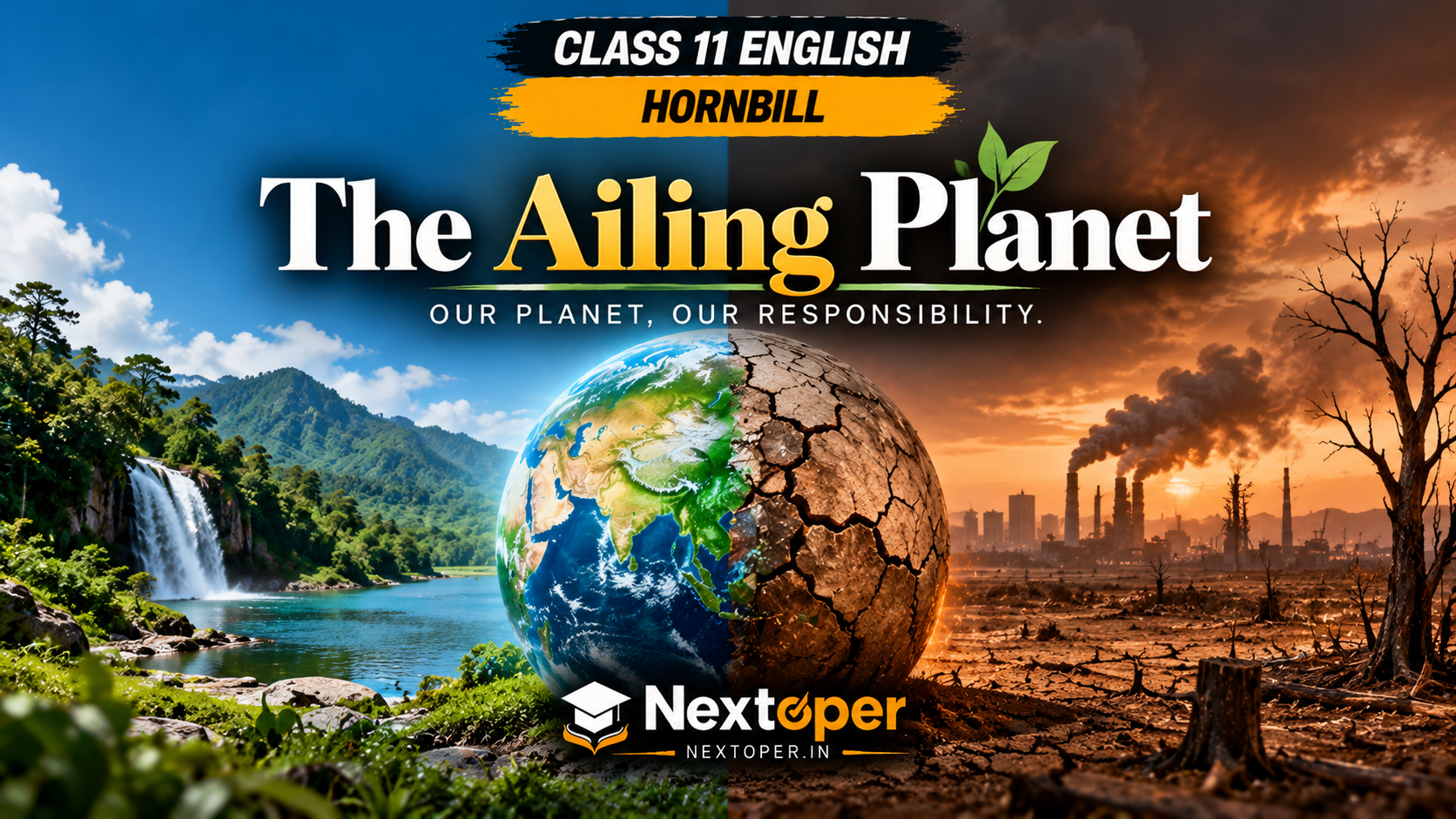
CBSE Class 11 English Chapter 5 PDF Notes The Ailing Planet – Hornbill 2026-27 | Nextoper Notes
What is Chapter 5 of Class 11 English Hornbill?
The Ailing Planet: The Green Movement’s Role is Chapter 5 of the Class 11 English core book, Hornbill. It is a prose essay by Nani Palkhivala. It first appeared in The Indian Express in 1994. The essay warns that Earth’s forests, fisheries, grasslands and croplands are wearing out. Every generation, it says, must protect them.
| Detail | Fact |
|---|---|
| Chapter | Class 11 English, Hornbill, Chapter 5 (prose) |
| Title | The Ailing Planet: The Green Movement’s Role |
| Author | Nani Palkhivala, Indian jurist, economist and writer |
| First published | The Indian Express, 24 November 1994 |
| Form | Essay (an article, not a story) |
| Board and session | CBSE, 2026-27 |
| Key ideas | Green Movement, sustainable development, population, Era of Responsibility |
Check the chapter in the official book on the NCERT textbook page.
What is the summary of The Ailing Planet?
The Ailing Planet says Earth is like a patient whose health is falling. Palkhivala explains that people overuse fish, forests, grass and crops. He blames weak law enforcement and fast population growth. He ends with hope. If we act as caretakers, the planet can recover for our children.
A new way of seeing Earth
The Green Movement began nearly twenty-five years before 1994. In 1972, New Zealand founded the first nationwide Green party. Since then the movement has spread fast.
Save Free Notes PDF – Class 11 English Chapter 5 PDF Notes | Click Here to Save
People once saw nature as a machine. Now many see Earth as one living being, and we are its parts. Palkhivala calls this shift as big as the idea of Copernicus, who showed that Earth moves around the sun.
The author says Earth’s vital signs show a patient in declining health. So we must be good stewards and responsible trustees for future generations. In 1987, the World Commission on Environment and Development made sustainable development a popular idea. It means meeting today’s needs without harming tomorrow’s.
The most dangerous animal
A zoo in Lusaka, Zambia, has a cage with a notice about the world’s most dangerous animal. The cage holds only a mirror. You see yourself, and the joke becomes a warning.
Scientists have listed about 1.4 million living species. Biologists guess that three to a hundred million more remain unnamed.
Four systems that feed the world
Lester Brown, in The Global Economic Prospect, names four main biological systems. They are fisheries, forests, grasslands and croplands. They give us food and nearly all raw material for industry, except minerals and petroleum-based synthetics.
In many places, human demand has passed a safe limit. Fisheries then collapse, forests vanish, grasslands turn barren, and croplands decline. Poor families cut trees for cooking fuel. In some places firewood costs more than the food in the pot.
Forests come before people, and deserts follow them. Tropical forests are vanishing at forty to fifty million acres a year. Dr Myers calls these forests the powerhouse of evolution, so many species face extinction.
India: laws that stay on paper
Article 48A of the Constitution asks the State to protect the environment, forests and wildlife. Yet Palkhivala says laws in India are neither respected nor enforced. Casteism, untouchability and bonded labour were also banned, but they still survive.
India loses 3.7 million acres of forest every year, by official data. The real loss is about eight times higher. Large areas marked as forest are almost treeless.
Population and poverty
A United Nations study, using satellites and aerial photos, found the environment “critical” in many of eighty-eight countries. The author calls population growth one of the strongest forces bending the future.
The world took over a million years to reach one billion people, around 1800. It added the next billion by 1900. The twentieth century added 3.7 billion more, reaching 5.7 billion. The world now gains one million people every four days.
Development is the best contraceptive, he says. Fertility falls when income rises, schools spread and health improves. He rejects forced sterilisation and backs voluntary family planning. India had 920 million people then, more than Africa and South America together.
The Era of Responsibility
For the first time, humans worry about the survival of the planet, not just people. The environmental problem need not mean our end. It can be our passport for the future.
Industry has a big role. Edgar S. Woolard, chairman of Du Pont, called himself the company’s Chief Environmental Officer. Margaret Thatcher said no generation owns the earth outright. Lester Brown’s line ends the essay: we borrowed the earth from our children.
Who are the key figures in The Ailing Planet?
The essay has no characters in the story sense. It names real people and bodies who support Palkhivala’s argument. Each one adds a fact, a warning or a quotable line. Learn who said what, because exam questions often test that link.
| Person or body | Who they are | What the essay uses them for |
|---|---|---|
| Nani Palkhivala | Author, Indian jurist | Builds the whole argument |
| Copernicus | Sixteenth-century astronomer | Shows how big the shift in thinking is |
| Brandt Commission and L.K. Jha | Early international commission; Jha was an Indian member | Asks if we will leave a scorched planet |
| Lester R. Brown | Writer of The Global Economic Prospect | Names the four systems; “borrowed from our children” |
| Dr Myers | Scientist quoted in the essay | Tropical forest is the powerhouse of evolution |
| James Speth | President, World Resources Institute | Forests vanish faster than an acre a second |
| Edgar S. Woolard | Chairman of Du Pont | Shows industry can lead |
| Margaret Thatcher | British Prime Minister | No generation holds a freehold on Earth |
What are the main themes of The Ailing Planet?
The main theme of The Ailing Planet is shared responsibility for Earth. The essay links five ideas. Earth is a living being. Resources have limits. Population growth has a cost. Laws often fail. We owe a duty to future generations. Together they argue for sustainable development.
| Theme | What it means | Where you see it |
|---|---|---|
| Earth is alive | Nature has needs and limits, like a body | Patient in declining health |
| Human blame | People cause the damage | Mirror in the Lusaka zoo |
| Limits of resources | Overuse breaks the four systems | Overfishing, firewood, barren grasslands |
| Population and poverty | More people can mean more poverty | One million people every four days |
| Weak law enforcement | Rules mean little without action | Article 48A and treeless forest land |
| Era of Responsibility | Everyone, including industry, must act | Woolard, Thatcher and Brown |
Which numbers should you remember from The Ailing Planet?
Remember eleven numbers from The Ailing Planet. Each one proves a point, such as how fast forests vanish or how quickly population grows. Link every number to its claim, not just its value. Examiners reward answers that use a figure to support an idea.
This number map is original to Nextoper.in.
| Number | What it counts | Point it proves |
|---|---|---|
| 1972 | First nationwide Green party, New Zealand | The movement is real and organised |
| 1987 | Sustainable development became popular | The idea has an official origin |
| 1.4 million | Species listed by scientists | We know only part of life on Earth |
| 3 to 100 million | Estimated unnamed species | Many species may vanish unseen |
| 4 | Principal biological systems | The economy rests on a few systems |
| 40 to 50 million acres | Tropical forest lost each year | Deforestation is huge |
| 3.7 million acres | India’s yearly forest loss (official) | Loss is serious even on paper |
| 8 times | Real loss compared with official data | Government figures hide the truth |
| 88 | Countries in the United Nations study | The crisis is global |
| 5.7 billion | World population then | Growth is rapid |
| 920 million | India’s population then | Population control is urgent |
What do the difficult words in The Ailing Planet mean?
The difficult words in The Ailing Planet are mostly about nature, law and responsibility. NCERT asks you to guess eight expressions from context. Learn the meanings below in simple words. Then use each word in your own sentence, because that is how you remember it.
| Word or phrase | Simple meaning |
|---|---|
| a holistic and ecological view | Seeing nature as one connected whole |
| inter alia | Among other things |
| sustainable development | Growth that does not use up what the future needs |
| decimated | Destroyed in large numbers |
| languish | Stay neglected and weak |
| catastrophic depletion | A disastrous running out of something |
| ignominious darkness | Shameful lack of notice or knowledge |
| transcending concern | A worry that goes beyond one group or time |
| irrevocably | In a way that cannot be undone |
| stewards | People who look after something for others |
| patrimony | What we inherit from our ancestors |
| coercion | Using force to make someone act |
| felicitous | Well chosen and fitting |
| freehold | Full ownership of land forever |
| impaired | Weakened or damaged |
| demise | Death or end |
Memory trick: remember the four systems as FFGC. Say it as “Fish, Forests, Grass, Crops”. Picture a plate of food and a fireplace, since fish, grain and firewood come from these four.
What are the NCERT questions and answers for The Ailing Planet?
The NCERT exercise for The Ailing Planet has four parts. They cover understanding, discussion, language and vocabulary. A good answer states the point first. Then it adds one fact from the essay and links to the theme. Model answers below use our own wording.
Understanding the text
Q1. Locate the lines in the text that support the title “The Ailing Planet”.
The essay says the earth’s vital signs show a patient in declining health. It also asks if we will leave a scorched planet of advancing deserts. A third line says a United Nations study found the environment “critical” in many of eighty-eight countries.
Q2. What does the notice “The world’s most dangerous animal” at a cage in the zoo at Lusaka, Zambia, signify?
The cage holds no animal, only a mirror. Visitors see their own faces. The zoo is saying that humans are the most dangerous animal, because we destroy forests, species and resources. Our own survival is now at risk.
Q3. How are the earth’s principal biological systems being depleted?
Demand from people has crossed a safe limit. Overfishing empties fisheries. Poor families cut forests for cooking fuel. Grasslands turn into barren land, and croplands lose their strength. The loss of tropical forests also pushes many species towards extinction.
Q4. Why does the author aver that the growth of the world population is one of the strongest factors distorting the future of human society?
Population growth presses on all four biological systems. It also locks poor families in poverty, because more children mean more people without work. Development cannot happen if numbers keep rising. So the author says the real choice is between controlling population and keeping poverty alive.
Talking about the text
Q5. “Laws are neither respected nor enforced in India.” Discuss.
The author gives the Constitution as proof. It bans casteism, untouchability and bonded labour, yet they continue. Article 48A asks the State to protect forests and wildlife, yet forest loss is severe. You can add an everyday example, such as breaking traffic rules.
Q6. “Are we to leave our successors a scorched planet of advancing deserts, impoverished landscapes and an ailing environment?”
The first Brandt Report asked this question. It warns that overuse of fish, forests, grass and crops will leave a harsh world for our children. The answer must be no. We have to act now and protect resources for later generations.
Q7. “We have not inherited this earth from our forefathers; we have borrowed it from our children.”
Lester Brown says Earth is a loan, not a gift. A borrower must return what he takes in good shape. So we should use resources with care. This is the heart of sustainable development.
Q8. The problems of overpopulation that directly affect our everyday life.
More people mean more demand for food, fuel, land and jobs. Resources run out faster, and forests shrink. Poverty and unemployment grow. You can add crowded transport and rising pollution from your own experience.
Thinking about language
Q9. Find out what these Latin phrases mean.
| Latin phrase | Meaning | Example sentence |
|---|---|---|
| prima facie | At first sight | The case looked strong prima facie. |
| ad hoc | For one special purpose | The school formed an ad hoc committee. |
| in camera | In private | The judge heard the matter in camera. |
| ad infinitum | Without end | The debate went on ad infinitum. |
| mutatis mutandis | With the needed changes made | The rules apply mutatis mutandis. |
| caveat | A warning | He gave one caveat before agreeing. |
| tabula rasa | A blank slate | The new student arrived a tabula rasa. |
Working with words
Q10. Locate these words in the text and study their connotation.
| Expression | Meaning in the essay |
|---|---|
| gripped the imagination of | Excited and held people’s minds |
| dawned upon | Became clear for the first time |
| ushered in | Brought in something new |
| passed into current coin | Became common in everyday use |
| passport of the future | Something that opens the way to a better future |
Q11. Write pairs of sentences using grip, dawn, usher, coin and passport in a literal and a figurative sense.
| Word | Literal | Figurative |
|---|---|---|
| grip | She kept a firm grip on the rope. | The story gripped the whole class. |
| dawn | The day dawned bright and cold. | The truth dawned on him slowly. |
| usher | The guard ushered us to our seats. | The invention ushered in a new age. |
| coin | He dropped a coin in the box. | She coined a new word for it. |
| passport | Show your passport at the gate. | Honest work is a passport to success. |
The last task asks you to make posters on the Green Movement. It also asks you to record local acts that harm the environment and write to a newspaper. Read the exercise in the official NCERT Hornbill Chapter 5 PDF.

Which MCQs test The Ailing Planet?
These ten MCQs test facts that students often mix up in The Ailing Planet. They cover names, dates, places and figures. Try each one before you read the answer. The one-line reason shows where the fact sits in the essay.
- Who wrote The Ailing Planet? (a) Lester Brown (b) Nani Palkhivala (c) L.K. Jha (d) Dr Myers
Answer: (b). Palkhivala is the author; the others are quoted in the essay. - Where was the first nationwide Green party founded, and when? (a) Germany, 1980 (b) India, 1972 (c) New Zealand, 1972 (d) Zambia, 1987
Answer: (c). The essay places it in New Zealand in 1972. - In which city’s zoo does the “most dangerous animal” cage stand? (a) Lusaka (b) Nairobi (c) Delhi (d) Cape Town
Answer: (a). The zoo is in Lusaka, Zambia. - Which is NOT one of the four principal biological systems? (a) Fisheries (b) Forests (c) Minerals (d) Croplands
Answer: (c). Industry gets raw material from the four systems except minerals. - Article 48A of the Constitution deals with: (a) Education (b) Protection of the environment, forests and wildlife (c) Voting rights (d) Bonded labour
Answer: (b). The essay quotes it to show the State’s duty. - By official data, India loses forest at about: (a) 3.7 million acres a year (b) 37 million acres a year (c) 3.7 lakh acres a year (d) 8 million acres a year
Answer: (a). The real loss is estimated at about eight times this figure. - The world population grows by one million every: (a) day (b) four days (c) month (d) year
Answer: (b). The essay says every four days. - Who said we have “borrowed” the earth from our children? (a) Thatcher (b) Woolard (c) Lester Brown (d) Speth
Answer: (c). Thatcher spoke of a “freehold” and a life tenancy. - Edgar S. Woolard called himself the company’s: (a) Chief Executive (b) Chief Environmental Officer (c) Chief Engineer (d) Chief Economist
Answer: (b). He led Du Pont. - According to the author, the best contraceptive is: (a) Law (b) Fear (c) Development (d) Migration
Answer: (c). Rising income, schooling and health lower fertility.
What should you revise the night before the exam?
The night before the exam, revise one idea, one list and one quote. The idea is sustainable development. The list is the four systems. The quote is the borrowed-from-children line. Then check the number map and the mistakes table once, before you sleep.
Quick revision box
- Author and source: Nani Palkhivala, The Indian Express, 24 November 1994.
- Title idea: Earth is a patient in declining health.
- Four systems (FFGC): fisheries, forests, grasslands, croplands.
- Cause 1: overuse of resources.
- Cause 2: weak laws, such as Article 48A in practice.
- Cause 3: population growth, one million every four days.
- Cure: development, voluntary family planning, industry action.
- Key phrase: Era of Responsibility.
What practice questions can you try for The Ailing Planet?
These practice questions are written by Nextoper.in. They are not past board papers, and we do not claim they will appear in your exam. Use them to test how well you can explain, link and conclude. Write each answer in your own words, then compare it with the model answers above.
- Why does Palkhivala compare the Green Movement to the idea of Copernicus? (3 to 4 sentences)
- Explain how overfishing and firewood collection both harm people. (3 to 4 sentences)
- Why does the author reject forced sterilisation but still stress population control? (3 to 4 sentences)
- “Industry has a crucial role in the Era of Responsibility.” Explain with two examples from the essay. (about 100 words)
- How does the title The Ailing Planet fit the whole essay? Support your answer with three facts. (about 120 words)
Board paper pattern: check the official sample papers and syllabus on the CBSE Academic website. We have not claimed any question frequency here.
What common mistakes do students make in The Ailing Planet?
Students most often lose marks by mixing up names, numbers and quotes in The Ailing Planet. These errors are easy to fix once you know them. Read the table, then re-check your own notes for the same slips. Several of them also appear on other websites.
This self-check table is original to Nextoper.in.
| Common mistake | Correct fact |
|---|---|
| Writing that population grows by a million every day | The essay says one million every four days |
| Giving the “borrowed from our children” line to Thatcher | It is Lester Brown’s line; Thatcher spoke of a freehold |
| Mixing the Brandt Commission with the 1987 commission | Brandt asked the “scorched planet” question; the World Commission on Environment and Development popularised sustainable development |
| Calling 3.7 million acres the real forest loss | It is the official figure; the real loss is about eight times higher |
| Saying the author wants forced sterilisation | He rejects treating people like cattle and backs voluntary family planning |
| Treating the chapter as a story with characters | It is an essay; the named people support the argument |
| Leaving out the hopeful ending | The problem is a passport for the future, not a sign of the end |
What is the short answer to “What is The Ailing Planet about?”
The Ailing Planet, Class 11 English Hornbill Chapter 5, is Nani Palkhivala’s essay on Earth’s declining health. He shows how overuse of forests, fisheries, grasslands and croplands, weak laws and fast population growth harm the planet. He urges everyone, including industry, to act as caretakers so future generations inherit a living Earth.
What do students ask about The Ailing Planet?
Students ask five main questions about The Ailing Planet: its summary, author, title, zoo notice and sustainable development. The short answers below can be lifted straight into your notes. Each answer names the chapter, so it makes sense on its own.
What is the summary of The Ailing Planet Class 11?
The Ailing Planet, Class 11 English Hornbill Chapter 5, says Earth is a patient in declining health. People overuse fisheries, forests, grasslands and croplands. Weak laws and rising population make it worse. The author asks us to act as caretakers and protect the planet for our children.
Who wrote The Ailing Planet and when was it published?
Nani Palkhivala, an Indian jurist and writer, wrote The Ailing Planet. It first appeared in The Indian Express on 24 November 1994. NCERT includes it as Chapter 5 of the Class 11 English book Hornbill.
Why is the chapter called The Ailing Planet?
The word ailing means unwell. The author says Earth’s vital signs show a patient in declining health. Deserts advance, forests vanish and a United Nations study found the environment critical in many countries. So the title treats the whole planet as a sick living being.
What does the notice in the Lusaka zoo mean?
The cage in the Lusaka zoo has a notice about the world’s most dangerous animal. Inside is a mirror, not an animal. It means humans are the most dangerous animal because our actions destroy nature and threaten our own survival.
What is sustainable development in The Ailing Planet?
In The Ailing Planet, sustainable development means meeting present needs. It must not harm the ability of future generations to meet theirs. The World Commission on Environment and Development popularised the idea in 1987. In simple terms, use nature, but leave enough behind.
How should you use these notes?
Read the summary once, learn the number map, and practise the NCERT answers in your own words. Then try the ten MCQs and the practice questions without looking. These Class 11 English Chapter 5 The Ailing Planet notes work best when you revise a little every day. Repeat the quick revision box before the exam.
Related notes
Sources
Last updated: 2026-10-25 | Session 2026-27