CBSE Class 11 English Chapter 4 PDF Notes Landscape of the Soul – Chapter Summary, NCERT Solutions & MCQs | Nextoper Notes
Is Landscape of the Soul in the CBSE Class 11 syllabus for 2026-27?
Not on the lists we checked. Pages that list the 2026-27 Class 11 English Core syllabus show eleven Hornbill chapters and poems, and this chapter is absent. Educart says it was deleted from the 2025-26 syllabus. We could not open the official CBSE document, so confirm the status with your teacher.
Read the chapter for understanding. Do not assume exam marks from it.
The poem The Voice of the Rain is printed right after this chapter in the book. It did appear on the 2026-27 list we saw.
Save Free Notes PDF – Class 11 English Chapter 4 PDF Notes | Click Here to Save
Check the syllabus on the CBSE Academic website. Your school’s teaching plan decides what you study.
What is Landscape of the Soul about?
Landscape of the Soul is an essay by Nathalie Trouveroy in NCERT Class 11 English Hornbill, Chapter 4. It compares how China and Europe think about art. A boxed article by Brinda Suri then introduces outsider art, with Nek Chand’s Rock Garden in Chandigarh as the Indian example.
| Fact | Detail |
|---|---|
| Chapter | Chapter 4, Landscape of the Soul |
| Class and subject | Class 11, English (Core) |
| Textbook | NCERT Hornbill (pages 34 to 40) |
| Author | Nathalie Trouveroy, who grew up in Flanders |
| Source of the essay | An excerpt from her book on ethics and spirituality in Chinese painting, slightly edited |
| Second part | Getting Inside ‘Outsider Art’ by Brinda Suri, Hindustan Times, 28 August 2005 |
| Board | CBSE |
What is the summary of Landscape of the Soul?
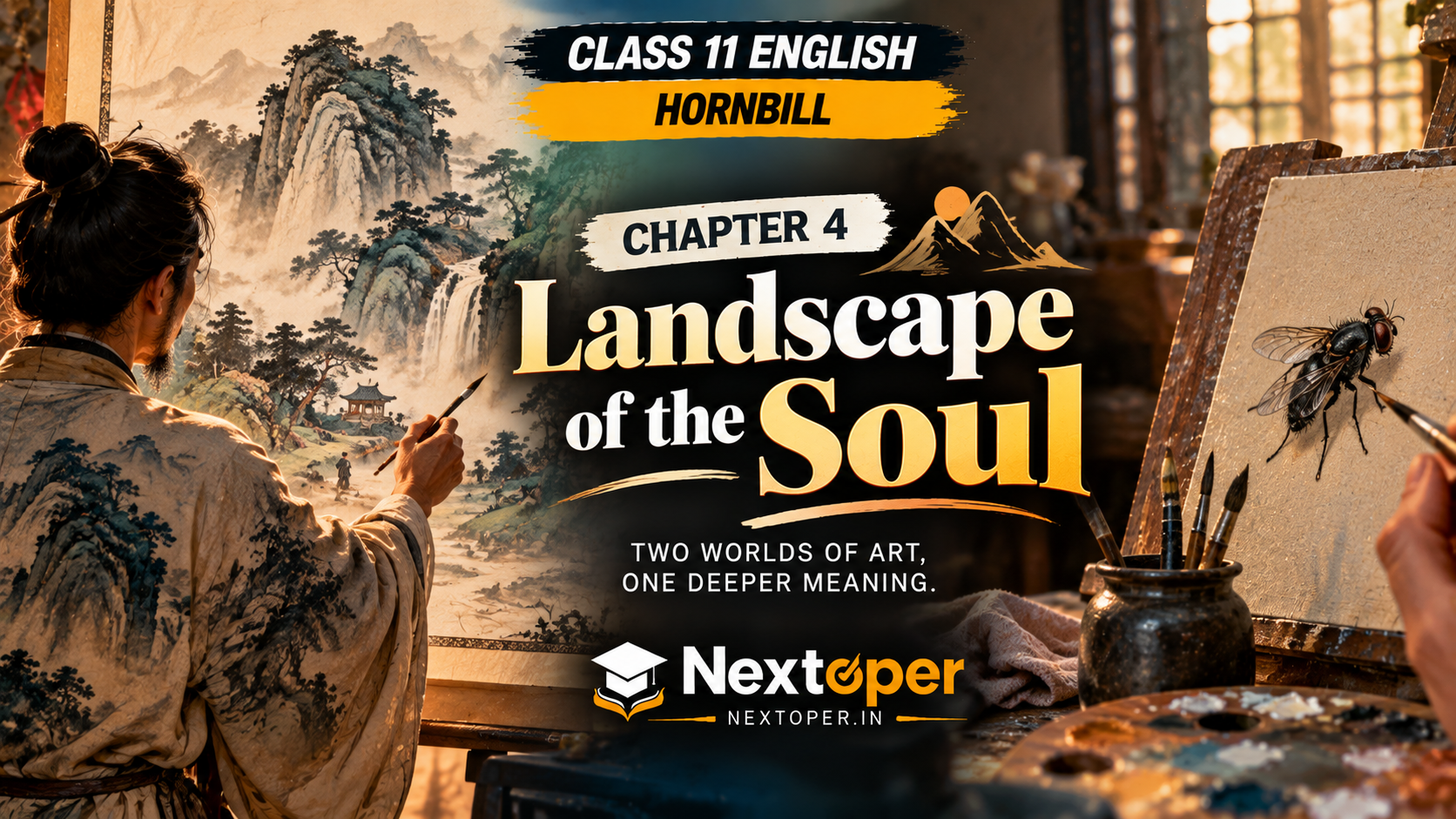
In this essay, a Chinese painter vanishes into his own painting, while a Flemish blacksmith paints a fly that looks alive. The two stories show two goals. European art aims for a perfect likeness. Chinese art aims to show inner life and spirit. The writer then explains shanshui, the Middle Void and the viewer’s role.
Story 1: Wu Daozi and the vanishing painting
Wu Daozi lived in the eighth century. The Tang Emperor Xuanzong asked him to paint a landscape for a palace wall.
The painter hid his work behind a screen. Only the Emperor saw it. He admired forests, mountains, waterfalls, clouds and birds.
Then the painter pointed to a cave at the foot of a mountain. He clapped his hands, and the cave opened. He offered to show the Emperor the way inside.
The painter walked in. The entrance closed. The painting vanished from the wall, and nobody saw the artist again.
Story 2: Quinten Metsys and the fly
Quinten Metsys was a blacksmith in fifteenth-century Antwerp. He loved a painter’s daughter. Her father refused to accept a blacksmith as a son-in-law.
So Quinten sneaked into the studio. He painted a fly on the master’s newest panel. It looked so real that the master tried to swat it.
The master took Quinten as an apprentice. Quinten married the daughter and became a famous painter.
What do the two stories show?
Trouveroy says each story shows what its art form wants. European art wants an illusionistic likeness. Asian art wants the essence of inner life and spirit.
In the Chinese story, the Emperor sees only the outer look. The artist shows the true meaning. The Emperor rules the land he conquered, but only the artist knows the way within.
The artist says “Let me show the Way”. The word Dao means a path or method. It also means the mysterious working of the universe.
How is a Chinese landscape different?
A classical Chinese landscape does not copy one real view. A European figurative painting does. The European painter wants you to borrow his eyes and look from his angle.
The Chinese painter picks no single viewpoint. You can enter at any point and travel through it. Your eyes move up, down and back again, slowly.
The horizontal scroll adds time. You open one section, then roll it up to see the next. You decide the pace. So the Chinese painter wants you to enter his mind.
What are shanshui and the Middle Void?
The Chinese word shanshui means mountain-water. Together the words mean landscape. They also stand for two opposite but matching forces in Daoism.
The mountain is Yang. It rises up toward Heaven. It is stable, warm and dry. The water is Yin. It lies flat on the earth. It is fluid, moist and cool.
A third element is often missed. It is the Middle Void, where Yin and Yang meet. The writer compares it to the pause in the yogic breathing practice of pranayama. That is why Chinese paintings keep white, unpainted space.
Man also has a role here. He links Heaven and Earth. Even when only hinted at, he is “the eye of the landscape”, in François Cheng’s words.
Getting Inside ‘Outsider Art’
The boxed article starts with Jean Dubuffet. In the 1940s he proposed the idea of art brut. At first, few people cared about art by untrained visionaries.
Today, outsider art is one of the fastest growing areas of interest in contemporary art. It is art by people with no formal training who still show talent.
India’s example is Nek Chand. He cleared a patch of jungle and built a garden of stone and recycled material. The world knows it as the Rock Garden at Chandigarh.
The magazine Raw Vision put his sculpture “Women by the Waterfall” on the cover of its fiftieth issue in Spring 2005. The Swiss Commission for UNESCO planned a European show of his work in Switzerland, Belgium, France and Italy.
Who are the key figures in Landscape of the Soul?
The chapter is an essay, so it has people rather than characters. The main figures are Wu Daozi and Emperor Xuanzong from China, and Quinten Metsys from Flanders. The thinkers are Nathalie Trouveroy, François Cheng and Jean Dubuffet. The Indian artist is Nek Chand.
| Figure | Who they are | Role in the chapter |
|---|---|---|
| Wu Daozi | Chinese painter, eighth century | Walks into his own painting and vanishes |
| Emperor Xuanzong | Tang Emperor | Sees only the outer beauty of the work |
| Quinten Metsys | Blacksmith turned painter, Antwerp | Paints a fly that fools the master |
| The master painter | Father of the beloved, unnamed | Tries to swat the painted fly |
| Nathalie Trouveroy | Author, native of Flanders | Compares Chinese and Western art |
| François Cheng | Writer quoted in the essay | Calls man “the eye of the landscape” |
| Jean Dubuffet | French painter | Proposed the idea of art brut in the 1940s |
| Nek Chand | Creator of the Rock Garden | India’s biggest contributor to outsider art |
What are the main themes of Landscape of the Soul?
The main themes are the contrast between Eastern and Western art, art as an inner journey, balance in nature, and creativity without training. The chapter asks you to look beyond the surface of a painting. It also says talent can grow outside schools and rules.
1. Outer likeness versus inner spirit
European art chases a perfect copy of the real world. Chinese art chases the spirit behind it. Neither is called better. They simply aim at different things.
2. Art as a journey
You do not just look at a Chinese landscape. You travel through it. The scroll, the missing single viewpoint and the white space all invite your mind in.
3. Balance and harmony
Mountain and water, Yang and Yin, need the Middle Void between them. Nothing happens without that empty space. Balance is the heart of the Daoist view.
4. Creativity beyond training
The boxed article shows that art can come from untrained people. Nek Chand used a tin, a sink and a broken car as material, in the spirit of art brut. His reward was seeing people enjoy the garden.
Why these lines matter
| Line from the text | Why it matters |
|---|---|
| Borrow his eyes / enter his mind | It sums up the whole contrast. Europe gives you a fixed view. China gives you a space to explore. |
| Only the artist knows the way within | It shows power and wisdom are different. The Emperor owns land. The artist reaches the Dao. |
| The eye of the landscape | It places man inside nature as a link, not as a small, lost figure. |
What do the key terms in Landscape of the Soul mean?
The key terms are anecdote, delicate realism, illusionistic likeness, figurative painting and conceptual space. These are the five expressions NCERT asks you to infer from context. Add shanshui, Dao, Yin, Yang, Middle Void, art brut and outsider art, and you can handle most questions on this chapter.
| Term | Meaning in simple words |
|---|---|
| Anecdote | An anecdote is a short story about a real or imagined event that makes a point. |
| Delicate realism | Delicate realism is very fine, lifelike detail, like the painted fly. |
| Illusionistic likeness | Illusionistic likeness is a copy so exact that it tricks the eye. |
| Figurative painting | A figurative painting is one that shows real things as the painter saw them. |
| Conceptual space | A conceptual space is an inner world of ideas, not a place you can visit. |
| Shanshui | Shanshui is the Chinese word for landscape. It literally means mountain-water. |
| Dao | The Dao is the Way. It means a path or method, and the mysterious working of the universe. |
| Yang | Yang is the active, masculine energy. In the painting, it is the mountain. |
| Yin | Yin is the receptive, feminine energy. In the painting, it is the water. |
| Middle Void | The Middle Void is the empty space where Yin and Yang meet. It is the white part of the scroll. |
| Art brut | Art brut, or raw art, is art that is raw in its cultural and artistic influences. |
| Outsider art | Outsider art is art by people with no formal training who still show talent. |

What are the NCERT questions and answers for Landscape of the Soul?
NCERT gives questions under five headings: Understanding the text, Talking about the text, Thinking about language, Working with words and Noticing form. The model answers below are in our own words. Write them in your own style, and keep each point tied to a story from the chapter.
Understanding the text
1. (i) Contrast the Chinese view of art with the European view with examples.
European art aims for a perfect, illusionistic likeness. Quinten Metsys’s fly is the example. The painter shows one fixed view, and you borrow his eyes.
Chinese art aims for the essence of inner life and spirit. Wu Daozi’s vanishing painting is the example. The landscape has no single viewpoint. You enter it anywhere and travel through it.
(ii) Explain the concept of shanshui.
Shanshui means mountain-water. Together the words mean landscape. The mountain is Yang, rising to Heaven. The water is Yin, resting on the earth.
They are two complementary poles of Daoism. Their meeting place is the Middle Void, shown as white, unpainted space.
2. (i) What do you understand by the terms ‘outsider art’ and ‘art brut’ or ‘raw art’?
Outsider art is made by people with no formal training. They still show talent and artistic insight. Art brut, or raw art, is art that is raw in its cultural and artistic influences. Almost any object can become material, from a tin to a sink.
(ii) Who was the “untutored genius who created a paradise” and what is the nature of his contribution to art?
He was Nek Chand. He cleared a patch of jungle and made a garden of stone and recycled material. It is the Rock Garden at Chandigarh. He is hailed as India’s biggest contributor to outsider art.
Talking about the text
1. “The Emperor may rule over the territory he has conquered, but only the artist knows the way within.”
The Emperor has power over land and people. But he only sees the painting’s surface. The artist understands the Dao and reaches a place beyond any material form. True knowledge belongs to the one who looks inward.
2. “The landscape is an inner one, a spiritual and conceptual space.”
The Chinese painter does not copy a real place. He builds a space of ideas and spirit. You enter it with mind and body, at your own pace. It lives in thought, not on a map.
Thinking about language
1. Find out the correlates of Yin and Yang in other cultures.
This is a research task, so write what you find. Two Indian pairs are often cited: Purusha and Prakriti, and Shiva and Shakti. Each pairs two opposite but joined forces. Check your answer with your teacher.
2. What is the language spoken in Flanders?
Flanders is the northern part of Belgium. People there speak Dutch, called Flemish in everyday use. The NCERT text does not state this, so it comes from general knowledge. Some websites wrongly say French.
Working with words
The words ‘panel’ and ‘essence’ in different contexts.
Panel can mean a flat board of wood, a group of jurors, a group of experts, a window pane, a discussion group, or a hinged board. Essence can mean the most important quality, the main part, practical importance, or a flavouring such as vanilla.
For the rest of the words (studio, brush, material), write five sentences each. Use a different meaning in every sentence.
Noticing form
Use whereas, while, but or however to show contrast.
- European art tries to achieve a perfect, illusionistic likeness, whereas Asian art tries to capture the essence of inner life and spirit.
- The Emperor commissions a painting and admires its outer look, but the artist reveals the true meaning of his work.
- The Emperor may rule the territory he has conquered; however, the artist alone knows the way within.
What are the important MCQs from Landscape of the Soul?
Here are ten practice MCQs on Landscape of the Soul with answers and a one-line reason each. They test names, places, terms and ideas from the NCERT text. These are practice questions written by us. They are not past board questions.
- Who wrote Landscape of the Soul? (a) Nek Chand (b) Nathalie Trouveroy (c) Brinda Suri (d) François Cheng
Answer: (b). She wrote the essay. Brinda Suri wrote the boxed article. - Which emperor asked Wu Daozi for a palace painting? (a) Xuanzong (b) Huizong (c) Qin (d) Kangxi
Answer: (a). The text names the Tang Emperor Xuanzong. - What happened to the painting after Wu Daozi entered the cave? (a) It was sold (b) It was burnt (c) It vanished from the wall (d) It was moved
Answer: (c). Not a trace of his brush was left. - What was Quinten Metsys’s first profession? (a) Sculptor (b) Blacksmith (c) Merchant (d) Teacher
Answer: (b). He was a master blacksmith. - In which city did Quinten Metsys live? (a) Paris (b) Rome (c) Antwerp (d) Beijing
Answer: (c). The story is set in fifteenth-century Antwerp. - What does shanshui literally mean? (a) Sun-moon (b) Mountain-water (c) Earth-sky (d) Tree-river
Answer: (b). Together the words mean landscape. - In the essay, the mountain stands for which force? (a) Yin (b) Dao (c) Yang (d) Void
Answer: (c). Mountain is Yang. Water is Yin. - How does a Chinese painting show the Middle Void? (a) Dark ink (b) White, unpainted space (c) Gold paint (d) A frame
Answer: (b). The empty space is essential. - Who called man “the eye of the landscape”? (a) Zhuangzi (b) Confucius (c) Jean Dubuffet (d) François Cheng
Answer: (d). The essay quotes him. - Where is Nek Chand’s Rock Garden? (a) Delhi (b) Jaipur (c) Chandigarh (d) Kolkata
Answer: (c). The article places it at Chandigarh.
What should I revise the night before the exam?
Revise two stories, two goals, one Chinese idea and one Indian example. The stories are Wu Daozi and Quinten Metsys. The goals are inner spirit and perfect likeness. The Chinese idea is shanshui with the Middle Void. The Indian example is Nek Chand. Use the box below.
- Wu goes in; Metsys stays on the surface. Wu walks into his painting. Metsys’s fly stays on the panel. Use this trick to remember the contrast.
- Mountain stands, water lies. Yang is upright. Yin is flat.
- Europe: illusionistic likeness, one viewpoint, “borrow his eyes”.
- China: essence of inner life and spirit, no single viewpoint, “enter his mind”.
- The scroll adds time and needs the viewer’s active part.
- The Middle Void is the white space. Man is “the eye of the landscape”.
- Dubuffet proposed art brut in the 1940s. Nek Chand built the Rock Garden.
- Spelling: Quinten Metsys, Wu Daozi, Xuanzong, Trouveroy.
Self-check: say it in one line
| Question | Your one-line answer should say |
|---|---|
| What does the Wu Daozi story show? | Chinese art reaches for inner life, not outer looks. |
| What does the fly story show? | European art reaches for a perfect likeness. |
| Why is white space in the scroll important? | It is the Middle Void where Yin and Yang meet. |
| Why is Nek Chand in this chapter? | He is India’s biggest name in outsider art. |
What practice questions can I try?
Try these practice questions after reading the notes. They are written by Nextoper and are not previous-year board questions. We have not verified any past paper on this chapter. Answer in your own words, then check your points against the summary above.
- Why does the Emperor see only the outer look of the painting? (3 to 4 sentences)
- How does the horizontal scroll change the way you see a painting? (3 to 4 sentences)
- Why is the Middle Void called essential? (3 to 4 sentences)
- Compare Wu Daozi and Quinten Metsys. Use two points each. (about 100 words)
- Why does the writer say man is “the eye of the landscape”? (about 80 words)
- Write a short note on Nek Chand and the Rock Garden. (about 100 words)
What mistakes do students make in Landscape of the Soul?
The common mistakes are spelling names wrongly, mixing up Yin and Yang, and saying Wu Daozi died. Students also call the essay a story with characters, and some write that Flanders speaks French. Fix these five slips, and your answers will read cleaner and score safer.
- Spelling Quinten as Quentin. The NCERT text uses Quinten Metsys.
- Swapping Yin and Yang. Mountain is Yang. Water is Yin.
- Saying Wu Daozi died. The text says he was never seen again in this world. It does not say he died.
- Writing “character sketch”. This is an essay. Write about figures and ideas, not characters.
- Treating the white space as empty. The text calls the Middle Void essential. Nothing happens without it.
Landscape of the Soul in one short answer
Landscape of the Soul compares Chinese and European art. Chinese painters like Wu Daozi try to show inner life, so viewers enter the painting and travel through it. European painters like Quinten Metsys aim for a perfect likeness of the real world. The chapter also introduces outsider art through Nek Chand’s Rock Garden in Chandigarh.
Frequently asked questions
What is the summary of Landscape of the Soul?
Landscape of the Soul is an essay by Nathalie Trouveroy. It uses two stories to compare Chinese and European art. Wu Daozi vanishes into his own painting, which shows art as an inner journey. Quinten Metsys paints a fly so real that it gets swatted, which shows art as perfect likeness. A boxed article then introduces outsider art and Nek Chand.
What is the difference between Chinese and European art in Landscape of the Soul?
European art aims for an illusionistic likeness, so the viewer borrows the painter’s eyes and sees from one angle. Chinese art aims to show the essence of inner life and spirit. The viewer can enter the landscape at any point and travel through it, so he enters the painter’s mind.
What is shanshui in Landscape of the Soul?
Shanshui literally means mountain-water, and together the two words mean landscape. The mountain is Yang and the water is Yin, two complementary poles of the Daoist view of the universe. Their interaction happens in a third element, the Middle Void, shown as white, unpainted space.
Who is the untutored genius who created a paradise in Landscape of the Soul?
He is Nek Chand, creator-director of the Rock Garden at Chandigarh. He had no formal art training. He sculpted with stone and recycled material, and he is hailed as India’s biggest contributor to outsider art.
What do outsider art and art brut mean?
Outsider art is art made by people with no formal training who still show talent and insight. Art brut, or raw art, means works that are raw in their cultural and artistic influences. Jean Dubuffet proposed the idea of art brut in the 1940s.
Where does this chapter leave you?
Use these Class 11 English Chapter 4 PDF Notes Landscape of the Soul notes as a reading guide first. Two stories carry the whole idea. One painter enters his picture, and one paints a fly on the surface. If you remember that pair, the rest of the chapter falls into place.
Related notes
- Class 11 English Chapter 2 PDF Notes
- Class 11 English Chapter 3 PDF Notes
- Class 11 English Hornbill notes: all chapters
Sources
- NCERT textbooks: Class 11 English, Hornbill, Chapter 4 Landscape of the Soul
- CBSE Academic: curriculum and syllabus
- Boxed article: Brinda Suri, Hindustan Times, 28 August 2005, as printed in the NCERT chapter.