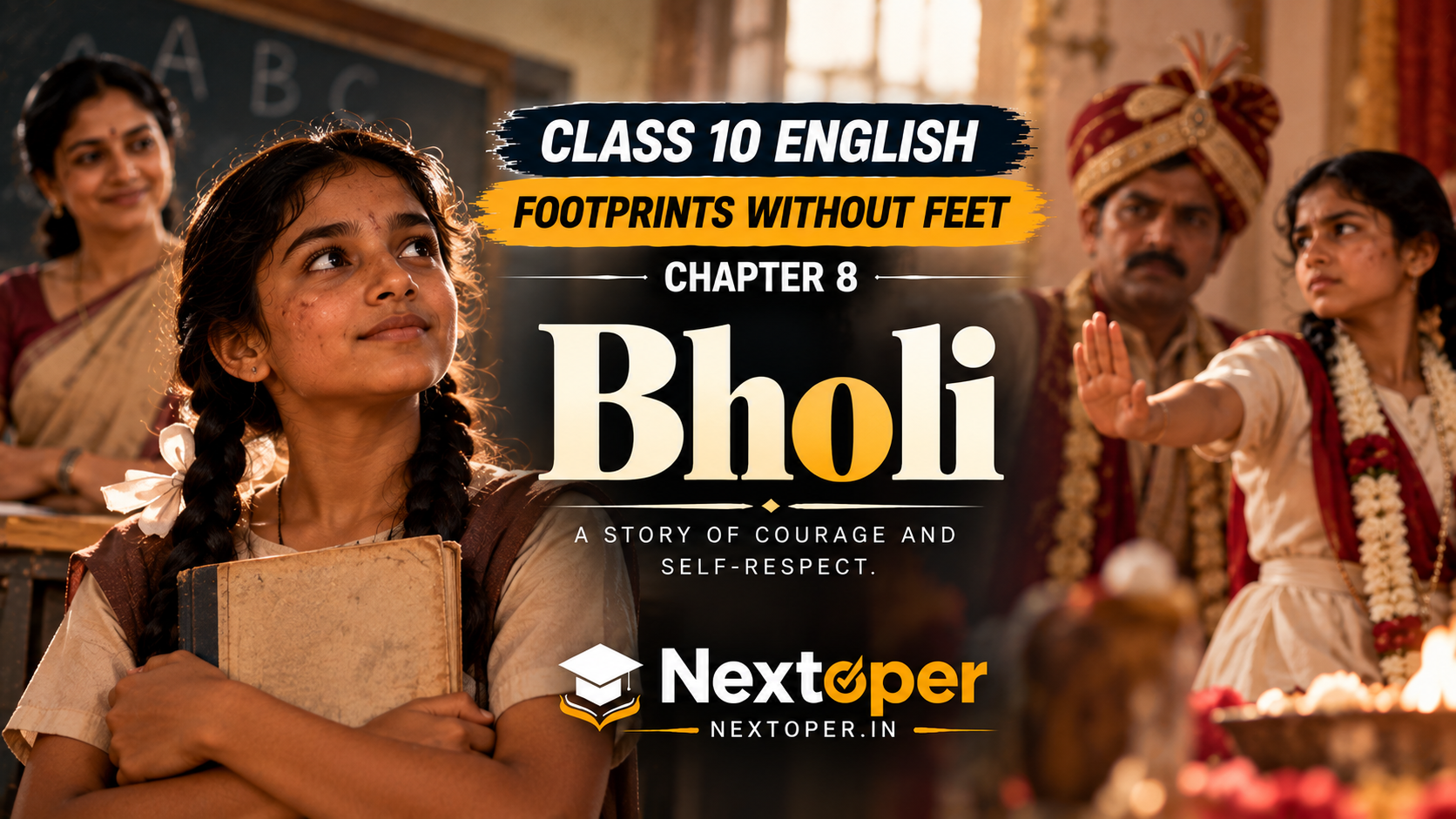
Class 10 English Chapter 8 Bholi Notes 2026-27 | Nextoper Notes
Short on time? Jump to the quick revision box or try the 10 MCQs.
What is Chapter 8 Bholi about?
Bholi is Chapter 8 of the Class 10 English supplementary reader, Footprints without Feet. K.A. Abbas wrote it. The story follows Sulekha, a girl nicknamed Bholi, meaning simpleton. Neglected at home, she finds hope at school. Years later, she refuses to marry a dowry-hungry man and decides to become a teacher.
| Fact | Detail |
|---|---|
| Story | Bholi |
| Book | Footprints without Feet, NCERT English, Class 10 |
| Chapter number | 8 (2026-27 reprint) |
| Pages in the reprint | 47 to 55 |
| Author | K.A. Abbas (Khwaja Ahmad Abbas), an Indian writer, journalist and filmmaker |
| Real name of Bholi | Sulekha |
| Setting | A village that grows into a small town |
| Core message | Education gives courage and self-respect |
| Board and session | CBSE, 2026-27 |
What is the summary of Chapter 8 Bholi in Class 10 English?
Bholi, whose real name is Sulekha, is a neglected village girl who stammers and carries smallpox marks. A kind teacher at a new girls’ school gives her confidence. Years later, her parents arrange her marriage to a grocer, Bishamber Nath. When he demands dowry, Bholi refuses him and plans to teach.
Part 1: Why Bholi is neglected
Her real name is Sulekha, but everyone calls her Bholi. The word means simpleton. She is the fourth daughter and the youngest child of Numberdar Ramlal.
At ten months, she fell off a cot on her head. The story says this perhaps harmed her brain. At two, smallpox left deep marks on her body. She did not speak until five, and then she stammered.
Other children mimicked her, so she spoke very little. Her sisters were healthy and easy to marry off. Her father worried only about Bholi.
Part 2: How Bholi reaches school
Bholi is seven when her sister Mangla gets married. That year, a primary school for girls opens in the village. The Tehsildar, a government revenue officer, tells Ramlal to send his daughters. He says an official must set an example.
Ramlal’s wife objects. She asks who will marry girls who go to school. Then she suggests sending only Bholi. Her reason is cruel: Bholi will probably never marry anyway.
Part 3: The first day and the kind teacher
Next morning, Ramlal takes Bholi to school. She is terrified. She remembers the old cow, Lakshmi, who was sold. That day she gets a clean dress, a bath and oil in her hair. She begins to hope that school is a better place than home.
In class, she sits in a corner. The coloured pictures on the wall fascinate her. When the teacher asks her name, Bholi can only stammer. She cries, and she thinks the girls are laughing.
After the bell, the teacher speaks softly. She praises each small effort until Bholi says her full name. She promises that Bholi will speak freely once she loses her fear. Then she hands Bholi a picture book. Bholi walks home full of hope.
Part 4: The marriage proposal
Years pass. The village becomes a small town, and the school becomes a high school. Bishamber Nath, a well-off grocer, asks to marry Bholi. He asks for no dowry. Her mother is delighted.
Ramlal hesitates. Bishamber is nearly his own age, and he limps. His children from a first marriage are grown up. Her mother brushes this aside. She says Bishamber is from another village and does not know about Bholi’s marks.
She calls Bholi a “dumb cow”. Bholi lies awake on her cot and hears every word.
Part 5: The wedding day
The wedding is grand. A band plays, and the groom rides a decorated horse. When the veil is lifted, Bishamber sees the marks on her face. He demands five thousand rupees.
Ramlal begs and places his turban at the groom’s feet. He offers two thousand. Bishamber refuses. In tears, Ramlal counts out five thousand rupees.
Bishamber smiles, sure he has won. The veil is lifted once more. This time Bholi looks straight at him with cold contempt. She flings the garland into the fire.
Part 6: Bholi’s final decision
Bholi speaks loudly, without a stammer. She tells her father to take back the money. She says she was ready to marry a lame old man for her father’s honour. But she will not marry a mean, greedy coward.
The guests call her shameless. Bishamber leaves with his party. Ramlal stands with his head bowed in grief and shame. He asks what will become of her.
Now called Sulekha, she answers calmly. She will serve her parents and teach at her old school. The teacher watches with deep satisfaction, like an artist who has finished a masterpiece.
Save Free Notes PDF – No Signup Needed! Click Here to Save
Who are the main characters in Bholi?
The main characters in Bholi are Bholi (Sulekha), her father Ramlal, her mother, her unnamed teacher and the grocer Bishamber Nath. Bholi changes the most, growing from a frightened girl into a brave woman. The teacher inspires her. The others show the social attitudes she must face.
| Character | Who they are | Key traits and proof |
|---|---|---|
| Bholi (Sulekha) | Youngest daughter of Ramlal | Timid at first, later brave and self-respecting. She refuses Bishamber and plans her own future. |
| Ramlal | Her father, a village numberdar | Weak and worried about honour. He fears the Tehsildar and bows to a greedy groom. |
| Ramlal’s wife | Bholi’s mother | Harsh and practical. She calls Bholi a “dumb cow” and thinks only of marriage. |
| The teacher | Teaches at the new girls’ school | Kind, patient and encouraging. She is never named in the story. |
| Bishamber Nath | A well-off grocer, the groom | Greedy and cowardly. He demands dowry after seeing Bholi’s face. |
| The Tehsildar | Revenue officer who opens the school | Believes officials should set an example. His order sends Bholi to school. |
| Radha, Mangla, Champa | Bholi’s three elder sisters | Healthy and good-looking. Their easy marriages highlight Bholi’s neglect. |
What are the themes and message of Bholi?
The main themes of Bholi are the power of education, self-respect, the evil of dowry and the unequal treatment of girls. K.A. Abbas also shows how one caring teacher can change a child’s life. The message is simple: learn, speak up, and never trade your dignity for approval.
| Theme | How the story shows it |
|---|---|
| Education empowers | Reading and encouragement turn a silent girl into someone who speaks boldly at her own wedding. |
| Self-respect | Bholi agrees to protect her father’s honour but refuses to accept insult and greed. |
| Evil of dowry | Bishamber treats marriage as a bargain. He raises his price after seeing her face. |
| Gender inequality | The sons study in the city. Bholi is ignored and sent to school only as a last resort. |
| Role of a teacher | One kind voice does what years of mockery could not: it gives Bholi hope. |
| Prejudice about looks | Everyone judges Bholi by her marks and stammer. The ending proves them wrong. |
Which lines in Bholi matter most, and why?
A few moments carry the story’s turning points. They show Bholi’s fear, her teacher’s kindness and her final courage. Knowing why each one matters helps you pick strong evidence. Use this table for extract-based and long answers on Class 10 English Chapter 8 Bholi.
| Moment | Short phrase from the text | Why it matters |
|---|---|---|
| Teacher’s advice | “Put the fear out of your heart” | The teacher treats fear, not the stammer. Confidence becomes Bholi’s cure. |
| The sold cow | Lakshmi, turned out and sold | Bholi fears school because she feels unwanted, like the old cow. |
| Parents’ whispers | “dumb cow” | Her mother sees her as an animal. Bholi later throws the words back. |
| Ramlal’s turban | Honour placed at the groom’s feet | Dowry strips a father of dignity. This pushes Bholi to act. |
| Her second look | “cold contempt” | Fear has gone. She now judges the man who judged her. |
| First loud word | “Pitaji!” | She speaks without a stammer for the first time in public. |
| Her argument | “izzat” | She obeyed for honour’s sake. Her refusal is about dignity, not defiance. |
| Her new name | Sulekha | The story uses her real name when she becomes calm and independent. |
| Last image | “masterpiece” | The teacher is an artist. Bholi is her finished work. |
What do the difficult words in Bholi mean?
The NCERT glossary for Bholi lists seven words: simpleton, numberdar, matted, squatted, scurried, ginning and downcast. A simpleton is a person others think is foolish. A numberdar is a village official linked to revenue. Learn these first, because they appear in the story’s key scenes.
| Word | Meaning in simple words | Where it appears |
|---|---|---|
| simpleton | A person others think is foolish | Bholi’s nickname |
| numberdar | A village official who collects revenue | Ramlal’s position |
| matted | Tangled together | Bholi’s dry, oily-less hair |
| squatted | Sat low on the heels | Girls sitting on school mats |
| scurried | Hurried away with quick steps | Girls leaving class at the bell |
| ginning | Separating raw cotton from its seeds | The new cotton ginning mill |
| downcast | Looking downwards | Bholi’s eyes before she looks up |
The story also uses Indian words. Pitaji means father, said respectfully. Izzat means honour. Tehsildar is a revenue officer of a tehsil.
What are the NCERT questions and answers for Class 10 English Chapter 8 Bholi?
The Bholi exercises have three groups: Read and Find Out (six questions inside the story), Think about it (five questions) and Talk about it (three questions). Each question below appears as printed in NCERT. A model answer in our own words follows. Write in your own style and use evidence from the story.
Read and Find Out
Q1. Why is Bholi’s father worried about her?
Ramlal worries because Bholi has neither good looks nor intelligence, in his eyes. She has smallpox marks and a stammer. Her sisters are healthy and easy to marry. He fears nobody will marry Bholi.
Q2. For what unusual reasons is Bholi sent to school?
Bholi goes to school for reasons that have nothing to do with learning. Ramlal cannot disobey the Tehsildar, who wants him to set an example. His wife fears school will spoil her other daughters’ chances.
She says Bholi will not marry anyway. So the teachers can worry about her.
Q3. Does Bholi enjoy her first day at school?
Not at first, but by the end she does. She is scared, and she cries when she cannot say her name. Then the teacher’s soft voice and the picture book give her hope. She leaves school happy and excited.
Q4. Does she find her teacher different from the people at home?
Yes, completely different. At home, people mock her, ignore her and call her a fool. The teacher smiles and calls her gently. She treats the stammer as something to fix with practice, not a reason for shame.
Q5. Why do Bholi’s parents accept Bishamber’s marriage proposal?
They see a chance to settle a daughter they think is hard to marry. Bishamber is rich, owns a shop and a house, and asks for no dowry. He also lives in another village, so he does not know about her marks.
Q6. Why does the marriage not take place?
Bishamber demands five thousand rupees after seeing Bholi’s face. Ramlal pays to save his honour. Then Bholi throws the garland into the fire and refuses. She will not marry a greedy, cowardly man.
Think about it
Q1. Bholi had many apprehensions about going to school. What made her feel that she was going to a better place than her home?
Small acts of care made her hopeful. For the first time, she gets a clean dress, a bath and oil in her hair. She thinks a place that begins so kindly must be better than home.
Q2. How did Bholi’s teacher play an important role in changing the course of her life?
The teacher is the first person to treat Bholi with respect. She listens patiently and praises every attempt. She tells Bholi that fear is the real problem.
She gives Bholi a book and a goal. Slowly, learning makes Bholi confident enough to speak and act.
Q3. Why did Bholi at first agree to an unequal match? Why did she later reject the marriage? What does this tell us about her?
At first, Bholi agrees to protect her father’s honour. She is ready to marry an older, lame man. She rejects him when he shows greed and humiliates her father.
This shows she is dutiful, but she values self-respect more. She can tell right from wrong and act on it.
Q4. Bholi’s real name is Sulekha. We are told this right at the beginning. But only in the last but one paragraph of the story is Bholi called Sulekha again. Why do you think she is called Sulekha at that point in the story?
At that point, she speaks to her father in a calm, steady voice. She plans her own future. The real name marks her new identity as an educated, mature woman.
“Bholi” is a label others gave her. “Sulekha” is who she has become. Many readers also link the name to fine writing, which suits an educated woman.
Q5. Bholi’s story must have moved you. Do you think girl children are not treated at par with boys? You are aware that the government has introduced a scheme to save the girl child as the sex ratio is declining. The scheme is called Beti Bachao Beti Padhao, Save the Girl Child. Read about the scheme and design a poster in groups of four and display on the school notice board.
This is a group activity, so there is no single answer. Plan your poster in four parts: a slogan, one clear picture, two facts about the scheme, and a call to action. Take the facts from the official government source, not from memory.
A sample slogan: “Educate her, and she will write her own future.”
Talk about it
Q1. Bholi’s teacher helped her overcome social barriers by encouraging and motivating her. How do you think you can contribute towards changing the social attitudes illustrated in this story?
I can treat girls and boys equally at home and in school. I can refuse to support dowry in my own family. I can also stand by classmates who are teased, as Bholi’s teacher stood by her.
Q2. Should girls be aware of their rights, and assert them? Should girls and boys have the same rights, duties and privileges? What are some of the ways in which society treats them differently? When we speak of ‘human rights’, do we differentiate between girls’ rights and boys’ rights?
Yes. Girls and boys should share the same rights, duties and privileges. Society often treats them differently. In the story, Ramlal sends his sons to the city to study, while Bholi is almost forgotten.
Human rights belong to everyone. They do not separate girls from boys.
Q3. Do you think the characters in the story were speaking to each other in English? If not, in which language were they speaking? (You can get clues from the names of the persons and the non-English words used in the story.)
No. They were most likely speaking Hindi or a close Indian language. The names Ramlal and Bholi give a clue. So do words like Pitaji, izzat, numberdar and Tehsildar. The author has presented their talk in English.
Which MCQs should you practise for Bholi?
Practise these ten multiple-choice questions after reading the summary. Each one tests a fact from the NCERT text and gives the answer with a one-line reason. Cover the answers, pick an option, then check. If you score below seven, read the summary section again.
- What is Bholi’s real name?
(a) Radha (b) Sulekha (c) Champa (d) ManglaAnswer: (b) Sulekha. The story states it in the first line. - Who wrote the story Bholi?
(a) Ruskin Bond (b) Qazi Abdul Sattar (c) K.A. Abbas (d) Rajkumari Amrit KaurAnswer: (c) K.A. Abbas. His name closes the story. - At what age did Bholi fall off the cot?
(a) Ten months (b) Two years (c) Five years (d) Seven yearsAnswer: (a) Ten months. Smallpox came later, at two. - Who told Ramlal to send his daughters to school?
(a) The headmistress (b) The Tehsildar (c) Bishamber (d) The priestAnswer: (b) The Tehsildar. He came to open the new girls’ school. - Which sold animal does Bholi remember on the way to school?
(a) A horse (b) A goat (c) A parrot (d) The cow LakshmiAnswer: (d) The cow Lakshmi. She fears being sent away like the cow. - What was Bishamber Nath’s work?
(a) Grocer (b) Teacher (c) Tehsildar (d) PriestAnswer: (a) Grocer. The story calls him a well-to-do grocer. - How much dowry did Bishamber demand at the wedding?
(a) Two thousand (b) Three thousand (c) Five thousand (d) Ten thousandAnswer: (c) Five thousand rupees. Ramlal first offered two thousand. - What did Bholi fling into the sacred fire?
(a) The veil (b) The garland (c) The money (d) The bookAnswer: (b) The garland. This ends the wedding. - Which word does Bholi say first in a clear, loud voice at the wedding?
(a) Mother (b) Teacher (c) Pitaji (d) SulekhaAnswer: (c) Pitaji. Everyone is startled by her stammer-free speech. - What does Bholi plan to do at the end?
(a) Run away (b) Marry later (c) Join a mill (d) Serve her parents and teach in her old schoolAnswer: (d). She says this to her father in a calm voice.
What should you revise the night before the exam?
Revise the six story beats, the age ladder, the three key contrasts and the seven glossary words. Use the BHOLI memory trick to recall the plot in order. Then read the common mistakes section. This keeps your revision short and focused on what the text actually says.
BHOLI memory trick
- B for Born neglected: stammer, smallpox marks, mocked by children.
- H for Headed to school: the Tehsildar’s order and her mother’s cruel idea.
- O for One kind teacher: soft voice, “Well done”, the picture book.
- L for Loud refusal: garland in the fire, “Pitaji!”, no stammer.
- I for Independent future: serve her parents and teach in the same school.
Bholi’s age ladder
| Age | What happens |
|---|---|
| Ten months | She falls off the cot on her head. |
| Two years | Smallpox leaves pockmarks all over her body. |
| Five years | She begins to speak, with a stammer. |
| Seven years | Her sister Mangla marries, and she is sent to the new school. |
Three contrasts to remember
- Home vs school: mockery and neglect at home, patience and praise at school.
- Bholi before vs after: head bowed and silent, then eyes up and voice clear.
- Bishamber before vs after: no dowry asked, then five thousand rupees demanded.
What practice questions can you try for Bholi?
Try these practice questions after revising. They were written by Nextoper for self-testing. They are not previous-year board questions. For the current paper pattern, check the official CBSE Academic sample papers and syllabus.
Short-answer practice
- Why did Bholi talk very little as a child?
- Why did Ramlal’s wife want Bholi, and only Bholi, to go to school?
- Why does the teacher’s smile in the last scene resemble an artist’s satisfaction?
Long-answer practice
- “Education changes Bholi from a silent girl into a confident woman.” Discuss with examples.
- Compare how Ramlal and Bholi each react to Bishamber’s demand for dowry.
- Write a character sketch of Bholi’s teacher.
Self-check table
| Can you do this? | Check yourself |
|---|---|
| Explain why she is called “Bholi” in two sentences | Did you mention the fall, the late speech and the stammer? |
| Name three things the teacher does differently from the family | Soft voice, praise, and a book to read |
| Give two reasons Bholi refuses the marriage | Greed and cowardice, not age or looks |
| Explain the name change to Sulekha | Did you link it to her calm voice and plans? |
What common mistakes do students make in Bholi answers?
The most common mistakes are mixing up cause and effect, adding details the story never states, and using old chapter numbers. Check every claim against the NCERT text. The table below pairs each mistake with what the story really says.
| Common mistake | What the text says |
|---|---|
| “Smallpox made Bholi a simpleton.” | The fall from the cot at ten months perhaps harmed her brain. Smallpox came at two and left marks. |
| “The teacher’s name is …” | The teacher is never named. Write “Bholi’s teacher”. |
| “Ramlal feels proud when Bholi refuses.” | He is thunderstruck and stands with his head bowed in grief and shame. |
| “Bishamber asked for dowry from the start.” | The proposal came without a dowry demand. He asked for five thousand rupees only after seeing her face. |
| “Bholi refused because he was old and lame.” | She says she was willing to marry a lame old man for her father’s honour. She refused his greed. |
| “Bholi lost her stammer at school.” | She still stammers in class. The stammer-free speech comes at the wedding. |
| “Bholi is Chapter 9.” | The 2026-27 reprint numbers it Chapter 8. Older pages show Chapter 9 and old page numbers. |
What is Bholi in short?
Short answer: Bholi is a short story by K.A. Abbas about a village girl called Sulekha, whom everyone calls Bholi. Ignored because of her stammer and smallpox marks, she finds kindness in a teacher at a new school. Years later, she refuses to marry a greedy groom who demands dowry. She decides to serve her parents and teach, showing that education gives courage.
Frequently asked questions about Bholi
What is the summary of Bholi Class 10?
Bholi is a story by K.A. Abbas about Sulekha, a neglected village girl who stammers. A kind teacher teaches her to read and speak without fear. Years later, her parents arrange a marriage with a grocer. When he demands dowry at the wedding, Bholi refuses him and decides to serve her parents and teach.
What is the moral of Bholi?
The moral of Bholi is that education gives people courage and self-respect. The story also teaches that dowry is a shameful practice and that kindness can change a life. Bholi shows that dignity matters more than social approval. Anyone, however ignored, can find a voice with support and learning.
Why did Bholi refuse to marry Bishamber?
Bholi refused because Bishamber demanded five thousand rupees as dowry after seeing her pockmarked face. His greed and cruelty showed he was a mean and cowardly man. She had agreed earlier to protect her father’s honour. But she would not accept a husband who treated marriage as a bargain.
Why was Sulekha called Bholi?
Sulekha was called Bholi, meaning simpleton, because people thought she lacked intelligence. She fell off a cot at ten months, and the story says this perhaps harmed her brain. She also spoke late and stammered. Other children mimicked her, so she spoke little. The nickname stayed from childhood.
How did the teacher change Bholi’s life?
The teacher was the first person to treat Bholi kindly. She spoke softly, praised small efforts, and told Bholi that losing her fear would help her speak. She gave her a picture book and a clear goal. This hope and practice slowly built the confidence Bholi needed to speak for herself.
How to use these Bholi notes well
With these Class 10 English Chapter 8 Bholi notes, read the summary once, then test yourself with the MCQs. Write two NCERT answers from memory and compare them with the model answers. Finish with the common mistakes table, and you will be ready to write confident, text-based answers.
Related notes
- Class 10 English Chapter 6 The Making of a Scientist Notes
- Class 10 English Chapter 7 The Necklace notes
- Class 10 English Footprints without Feet: all chapter notes
NCERT also suggests three further stories: “The Brass Gong” by Qazi Abdul Sattar, “Old Man at the Bridge” by Ernest Hemingway, and “Gandhiji the Teacher” by Rajkumari Amrit Kaur.
Sources
- NCERT, Footprints without Feet, Class 10 English, Chapter 8 “Bholi” (2026-27 reprint), by K.A. Abbas. NCERT textbooks
- CBSE Academic, official syllabus and sample papers. cbseacademic.nic.in