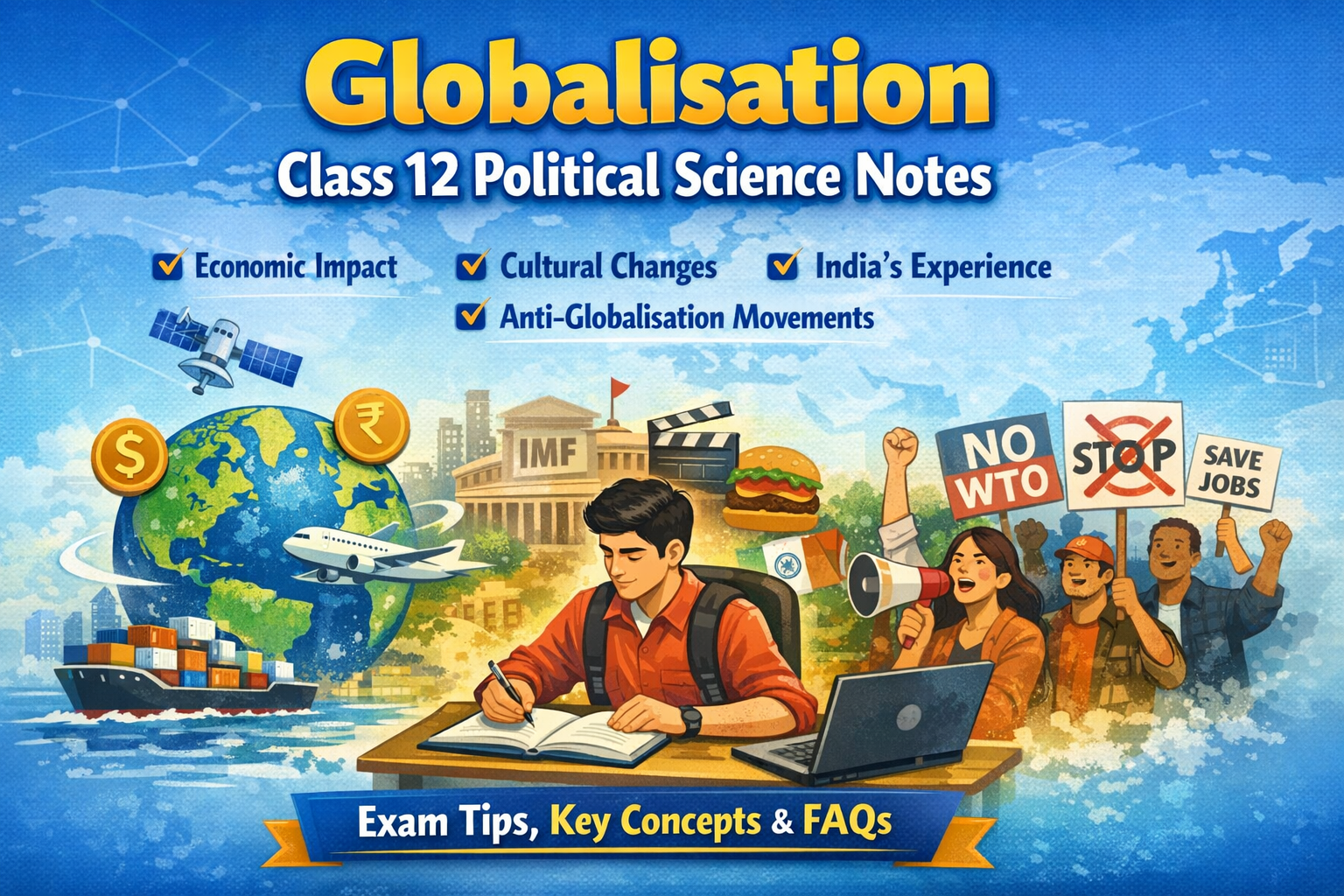
Class 12 Political Science Globalisation Notes Chapter 9 | Nextoper Notes
Introduction to Globalisation
Globalisation is the final chapter of the Class 12 Political Science book Contemporary World Politics. You may have already come across this term in Economics, Geography, and even in daily news. In this chapter, globalisation is studied from a political science perspective, focusing on how it affects states, economies, cultures, and societies.
The chapter explains:
- What globalisation really means
- Why globalisation has increased in the modern world
- Its political, economic, and cultural consequences
- How globalisation has impacted India
- Why there is resistance to globalisation across the world
This chapter is highly important for CBSE board exams, as it includes conceptual questions, long answers, and case-based questions.
What is Globalisation?
Meaning of Globalisation
Globalisation refers to a process through which countries, societies, and people across the world become more connected and dependent on each other. This connection happens through the movement of goods, services, money, people, ideas, and information across national borders.
Globalisation does not mean that borders disappear, but it means that what happens in one part of the world can affect people living in another part.
Globalisation as Worldwide Interconnectedness
The most important idea in this chapter is worldwide interconnectedness.
This means:
- Countries are linked economically, politically, and culturally
- Events in one country can influence others
- No country can remain completely isolated
For example:
- A financial crisis in one country can affect markets worldwide
- Diseases like bird flu or pandemics do not respect national borders
- International trade links producers and consumers globally
Globalisation as Flows
Globalisation is best understood as a set of flows. These flows create and maintain global connections.
1. Flow of Ideas
Ideas such as democracy, human rights, feminism, environmentalism, and lifestyles travel across countries through media, education, and the internet.
2. Flow of Capital
Money moves across countries in the form of:
- Foreign investment
- Loans
- Business expansion by multinational companies
3. Flow of Commodities
Goods produced in one country are sold in other countries.
Example:
- Electronics made in China sold in India
- Clothes designed in Europe manufactured in Asia
4. Flow of People
People move across borders for:
- Jobs
- Education
- Better living conditions
However, the movement of people is more restricted compared to goods and capital.
Is Globalisation a New Phenomenon?
Globalisation is not entirely new.
The movement of goods, people, and ideas has existed for centuries. Trade routes, migration, and cultural exchange existed even in ancient times.
What is new about modern globalisation is:
- The speed of movement
- The scale of global connections
- The role of modern technology
Globalisation as a Multi-Dimensional Process
Globalisation is not purely economic. This is a very important exam point.
It has three main dimensions:
- Economic
- Political
- Cultural
All these dimensions are interconnected and influence each other.
Causes of Globalisation
Historical Roots
Globalisation has a strong historical background. Trade, colonialism, and migration created early global connections. Modern globalisation builds upon these earlier interactions.
Role of Technology (Most Important Cause)
Technology is the most significant cause of globalisation.
Key technological developments include:
- Telegraph
- Telephone
- Internet
- Computers and digital communication
These technologies:
- Reduce distance
- Increase speed of communication
- Make global interaction easier and faster
Scale and Speed of Flows
In contemporary globalisation:
- Capital and goods move faster than people
- Information travels instantly
- Markets react quickly to global events
Growing Awareness of Global Interdependence
People now understand that:
- Environmental disasters affect many countries
- Economic crises spread globally
- Health emergencies are international problems
Political Consequences of Globalisation
Impact on State Sovereignty
One major debate is whether globalisation weakens the state.
Globalisation:
- Reduces the government’s control over economic decisions
- Increases the influence of multinational companies
- Shifts some power from governments to markets
From Welfare State to Minimalist State
Earlier, many states followed the welfare model, providing:
- Education
- Healthcare
- Employment support
Under globalisation:
- States reduce welfare spending
- Focus on core functions like law, order, and security
- Markets play a larger role in economic decisions
Role of Multinational Corporations (MNCs)
MNCs operate in multiple countries and:
- Influence government policies
- Reduce independent decision-making by states
Is the State Really Weakening?
Globalisation does not eliminate the state.
States remain important because:
- They maintain law and order
- They ensure national security
- They regulate society
Technology and Stronger States
Technology has:
- Increased surveillance capacity
- Improved information collection
- Strengthened state control in some areas
Thus, globalisation both weakens and strengthens states in different ways.
Economic Consequences of Globalisation
Meaning of Economic Globalisation
Economic globalisation refers to:
- Increased trade between countries
- Free movement of capital
- Integration of national economies
Role of International Institutions
Institutions like:
- International Monetary Fund (IMF)
- World Trade Organization (WTO)
Influence global economic policies by:
- Promoting free trade
- Reducing trade barriers
- Encouraging liberalisation
Trade Liberalisation and Capital Flows
Economic globalisation involves:
- Reduction of import restrictions
- Easier foreign investment
- Expansion of global markets
Uneven Distribution of Economic Gains
A key NCERT point:
- Benefits of globalisation are not equally shared
- Some countries and groups gain more than others
- Poor and weaker sections often suffer
Supporters of Economic Globalisation
Supporters argue that:
- It increases economic growth
- It improves efficiency
- It creates new opportunities
Critics of Economic Globalisation
Critics argue that:
- It increases inequality
- It weakens state welfare
- It harms small producers
Social Safety Nets
Social safety nets refer to:
- Welfare measures to protect weaker sections
- Support systems for those affected by globalisation
Cultural Consequences of Globalisation
Globalisation and Daily Life
Globalisation affects:
- Food habits
- Clothing
- Entertainment
- Values and thinking
Cultural Homogenisation
This refers to:
- Spread of a uniform culture
- Dominance of Western culture
- Influence of US lifestyle
This is also called soft power.
Westernisation and McDonaldisation
Examples include:
- Fast food culture
- Western clothing styles
- Global brands
Cultural Heterogenisation
Globalisation also leads to:
- Cultural diversity
- Mixing of cultures
- Hybrid traditions
Example:
- Indian clothing combined with Western styles
Thus, cultural exchange is not one-way.
Globalisation: Positive and Negative Impacts
Positive Impacts
- Economic growth
- Global connectivity
- Cultural exchange
- New opportunities
Negative Impacts
- Inequality
- Cultural dominance
- Loss of local industries
- Social tensions
India and Globalisation
India Before Independence
India had global trade links for centuries.
Colonial Experience
Under British rule:
- India exported raw materials
- Imported finished goods
- Became economically dependent
Post-Independence Protectionism
After independence:
- India focused on self-reliance
- Restricted imports
- Protected domestic industries
Problems with Protectionism
- Slow economic growth
- Poor infrastructure
- Limited development in health and education
1991 Economic Reforms
In 1991, India adopted:
- Liberalisation
- De-regulation
- Opening to foreign investment
Has Globalisation Benefited India?
The real test is:
- Whether growth benefits are shared
- Whether development is inclusive
Resistance to Globalisation
Why Globalisation is Controversial
Globalisation has faced criticism worldwide.
Left-Wing Criticism
Left-wing critics argue:
- It benefits the rich
- It increases inequality
- It weakens state protection
Right-Wing Criticism
Right-wing critics focus on:
- Cultural erosion
- Loss of traditional values
- Threat to national identity
WTO Protests (Seattle, 1999)
Protests highlighted:
- Unfair trade practices
- Ignoring developing countries
World Social Forum (WSF)
WSF brings together:
- Human rights activists
- Environmentalists
- Labour groups
India and Resistance to Globalisation
Resistance in India includes:
- Trade union protests
- Farmers’ movements
- Opposition to multinational patents (Neem case)
- Cultural resistance to western influence
Important Terms & Definitions
- Globalisation
- Worldwide Interconnectedness
- Cultural Homogenisation
- Cultural Heterogenisation
- Economic Liberalisation
- Protectionism
- Social Safety Nets
How Nextoper Notes Help in Globalisation
Nextoper notes are designed specifically for CBSE students and focus on clarity, revision, and exam success.
For the chapter Globalisation, Nextoper notes help students by:
- Explaining NCERT concepts in simple language
- Covering all dimensions (political, economic, cultural) clearly
- Highlighting exam-important points
- Providing structured explanations for long answers
- Helping with last-minute revision
- Reducing confusion through clear headings and flow
These notes ensure students understand concepts deeply, not just memorize answers.
Frequently Asked Questions (FAQs)
FAQ 1: What is globalisation in Class 12 Political Science?
Globalisation is the process of worldwide interconnectedness through flows of goods, capital, ideas, and people.
FAQ 2: Why is globalisation called a multi-dimensional process?
Because it has political, economic, and cultural dimensions, not just economic effects.
FAQ 3: What role does technology play in globalisation?
Technology increases the speed and scale of global communication, trade, and interaction.
FAQ 4: How does globalisation affect the role of the state?
It reduces welfare functions but strengthens regulatory and surveillance capacities.
FAQ 5: What are the economic consequences of globalisation?
Increased trade, uneven economic benefits, and debates on inequality and growth.
FAQ 6: What is cultural homogenisation?
It refers to the spread of a uniform culture dominated by Western lifestyles.
FAQ 7: What is cultural heterogenisation?
It is the process where global interaction increases cultural diversity.
FAQ 8: How did globalisation impact India after 1991?
India adopted economic reforms, opened markets, and integrated with the global economy.
FAQ 9: Why is there resistance to globalisation?
Due to inequality, cultural erosion, and reduced state protection for weaker sections.
FAQ 10: Is globalisation the same as westernisation?
No, globalisation involves global interaction, while westernisation focuses only on Western influence.
Conclusion
Globalisation is one of the most important concepts in Class 12 Political Science because it explains how the world today is deeply connected economically, politically, and culturally. Through the movement of goods, capital, ideas, and people, globalisation has changed the way countries function and societies interact.
The chapter clearly shows that globalisation is not purely an economic process. It has:
- Political effects, such as changes in the role of the state
- Economic effects, including growth as well as inequality
- Cultural effects, leading to both homogenisation and heterogenisation
Globalisation has had an uneven impact. While some countries and sections of society have benefited greatly, others have faced challenges like job insecurity, cultural dominance, and reduced state support. This unequal impact is the main reason behind resistance to globalisation, both globally and in India.
In the Indian context, globalisation became more prominent after the 1991 economic reforms. India’s experience shows that globalisation can bring growth and opportunities, but its real success depends on how fairly the benefits are distributed among people.
Overall, this chapter helps students understand that globalisation is a complex and ongoing process, filled with both opportunities and challenges. For board exams, students should focus on clear definitions, balanced arguments, and India-specific examples, as these are key to writing high-scoring answers.
Click to open Globalisation notes MCQ and Q&A on your phone – NOTES
Class 12 Political Science Globalisation Chapter 9 Notes highlight the importance of global cooperation for peace and development. International organizations like the UN play a key role in ensuring harmony and security across nations. Understanding these concepts helps students appreciate the need for unity in solving global challenges.
These revision notes for Class 12 Political Science Globalisation Chapter 9 Notes are available for free in PDF format. To get them, simply send us an email mentioning the chapter you need along with your details, and we’ll provide the notes within 2 hours. If you want to stay updated with the latest educational news and resources, you can also join our WhatsApp community. These notes make it easy to revise the chapter before exams and score better marks. You can also explore other Class 12 Political Science notes for complete preparation.
| Chapter No. | Chapter Name | Book |
|---|---|---|
| 1 | The Cold War Era | Book -1 |
| 2 | The End of Bipolarity | Book -1 |
| 3 | US Hegemony in World Politics | Book -1 |
| 4 | Alternative Centres of Power | Book -1 |
| 5 | Contemporary South Asia | Book -1 |
| 6 | International Organizations | Book -1 |
| 7 | Security in the Contemporary World | Book -1 |
| 8 | Environment and Natural Resources | Book -1 |
| 9 | Globalisation | Book -1 |
| 1 | Challenges of Nation Building | Book -2 |
| 2 | Era of One-Party Dominance | Book -2 |
| 3 | Politics of Planned Development | Book -2 |
| 4 | India’s External Relations | Book -2 |
| 5 | Challenges to and Restoration of Congress System | Book -2 |
| 6 | The Crisis of Democratic Order | Book -2 |
| 7 | Rise of Popular Movements | Book -2 |
| 8 | Regional Aspirations | Book -2 |
| 9 | Recent Developments in Indian Politics | Book -2 |
Also read your other CBSE 12th Class Notes
| Subject | Description | Notes Link |
|---|---|---|
| 12th Class Hindi Notes PDF | All 12th class Hindi notes PDF. Click Read More and access all your notes. These notes are perfect for beating the competition. | Read More |
| 12th Class Math Notes PDF | Get all your 12th class Math notes PDF perfect for beating the competition. Click Read More to access them. | Read More |
| 12th Class English Notes PDF | Click Read More to access all your 12th class English notes PDF. These notes are perfect for beating the competition. | Read More |
| 12th Class Accountancy Notes | Here is your 12th class accountancy notes pdf. Click Read More and access all your notes. | Read More |
| 12th Class Economics Notes PDF | Access all your 12th class Economics notes PDF click Read More. Perfect notes for beating the competition. | Read More |
| 12th Class MCQ Notes | Click Read More to access all 12th class MCQs notes PDF. These notes are perfect for beating the competition. | Read More |
| 12rh class Pol Science Notes | Click Read More to get access to all Class 12 MCQ Notes PDFs the perfect resource to stay ahead of the competition. | Read More |
| 12th class History Notes | Here is your 12th class History notes pdf. Click Read More and access all your notes. | Read More |
| All Class PYQ Notes | Click Read More to access all 12th class MCQs notes PDF. These notes are perfect for beating the competition. | Read More |
Why choose our CBSE 12th Class Pol Science notes
There’s no need to sign up or register,
making it easy for you to access the materials you need. I genuinely hope these resources assist you in achieving excellent results in you exams!
Thank you for spending time on these notes! If you liked npotes or want to stay connected with me on my learning journey, do follow me on social media.
You can join me on Facebook, Instagram here you will keep getting new notes, updates, and important information related to education.
Your suggestions and feedback are very valuable to me, so feel free to message me.
Stay connected to get new information, study tips, and notifications!
Be a part of our online education community and give a new direction to your studies.
If you want these notes you don’t need to download anything from anywhere, just click on Nextoper Notes Portal, submit the form and get the notes on your email within minutes and seconds.
