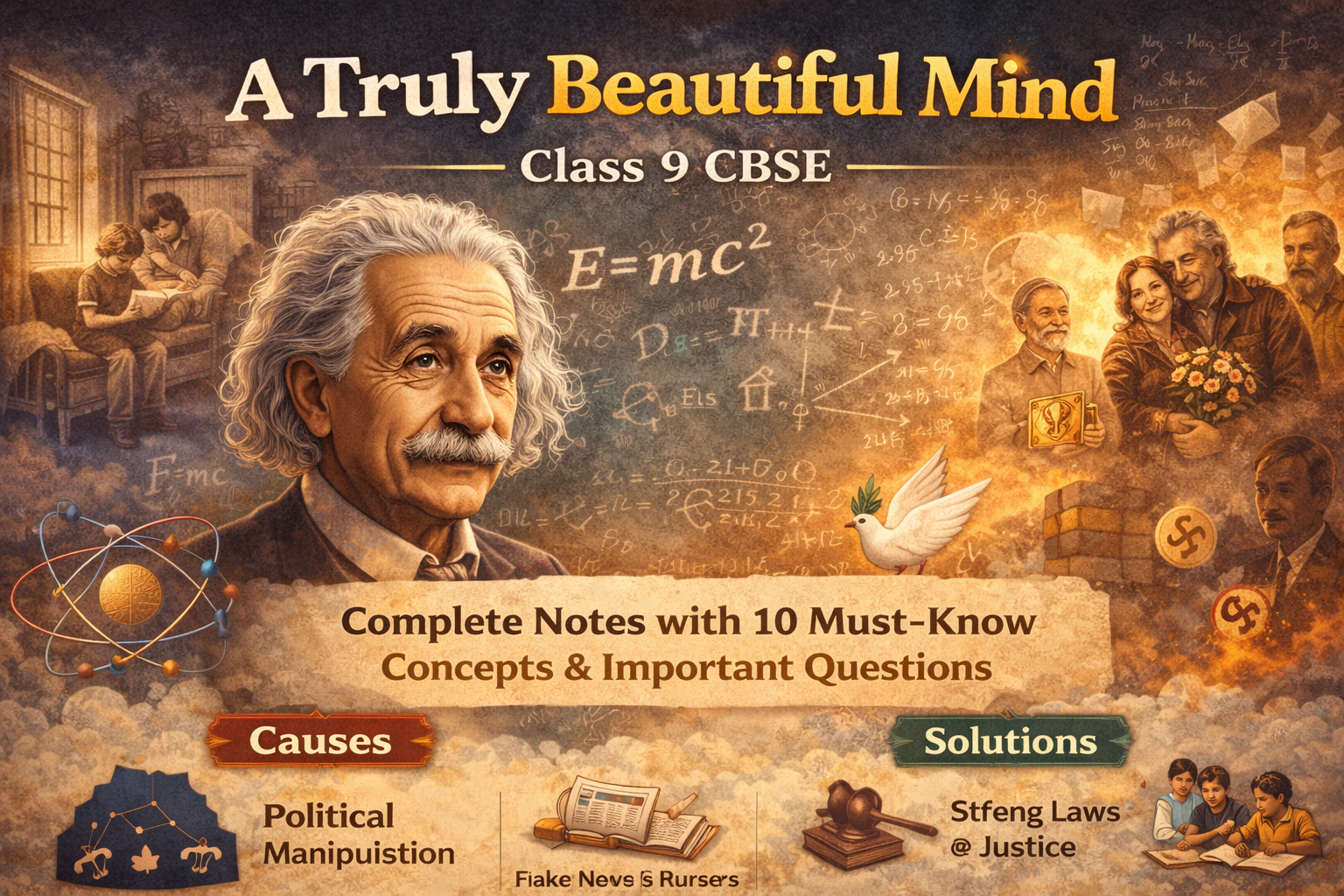
A Truly Beautiful Mind Class 9 CBSE – Complete Notes with 10 Must-Know Concepts & Important Questions
| Field | Detail |
|---|---|
| Chapter | 4 – A Truly Beautiful Mind |
| Subject | English (Beehive) |
| Class | 9 |
| Board | CBSE |
| Exam Weightage | Check latest CBSE syllabus |
A Truly Beautiful Mind Class 9 CBSE is a biographical chapter from the Beehive textbook that takes you through the remarkable life of Albert Einstein — not just as a scientist, but as a deeply human, humble, and peace-loving individual. While most students know Einstein’s name from their Science textbooks, this chapter shows the person behind the equations: curious, compassionate, and quietly courageous. It is a chapter that rewards careful reading, and board exams frequently draw questions from it.
These notes cover the complete chapter summary, Einstein’s character sketch, all key themes, word meanings, and five model exam answers. Whether you are revising the night before your exam or studying the chapter for the first time, this guide is structured to help you understand and remember everything that matters.
Think about it this way: Einstein was once told by his own headmaster that nothing good would come of him. Yet he went on to reshape our understanding of the universe. This chapter is not just about physics — it is about what happens when curiosity refuses to give up. Keep that spirit in mind as you revise, and your answers will stand out.
Table of Contents
- About Albert Einstein – Key Facts
- A Truly Beautiful Mind Class 9 CBSE – Complete Chapter Summary
- Character Sketch of Albert Einstein
- Themes and Literary Devices in A Truly Beautiful Mind Class 9 CBSE
- Word Meanings from the Chapter
- Important Questions – A Truly Beautiful Mind Class 9 CBSE
- Quick Revision – 10 Key Points to Remember
- Related Notes on Nextoper – Internal Links
- Useful External Resources – Outbound Links
About Albert Einstein – Key Facts
Before diving into the chapter summary, it helps to know the basics about the man at the centre of this story.
- Born: 14 March 1879, Ulm, Germany
- Died: 18 April 1955, Princeton, USA
- Field: Theoretical Physics
- Major Contributions: Special and General Theory of Relativity, the equation E = mc², work on the Photoelectric Effect
- Nobel Prize: Physics, 1921 — awarded specifically for his explanation of the Photoelectric Effect
- Later Life: Left Germany when the Nazis came to power; settled in the United States; worked at Princeton University
Einstein’s legacy is unusual because it spans two very different worlds — the world of abstract science and the world of moral action. This chapter celebrates both equally.
[Image: A photograph or illustration of Albert Einstein at his desk | Alt text: A Truly Beautiful Mind Class 9 CBSE – Albert Einstein portrait]
A Truly Beautiful Mind Class 9 CBSE – Complete Chapter Summary
Early Childhood and School Years
Albert Einstein was born in Ulm, Germany, on 14 March 1879. As a small child, he was unusually slow to begin speaking, which worried his mother. His classmates found him strange and distant, and his teachers were largely unimpressed. His headmaster reportedly told Einstein’s father that the boy would amount to nothing — a judgment that history has made thoroughly embarrassing.
Despite these early setbacks, young Einstein had a rich inner life. He was fascinated by mechanical toys and spent hours wondering about the invisible forces that made things work. His curiosity about light, motion, and the hidden structure of the universe began taking shape well before he set foot in any laboratory.
Struggles with Formal Education
Einstein deeply disliked the rigid, regimented style of German schooling. Regimentation — meaning extreme discipline and strict adherence to rules — was the dominant approach in his school, and it clashed completely with his need to question, explore, and think independently. His teachers found his habit of asking probing questions irritating rather than impressive.
When his family relocated to Milan, Italy, Einstein was left behind in Munich to finish his schooling. Feeling isolated and constrained, he left school at the age of 15 and rejoined his family. This decision was unconventional for the time, but it reflected something important about his character: he would not sacrifice his freedom of thought for institutional approval.
He eventually continued his studies in Zurich, Switzerland. The academic environment there was far more open and encouraging — exactly the kind of space where a mind like Einstein’s could begin to flourish.
College Life and Personal Relationships
In Zurich, Einstein met Mileva Maric, a fellow student who shared his passion for science and mathematics. Their intellectual friendship deepened into a romantic relationship, and they eventually married. Mileva was a strong, intelligent woman, and she supported Einstein during the difficult years when recognition for his work was still a distant prospect.
After completing his degree, Einstein found it surprisingly hard to get an academic job. He spent time unemployed before finally securing a position as a technical assistant at the Swiss Patent Office in Bern. It was a modest, unglamorous job — but it gave him financial stability and, crucially, enough mental space to continue thinking about physics.
The Miracle Year of 1905
The years at the patent office turned out to be among the most productive in the history of science. In 1905 — a year later referred to as his Annus Mirabilis, which is Latin for “miracle year” — Einstein published four landmark research papers. Among them was his paper on the Special Theory of Relativity, which fundamentally changed how scientists understand time, space, and motion.
That same year, he published his most famous equation: E = mc². This equation states that energy (E) and mass (m) are interchangeable, connected by the square of the speed of light (c²). In simple terms, it showed that even a tiny amount of matter contains an enormous amount of energy — a discovery with consequences that would echo through the rest of the twentieth century.
These papers earned Einstein international recognition almost immediately. Universities and scientific institutions around the world began taking notice, and his career transformed rapidly from obscurity to global fame.
Fame, Simplicity, and Leaving Germany
Despite becoming one of the most celebrated scientists alive, Einstein remained notably humble and unpretentious. He wore simple clothes, avoided unnecessary formality, and cared far more about ideas than public recognition. His personality was warm and self-deprecating — a sharp contrast to the gravity of his scientific achievements.
When the Nazi Party rose to power in Germany during the 1930s, Einstein — who was Jewish — became a target of state-sponsored persecution. He left Germany permanently and moved to the United States, where he joined Princeton University as a professor. He would never return to Germany.
[Image: Timeline of Einstein’s life from 1879 to 1955, with key milestones marked | Alt text: A Truly Beautiful Mind Class 9 CBSE – Einstein’s life timeline]
The Letter to Roosevelt and the Pursuit of Peace
In 1939, with World War II looming, Einstein wrote a letter to U.S. President Franklin D. Roosevelt. In it, he warned that Germany might be working to develop a nuclear weapon and urged the United States to begin its own research. This letter contributed to the launch of the Manhattan Project — America’s programme to develop the atomic bomb.
However, when atomic bombs were dropped on the Japanese cities of Hiroshima and Nagasaki in 1945, Einstein was devastated. He felt his warning had been misused, and he spent the final decade of his life advocating loudly and consistently for nuclear disarmament and global peace. He signed petitions, gave speeches, and co-authored declarations urging the world’s governments to step back from the brink of nuclear war.
Einstein once described himself not just as a scientist but as a citizen of the world — someone whose responsibilities extended far beyond any laboratory or equation.
Character Sketch of Albert Einstein
Einstein’s character in this chapter is multi-layered and worth studying carefully, as board exams often ask for a detailed character analysis.
- Curious from childhood: Even before he had the vocabulary to express it, Einstein was drawn to questions about how the world worked.
- Independent thinker: He refused to accept knowledge passively and consistently challenged what he was taught — even when it made him unpopular.
- Persevering: Rejected by teachers, left school early, struggled to find employment — and yet continued pursuing science on his own terms.
- Humble despite fame: Worldwide recognition did not change his simple, approachable personality.
- Morally courageous: He used his public platform to oppose war, racism, and nuclear weapons at a time when doing so carried real risks.
- Compassionate: His concern for humanity was not abstract — it shaped his decisions and consumed his final years.
In short, Einstein’s character arc moves from a misunderstood child to a celebrated scientist to a moral voice for humanity — which is precisely why the chapter is titled A Truly Beautiful Mind.
Themes and Literary Devices in A Truly Beautiful Mind Class 9 CBSE
Key Themes
Curiosity and Independent Thinking is the chapter’s foundational theme. Einstein’s entire life story is an argument for the value of asking questions — even inconvenient, uncomfortable ones. His curiosity, which his teachers found disruptive, turned out to be the engine of his greatest achievements.
Science and Moral Responsibility is the theme that gives the chapter its emotional weight. The atomic bomb episode shows that scientific discovery is never neutral — it can be used for both creation and destruction. Einstein’s response to this reality was to take personal responsibility and dedicate himself to peace.
Humility in Greatness runs quietly through the entire chapter. Einstein’s refusal to let fame change his character is presented as an essential part of what made him truly great — not just brilliant.
Education and Freedom of Thought is explored through the contrast between the rigid German school system that stifled Einstein and the open Swiss system that helped him grow. The chapter implicitly argues that real learning requires intellectual freedom.
Literary Devices
- Irony: Einstein’s headmaster predicted he would achieve nothing; he became the most famous scientist of the modern era.
- Contrast: The strict German school environment versus the open Swiss one; the young struggling clerk versus the globally celebrated professor.
- Biographical Narrative Style: The chapter reads like a well-crafted life story — chronological, warm, and carefully selective in which details it includes.
Word Meanings from the Chapter
| Word | Meaning |
|---|---|
| Regimentation | Extremely strict, rule-bound discipline |
| Patent | An official licence protecting an invention |
| Humanitarian | Someone devoted to promoting human welfare |
| Emigrate | To leave one’s home country to live elsewhere |
| Physicist | A scientist who studies matter, energy, and their interactions |
| Equation | A mathematical statement expressing equality between two things |
| Fascism | An authoritarian, often violently nationalist political system |
| Diplomat | A person who officially represents their country abroad |
| Genius | A person with exceptional, rare intellectual ability |
| Disarmament | The reduction or elimination of military weapons |
Important Questions – A Truly Beautiful Mind Class 9 CBSE
Q1. What does the title “A Truly Beautiful Mind” mean? (1 Mark) The title refers to Einstein’s mind, which combined exceptional scientific intelligence with deep human compassion, moral courage, and a commitment to world peace.
Q2. Why did Einstein dislike his German school, and how did this shape him? (3 Marks) Einstein found the strict, regimented style of German schooling deeply frustrating. The system valued obedience and rote memorisation over curiosity and creative thinking — exactly the opposite of how Einstein’s mind worked. His teachers disliked his questioning attitude, and the environment made him feel confined rather than inspired. This experience pushed him to seek out spaces — like Zurich — where independent thinking was valued, and ultimately reinforced his lifelong belief that real education must encourage freedom of thought rather than suppress it.
Q3. Describe Einstein’s “Miracle Year” of 1905 and explain its significance. (3 Marks) In 1905, while working as a technical assistant at the Swiss Patent Office, Einstein published four major research papers in the field of physics. Among these was his paper on the Special Theory of Relativity, which revolutionised how scientists understand the relationship between time, space, and motion. He also published the equation E = mc², demonstrating that mass and energy are fundamentally equivalent. These papers transformed physics almost overnight and established Einstein as one of the greatest scientific minds in history — remarkable especially because he produced them without access to a university lab or academic colleagues.
Q4. What was the significance of Einstein’s letter to President Roosevelt, and how did Einstein feel about its consequences? (5 Marks) In 1939, as the threat of World War II intensified, Einstein wrote to U.S. President Franklin D. Roosevelt to warn him that German scientists might be close to developing a nuclear weapon. He urged the United States to begin its own nuclear research programme to stay ahead of this danger. His letter played a significant role in prompting the launch of the Manhattan Project — the American effort that ultimately produced the atomic bombs dropped on Japan in 1945. Einstein, however, was deeply troubled by this outcome. He had intended his letter as a warning to prevent catastrophe, not as encouragement for nuclear warfare. The destruction caused at Hiroshima and Nagasaki affected him profoundly, and he spent the rest of his life campaigning for nuclear disarmament and global peace. This episode illustrates the chapter’s central theme: that scientific knowledge carries moral responsibility, and that a truly great mind cannot separate discovery from its consequences for humanity.
Q5. Write a character sketch of Albert Einstein as presented in the chapter “A Truly Beautiful Mind.” (5 Marks) Albert Einstein, as portrayed in this chapter, is far more than a scientific genius — he is a complete human being whose greatness lay as much in his character as in his intellect. As a child, he was slow to speak and dismissed by teachers, yet he harboured an extraordinary curiosity about the natural world. He resisted the rigid discipline of formal schooling not out of laziness but because his mind needed freedom to explore ideas on its own terms. Despite years of struggle — including unemployment after graduation and the hardships of working in a modest patent office — he never abandoned his scientific pursuits. When recognition finally came, it did not change his simple, unpretentious personality; he continued to dress casually, avoid formality, and prioritise thinking over fame. Most strikingly, Einstein did not retreat into his scientific work when the world around him faced moral crises. He opposed the Nazi regime, spoke out against racism, and devoted his final years to campaigning for nuclear disarmament. His life demonstrates that intelligence without compassion is incomplete, and that the most truly beautiful minds are those that use their gifts in service of humanity.
Quick Revision – 10 Key Points to Remember
- A Truly Beautiful Mind Class 9 CBSE is a biographical account of Albert Einstein’s life, highlighting both his scientific genius and his humanitarian values.
- Einstein was born on 14 March 1879 in Ulm, Germany, and was initially considered slow by his teachers and classmates.
- He disliked the strict, regimented approach of German schools and left at age 15 to reunite with his family in Milan.
- In Zurich, he met Mileva Maric, who shared his scientific interests and later became his wife.
- After graduation, Einstein worked at the Swiss Patent Office in Bern, where he found time to pursue his scientific research.
- The year 1905 is called his Annus Mirabilis — he published four landmark papers, including one introducing the Special Theory of Relativity.
- His equation E = mc² showed that mass and energy are interchangeable, one of the most consequential ideas in the history of science.
- Einstein left Germany permanently when the Nazi Party came to power in the 1930s and relocated to Princeton University in the USA.
- In 1939, he wrote to President Roosevelt warning about the possibility of a German nuclear weapon — a letter that helped trigger the Manhattan Project.
- He spent his later years as a committed advocate for nuclear disarmament and world peace, believing that scientists bear moral responsibility for how their discoveries are used.
Related Notes on Nextoper — Internal Links
Explore these related CBSE notes on Nextoper to strengthen your preparation:
- Class 9 English Beehive Chapter 3 Notes – The Little Girl
- Class 9 English Beehive Chapter 2 Notes – The Sound of Music
- Class 9 English Beehive Chapter 1 Notes – The Fun They Had



Pingback: Class 9 English Beehive Chapter 5 Notes – The Snake and the Mirror | Nextoper - Nextoper
Pingback: NCERT Class 9 English Beehive Chapter 7 Parking Handwritten Style Notes | Nextoper - Nextoper