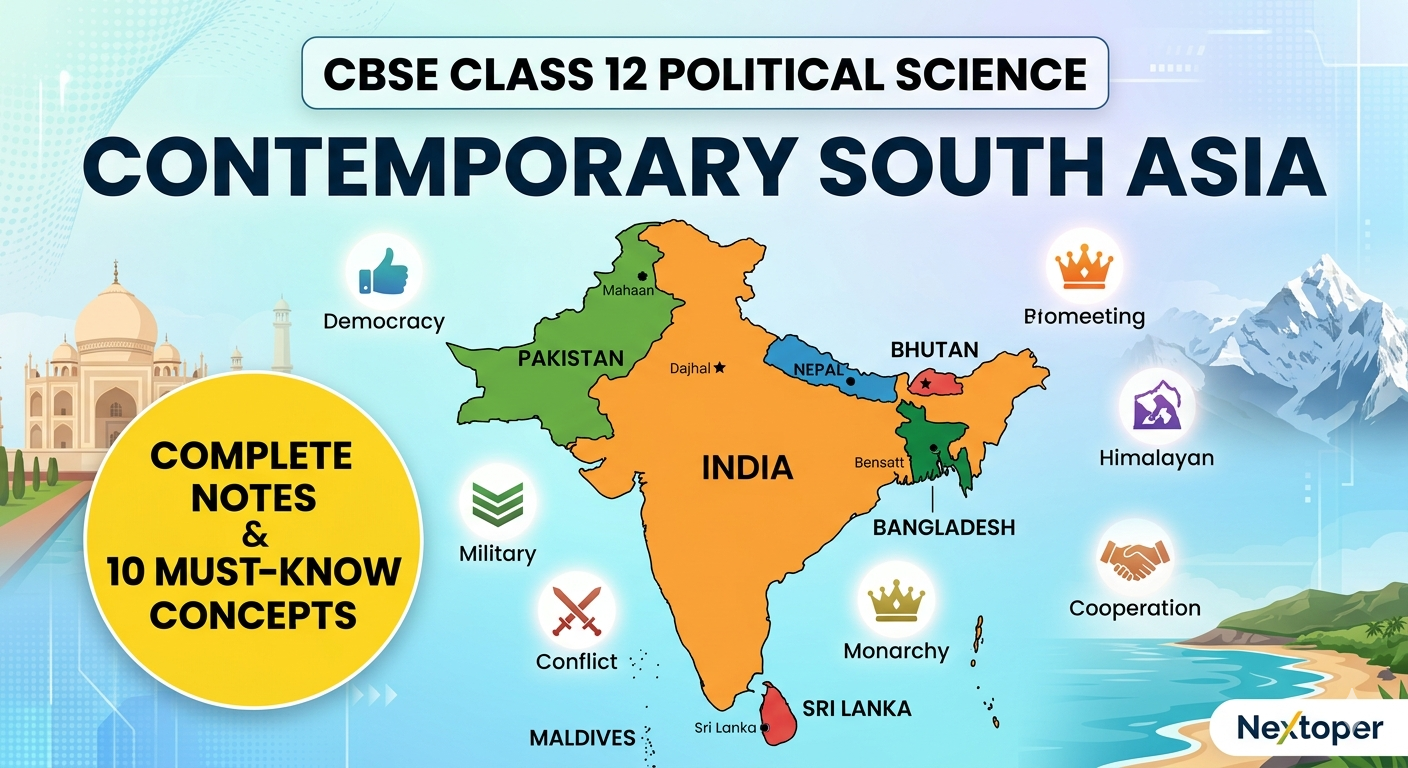
Contemporary South Asia Class 12 CBSE – Complete Notes with 10 Must-Know Concepts
Quick Overview
| Field | Detail |
|---|---|
| Chapter | Chapter 5 – Contemporary South Asia |
| Subject | Political Science (Contemporary World Politics) |
| Class | 12 |
| Board | CBSE |
| Exam Weightage | Check latest CBSE syllabus |
Contemporary South Asia Class 12 CBSE is one of the most scoring and relevant chapters in your Political Science board exam. It covers the political systems, conflicts, and cooperation attempts of South Asian countries — India, Pakistan, Bangladesh, Nepal, Sri Lanka, Bhutan, and the Maldives — from independence to the present day. When India and Pakistan both became nuclear powers in 1998, this entire region came under intense global attention.
These notes cover everything you need: democracy and military rule in Pakistan and Bangladesh, Nepal’s journey from monarchy to republic, Sri Lanka’s ethnic conflict, the India-Pakistan conflict over Kashmir, India’s bilateral relationships with smaller neighbours, and the role of SAARC and SAFTA in regional cooperation. Each section is explained clearly so you can read and revise quickly, whether you are preparing a week before the exam or the night before.
Think of South Asia like a joint family — different personalities, old disputes, unequal sizes, and yet living under the same roof. India, being the largest and centrally located, is like the eldest sibling — the others both rely on it and resent it at the same time. Understanding this dynamic is the key to mastering this chapter.
Table of Contents
- What is South Asia? Countries and Political Systems
- The Military and Democracy in Pakistan
- Democracy in Bangladesh
- Monarchy and Democracy in Nepal
- Ethnic Conflict and Democracy in Sri Lanka
- Contemporary South Asia Class 12 CBSE – India-Pakistan Conflicts
- India and Its Other Neighbours
- External Powers in South Asia – China and the US
- SAARC and Regional Cooperation – Contemporary South Asia Class 12 CBSE
- SAFTA – The Free Trade Dream
- Timeline of South Asia Since 1947 – A Board Exam Essential
- Important Questions – Contemporary South Asia Class 12 CBSE
- FAQ – Contemporary South Asia Class 12 CBSE
- Quick Revision – Key Points to Remember
- Related Notes on Nextoper – Internal Links
- Useful External Resources
What is South Asia? Countries and Political Systems
South Asia refers to the geo-political region that includes seven countries: Bangladesh, Bhutan, India, the Maldives, Nepal, Pakistan, and Sri Lanka. The mighty Himalayas form a natural boundary in the north, while the Indian Ocean, Arabian Sea, and Bay of Bengal surround the region in the south, west, and east. These natural boundaries have historically shaped the region’s distinct linguistic, social, and cultural identity.
Afghanistan and Myanmar are sometimes included in broader discussions of South Asia, and China is a major regional player — but in the NCERT textbook’s definition, South Asia means the seven countries listed above.
Political Diversity in the Region
The countries of South Asia do not share a single type of political system. Here is a country-wise summary:
- India and Sri Lanka — have maintained democratic systems since independence from the British.
- Pakistan and Bangladesh — have experienced alternating civilian and military rule.
- Nepal — was a constitutional monarchy until 2006–08, when it abolished the monarchy and became a democratic republic. It adopted a new constitution in 2015.
- Bhutan — became a constitutional monarchy in 2008 and transitioned to a multi-party democracy.
- Maldives — was a Sultanate until 1968, became a republic, and introduced a multi-party system in 2005. The Maldivian Democratic Party (MDP) dominates its politics.
Despite the uneven record, a major survey of 19,000+ citizens across five South Asian countries found widespread support for democracy. People across income levels and religions prefer democracy over any other form of government — challenging the earlier assumption that democracy can only thrive in wealthy countries.
[Image: Political map of South Asia showing all seven countries | Alt text: Contemporary South Asia Class 12 CBSE – political map of South Asian countries]
The Military and Democracy in Pakistan
Pakistan’s political history is a story of repeated tension between elected governments and military coups. After framing its first constitution, General Ayub Khan took over the government and got himself elected by manipulating the process. Popular dissatisfaction forced him out, but another military takeover followed under General Yahya Khan.
During Yahya Khan’s rule, the Bangladesh crisis emerged. After the 1971 war with India, East Pakistan broke away and became Bangladesh. An elected government under Zulfikar Ali Bhutto then came to power (1971–1977), but was removed by General Zia-ul-Haq in 1977.
Zia faced a pro-democracy movement from 1982 onwards. Elections were held in 1988, bringing Benazir Bhutto to power. For a decade, Pakistani politics alternated between her Pakistan People’s Party and Nawaz Sharif’s Muslim League. In 1999, General Pervez Musharraf ended this phase by removing Nawaz Sharif. Musharraf ran the country until civilian governments returned in 2008.
Why Has Pakistan Struggled with Democracy?
Several factors explain Pakistan’s recurring democratic failures:
- Social dominance of the military, clergy, and landowning aristocracy — these groups have consistently undermined elected governments.
- Conflict with India — has empowered pro-military groups who argue that “chaotic democracy” endangers national security.
- Lack of genuine international support — the US and Western countries have often preferred Pakistan’s military rulers as stable partners, particularly during the Cold War and the war on terror, because they feared Pakistan’s nuclear arsenal falling into the hands of extremist groups.
Despite these challenges, Pakistan has a courageous press and a strong human rights movement — showing that pro-democracy sentiment remains alive.
Democracy in Bangladesh
Bangladesh was part of Pakistan from 1947 to 1971. It comprised the partitioned areas of Bengal and Assam from British India. From the beginning, the people of this region resented the dominance of West Pakistan and the imposition of Urdu as the national language.
Sheikh Mujibur Rahman led the movement for Bengali autonomy. In the 1970 elections, his Awami League won all East Pakistan seats and secured a majority in the national assembly — but the West Pakistani leadership refused to convene the assembly. Sheikh Mujib was arrested. The Pakistani army brutally suppressed the mass movement, killing thousands and triggering a massive refugee crisis for India.
India supported the people of East Pakistan, and after a war in December 1971, Pakistan’s forces surrendered. Bangladesh emerged as an independent country.
Bangladesh’s Turbulent Democratic Journey
- Bangladesh’s new constitution declared faith in secularism, democracy and socialism.
- In 1975, Sheikh Mujib was assassinated in a military uprising. Military rule followed under Ziaur Rahman and then Lt Gen H.M. Ershad.
- Mass student protests in 1990 forced Ershad to step down.
- Since 1991, Bangladesh has operated a representative democracy based on multi-party elections.
Bangladesh’s story shows that democracy can survive even after prolonged military interruptions, when people’s demand for elected government remains strong.
Monarchy and Democracy in Nepal
Nepal was a Hindu kingdom for centuries, then became a constitutional monarchy in the modern era. But even under the constitutional monarchy, the king — supported by the army — retained full control over the government and limited democratic expansion.
In 1990, a strong pro-democracy movement forced the king to accept a new democratic constitution. However, democratic governments had a troubled run throughout the 1990s. The Maoists of Nepal spread their influence across the country, waging an armed insurgency against the monarchy and ruling elite. This created a three-way conflict — monarchist forces, democrats, and Maoists.
In 2002, the king abolished parliament and dismissed the government. In April 2006, massive countrywide pro-democracy protests erupted. The Seven Party Alliance (SPA), Maoists, and social activists led a largely non-violent movement that forced the king to restore the House of Representatives.
Key milestones:
- 2008 — Nepal abolished the monarchy and became a democratic republic
- 2015 — Nepal adopted a new constitution
The Maoists agreed to suspend armed struggle and join the democratic process, though they demanded radical social and economic restructuring be included in the constitution.
Ethnic Conflict and Democracy in Sri Lanka
Sri Lanka (formerly Ceylon) has maintained democracy since independence in 1948 — unlike Pakistan or Bangladesh. But it faced a different kind of challenge: ethnic conflict that nearly tore the country apart.
After independence, Sri Lankan politics was dominated by the Sinhala community. Sinhala nationalists were hostile to the large Tamil population — many of whom had migrated from India. Sinhala nationalism argued that Sri Lanka “belongs to the Sinhala people only” and opposed granting any political concessions to Tamils. The neglect of Tamil concerns gave rise to Tamil militant nationalism.
From 1983 onwards, the Liberation Tigers of Tamil Eelam (LTTE) fought an armed struggle against the Sri Lankan army, demanding a separate Tamil homeland called “Tamil Eelam” in the northeastern parts of the island.
India’s Role in Sri Lanka
India got directly involved in 1987 — signing an accord with Sri Lanka and sending the Indian Peace Keeping Force (IPKF) to stabilise the situation. However, the IPKF ended up in conflict with the LTTE itself. Sri Lankans also resented Indian troops as interference in their internal affairs. The IPKF withdrew in 1989 without achieving its objectives.
Resolution of the Conflict
Scandinavian countries (Norway and Iceland) tried to bring both sides to negotiations. The conflict finally ended in 2009 when the LTTE was militarily defeated by the Sri Lankan army.
Despite years of civil war, Sri Lanka has maintained a democratic system and recorded impressive economic development — including being the first South Asian country to liberalise its economy and the country with the highest per capita GDP in the region for many years.
Contemporary South Asia Class 12 CBSE – India-Pakistan Conflicts
The most significant and complex conflict in South Asia is between India and Pakistan. It began almost immediately after partition in 1947 and has multiple dimensions that the NCERT textbook covers in detail.
The Kashmir Dispute
Soon after partition, the two countries went to war over Jammu and Kashmir. Pakistan claimed Kashmir belonged to it. Wars in 1947–48 and 1965 failed to settle the matter. The 1947–48 war divided the region into Pakistan-occupied Kashmir and the Indian province of Jammu and Kashmir, separated by the Line of Control (LoC). India won the 1971 war decisively but the Kashmir issue remained unresolved.
Nuclear Rivalry
The India-Pakistan conflict took on a new, more dangerous dimension in 1998, when both countries conducted nuclear tests within days of each other:
- India tested in Pokaran (Rajasthan)
- Pakistan tested in the Chagai Hills
Since then, the two countries have built a military relationship based on nuclear deterrence — the logic that neither can launch a full-scale war because both sides can retaliate with nuclear weapons.
Cross-Border Terrorism and Other Issues
India blames Pakistan for supporting Kashmiri militants — providing arms, training, money, and protection for terrorist strikes. India also believes Pakistan’s ISI (Inter Services Intelligence) has been involved in anti-India campaigns in the northeast, operating through Bangladesh and Nepal.
Pakistan, in turn, blames Indian agencies for fomenting trouble in Sindh and Balochistan.
Other disputes include:
- Siachen Glacier — a strategic high-altitude conflict zone
- Sir Creek — a maritime boundary dispute in the Rann of Kutch
- Indus Waters Treaty (1960) — signed with World Bank mediation; has survived multiple wars but minor disagreements continue
Despite all this, there have been peace efforts: bus routes opened between the two countries, cross-border trade in Punjab increased, and visas have been made more accessible. Leaders have met at summits and signed confidence building measures (CBMs).
India and Its Other Neighbours
India’s relationship with each of its smaller neighbours is unique — shaped by geography, history, and politics. In general, smaller neighbours sometimes feel India behaves like a “regional bully,” while India often feels exploited or surrounded by instability.
India and Bangladesh
Disputes include:
- Sharing of Ganga and Brahmaputra river waters
- Illegal immigration from Bangladesh into India
- Bangladesh’s alleged support for anti-Indian Islamic fundamentalist groups
- Bangladesh’s refusal to allow Indian troops to move through its territory to northeast India
Bangladesh, in turn, has accused India of:
- Being unfair in trade and river water sharing
- Encouraging rebellion in the Chittagong Hill Tracts
- Behaving like a regional bully
Despite these tensions, cooperation also exists — on disaster management, environmental issues, and trade. India’s Act East policy (formerly Look East) involves Bangladesh as a corridor to Southeast Asia via Myanmar. In 2015, the two countries exchanged certain enclaves, resolving a long-standing boundary issue.
India and Nepal
Nepal and India share one of the world’s most unique relationships — citizens of both countries can travel and work in each other’s country without visas or passports. Despite this, tensions exist:
- India has expressed concern over Nepal’s closeness to China and its inaction against anti-Indian elements
- Nepal believes India interferes in its internal affairs and has designs on its river water and hydroelectric power
- India sees the Maoist movement in Nepal as a growing security threat
Despite differences, Indo-Nepal relations remain largely stable. Trade, electricity, hydroelectric cooperation, and shared water resources keep the two countries tied together.
India and Sri Lanka, Bhutan, and Maldives
- Sri Lanka: India signed a Free Trade Agreement (FTA) with Sri Lanka in 1998. India’s help in post-tsunami reconstruction brought the two countries closer. The main irritant is the Sri Lankan Tamil issue.
- Bhutan: India and Bhutan have a very warm relationship. Bhutan has helped India by flushing out guerrillas from northeast India who operate on Bhutanese soil. India funds big hydroelectric projects in Bhutan.
- Maldives: India responded quickly in 1988 when Tamil mercenaries attacked the Maldives, sending naval and air force units to foil the invasion. India has contributed to the Maldives’ economic development, tourism and fisheries.
External Powers in South Asia – China and the US
No region exists in complete isolation. China and the United States are the two most significant external players shaping South Asian politics.
China’s Role
Sino-Indian relations have improved significantly since 1991. The two economies have become deeply linked through trade. However, China’s strategic partnership with Pakistan remains a major irritant for India. China’s support for Pakistan — in military technology, infrastructure (notably the China-Pakistan Economic Corridor), and diplomatic cover at the UN — complicates India’s security calculations.
The United States’ Role
American involvement in South Asia increased sharply after the Cold War ended. The US has built good relationships with both India and Pakistan, sometimes acting as a moderator in their disputes. Economic liberalisation in both countries has deepened American investment and commercial involvement in the region.
The large South Asian diaspora in the United States — particularly the Indian-American and Pakistani-American communities — gives America an added stake in the region’s peace and stability. However, American foreign policy in the region has also been criticised for prioritising short-term security interests (like supporting Pakistan’s military) over long-term democratic development.
SAARC and Regional Cooperation – Contemporary South Asia Class 12 CBSE
The South Asian Association for Regional Cooperation (SAARC) was established in 1985 as the main regional framework for cooperation among South Asian states. It is headquartered in Kathmandu, Nepal. The first SAARC Summit was held in Dhaka in December 1985.
SAARC’s goals include:
- Promoting economic development and social progress
- Strengthening collective self-reliance among member nations
- Encouraging regional peace and stability
Why Has SAARC Underperformed?
Despite its promise, SAARC has largely failed to deliver on its potential. The main reason is that India-Pakistan tensions have repeatedly derailed regional cooperation. SAARC operates on the principle of consensus — meaning any one country can block a decision. Since India and Pakistan almost always disagree, SAARC summits often end without meaningful agreements.
Afghanistan joined SAARC in 2007, making it an 8-member grouping. The 18th SAARC Summit was held in Kathmandu, Nepal in November 2014.
SAFTA – The Free Trade Dream
SAFTA (South Asian Free Trade Agreement) was signed at the 12th SAARC Summit in Islamabad in January 2004 and came into effect on 1 January 2006. Its goal is to lower trade tariffs and create a free trade zone across South Asia.
There are competing views on SAFTA:
- India’s view: Free trade will bring real economic benefits to everyone and a region that trades freely will cooperate better politically.
- Smaller countries’ fear: SAFTA is a way for India to “invade” their markets and increase Indian commercial and political influence.
- Some in India argue: SAFTA is unnecessary since India already has bilateral trade agreements with Bhutan, Nepal, and Sri Lanka.
SAFTA remains more of an aspiration than a reality, hampered by political differences and economic asymmetries.
Timeline of South Asia Since 1947 – A Board Exam Essential
This timeline is a unique value-add for board students — no competitor covers it systematically:
- 1947 — India and Pakistan become independent nations
- 1948 — Sri Lanka gains independence; first Indo-Pak conflict over Kashmir
- 1960 — India and Pakistan sign the Indus Waters Treaty
- 1965 — Second Indo-Pak War
- 1971 — Bangladesh Liberation War; East Pakistan becomes Bangladesh
- 1972 — India and Pakistan sign the Shimla Agreement
- 1985 — SAARC established at first summit in Dhaka
- 1987 — Indo-Sri Lanka Accord; IPKF sent to Sri Lanka
- 1988 — India sends troops to Maldives to foil a coup attempt
- 1996 — India and Bangladesh sign Farakka Treaty on Ganga water sharing
- 1998 — India and Pakistan conduct nuclear tests
- 1999 — Kargil conflict between India and Pakistan
- 2004 — SAFTA signed at 12th SAARC Summit in Islamabad
- 2006 — SAFTA comes into effect; Nepal’s pro-democracy movement succeeds
- 2007 — Afghanistan joins SAARC
- 2008 — Nepal abolishes monarchy; becomes democratic republic
- 2009 — LTTE defeated; Sri Lanka’s civil war ends
- 2014 — 18th SAARC Summit in Kathmandu
Important Questions – Contemporary South Asia Class 12 CBSE
1 Mark Question
Q: When was SAARC established and where was the first summit held? A: SAARC was established in December 1985. The first summit was held in Dhaka, Bangladesh.
3 Mark Questions
Q: Explain three main reasons why Pakistan has repeatedly failed to sustain democratic governments. A: First, the social dominance of the military, clergy, and landowning aristocracy has led to the frequent overthrow of elected governments. These groups argue that elected parties are corrupt and that military rule better protects Pakistan’s security. Second, Pakistan’s ongoing conflict with India has strengthened pro-military groups who use national security as justification for military rule. Third, Pakistan has lacked genuine international support for democratic rule — Western countries, including the US, have often preferred to deal with Pakistan’s military rulers as more predictable partners, especially in the context of anti-terror operations.
Q: What is the Tamil question in Sri Lanka? How did India get involved? A: After Sri Lanka’s independence, politics was dominated by the Sinhala majority, which was hostile to the Tamil population. Tamil concerns were consistently ignored, leading to the rise of militant Tamil nationalism. From 1983, the LTTE fought for a separate Tamil homeland called “Tamil Eelam.” India got directly involved in 1987 by signing an accord with the Sri Lankan government and sending the Indian Peace Keeping Force (IPKF). However, the IPKF ended up fighting the LTTE itself and was resented by Sri Lankans as interference in their internal affairs. India withdrew the IPKF in 1989 without achieving its objectives.
5 Mark Questions
Q: Write a note on the major areas of conflict and cooperation between India and Pakistan. A: The most enduring conflict between India and Pakistan is over Kashmir. Wars in 1947–48 and 1965 left the region divided into Pakistan-occupied Kashmir and the Indian province of Jammu and Kashmir, separated by the Line of Control. India won the 1971 war but Kashmir remained unresolved.
The conflict took on a nuclear dimension when both countries tested nuclear weapons in 1998 — India at Pokaran and Pakistan at Chagai Hills. Since then, a nuclear deterrence logic has reduced the chance of full-scale war but increased the risk of miscalculation.
India also accuses Pakistan’s ISI of supporting Kashmiri militants and anti-India operations in the northeast. Pakistan blames India for trouble in Sindh and Balochistan. Other disputes include the Siachen Glacier, the Sir Creek maritime boundary, and the Indus Waters Treaty.
However, there are also important cooperation efforts. India and Pakistan signed the Indus Waters Treaty in 1960, which has survived multiple wars. Bus routes connecting the two countries have been opened, cross-border trade in Punjab has grown, and leaders have met at summits. Both governments have agreed on confidence building measures (CBMs) to reduce the risk of accidental war.
Q: What is SAARC? Why has it not been fully successful? Explain with reference to SAFTA. A: The South Asian Association for Regional Cooperation (SAARC) was established in December 1985 at a summit in Dhaka. Its purpose is to promote economic development, social progress, and regional cooperation among the seven South Asian nations.
SAARC has not been fully successful primarily because of the deep political distrust between India and Pakistan. Since SAARC operates on consensus, either country can veto any initiative, and India-Pakistan tensions routinely paralyse the organisation’s functioning.
SAFTA — the South Asian Free Trade Agreement — was signed in 2004 and came into effect in 2006, with the goal of creating a free trade zone across South Asia. India sees SAFTA as a genuine economic opportunity that will benefit all members. However, smaller countries fear that SAFTA is actually a vehicle for Indian economic dominance — allowing India to “invade” their markets. Some in India also argue that SAFTA is unnecessary since India already has bilateral trade agreements with Nepal, Bhutan, and Sri Lanka. This combination of political suspicion and competing economic interests has prevented SAFTA and SAARC from realising their potential.
FAQ – Contemporary South Asia Class 12 CBSE
Q1: What are the seven countries of South Asia according to NCERT? A: According to the NCERT textbook, South Asia includes Bangladesh, Bhutan, India, the Maldives, Nepal, Pakistan, and Sri Lanka. While Afghanistan and Myanmar are sometimes mentioned in discussions about the region, and China is an important player, the NCERT definition for exam purposes sticks to these seven nations. South Asia is described as standing for diversity in every sense while constituting one geo-political space.
Q2: What is the Shimla Agreement and why is it important? A: The Shimla Agreement was signed between India and Pakistan in July 1972, following the 1971 war and the creation of Bangladesh. Under this agreement, both countries agreed to settle their disputes through peaceful bilateral negotiations and to respect the Line of Control in Jammu and Kashmir. It remains one of the most significant documents in India-Pakistan relations because it laid the framework for bilateral diplomacy even after a war. It is a frequently examined topic in CBSE board papers.
Q3: What were the reasons for the creation of Bangladesh? A: Bangladesh was created through the 1971 Liberation War. The people of East Pakistan (who were Bengali) resented West Pakistani domination — particularly the imposition of Urdu as the national language and the denial of fair political representation. Sheikh Mujibur Rahman’s Awami League won the 1970 elections convincingly, but the West Pakistani leadership refused to hand over power. The Pakistani army then brutally cracked down on the Bengali people. India supported the independence movement, and after a war in December 1971, Pakistan surrendered and Bangladesh emerged as an independent nation.
Q4: What is the significance of the nuclear tests of 1998 in South Asia? A: India conducted nuclear tests in Pokaran (Rajasthan) in May 1998. Pakistan responded within days by testing in the Chagai Hills. These tests transformed South Asia into an officially nuclear-armed region and brought intense international pressure on both countries. The tests also changed the nature of India-Pakistan military competition — from conventional to nuclear deterrence. While this has made a full-scale war less likely (since both sides fear nuclear retaliation), it has also increased the risk of dangerous miscalculations during crises. The 1998 tests are a key exam topic for both the chapter on Contemporary South Asia and nuclear non-proliferation.
Q5: What are the main limitations of SAARC? A: SAARC was established in 1985 with high hopes for South Asian regional cooperation but has delivered limited results. Its main limitations are: First, the persistent India-Pakistan conflict poisons every SAARC forum since the two largest members cannot agree on most issues. Second, SAARC operates by consensus, meaning any one country can block proposals. Third, the economic asymmetry between India and its smaller neighbours creates suspicion — smaller countries fear that any deep integration will benefit India disproportionately. Fourth, the lack of effective dispute-resolution mechanisms means political disagreements have no neutral forum for resolution within SAARC.
Quick Revision – Key Points to Remember
- South Asia includes seven countries: Bangladesh, Bhutan, India, Maldives, Nepal, Pakistan, and Sri Lanka — defined by the NCERT textbook.
- Despite different political systems, a survey of 19,000+ South Asian citizens showed widespread support for democracy across the region.
- Pakistan’s democracy has been repeatedly interrupted by military coups — by Generals Ayub Khan, Yahya Khan, Zia-ul-Haq, and Pervez Musharraf. Civilian governments returned in 2008.
- Bangladesh became independent in December 1971 after India helped defeat Pakistan in a war triggered by Pakistan’s suppression of the Bengali democracy movement.
- Nepal abolished its monarchy in 2008 and became a democratic republic; it adopted a new constitution in 2015 after a political struggle involving monarchists, democrats, and Maoists.
- Sri Lanka’s ethnic conflict between the Sinhala majority and the Tamil minority led to the rise of the LTTE, which fought for a separate Tamil homeland from 1983 until its military defeat in 2009.
- India and Pakistan have fought three wars (1947–48, 1965, 1971). The Kashmir dispute remains unresolved, divided by the Line of Control.
- Both India and Pakistan tested nuclear weapons in 1998 (Pokaran and Chagai Hills respectively), making South Asia the world’s most nuclearised conflict zone.
- The Indus Waters Treaty (1960), signed with World Bank mediation, has survived multiple wars and remains the most successful India-Pakistan bilateral agreement.
- SAARC was founded in 1985 in Dhaka; SAFTA was signed in 2004 and came into effect on 1 January 2006, aiming at a free trade zone for South Asia.
Related Notes on Nextoper
Explore these related CBSE notes on Nextoper to strengthen your preparation:
- End of Bipolarity – Class 12 CBSE Political Science Notes
- Alternative Centres of Power Notes – Class 12 Political Science Chapter 4 Notes
- Class 12 Political Science Chapter 6 Notes – International Organizations
- Class 12 Chapter 3 – US Hegemony in World Politics
You can join me on Facebook, Instagram here you will keep getting new notes, updates, and important information related to education.


dental plaque why ultrasonic dental cleaning matters
gta 5 mods ps5 money for gta 5 online
Читать статью полностью: https://dfprices.ru
Новое в категории: https://hidplanet.ru
Вся суть в источнике: https://onliskill.ru
Переходите по ссылке: https://mudrila.ru
Все ключевые моменты: https://gshimki.ru
КтоЛетит https://ktoletit.ru сайт об экстремальных видах спорта и отдыха: параглайдинг, кайт-серфинг, серфинг, виндсерфинг. База знаний, советы по выбору хобби, спорта, или экстремального досуга. Локации для путешествий на карте, каталог школ экстрим спорта в России и мире.
Корисні статті для користувачів https://ukrglobe.com зібрані для зручного читання онлайн.
Пізнавальний сайт для читачів https://zastava.com.ua допомагає знаходити актуальну інформацію та нові матеріали.
Цікавий портал для користувачів https://vilnapresa.com/dity.html зібрані для зручного читання онлайн.
Актуальні матеріали для користувачів https://vechorka.com.ua/didzhytal.html містить цікаві публікації та тематичні огляди.
Легко в любое время дьюти фри духи купить на каждый день. Среди представленных ароматов доступны унисекс композиции. Сравнивайте аромат для определенного случая по характеру. Обратите внимание на верхние и базовые ноты. Заказывайте понравившийся парфюм через сайт и оформляйте доставку по нужному адресу.
Воспользоваться SEO-сопровождение seo продвижение бизнеса. Команда продвижения проведут анализ конкурентов. На первом этапе формируются приоритетные запросы. С учетом конкуренции расширяются внутренняя перелинковка. Отслеживание результатов дает возможность контролировать эффективность работ. Запросите условия сотрудничества для своего проекта. Закажите консультацию онлайн и выберите подходящий формат SEO-сопровождения.
Integrate secure gaming payment gateway provider for a digital service. Technology platform enables accepting online payments. As part of the integration available bank cards. Implementation carried out using ready-made tools. Before choosing important to check security measures. Request available payment methods based on the expected volume of transactions. Send a request online and learn the integration procedure.
Можно дома радио дача онлайн в любое время. На радиостанции собраны знакомые мелодии. Запускайте эфир во время отдыха. Включайте любимые композиции с планшета без сложных настроек.
A practical wellness website healthfare.ca about health, proper nutrition, and everyday well-being. The resource provides helpful content on proper diet, along with practical advice. Additional content includes product overviews. The content also covers healthy habits, healthy eating and diet, exercise and fitness, self-care, and everyday health.
Организовать сопровождение аутсорсинг охраны труда для крупной компании. Эксперты по охране труда контролируют необходимые процедуры. В процессе сопровождения проводится организация обучения. Все материалы актуализируются с учетом особенностей компании. При возникновении задачи ведение направления можно передать внешним специалистам. Передача функций на аутсорсинг позволяет контролировать выполнение требований. Представителю организации можно не вести весь объем документации. Рассчитайте состав работ с учетом специфики бизнеса. Свяжитесь со специалистами через сайт и получите помощь в ведении охраны труда.
Интересный ресурс https://russkajakrasota.ru о моде. Изучайте актуальные публикации о косметике, саморазвитии и современной женщины.
Актуальный сайт https://vladimir-courses.ru с актуальными материалами в стране. На сайте публикуются новости об культуре и других интересных темах.
Информационный ресурс https://kiaportal.ru для автомобилистов. На сайте публикуются автоновости, а также материалы о ремонте для автовладельцев.
Информационный сайт https://mulino58.ru с информацией о разных сферах жизни. Находите актуальную информацию об повседневных вопросах и региональных событиях.
Тематический портал https://clanauto.ru для автовладельцев. Здесь собраны автоновости, материалы об автомобилях и новости автопрома.
Интересный сайт https://kulinarika.ru для любителей готовить. В каталоге можно найти кулинарные советы для праздничного стола, а также секреты приготовления.
Информационный портал https://castor-mebel.ru о интерьере. Находите полезные материалы о дизайне интерьера, современных интерьерных решениях и практичных решениях.
Полезный ресурс https://ru-nedvizhimost.ru о жилье. Изучайте полезную информацию о покупке квартир, ипотеке и операциях с недвижимостью.
Информационный сайт https://mebel-lotos18.ru о строительстве. В материалах представлены идеи по обустройству дома, созданию комфортного жилья и современным решениям.
Информационный ресурс https://no-lamer.ru о программном обеспечении. В материалах публикуются советы по настройке ПК, информация о драйверах и полезные компьютерные решения.
Find the full story http://www.cricketscore.website.yandexcloud.net
Show more nekopara pro
Must-read collection conversionweb github io conversion
Curated for you nukitashi
See the breakdown here https://www.premier-league-jatekok.hu
Discover the full post https://winter-memories.pro/
What’s changed https://poki-game.hu/
Цікавий портал для користувачів https://infoquorum.com.ua/domivka.html допомагають дізнаватися новей стежити за актуальними подіями.
Цікаві публікації для читачів https://infopark.com.ua пропонує різноманітні статті й рекомендації.
Engaging attitude on myth inspired digital entertainment. Thanks for the sake sharing.
Цікаві публікації для користувачів https://dobraporada.com.ua/budivnytstvo.html містить пізнавальні матеріали та огляди.
Пізнавальний сайт для читачів https://databank.com.ua/kulinariia.html допомагає знаходити актуальну інформацію та нові матеріали.
Інформаційний ресурс для аудиторії https://altavista.org.ua пропонує різноманітні статті й рекомендації.
Цікаві публікації для користувачів https://dailyfacts.com.ua/domivka.html містить цікаві публікації та тематичні огляди.
Пізнавальний сайт для читачів https://dailymail.com.ua/didzhytalizatsiia.html зібрані для зручного читання онлайн.
Сучасний портал для аудиторії https://elementarno.com.ua/krasa.html пропонує різноманітні статті й рекомендації.
Ideas almost treasure and karma at to appear in recreation, literature and novel online culture. This article presents the case from an open angle and connects affable quotations with stylish forms of digital storytelling. The constituents take fortune fortune quotes digital culture was informative and enjoyable to read. I treasure the effort that went into collecting these observations.