Class 12 History Chapter 9 Notes | Kings and Chronicles Notes 2025-26
Introduction to Class 12 History Chapter 9 Notes
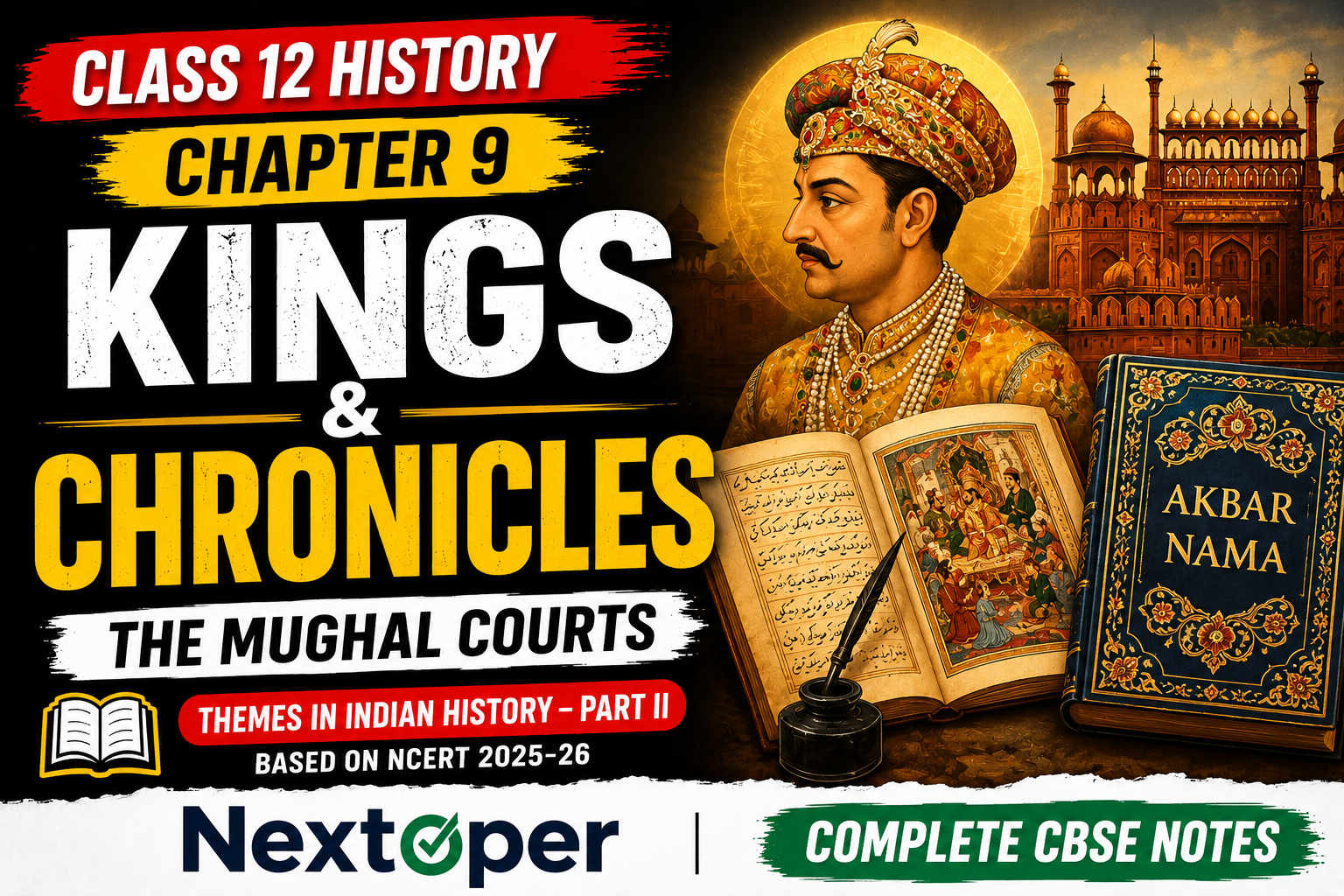
Class 12 History Chapter 9 Notes cover Kings and Chronicles. This chapter is about the Mughal Empire. It tells us how Mughal rulers kept records of their rule. These records are called chronicles. They help us understand how the Mughals governed India.
This is a very important chapter. It is based on the official NCERT textbook for CBSE 2025-26. You will learn about Mughal kings, their courts, their paintings, and their administration.
All notes here are 100% free. They are based on the NCERT syllabus 2025-26.
Table of Contents
- Chapter Overview
- The Mughals and Their Empire
- Production of Chronicles — Class 12 History Chapter 9 Notes
- The Painted Image (Taswir)
- Akbar Nama and Badshah Nama
- The Ideal Kingdom
- Capitals and Courts
- The Imperial Household
- The Imperial Officials and Mansab System
- Beyond the Frontiers
- Key Definitions Table
- Important Questions and Answers
- MCQs with Answers
- Quick Revision Points
- Previous Year Questions (PYQs)
- Featured Snippet Block
- People Also Ask
- FAQs
- Conclusion
Chapter Overview Table
| Detail | Information |
|---|---|
| Chapter Number | 9 |
| Chapter Name | Kings and Chronicles: The Mughal Courts |
| Subject | History (Themes in Indian History – Part II) |
| Class | 12 |
| Board | CBSE |
| Session | 2025-26 |
| Period Covered | c. 16th–17th centuries |
| Key Text | Akbar Nama, Badshah Nama |
| Key Author | Abu’l Fazl |
| Source | NCERT Official Textbook |
The Mughals and Their Empire
The word “Mughal” comes from Mongol. But the rulers called themselves Timurids. That means they were descendants of Timur, the Turkish ruler.
Babur was the first Mughal king. He came from Farghana in Central Asia. The Uzbeks drove him out. He set up his base in Kabul. Then in 1526, he entered India.
Here is a simple list of Mughal rulers:
- Babur (1526–1530) — Founder of the Mughal Empire
- Humayun (1530–40, 1555–56) — Lost and regained the empire
- Akbar (1556–1605) — Greatest Mughal emperor
- Jahangir (1605–27) — Known for his memoirs
- Shah Jahan (1628–58) — Built Shahjahanabad (Delhi)
- Aurangzeb (1658–1707) — Last of the great Mughals
- Bahadur Shah Zafar II — Last Mughal; overthrown by British in 1857
Akbar was the greatest Mughal emperor. He expanded the empire. He also made it the richest and strongest kingdom of his time.
After 1707, the power of the Mughals fell. Regional rulers became stronger. But the Mughal name still had respect.
Production of Chronicles — Class 12 History Chapter 9 Notes
This is one of the most important parts of Class 12 History Chapter 9 Notes. A chronicle is a written record of events in the order they happened.
Mughal emperors ordered court writers to record their reigns. These writers were called courtiers. The chronicles they wrote focused on:
- The emperor’s life
- His family and court
- Wars and victories
- Administrative decisions
Chronicles served three purposes:
- To show that the emperor ruled by God’s will
- To warn enemies that resistance would fail
- To record history for future generations
From Turkish to Persian
The Mughals spoke Turkish. Babur wrote his memoirs in Turkish. But Akbar made Persian the official language of the court.
Why Persian? Because:
- Iran and Central Asia had cultural ties with the Mughals
- Persian gave power and prestige
- It became the language of administration
Even local languages like Rajasthani, Marathi, and Tamil absorbed Persian words. A new language, Urdu, grew from the mix of Persian and Hindavi.
Key translations done by Mughal emperors:
- Babur’s memoirs → translated into Persian as Babur Nama
- Mahabharata → translated as Razmnama (Book of Wars)
The Making of Manuscripts
All books in Mughal India were handwritten. They are called manuscripts. The centre of manuscript production was called the kitabkhana.
A kitabkhana was not just a library. It was a scriptorium — a place to write and store books.
Making a manuscript needed many people:
- Paper makers — prepared folios (pages)
- Calligraphers — copied the text
- Gilders — added gold decoration
- Painters — drew illustrations
- Bookbinders — bound all pages together
Calligraphers and painters were highly respected. Akbar’s favourite style of writing was nastaliq — a fluid, flowing script. The pen used was called qalam.
The Painted Image (Taswir)
Paintings in Mughal manuscripts were not just decoration. They were a way to communicate power and ideas.
Abu’l Fazl called painting a “magical art.” He said it could make lifeless objects look alive.
But the Muslim scholars (ulama) had a problem with paintings. They said Islam forbids drawing living beings. This created tension at the Mughal court.
Akbar disagreed. He said an artist recognises God when he sees he cannot give life to his work. He supported painting strongly.
Two famous Iranian artists — Mir Sayyid Ali and Abdus Samad — came to Mughal India. They trained Indian artists.
From the 17th century, Mughal painters drew emperors with a halo around their head. This was borrowed from European paintings of Christ. It showed the emperor had divine light.
Akbar Nama and Badshah Nama
These are the two most famous Mughal chronicles. They are key topics in Class 12 History Chapter 9 Notes for board exam preparation.
Akbar Nama
- Written by Abu’l Fazl
- Took 13 years to complete (1589–1602)
- Divided into 3 books:
- Book 1: History from Adam to 30 years of Akbar’s reign
- Book 2: Events up to Akbar’s 46th year (1601)
- Book 3: The Ain-i Akbari — a description of Akbar’s empire
- Based on: official records (waqai), documents, and oral testimonies
- Each manuscript had about 150 paintings
Abu’l Fazl was killed by Prince Salim (later Jahangir) before completing the work.
Badshah Nama
- Written by Abdul Hamid Lahori (a student of Abu’l Fazl)
- Commissioned by Shah Jahan
- Modelled on the Akbar Nama
- Written in 3 volumes (daftars) of 10 lunar years each
- Volume 3 was completed by historian Waris
The Badshah Nama was gifted to King George III of England in 1799. It is now preserved at Windsor Castle.
The Ideal Kingdom
The Mughal idea of kingship had three main pillars:
1. Divine Light (Farr-i Izadi)
Abu’l Fazl said Mughal kings received light from God. This idea came from the Iranian Sufi philosopher Shihabuddin Suhrawardi. The king was the highest receiver of God’s light. He guided his subjects like a spiritual leader.
Mughal paintings showed emperors with a halo to show this divine connection.
2. Sulh-i Kul (Absolute Peace)
Abu’l Fazl introduced the concept of sulh-i kul. It means absolute peace. Under this idea:
- All religions had freedom of expression
- No group could undermine the state
- No group could fight with another
Akbar followed this policy. He abolished the pilgrimage tax in 1563 and the jizya (tax on non-Muslims) in 1564. He also gave grants to all places of worship — temples, mosques, and churches.
3. Just Sovereignty as Social Contract
Abu’l Fazl said the emperor had a duty to protect four things for his subjects:
- Jan — life
- Mal — property
- Namus — honour
- Din — faith
In return, subjects gave obedience and taxes. This was like a social contract between the king and the people.
Capitals and Courts
The capital cities of the Mughals kept changing:
| Period | Capital |
|---|---|
| Babur onwards | Agra (Lodi capital taken over) |
| 1560s | Fort of Agra built by Akbar |
| 1570s | Fatehpur Sikri (new city by Akbar) |
| 1585 | Lahore (to watch the northwest) |
| 1648 | Shahjahanabad (by Shah Jahan) |
Fatehpur Sikri was built near a Sufi shrine. Akbar had a close bond with the Chishti Sufi saints. The Buland Darwaza (great gate) was built to mark Akbar’s victory in Gujarat.
Shahjahanabad (present Delhi) was Shah Jahan’s capital. It had:
- The Red Fort
- Jama Masjid
- Chandni Chowk (designed by Princess Jahanara)
The Mughal Court (Darbar)
The Mughal court showed the emperor’s power. The emperor sat on the takht (throne). The throne was called the axis mundi — the centre of the world.
Rules in the darbar:
- Status was decided by how close you stood to the emperor
- No one could move without permission
- Salutations showed rank:
- Sijda — complete prostration (highest)
- Kornish — right palm on forehead, head bowed
- Chahar taslim — hands raised and lowered four times
- Zaminbos — kissing the ground
Every morning, the emperor appeared at the jharoka (balcony). People waited below for a view of him. This was called jharoka darshan. Akbar introduced this to make people feel connected to royal authority.
The emperor’s daily schedule:
- Morning prayers at sunrise
- Jharoka darshan
- Diwan-i Am — public audience hall (for state business)
- Diwan-i Khas — private audience (for confidential matters)
Festivals at the Mughal court:
- Solar and lunar birthdays of the emperor
- Nauroz (Iranian New Year)
- Eid and Shab-i Barat
On birthdays, the emperor was weighed against gold and goods. These were given to the poor.
The Imperial Household
The Mughal household is often called the harem. The word comes from the Persian word haram, meaning a sacred place.
The household included:
- Emperor’s wives and concubines
- Female relatives (mother, sisters, daughters)
- Female servants and slaves
Types of wives:
- Begam — wives from royal families (highest rank)
- Agha — wives not of noble birth
- Aghacha — concubines (lowest rank)
Marriage was political. Both Rajputs and Mughals used marriage to form alliances. A Rajput chief would give his daughter in marriage to secure a relationship with the Mughal emperor.
Important women of the Mughal household:
- Nur Jahan — wife of Jahangir; held great political power
- Jahanara — Shah Jahan’s daughter; designed Chandni Chowk; received income from Surat port
- Gulbadan Begum — wrote the Humayun Nama; gave honest accounts of royal conflicts
The Imperial Officials and Mansab System
The Mughal state depended on its officers. Collectively, they were called the nobility.
Mansab System
Every officer held a mansab (rank). It had two numbers:
- Zat — showed rank in the empire and salary
- Sawar — showed how many horsemen the officer must maintain
Officers with 1,000 zat or more were called umara (nobles).
The officer corps included many groups:
- Turani and Iranian nobles (from Akbar’s time)
- Rajputs (from 1560 onwards)
- Indian Muslims (Shaikhzadas)
- Marathas (under Aurangzeb)
Raja Todar Mal (Akbar’s finance minister) was from the Khatri caste. Nur Jahan brought Iranian nobles to power under Jahangir.
Key Ministers at the Centre
- Mir Bakhshi — paymaster general; managed the officer corps
- Diwan-i Ala — finance minister
- Sadr-us Sudur — minister for grants and religious affairs
Information System
The Mughal administration was famous for record keeping. The mir bakhshi supervised court writers called waqia nawis. They recorded all orders and documents.
News from the court was called Akhbarat-i Darbar-i Mualla. Foot-runners called qasid or pathmar carried news across the empire in bamboo containers. Even news from faraway provinces reached the emperor within a few days.
Provincial Administration
Each province was called a suba. The governor was called subadar. Each suba was divided into sarkars. Local areas were called parganas.
Local officers at the pargana level:
- Qanungo — kept revenue records
- Chaudhuri — collected revenue
- Qazi — local judge
Beyond the Frontiers
The Mughals had relations with three important powers:
1. The Safavids and Qandahar
Qandahar was a contested fortress between the Mughals and the Safavids of Iran. Akbar reconquered it in 1595. But in 1622, the Safavids took it back.
Jahangir’s famous painting “Jahangir’s Dream” shows him embracing the Safavid ruler Shah Abbas — though the two never actually met.
2. The Ottomans: Pilgrimage and Trade
The Mughals wanted safe passage for merchants and pilgrims going to Mecca and Medina in Ottoman-controlled Arabia. Mughal emperors sent charity money to shrines in the Hijaz.
3. Jesuits at the Mughal Court
Akbar was curious about Christianity. He invited Jesuit priests from Goa. The first Jesuit mission arrived at Fatehpur Sikri in 1580. Two more missions came in 1591 and 1595.
Akbar also held interfaith debates in the Ibadat Khana at Fatehpur Sikri. Scholars of Hinduism, Islam, Jainism, Zoroastrianism, and Christianity took part.
This showed Akbar’s sulh-i kul philosophy in action.
Key Definitions and Terms Table
| Term | Meaning |
|---|---|
| Chronicle | A continuous record of historical events |
| Kitabkhana | Mughal scriptorium/library for making manuscripts |
| Nastaliq | A flowing style of Persian calligraphy |
| Qalam | Reed pen used for calligraphy |
| Taswir | The art of painting (term used by Abu’l Fazl) |
| Farr-i Izadi | Divine light from God received by the Mughal king |
| Sulh-i Kul | Absolute peace — policy of religious tolerance |
| Mansab | Rank held by Mughal officials |
| Zat | Part of mansab showing rank and salary |
| Sawar | Part of mansab showing number of horsemen required |
| Jharoka Darshan | Emperor appearing at balcony for public viewing |
| Takht | Mughal throne |
| Sijda | Complete prostration — highest form of salutation |
| Kornish | Ceremonial salutation — palm to forehead |
| Diwan-i Am | Hall of public audience |
| Diwan-i Khas | Hall of private audience |
| Suba | Province in Mughal administration |
| Subadar | Governor of a province |
| Mir Bakhshi | Paymaster general of the Mughal Empire |
| Waqia Nawis | Court writers who recorded proceedings |
| Ibadat Khana | House of worship where Akbar held debates |
Important Questions and Answers
2-Mark Questions
Q1. What is a Mughal chronicle? A Mughal chronicle is a written historical record. It described events of an emperor’s reign. It was written by court historians called courtiers. Examples are Akbar Nama and Badshah Nama.
Q2. What was the kitabkhana? The kitabkhana was the Mughal manuscript workshop and library. New manuscripts were created here. Calligraphers, painters, and bookbinders all worked in the kitabkhana.
Q3. What is sulh-i kul? Sulh-i kul means absolute peace. It was a policy introduced by Akbar and explained by Abu’l Fazl. All religions had freedom. But no religion could challenge the state.
Q4. What is the mansab system? The mansab system was the Mughal ranking system for officials. It had two parts — zat (showing rank and salary) and sawar (showing number of horsemen needed). Officers were called mansabdars.
Q5. Who was Abu’l Fazl? Abu’l Fazl was Akbar’s court historian. He wrote the Akbar Nama, the official history of Akbar’s reign. He also wrote the Ain-i Akbari. He was killed in 1602 on the orders of Prince Salim.
5-Mark Questions
Q6. Describe the production of manuscripts in the Mughal court.
All books in Mughal India were handwritten manuscripts. The centre of production was the kitabkhana.
Making a manuscript needed many skilled workers:
- Paper makers prepared the pages
- Calligraphers copied the text using the nastaliq style
- Painters illustrated the scenes
- Gilders added gold decoration
- Bookbinders assembled and bound all pages
Calligraphers and painters held high social status. The most valued calligraphers received royal titles. For example, Muhammad Husayn of Kashmir was given the title “zarrin qalam” (golden pen) by Akbar.
A finished manuscript was seen as a precious object. It showed the power of the emperor who commissioned it. Based on the official NCERT textbook for CBSE syllabus 2025-26, manuscripts were both works of art and tools of imperial authority.
Q7. Explain the Mughal ideal of kingship.
The Mughal ideal of kingship had three parts, all based on the official NCERT source.
First was divine light (farr-i izadi). Abu’l Fazl said the king received God’s light directly. This idea came from the Iranian Sufi philosopher Suhrawardi. Paintings showed emperors with a halo to show this.
Second was sulh-i kul (absolute peace). The emperor stood above all religions. All groups could follow their faith. But they could not fight each other or threaten the state.
Third was just sovereignty as social contract. The emperor had to protect four things for his people — life, property, honour, and faith. In return, subjects gave loyalty and taxes. Only a just king could fulfil this contract.
Want More Free Notes? Visit Nextoper.in for all Class 9 to 12 CBSE Notes — 100% Free!
MCQs — Class 12 History Chapter 9
1. The word “Mughal” is derived from which word? (a) Persian (b) Turkish (c) Mongol (d) Arabic
✅ Answer: (c) Mongol
2. The first Mughal emperor was: (a) Humayun (b) Akbar (c) Timur (d) Zahiruddin Babur
✅ Answer: (d) Zahiruddin Babur
3. The Akbar Nama was written by: (a) Abdul Hamid Lahori (b) Abu’l Fazl (c) Gulbadan Begum (d) Badauni
✅ Answer: (b) Abu’l Fazl
4. What is kitabkhana? (a) A royal kitchen (b) A treasury (c) An imperial manuscript workshop/library (d) A mosque
✅ Answer: (c) An imperial manuscript workshop/library
5. Which script did Akbar prefer for calligraphy? (a) Devanagari (b) Naskh (c) Nastaliq (d) Kufic
✅ Answer: (c) Nastaliq
6. Sulh-i kul means: (a) Holy war (b) Absolute peace (c) Divine king (d) Tax on non-Muslims
✅ Answer: (b) Absolute peace
7. The Badshah Nama was written by: (a) Abu’l Fazl (b) Jahangir (c) Abdul Hamid Lahori (d) Gulbadan Begum
✅ Answer: (c) Abdul Hamid Lahori
8. The first Jesuit mission arrived at the Mughal court in: (a) 1556 (b) 1580 (c) 1605 (d) 1526
✅ Answer: (b) 1580
9. Jharoka darshan was introduced by: (a) Jahangir (b) Shah Jahan (c) Akbar (d) Aurangzeb
✅ Answer: (c) Akbar
10. Humayun Nama was written by: (a) Nur Jahan (b) Gulbadan Begum (c) Jahanara (d) Mumtaz Mahal
✅ Answer: (b) Gulbadan Begum
Quick Revision Points
Remember this! These are your key points for Class 12 History Chapter 9 Notes:
- Mughals called themselves Timurids, not Mughals
- Babur (1526) was the first Mughal emperor
- Akbar (1556–1605) was the greatest Mughal
- Chronicles were written in Persian (not Turkish)
- Akbar made Persian the court language
- Kitabkhana = Mughal manuscript workshop
- Nastaliq = Akbar’s favourite calligraphy style
- Qalam = reed pen used for writing
- Abu’l Fazl wrote Akbar Nama (took 13 years)
- Akbar Nama has 3 books; third is Ain-i Akbari
- Lahori wrote Badshah Nama for Shah Jahan
- Sulh-i kul = Akbar’s policy of religious peace
- Jizya abolished in 1564, pilgrimage tax in 1563
- Jharoka darshan introduced by Akbar
- Mansab = rank; Zat + Sawar are its two parts
Previous Year Questions (PYQs)
1. Explain the main features of Mughal provincial administration. (2019, 5 marks) Answer hint: Suba, subadar, sarkar, pargana, diwan, bakhshi, sadr, qanungo, chaudhuri, qazi
2. Describe the process of manuscript production in the Mughal court. (2018, 3 marks) Answer hint: kitabkhana, paper makers, calligraphers, painters, gilders, bookbinders, nastaliq
3. What role did women play in the Mughal imperial household? (2017, 5 marks) Answer hint: Begam, agha, aghacha hierarchy; Nur Jahan, Jahanara, Gulbadan Begum
4. How did the Mughal emperors project their authority? Give examples. (2016, 5 marks) Answer hint: jharoka darshan, chronicles, paintings, sulh-i kul, titles, farr-i izadi
5. Discuss the distinctive features of the Akbar Nama. (2015, 3 marks) Answer hint: Abu’l Fazl, 3 books, 13 years, Ain-i Akbari, sources (waqai, documents, oral)
Featured Snippet Answer Block
What is the main topic of Class 12 History Chapter 9?
Class 12 History Chapter 9 is about the Mughal courts and their chronicles. It explains how Mughal emperors commissioned historians to write records of their reigns. These records are called chronicles. They help us understand Mughal administration, court life, paintings, and imperial ideology. Key texts include the Akbar Nama and Badshah Nama.
People Also Ask
Q1: What is the main theme of Class 12 History Chapter 9?
Class 12 History Chapter 9 is about Kings and Chronicles — the Mughal Courts. The chapter explains how Mughal rulers used written chronicles to show their power. It covers the production of manuscripts, court life, paintings, the mansab system, and Mughal relations with outside powers. It is part of the CBSE 2025-26 syllabus based on the NCERT textbook.
Q2: Who wrote the Akbar Nama and why?
Abu’l Fazl wrote the Akbar Nama starting in 1589. He worked on it for 13 years. He wrote it to describe Akbar’s reign in detail. It was meant to show the glory of Akbar’s rule and spread the ideology of the Mughal state. The third book, Ain-i Akbari, describes the organisation of Akbar’s empire.
Q3: What is the mansab system in the Mughal Empire?
The mansab system was the ranking system for Mughal officials. Every officer held a mansab (rank). It had two parts — zat (showing position and salary) and sawar (number of horsemen needed). Officers with 1,000 zat or above were called nobles (umara). Akbar designed this system to manage the empire’s military and administration.
Q4: What is sulh-i kul in Mughal history?
Sulh-i kul means absolute peace. It was the key policy of Akbar’s reign, explained by Abu’l Fazl. Under this policy, all religions — Hinduism, Islam, Christianity, Jainism — had freedom of expression. But no religion could challenge the authority of the Mughal state or fight with others. Akbar abolished jizya and pilgrimage tax to follow this policy.
Q5: What is the role of chronicles in the Mughal Empire?
Chronicles in the Mughal Empire were official histories written by court historians. They served three purposes. First, they showed that the emperor ruled by God’s will. Second, they warned enemies that resistance would fail. Third, they recorded events for future generations. Famous chronicles include the Akbar Nama, Badshah Nama, and Humayun Nama.
FAQs — Class 12 History Chapter 9 Notes
Q: What is a Mughal chronicle? A Mughal chronicle is an official written record of a Mughal emperor’s reign. Court historians called courtiers wrote these. They focused on the emperor, his family, court events, wars, and governance. Examples from the NCERT CBSE 2025-26 syllabus include Akbar Nama, Badshah Nama, and Humayun Nama.
Q: Why was Persian used in Mughal chronicles? Persian was used because Akbar made it the official language of the Mughal court. Persian was already used by the Delhi Sultans. It gave power and prestige. It also helped administration across all levels of the empire. Even local languages like Rajasthani and Marathi absorbed Persian vocabulary.
Q: What is the Ain-i Akbari? The Ain-i Akbari is the third book of the Akbar Nama. It was written by Abu’l Fazl. It gives a detailed picture of Akbar’s empire — geography, society, administration, and culture. It presents the empire as having a diverse population of Hindus, Jains, Buddhists, and Muslims living together.
Q: Who was Gulbadan Begum? Gulbadan Begum was the daughter of Babur, sister of Humayun, and aunt of Akbar. She wrote the Humayun Nama. Her book gives honest accounts of Mughal family life — including conflicts among princes. Akbar asked her to write her memoirs so Abu’l Fazl could use them as a source.
Q: How did the Badshah Nama reach England? The Badshah Nama was gifted to King George III of England in 1799 by the Nawab of Awadh. It has been preserved in the Royal Collection at Windsor Castle since then. In 1994, it was taken apart for conservation. In 1997, its paintings were shown publicly in New Delhi, London, and Washington for the first time.
Conclusion
Class 12 History Chapter 9 Notes on Kings and Chronicles are very important for the CBSE board exam 2025-26. This chapter teaches you how the Mughal rulers used chronicles, paintings, and court rituals to show their power.
You learned about the production of manuscripts, the Akbar Nama, Badshah Nama, sulh-i kul, the mansab system, Mughal capitals, the imperial household, and foreign relations.
All these notes are based on the official NCERT textbook and the latest CBSE syllabus 2025-26. Keep revising Class 12 History Chapter 9 Notes and you will score well in your board exams!
More Notes from This Subject (Content Silo)
- Class 12 History Chapter 8 Notes — Peasants, Zamindars and the State
- Class 12 History Chapter 6 Notes — Bhakti Sufi Traditions Changes in Religious Beliefs and Devotional
- All Class 12 History Notes — Nextoper.in
- NCERT Official Website — Download Textbooks
This article is written by the Nextoper Editorial Team. We provide free CBSE study notes for Class 9 to 12 students. All our notes are based on the latest NCERT syllabus 2025-26.