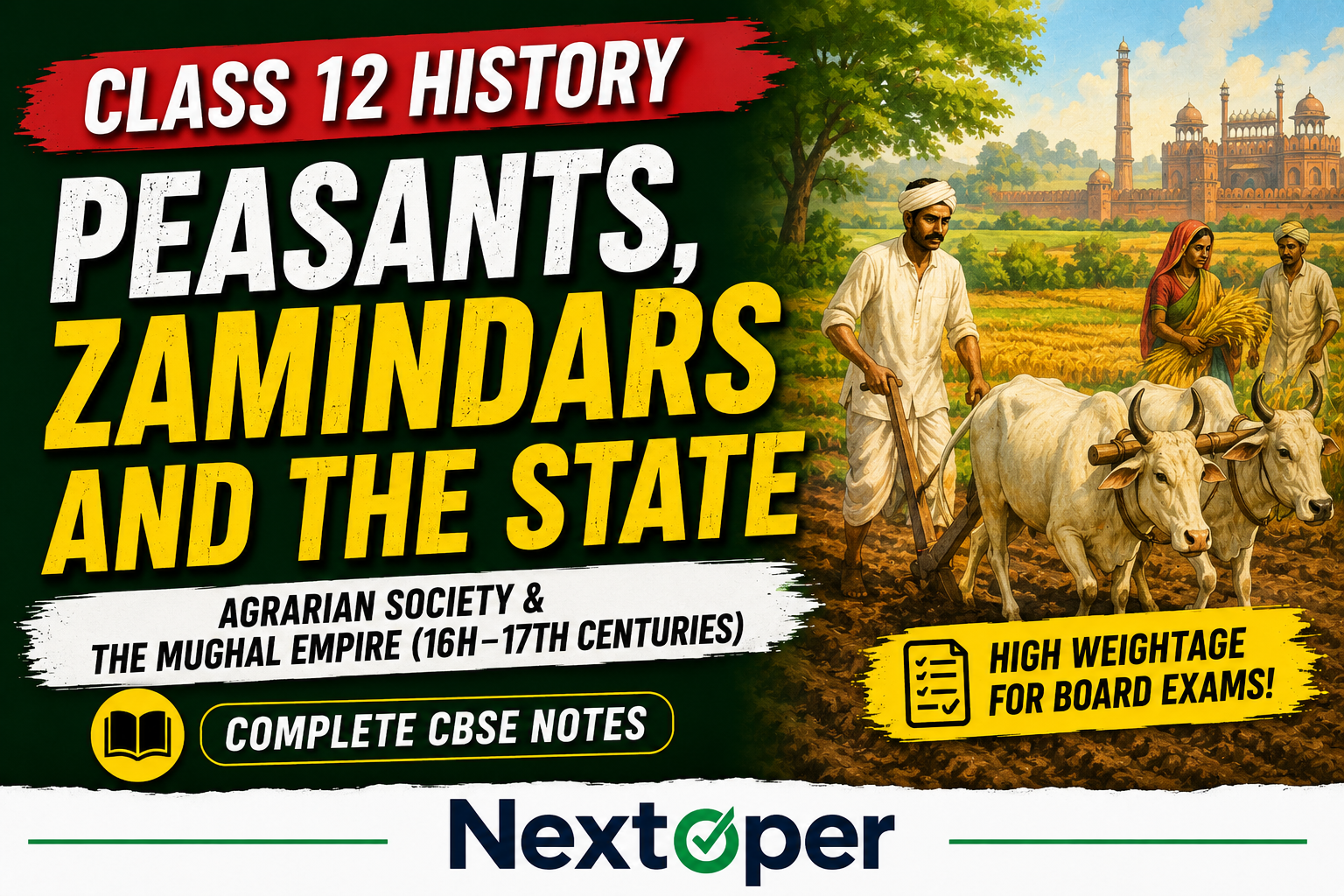
Class 12 Peasants Zamindars and State Detailed Notes
| Field | Detail |
|---|---|
| Chapter | Theme 8 – Peasants, Zamindars and the State: Agrarian Society and the Mughal Empire (c. 16th–17th Centuries) |
| Subject | History – Themes in Indian History Part II |
| Class | 12 |
| Board | CBSE |
| Difficulty | Important / High Weightage |
Peasants Zamindars and the State Class 12 CBSE reconstructs agrarian society in Mughal India during the sixteenth and seventeenth centuries, a period when roughly 85 per cent of the population lived in villages. The chapter examines how three groups — the cultivating peasantry, the landowning zamindars, and the revenue-extracting Mughal state — competed, cooperated, and sometimes collided over the control of agricultural produce. It also covers the role of forests, tribes, women, and the silver economy in shaping rural life.
From a board exam standpoint, this is one of the highest-weightage themes in Class 12 History. Expect source-based questions from the Ain-i Akbari, long-answer questions on the role of zamindars or the land revenue system, and short questions on terms like jins-i kamil, khud-kashta, and pahi-kashta. The chapter directly supports essay-type answers that require evidence from NCERT sources.
The themes here connect directly to India’s present. The abolition of the zamindari system after Independence, the ongoing debates over Minimum Support Price for farmers, and the agrarian distress in states like Maharashtra and Punjab all trace their roots to the structures of Mughal agrarian society that this chapter analyses. Understanding the jama-hasil distinction — assessed revenue versus actually collected revenue — makes a lot of modern policy debates about farmer debt more legible.
What’s in These Notes?
- Peasants, Zamindars and the State
- Important Terms / Glossary
- Timeline of Mughal Empire Landmarks
- Key Personalities
- Zamindars vs Peasants – Role Comparison
- Important Questions – Peasants Zamindars and State Class 12 CBSE
- FAQ – Peasants Zamindars and State Class 12 CBSE
- Quick Revision – Key Points to Remember
- Explore More CBSE Notes on Nextoper
- Trusted Resources for Deeper Study
Core Bullet Notes – Peasants, Zamindars and the State
1. Peasants and Agricultural Production
- About 85 per cent of India’s population lived in villages during the 16th–17th centuries; the village was the basic unit of agrarian society.
- Peasants in Indo-Persian sources were called raiyat (plural: riaya) or muzarian; other terms used were kisan or asami.
- Two categories of peasants: khud-kashta (resident cultivators who lived in the village where they held land) and pahi-kashta (non-resident cultivators who farmed land in other villages on a contractual basis, either by choice or economic compulsion).
- Average peasant in north India possessed no more than a pair of bullocks and two ploughs. In Gujarat, 6 acres was considered affluent; in Bengal, 5 acres was the average upper limit; 10 acres made one a rich asami.
- Agriculture was organised around two seasonal cycles: the kharif (autumn harvest) and the rabi (spring harvest), meaning most regions produced a minimum of two crops per year (do-fasla).
- The Ain records that Agra province produced 39 varieties of crops and Delhi produced 43 over two seasons; Bengal alone produced 50 varieties of rice.
- Crops such as cotton and sugarcane were termed jins-i kamil (literally “perfect crops”) — cash crops that maximised revenue and were actively encouraged by the Mughal state.
- New crops introduced in the 17th century via global trade routes: maize (from Africa and Spain), tomatoes, potatoes, chillies (from the New World), pineapple, and papaya.
- Irrigation technology included the Persian wheel, wooden ploughs with iron tips, drills pulled by oxen, and state-sponsored canals — the shahnahr in Punjab being a notable example from Shah Jahan’s reign.
2. The Village Community
- Three constituents of the village community: the cultivators, the panchayat, and the village headman (muqaddam or mandal).
- Caste deeply shaped rural society: lower-caste groups like the halalkhoran (scavengers in Muslim communities) and the mallahzadas in Bihar were treated comparably to slaves.
- The village panchayat was an assembly of elders with hereditary rights, representing various castes — though landless labourers rarely had representation.
- The headman’s primary function was to supervise the preparation of village accounts, assisted by the accountant or patwari. Headmen could be dismissed if they lost the confidence of village elders.
- Panchayat funds were used to entertain revenue officials, finance community welfare (flood relief, canal digging), and for other collective expenses.
- Panchayats had authority to levy fines and expel members from the community — expulsion meant loss of profession and outcaste status, a severe deterrent.
- Each caste also had its own jati panchayat, which settled civil disputes, mediated land claims, and regulated marriage practices.
- Petitions from Rajasthan and Maharashtra record lower-caste villagers complaining about extortionate taxation and begar (unpaid forced labour) imposed by elite groups.
- Artisans could make up as much as 25 per cent of village households; they were compensated by harvest shares, land allotments, or the jajmani system of reciprocal exchange.
3. Women in Agrarian Society
- Men and women worked side by side in the fields: men tilled and ploughed; women sowed, weeded, threshed, and winnowed.
- Women’s artisanal labour — spinning yarn, kneading clay for pottery, embroidery — was indispensable; the more commercialised the product, the greater the demand on female labour.
- High mortality rates among women (from malnutrition, frequent pregnancies, and childbirth deaths) led to bride-price payments in many rural communities rather than dowry, and remarriage was socially accepted.
- Women could inherit and own property: Hindu and Muslim women in Punjab and Bengal inherited zamindaris and actively participated in the rural land market as sellers and mortgagers.
- One of the largest 18th-century zamindaris — that of Rajshahi in Bengal — was headed by a woman.
- Despite economic contributions, women were subject to strict patriarchal control; in petitions to panchayats, women’s names were typically excluded — they were referred to as “wife of” or “mother of” the male head.
4. Forests and Tribes
- Forests covered an estimated 40 per cent of India’s territory in this period; forest dwellers were called jangli in contemporary texts — a term describing livelihood, not a mark of absence of civilisation.
- Forest dwellers’ lives were season-specific: among the Bhils, spring was for collecting forest produce, summer for fishing, monsoon for cultivation, and autumn/winter for hunting.
- Forest products — honey, beeswax, and gum lac — were major items of domestic and overseas trade. Gum lac became a significant export commodity by the 17th century.
- The peshkash (tribute) levied by the Mughal state from forest communities often included elephants for the imperial army.
- Many tribal chieftains gradually became zamindars or kings, building armies from their lineage groups; the Ahom kings of Assam used a system of paiks — men obliged to give military service in exchange for land grants.
- Sufi saints (pirs) contributed to the slow spread of Islam into forested and newly colonised agricultural zones.
5. The Zamindars
- Zamindars were landed proprietors who lived off agriculture without directly participating in cultivation; they occupied the apex of the social pyramid in Mughal rural society.
- Zamindars held milkiyat lands (personal property) cultivated by hired or servile labour, which they could sell, bequeath, or mortgage at will.
- They collected revenue on behalf of the state (khidmat) for which they were financially compensated, and maintained armed contingents with cavalry, artillery, and fortresses (qilachas).
- The combined military strength of zamindars in Mughal India, per the Ain, was 384,558 cavalry, 4,277,057 infantry, 1,863 elephants, 4,260 cannons, and 4,500 boats — a parallel army rivalling the state.
- Zamindars spearheaded agricultural colonisation by providing cultivators with cash loans and tools, and established local markets (haats) — accelerating monetisation of the countryside.
- Despite being an exploitative class, zamindars had relationships of reciprocity and paternalism with peasants; bhakti saints who condemned caste oppression rarely identified zamindars as exploiters — it was usually the revenue official who was the object of peasant anger.
- In many 17th-century agrarian uprisings in north India, zamindars and peasants united against the state.
6. Land Revenue System
- Land revenue was the economic backbone of the Mughal Empire; the diwan supervised the entire fiscal apparatus.
- Land revenue had two stages: assessment (jama) and actual collection (hasil). The gap between the two was often significant.
- Akbar classified land into four categories: polaj (continuously cultivated), parauti (fallow for recovery), chachar (fallow 3–4 years), and banjar (uncultivated for 5+ years).
- Revenue was ideally collected in cash (naqdi), but the amil-guzar (revenue collector) was instructed to also accept payment in kind (kankut, batai, khet-batai, lang batai).
- In 1665, Aurangzeb instructed revenue officials to compile annual village-by-village records of cultivators, keeping in view both government interests and peasant welfare.
7. The Flow of Silver
- The Mughal Empire coexisted with the Ming (China), Safavid (Iran), and Ottoman (Turkey) empires — all of which stabilised overland trade routes from China to the Mediterranean.
- Voyages of discovery opened the New World, massively expanding Asian trade with Europe and driving enormous inflows of silver bullion into India as payment for Indian goods.
- India lacked natural silver deposits, so this inflow was critical; it resulted in a stable supply of the silver rupya and unprecedented expansion of minting and monetary circulation from the 16th to 18th centuries.
- Italian traveller Giovanni Careri (c. 1690) documented how silver from the Americas and Japan ultimately flowed into India through multiple trade routes.
8. The Ain-i Akbari
- The Ain-i Akbari was authored by Abu’l Fazl, court historian to Akbar, and completed in 1598 after five revisions; it formed the third book of the Akbar Nama.
- Organised as a compendium of imperial regulations and a gazetteer of the empire, the Ain contains five daftars (books): manzil-abadi (imperial household), sipah-abadi (military and civil administration), mulk-abadi (fiscal details and provincial accounts), and two books on religious and cultural traditions.
- The Ain is the primary source for agrarian history of this period, but it represents “a view from the top” — Akbar’s centralised perspective, not the peasant’s voice.
- Limitations of the Ain: numerous arithmetic errors, uneven data collection across provinces (Bengal and Orissa lack zamindar caste data), and price/wage data largely limited to the Agra region.
- Supplementary sources include revenue records from Gujarat, Maharashtra, and Rajasthan, and East India Company records from eastern India.
Important Terms / Glossary
These terms appear in source-based and short-answer questions year after year. Know the literal meaning and the historical context of each.
| Term | Meaning |
|---|---|
| Raiyat / Riaya | The most common Indo-Persian term for a peasant cultivator in Mughal sources |
| Khud-kashta | Resident peasant who cultivated land in the village where they lived |
| Pahi-kashta | Non-resident peasant who cultivated land in a village other than their own, on a contractual basis |
| Jins-i kamil | Literally “perfect crops” — cash crops like cotton and sugarcane that brought maximum revenue; encouraged by the Mughal state |
| Do-fasla | A minimum of two harvests per year (kharif + rabi); the norm in most Mughal provinces |
| Muqaddam / Mandal | Village headman who supervised accounts and maintained social order; chosen by consensus and ratified by the zamindar |
| Patwari | Village accountant who assisted the headman in preparing land and revenue records |
| Milkiyat | Personal property lands held by a zamindar, cultivated for private use and freely transferable |
| Jama | The revenue amount assessed by the state — the target figure |
| Hasil | The revenue amount actually collected — often less than the jama |
| Begar | Unpaid or forced labour extracted from peasants or lower-caste groups by zamindars or state officials |
| Peshkash | A form of tribute collected by the Mughal state, including elephants, from forest communities |
| Qilacha | The fortress or fortification maintained by zamindars, a symbol of their military power |
| Miras / Watan | Hereditary land allotments given to artisans in Maharashtra as compensation for services rendered to the village |
| Ain-i Akbari | A detailed administrative and statistical compendium of the Mughal Empire authored by Abu’l Fazl in 1598; the primary source for this chapter |
Timeline of Mughal Empire Landmarks
| Year | Event |
|---|---|
| 1526 | Babur defeats Ibrahim Lodi at Panipat; becomes the first Mughal emperor |
| 1530–40 | First phase of Humayun’s reign |
| 1540–55 | Humayun defeated by Sher Shah; goes into exile at the Safavid court |
| 1555–56 | Humayun regains lost territories |
| 1556–1605 | Reign of Akbar — land classification system, Ain-i Akbari compiled |
| 1598 | Abu’l Fazl completes the Ain-i Akbari after five revisions |
| 1604 | Tobacco first encountered by Akbar and his nobles; Jahangir later bans it (ineffectively) |
| 1605–27 | Reign of Jahangir |
| 1628–58 | Reign of Shah Jahan — shahnahr canal in Punjab repaired; hunting expeditions documented |
| 1658–1707 | Reign of Aurangzeb — in 1665, orders detailed village-by-village cultivation records |
| c. 1690 | Italian traveller Giovanni Careri passes through India; documents flow of global silver into Mughal economy |
| 1739 | Nadir Shah invades India and sacks Delhi |
| 1765 | Diwani of Bengal transferred to the East India Company |
| 1857 | Last Mughal ruler Bahadur Shah II deposed; exiled to Rangoon |
Key Personalities
| Name | Role / Contribution |
|---|---|
| Akbar | Mughal emperor (1556–1605) who commissioned the Ain-i Akbari and developed the land classification system (polaj, parauti, chachar, banjar) to systematise revenue assessment across the empire |
| Abu’l Fazl | Akbar’s court historian and author of the Ain-i Akbari; compiled meticulous administrative, fiscal, and social data about the empire over five revisions completed in 1598 |
| Babur | First Mughal emperor; his memoir, the Babur Nama, contains valuable observations on irrigation technology and the mobility of peasant settlements in northern India |
| Shah Jahan | Mughal emperor (1628–58) during whose reign the state-sponsored shahnahr canal in Punjab was repaired — an example of imperial support for agricultural irrigation |
| Aurangzeb | Mughal emperor (1658–1707) who in 1665 ordered revenue officials to compile annual village-wise records of cultivators, balancing government fiscal interest with peasant welfare |
| Giovanni Careri | Italian traveller who passed through India c. 1690 and provided a graphic account of how global silver flows reached Mughal India, documenting the scale of 17th-century trade |
Zamindars vs Peasants – Role Comparison
| Dimension | Zamindars | Peasants (Raiyat) |
|---|---|---|
| Relation to land | Held milkiyat (personal property) lands; did not cultivate directly | Cultivated land individually; owned peasant plots bought and sold like any property |
| Source of power | Caste status, military resources (qilachas, armed contingents), revenue-collecting rights | Labour, mobility, and collective action (petitions, desertion of villages) |
| Role in revenue | Collected revenue on behalf of state; compensated financially for this service | Paid land revenue as jama; often harassed when hasil fell short of assessment |
| Social status | Apex of the rural social pyramid; mostly upper-caste (Brahman-Rajput) but also intermediate castes and Muslim zamindars | Highly heterogeneous; ranged from prosperous asamis to landless majurs (agricultural labourers) |
| Relationship with each other | Often exploitative; also provided credit, tools, and land to cultivators — elements of paternalism and reciprocity | Turned to zamindars for credit; sometimes united with them against state revenue demands |
| Form of resistance | Armed uprisings; mobilising lineage armies against state | Petitions to panchayat; deserting villages to exploit labour shortage as leverage |
Important Questions – Peasants Zamindars and State Class 12
1 Mark Question
Q: What does the term “jama” mean in the context of the Mughal land revenue system?
A: Jama refers to the amount of land revenue assessed (the target figure), as distinct from hasil, the amount actually collected.
3 Mark Questions
Q: What were the two types of peasants identified in 17th-century Mughal sources, and how did they differ?
Mughal sources of the 17th century classified peasants into two categories: khud-kashta and pahi-kashta. Khud-kashta were resident cultivators who lived in and farmed the village where they held their land — they had stable roots and were easier for the state to track for revenue. Pahi-kashta were non-resident cultivators who farmed land in a village other than their own, doing so on a contractual basis. They moved either by choice — for example, when revenue terms in another village were more favourable — or by compulsion, such as following a famine. The mobility of pahi-kashta made them a difficult group for the revenue apparatus to pin down and tax reliably.
Q: What were the main functions of the village panchayat in Mughal agrarian society?
The village panchayat performed several critical functions in Mughal rural society. First, it supervised the preparation of village accounts through the headman and patwari, making it central to the revenue process. Second, it managed a common fund — drawn from individual contributions — to pay for entertaining revenue officials, financing flood relief, and building canals that individual peasants could not afford. Third, it enforced social order by maintaining caste boundaries: in eastern India, all marriages had to be held in the presence of the mandal. Fourth, the panchayat could levy fines and expel members from the community — expulsion was reserved for serious violations and was often time-limited, as it deprived a person of livelihood and community status. Separately, each caste or jati maintained its own jati panchayat for civil disputes, land claims, and marriage regulation.
5 Mark Questions
Q: Examine the role played by zamindars in Mughal India, highlighting both their exploitative and constructive aspects.
Zamindars were landed proprietors who occupied the narrow apex of the social pyramid in Mughal rural society. They held milkiyat lands as personal property, collected revenue on behalf of the state for a financial commission, and maintained armed contingents — the Ain records their combined military strength at over 384,000 cavalry and four million infantry, making them a parallel army within the empire. Their power derived from a combination of high caste status, military resources, and hereditary control over revenue-collecting rights. Zamindari consolidation happened through colonisation of new lands, transfer of rights, and outright purchase — mechanisms that also allowed some lower-caste groups to enter the zamindar class.
That said, the zamindar-peasant relationship was not simply one of exploitation. Zamindars extended credit to cultivators, provided the means of cultivation, and established local markets (haats) that integrated villages into wider trade networks. The buying and selling of zamindaris accelerated monetisation of the countryside. Bhakti saints who eloquently condemned caste-based oppression rarely named zamindars as the primary oppressors — it was usually the revenue official (amil-guzar) who drew peasant anger. Most tellingly, in several 17th-century agrarian uprisings in north India, zamindars and peasants fought together against the Mughal state’s revenue demands. This suggests the relationship contained elements of reciprocity and paternalism alongside exploitation, and that zamindars occupied an ambiguous position as both oppressors of those below them and local protectors against an extractive imperial machine.
Q: Assess the Ain-i Akbari as a historical source for the study of agrarian relations in Mughal India. What are its strengths and limitations?
The Ain-i Akbari, completed in 1598 by Abu’l Fazl after five revisions, stands as the single most important source for understanding agrarian society in Mughal India. As the third book of the Akbar Nama, it functions simultaneously as an administrative compendium and a statistical gazetteer of the empire. Its mulk-abadi section provides detailed fiscal data, land classification, measured areas, assessed revenue (jama), and the caste composition of zamindars across the empire’s provinces. The Ain also records data on crop varieties — Agra produced 39, Delhi 43, Bengal 50 varieties of rice alone — and gives detailed price and wage lists centred on the imperial capital of Agra. As an administrative exercise unprecedented in medieval Indian historiography, it shifted the focus from political events (wars, dynasties) to the country’s people, productions, and economic structures.
Its limitations, however, are equally significant. The Ain remains a view from the top — it was commissioned by Akbar to present his empire as harmoniously governed, which means peasant voices and grievances are filtered through the eyes of a court loyal to the emperor. Data collection was uneven: detailed zamindar caste information is available for most provinces but absent for Bengal and Orissa. Arithmetic errors, likely introduced by scribal assistants, have been detected, though these are generally minor. Most importantly, price and wage data are derived primarily from the Agra region and cannot be generalised to the rest of the empire. Historians supplement the Ain with regional revenue records from Gujarat, Maharashtra, and Rajasthan, and with East India Company records from Bengal, to build a more complete picture of agrarian relations across the subcontinent.
FAQ – Peasants Zamindars and State Class 12 CBSE
Quick Revision – Key Points to Remember
- About 85 per cent of India’s population lived in villages in the 16th–17th centuries; the primary NCERT source for this period is the Ain-i Akbari authored by Abu’l Fazl in 1598.
- Peasants were called raiyat or muzarian; two types — khud-kashta (resident) and pahi-kashta (non-resident, contractual) — appear in almost every board paper.
- Jins-i kamil (“perfect crops”) like cotton and sugarcane were encouraged by the Mughal state because they generated maximum revenue; do-fasla (two harvests per year) was the norm.
- The village panchayat enforced social order, managed collective funds, levied fines, and could expel members — a form of local governance with real teeth.
- Zamindars held milkiyat lands, collected revenue for the state (khidmat), and maintained private armies — their combined military strength per the Ain exceeded four million infantry.
- Women’s labour was central to agrarian production: sowing, weeding, threshing, spinning, pottery, and embroidery all depended on female labour; in Punjab and Bengal, women including widows participated actively in the land market.
- Jama vs hasil: jama = revenue assessed; hasil = revenue actually collected. The gap between them was a structural feature of the Mughal fiscal system — the state always aimed for more than it could collect.
- Zamindars vs revenue officials: zamindars were not typically the target of peasant anger — the amil-guzar (revenue collector) was. In many uprisings, zamindars supported peasants against the state.
- Common board exam mistake — do not call the Ain-i Akbari an unbiased source. Always note it is “a view from the top,” written by a court historian to justify Akbar’s rule.
- The silver rupya remained stable from the 16th to 18th centuries because global trade brought massive bullion inflows into India — this was the foundation of cash-based revenue collection across the Mughal Empire.
Explore More CBSE Notes on Nextoper
Class 12 History has 15 themes — these linked notes follow the same board-exam-ready structure.
- Class 12 CBSE Notes Thinkers, Beliefs and Buildings Cultural Developments Notes
- Class 12 CBSE Notes Through the Eyes of Travellers Perceptions of Society Notes
- Class 12 CBSE Bhakti-Sufi Traditions Changes in Religious Beliefs and Devotional Texts Notes
Trusted Resources for Deeper Study
- NCERT Official Website (ncert.nic.in) — The full PDF of Themes in Indian History Part II, including Theme 8, is freely downloadable from the official NCERT portal; every source excerpt (Babur Nama passages, Aurangzeb’s 1665 order, Giovanni Careri’s account) is reproduced there exactly as it appears in the printed textbook. Students preparing source-based questions should read these excerpts directly rather than relying on paraphrases.
- CBSE Academic (cbseacademic.nic.in) — The CBSE academic portal publishes the official sample papers and marking schemes for Class 12 History, which reveal exactly how many marks are allocated to source analysis versus essay questions from this theme, and what keywords the examiner expects to see. Students writing board exams should download the latest sample paper and compare their practice answers against the official scheme before the exam.
- Khan Academy — Khan Academy’s world history modules on the Mughal Empire and South Asian agrarian economies provide useful context for understanding how Mughal land revenue systems compared to other early modern empires like the Ottoman and Safavid — a comparison the NCERT itself draws in the section on the flow of silver. Students who want a broader global perspective before writing analytical 5-mark answers will find the platform’s video essays helpful.



This is an incredibly thorough breakdown of the Mughal agrarian structure, especially the clear distinction between khud-kashta and pahi-kashta farmers which often confuses students. I particularly appreciate how you connected these historical revenue controversies to modern issues like MSP debates and agrarian distress in states like Punjab, making the chapter feel urgently relevant.
I liked how the notes connected Mughal agrarian systems with present-day issues like MSP debates and agrarian distress, because it makes the chapter feel much more relevant than just an exam topic. The explanation of terms like khud-kashta and pahi-kashta alongside the role of the Ain-i Akbari also seems really useful for students preparing source-based and long-answer questions.
Pingback: NCERT Class 12 History Chapter 9 Notes Kings and Chronicles Notes 2025-26 | Nextoper Notes - Nextoper
If you are unsure about your exact facial structure, taking a free face shape check online provides an easy breakdown of your feature boundaries.
Developing accessible audio features for digital applications usually relies on a natural voice synthesis engine capable of processing text strings into fluid spoken vocal lines.
Summarizing lengthy internal documents requires focusing on key decisions and metrics. Access document synthesis and summarization agent skills for workflows designed to extract core insights cleanly.
Evaluating a web tool through a free trial for removing text from images can help inspect editing capabilities. This approach is intended to assist with testing typo removal on personal pictures.
If you are searching for an online tool for midi to wav conversion, this browser app provides an effective platform for turning sequence files into uncompressed sound.
E-commerce brands employing an ai visual generator for commercial product shots can generate uniform visual presentation across all promotional and listing collateral.
Consulting vehicle entry steps when keys are locked inside offers stranded motorists practical knowledge on handling lockouts calmly while preserving vehicle door alignments and electronic wiring.
Preparing detailed canvas layouts for resin diamond art is seamless when utilizing an online diamond painting grid designer to format symbol grids accurately.
Digital artists seeking automated help with flower compositions should look into ai software for bouquet designing to generate unique botanical images for creative projects.
Workflow needs vary between casual webcomic readers and dedicated fan translation groups. Reviewing recommended ai manga translation software 2026 provides a clear overview of platforms designed to streamline graphic speech balloon localization.
Integrating modern image to video motion synthesis into visual production workflows speeds up scene generation by accurately predicting natural movement patterns across static graphics.
With a wan 3 AI photo animation tool, social media managers can rapidly convert portrait photography into engaging video clips tailored for modern mobile feeds.
When text renders strangely across different platforms, concealed characters are usually responsible. You can try this free zero width space cleanup tool to clean up non-printable symbols quickly.
Being able to view public m3u playlists in browser makes checking channel availability simple when accessing your media collection from different public terminals.
Keeping track of active journalistic broadcasts across different languages is simplified by referring to a curated list of live news channels rather than performing repeated manual searches.
Pasting structured notes into simple chat applications often renders broken list items and headers. Learning to strip special markdown characters from copy paste maintains clean readability across channels.
This tutorial covers several handy tips, especially regarding the tiktok story viewer omar Story Viewer (story-viewer.online) setup discussed earlier. Testing everything through Story Viewer (story-viewer.online) worked smoothly without requiring any extra browser extensions.