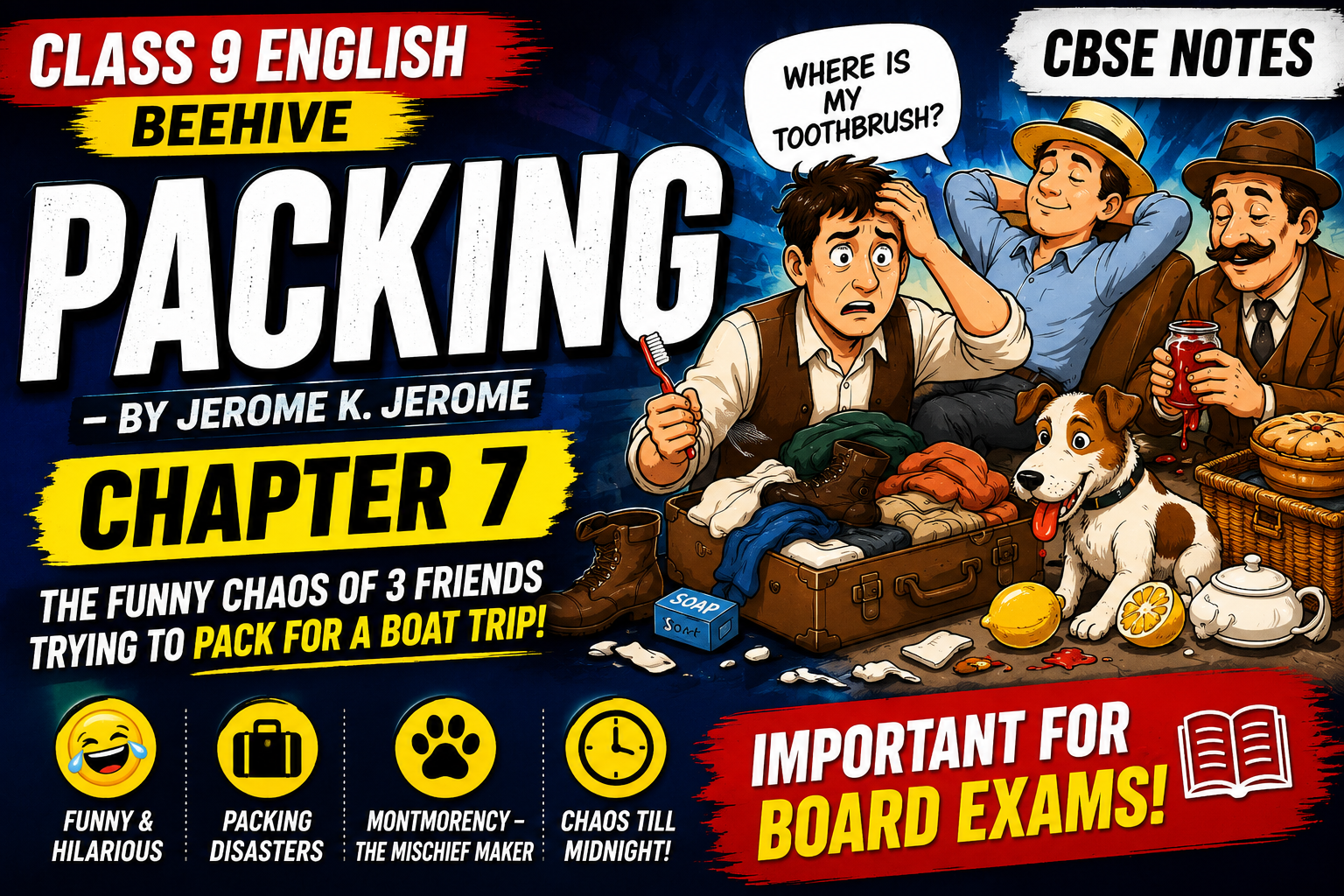
Packing Class 9 CBSE Notes – Complete and Free Study Guide
| Field | Detail |
|---|---|
| Chapter | Chapter 7 – Packing |
| Subject | English (Beehive) |
| Class | 9 |
| Board | CBSE |
| Difficulty | Moderate – Important for Board Exams |
Packing Class 9 CBSE is a humorous prose extract from Jerome K. Jerome’s classic novel Three Men in a Boat, and it covers the chaotic events that unfold when three friends — Jerome, George, and Harris — attempt to pack their luggage for a boat trip. The chapter is full of comic situations, exaggerated characters, and self-deprecating humour that makes it one of the most enjoyable chapters in the NCERT Beehive textbook.
Board exams regularly pull questions from this chapter — from short-answer questions about character traits to long-answer questions on humour and irony. Expect at least one 3-mark or 5-mark question on what the narrator’s real intention was, how George and Harris packed, or what role Montmorency the dog played. Understanding the narrative tone and irony in this chapter is essential for scoring full marks.
The spirit of this chapter — someone confidently volunteering for a job and then making a mess of it — is something every student has experienced before a school project or exam. The comedy works because it is deeply human. Indian readers, familiar with the chaos of packing for a summer trip to a relative’s house, will find Jerome’s toothbrush anxiety very relatable.
What’s in These Notes?
- Core Chapter Notes — Packing Class 9 CBSE
- Important Terms / Glossary
- Sequence of Events — Timeline
- Key Characters
- Humour vs Reality — Comparison Table
- Important Questions — Packing Class 9 CBSE
- FAQ — Packing Class 9 CBSE
- Quick Revision — Key Points to Remember
- Explore More CBSE Notes on Nextoper
- Trusted Resources for Deeper Study
Core Chapter Notes — Packing Class 9 CBSE
Jerome’s Packing — Paragraphs 1–7
- Jerome volunteers to pack, claiming he is the best packer alive — a classic example of self-importance and overconfidence.
- George and Harris accept too quickly, sitting back comfortably while Jerome does all the work. This irritates Jerome because he wanted to supervise, not actually pack alone.
- Jerome’s real plan was to “boss the job” — direct George and Harris while they did the actual packing. Their willingness to let him do everything single-handedly defeats the whole plan. Think of it like a group project where one person says “I’ll handle it” expecting others to ask for help, only for everyone else to take a nap.
- Jerome packs the bag, sits on it, straps it shut — and Harris immediately asks about the boots. Jerome had forgotten them entirely.
- Jerome reopens the bag to pack the boots, then panics about his toothbrush. He unpacks everything searching for it, finds it inside a boot, and repacks the whole bag.
- He packs the toothbrush before using it in the morning — a recurring problem he describes as a travelling misery. This comic aside is one of the most memorable passages in the chapter.
- George then asks whether the soap was packed. Jerome, exhausted and frustrated, slams the bag shut — only to realise he has packed his spectacles inside it and must reopen it again.
- The main bag is finally shut at 10:05 p.m., but the food hampers still remain.
George and Harris Pack the Hampers
- George and Harris take over the hampers (large food baskets) with a confident, show-off attitude — clearly intending to prove they can do it better than Jerome.
- Harris is described as the worst packer in the world, except for George (meaning both are terrible).
- They immediately break a cup — their opening achievement.
- Harris packs strawberry jam on top of a tomato, squashing it flat; the tomato had to be removed with a teaspoon.
- George treads on the butter — steps right on it with his foot.
- The narrator says nothing but sits and watches, which irritates George and Harris far more than any criticism could. This is a masterful comic device: silence as mockery.
- They pack pies at the bottom and put heavy things on top, smashing the pies.
- They spill salt over everything.
- The butter episode is extended comedy: George scrapes it off his slipper, tries to put it in a kettle (it won’t fit), scrapes it onto a chair, and Harris sits on it. The butter sticks to Harris and they spend several minutes trying to find it, not realising it is stuck to him.
- Packing finally finishes at 12:50 a.m. — nearly two hours after Jerome finished his bag.
Montmorency’s Role
- Montmorency is Jerome’s fox terrier who joins the chaos enthusiastically.
- His stated ambition in life is to get in the way and be scolded. He considers his day wasted if he hasn’t made someone trip over him and curse for at least an hour.
- He sits on items the moment they need to be packed, pushes his cold wet nose into anyone’s hand, puts his leg into the jam, chases the teaspoons, and treats the lemons like rats.
- He gets into the hamper and kills three lemons before Harris can reach him with a frying-pan.
- Harris accuses Jerome of encouraging Montmorency. Jerome denies it, saying a dog like that runs entirely on natural troublemaking instinct — no encouragement needed.
The Night Ends
- Harris is sleeping over, so they toss coins for who sleeps where.
- There is a small argument about the wake-up time — Harris wants 7 a.m., Jerome wants 6 a.m. They split the difference and agree on 6:30 a.m.
- They ask George to wake them at 6:30 — but George had already fallen asleep mid-conversation.
- As a prank, they place the bathtub where George will stumble into it when he gets up, and go to bed.
Important Terms / Glossary
| Term | Meaning |
|---|---|
| Pride myself on | To feel proud of one’s own ability in something |
| Uncanny | Strange or difficult to explain; mysterious |
| Potter about | To move around doing small, unimportant things |
| Rummaged | Searched through things in a hurried, careless way |
| Every mortal thing | Every single ordinary thing |
| Haunts | Here: repeatedly troubles or bothers someone |
| Hampers | Large baskets, typically used for carrying food |
| Trod on | Stepped on something accidentally |
| Conceit | An exaggerated pride in oneself |
| Be sworn at | To be scolded with strong or angry words |
| Loll | To sit or lie in a relaxed, lazy manner |
| Superintend | To supervise or manage work |
| Perspiration | Sweat; used here for anxious sweating |
| Split the difference | To agree on a middle point between two options |
| Reflection | A thought or quiet consideration |
Sequence of Events — Timeline
| Time / Point | Event |
|---|---|
| Evening | Jerome volunteers to pack; George and Harris sit down instead of helping |
| During packing | Jerome forgets boots after shutting the bag |
| Shortly after | Jerome panics about toothbrush; unpacks everything |
| After repacking | Finds toothbrush inside a boot |
| Same session | Repacks; slams bag shut; realises spectacles are inside; reopens again |
| 10:05 p.m. | Main travelling bag finally closed and strapped |
| After 10:05 p.m. | George and Harris take over the food hampers |
| Hamper packing | Break a cup; squash tomato under jam; George treads on butter; butter sticks to Harris |
| 12:50 a.m. | All packing completed |
| Before bed | Argument over wake-up time; agree on 6:30 a.m. |
| Going to bed | Discover George has fallen asleep; place bathtub as a prank |
Key Characters
| Character | Role / Key Trait |
|---|---|
| Jerome (the narrator / “I”) | Overconfident, self-important; volunteers to pack but forgets boots and toothbrush; uses irony and humour to describe his own flaws |
| George | Lazy; takes the easy-chair while Jerome works; worst packer according to Jerome; falls asleep before the conversation ends |
| Harris | Also lazy initially; takes over hampers confidently but makes a mess; described as the worst packer in the world (except George) |
| Montmorency | Jerome’s fox terrier; the comedic mascot; lives to cause chaos; treats lemons as prey and gets into the hamper |
Humour vs Reality — Comparison Table
| What Jerome Thinks | What Actually Happens |
|---|---|
| He is the best packer alive | He forgets boots, loses his toothbrush, packs his spectacles |
| George and Harris should work under his direction | They sit back and enjoy doing nothing |
| He finishes packing confidently | He reopens the bag three times |
| George and Harris will do the hampers badly | They do — they break a cup, squash a tomato, lose the butter |
| Montmorency is encouraged to cause trouble | Jerome denies it; says it is pure natural instinct |
| A simple packing job before bed | Takes the whole evening; ends past midnight |
Important Questions — Packing Class 9 CBSE
1 Mark
Q: Where did Jerome finally find his toothbrush? A: Jerome found his toothbrush inside one of his boots.
3 Marks
Q: Why did Jerome volunteer to pack, and what was his real intention?
Jerome volunteered to pack because he considered himself the best packer in the world and wanted to prove it. His real intention, however, was not to do the actual physical work himself. He wanted to supervise the packing — directing George and Harris while they did the labour, occasionally pushing them aside with remarks like “Here, let me do it” to show off his superiority. When George and Harris simply sat back and let him do everything alone, his plan backfired completely, and he was left doing all the work himself, which irritated him greatly.
Q: How did George and Harris manage the butter during their packing? What does this incident reveal about them?
The butter became a comic disaster in George and Harris’s hands. George stepped on it first, then scraped it off his slipper and tried to put it in the kettle — it wouldn’t fit. They then placed it on a chair, Harris sat on it, and it stuck to him. They spent several minutes searching for it around the room before George finally spotted it attached to Harris. They eventually packed it in the teapot. This incident reveals that George and Harris are careless, disorganised packers who work in a state of nervous confusion, particularly when the narrator watches them silently from the edge of the table.
5 Marks
Q: How does Jerome K. Jerome use humour in the chapter “Packing”? Describe at least three humorous situations with their effect.
Jerome K. Jerome builds his humour in “Packing” through a combination of comic situations, self-mockery, and irony. The first source of humour is Jerome’s own overconfidence. He announces himself as the world’s greatest packer, volunteers grandly for the task, and then forgets the boots, panics about his toothbrush, finds it inside a boot, and later discovers he has packed his spectacles. The gap between his self-image and his actual performance is deeply funny.
The second major comic situation involves the toothbrush. Jerome describes it as something that “haunts” him while travelling — he dreams about it, wakes up sweating, unpacks it, packs it before using it, has to unpack again, and finally carries it to the station wrapped in his handkerchief. This extended aside turns a small detail into an absurd portrait of a man completely defeated by a toothbrush.
The third source of humour is the butter episode, where George and Harris spend several frantic minutes looking for a piece of butter that is stuck to Harris’s clothes. Neither of them thinks to check Harris himself. The dialogue — “I’ll take my oath I put it down on that chair” — adds to the comedy because both men are completely baffled by something obvious to the reader.
Finally, Montmorency the dog adds physical comedy by getting into the hamper, killing three lemons he mistakes for rats, and generally treating the whole packing session as his personal entertainment. The cumulative effect is a portrait of three men and a dog who collectively cannot manage a task that should take an hour, and find themselves awake past midnight with a bathtub prank to finish the night.
Q: Compare Jerome as a packer with George and Harris. Who, in your opinion, is the worst packer, and why?
All three men pack badly, but they fail in different ways. Jerome’s failures are rooted in overconfidence and anxiety. He prides himself on being an expert, yet forgets boots, loses his toothbrush (finding it inside a boot), and packs his spectacles by accident. He reopens the main bag three times. His incompetence is ironic precisely because he volunteered as the expert.
George and Harris fail in a more chaotic, careless way. They begin with visible confidence, intending to impress Jerome, but immediately break a cup. Harris packs jam directly onto a tomato and squashes it. George treads on the butter. They pack heavy items on top of fragile pies, smash everything, spill salt over the food, and then lose a piece of butter that turns out to be stuck to Harris himself. Their packing takes from after 10 p.m. to 12:50 a.m.
In terms of pure damage caused — broken items, squashed food, wasted time — George and Harris are worse packers. Jerome at least produces a properly closed bag by 10:05 p.m. However, Jerome’s brand of incompetence is more entertaining because the gap between his self-image and his performance is the central comic irony of the whole chapter.
FAQ — Packing Class 9 CBSE
Q: Why does the toothbrush episode take up so much of the chapter? A: Jerome uses the toothbrush as a symbol of anxiety and disorganisation. The whole point is not the toothbrush itself but the way it reveals Jerome’s chaotic relationship with packing. He dreams about it, wakes up sweating, forgets to use it before packing it — it’s a running joke that reflects how the narrator loses control of even the simplest tasks. For your board exam, remember that this episode shows the chapter’s key technique: exaggerating small, relatable situations for comic effect.
Q: Is Montmorency a real dog or a character the author invented? A: Montmorency is based on a real dog Jerome K. Jerome owned when he wrote Three Men in a Boat (1889). In the novel, Montmorency is presented as a fox terrier with a completely straight-faced personality — he causes maximum disruption while looking entirely innocent. His description in the chapter (“his ambition in life is to get in the way and be sworn at”) is one of the funniest character introductions in the book.
Q: What is the main theme of the Packing chapter? A: The main theme is human self-importance and the comedy that results when reality doesn’t match our opinion of ourselves. Jerome thinks he is the best packer; he isn’t. George and Harris think they will show Jerome how it’s done; they make it worse. The chapter also touches on the theme of laziness — George and Harris happily let Jerome work alone, and George even falls asleep mid-conversation at the end. These are not extraordinary situations; the humour works because everyone has been in a version of Jerome’s position.
Q: Why does the narrator sit silently and watch George and Harris pack instead of helping or criticising? A: Jerome is deliberately using silence as mockery. He says himself that sitting on the table and watching them irritated George and Harris far more than anything he could have said. It’s a power move — he lets their own mistakes make his point for him. This is also ironic because earlier, George and Harris did exactly the same thing to him (sat back and watched), which annoyed Jerome greatly. The narrator unconsciously mirrors their earlier behaviour.
Q: Will questions about Montmorency come in the board exam? A: Yes, Montmorency-related questions appear quite regularly. Common formats: “What was Montmorency’s ambition in life?” (1-mark or short-answer) and “How did Montmorency contribute to the packing?” (3-mark). Always mention: he sat on things being packed, put his leg in the jam, chased teaspoons, treated lemons as rats, got into the hamper, and killed three lemons. Quote the “ambition in life” line in your answer for full marks.
Quick Revision — Key Points to Remember
- Jerome volunteers to pack because he considers himself the world’s greatest packer — this is the chapter’s central irony.
- George and Harris accept too eagerly, sitting back and relaxing instead of helping, which was the opposite of what Jerome intended.
- Jerome forgets boots after shutting the bag; repacks them; then panics about his toothbrush and unpacks everything.
- The toothbrush is found inside a boot; Jerome repacks once more.
- Jerome’s bag is finally shut at 10:05 p.m. — but the food hampers still remain.
- George and Harris take over the hampers: they break a cup, squash a tomato under jam, George treads on butter, butter ends up stuck to Harris, and heavy items crush the pies.
- Packing finishes at 12:50 a.m. — George and Harris take longer than Jerome despite starting fresh.
- Montmorency vs. Jerome: Jerome is annoyed when others watch him work; he then does the exact same thing to George and Harris — sitting on the table watching silently, which drives them mad.
- Irony vs. Sarcasm: The humour here is largely ironic — Jerome doesn’t mock others directly; the situations expose everyone’s flaws including his own. Don’t confuse this with sarcasm in board answers.
- Board Exam Tip: If asked to describe the humour in the chapter, always cover at least three situations — toothbrush, butter, and Montmorency. Mentioning Jerome’s self-importance as the source of the comedy earns extra credit.
Explore More CBSE Notes on Nextoper
These notes are part of our growing library for Class 9 English. Keep your preparation sharp with these chapters:
- A Truly Beautiful Mind – Class 9 CBSE Notes
- The Snake and the Mirror – Class 9 CBSE Notes
- My Childhood – Class 9 CBSE Notes
Trusted Resources for Deeper Study
NCERT Official Textbook — ncert.nic.in The official NCERT Beehive Class 9 PDF contains the original text of “Packing” along with all exercises — useful for cross-checking answers to the “Thinking About the Text” and “Thinking About Language” sections. Students who want to read the full Three Men in a Boat extract should start here before looking at any guide. 👉 https://ncert.nic.in
CBSE Academic — cbseacademic.nic.in The CBSE Academic portal publishes the official Class 9 English syllabus and sample question papers, which tell you exactly how many marks the Beehive prose section carries and what question formats are used. Students appearing for board exams should check the latest sample paper here before their pre-boards. 👉 https://cbseacademic.nic.in
Khan Academy — khanacademy.org Khan Academy’s grammar and reading comprehension lessons support the “Thinking About Language” section of this chapter, which covers imperative verbs and the use of “had better.” Students who find the grammar exercises in their textbook confusing will benefit from Khan Academy’s step-by-step lessons before attempting those exercises independently. 👉 https://www.khanacademy.org



I liked how the notes connect the humour in “Packing” with real-life situations students can relate to, especially the confusion and overconfidence during trip preparations. The mention of Montmorency’s role and the narrator’s toothbrush anxiety is a good reminder that small comic details are often important for exam answers too. Adding a short section on the chapter’s use of irony could make the revision notes even more useful for board preparation.
The comparison table highlighting the contrast between the characters’ confidence and the actual chaos of packing really captures the essence of Jerome’s self-deprecating humor. This resource is incredibly helpful for students trying to grasp the narrative irony, especially for those board exam questions focused on character traits and Montmorency’s role.
The thrilling wild trucks 5000 x wild trucks jackpot odds showcases heavy-duty trucks, attractive bonuses, and maximum excitement. User-friendly mechanics, swift payouts, and favorable winning odds make this spinner a premier choice. Line up combinations of Wild symbols, reap bonus rounds, and stand out as the king of the asphalt!
Открыть внешний трафик с первого дня получится, если купить тик ток аккаунт с 1000 подписчиков под нужное гео и сразу привязать свой домен в шапке. Сотрудники NPPR Team подскажут, какие профили лучше переносят смену прокси, и передадут cookies вместе с данными ящика. При заказе партии позиции подбираются из одного пула, чтобы поведение аккаунтов в кампании оставалось предсказуемым.
Expand at the link ???? ???
An online guide https://healthfare.ca/ focused on healthy living, nutrition, and self-care. The resource provides practical guides on healthy eating, along with practical advice. The resource also features product reviews. Among the main topics are wellness practices, healthy eating and diet, daily activity, self-care, and overall well-being.
Connect reliable payment gateway for igaming for a gaming project. Gateway provides tools for processing transactions. As part of the integration available electronic payment methods. Setup is performed according to technical documentation. Before choosing it is recommended to consider processing speed. Check technical capabilities based on the expected volume of transactions. Contact our specialists via the website and get connection information.
Looking for public https://weed-prague-telegram.com information can help visitors understand online discussions about cannabis culture in the Czech capital. Browse public communities covering local regulations, CBD products, travel tips, and cannabis-related news. Compare published information carefully, watch for misleading claims, and avoid suspicious accounts requesting advance payments.