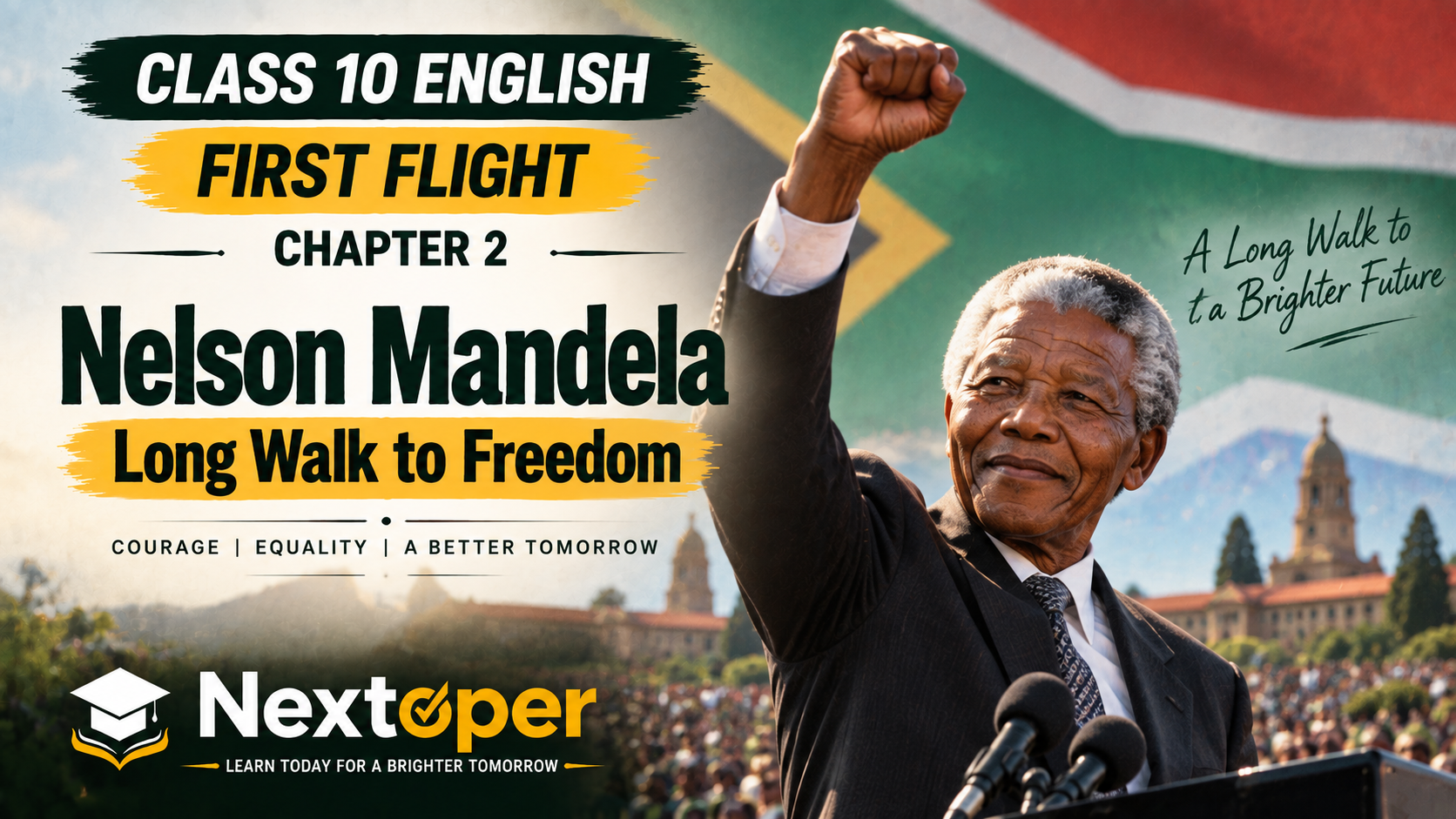
CBSE Class 10 English First Flight Chapter 2 PDF Notes – Nelson Mandela Long Walk to Freedom | Nextoper
If you’re looking for Class 10 English First Flight Chapter 2 PDF Notes that actually explain the chapter instead of just handing you answers to copy, this guide covers everything: the summary, theme, a full glossary, NCERT answers, MCQs, and the type of question this chapter draws most often in CBSE board papers.
This is Chapter 2 of your First Flight textbook, an extract from Nelson Mandela’s own autobiography. It isn’t a story with a plot twist — it’s a real speech, from a real historic day, and CBSE tends to test how well you’ve actually understood Mandela’s ideas about freedom and courage, not just whether you remember the ceremony details.
Use the table of contents below to jump to what you need, or read from the start to build your understanding properly.
Table of Contents
- Chapter Overview
- Detailed Summary
- Freedom in Four Stages
- Freedom Fighters Named in the Text
- Theme of the Chapter
- A Note on Mandela’s Writing Style
- Glossary
- NCERT Questions and Answers
- Quick Revision Notes
- MCQs for Practice
- Previous Year Question (PYQ) Pattern
- Featured Answer: What Is This Chapter Really About?
- Frequently Asked Questions
- Conclusion
Want chapter-wise MCQs and PYQs for the rest of First Flight? Explore more Class 10 English notes on Nextoper for every chapter, all in one place.
Save Free Notes PDF — No Signup Needed! Click Here to Save
Chapter Overview
This chapter is an extract from “Long Walk to Freedom,” the autobiography of Nelson Rolihlahla Mandela. It describes 10 May 1994 — the day Mandela was sworn in as South Africa’s first Black President, ending centuries of white minority rule and decades of the apartheid system, which legally separated people by race.
Unlike most First Flight chapters, this one is non-fiction, written in Mandela’s own voice, and includes a section of his actual inauguration speech. That matters for your exam: when a question asks what Mandela “means” by a line, it wants your understanding of his real argument, not a guess about a fictional character’s motives.
Detailed Summary
Mandela begins by describing the morning of 10 May 1994 — bright, clear, and busy with world leaders arriving to witness what would be the largest gathering of international dignitaries ever held on South African soil. The ceremony took place in the sandstone amphitheatre of the Union Buildings in Pretoria, a location that had symbolised white supremacy for decades and now hosted, in Mandela’s words, “a rainbow gathering of different colours and nations.”
Accompanied by his daughter Zenani, Mandela watched as F.W. de Klerk was sworn in as second deputy president and Thabo Mbeki as first deputy president. When his own turn came, he pledged to uphold the Constitution and serve the Republic. His speech spoke of “newborn liberty,” thanked the world for attending what he called “a common victory for justice, for peace, for human dignity,” and pledged to free South Africans from poverty and discrimination. He ended with the now-famous line: “Let freedom reign. God bless Africa!”
The ceremony closed with a military flypast — jets, helicopters, and troop carriers — that doubled as proof of the army’s loyalty to a government it would have arrested Mandela under, just years earlier. Two national anthems were sung, one historically associated with Black South Africans and one with white South Africans, a small but powerful symbol of a country trying to become one.
From there, Mandela shifts from describing the day to reflecting more broadly. He credits his freedom to the sacrifices of countless “African patriots” who came before him, naming several — Oliver Tambo, Walter Sisulu, Chief Luthuli, Yusuf Dadoo, Bram Fischer, and Robert Sobukwe — as examples of the courage oppression can produce. He defines courage not as fearlessness but as “the triumph over” fear, and argues that hatred is learned, not innate, which means it can be unlearned too.
The chapter closes with Mandela’s reflection on his own life: the “twin obligations” every person carries to family and to community, and how apartheid made it nearly impossible for him to honour both. He traces how his personal idea of freedom expanded over the years — from a boy’s simple joys, to a student’s small liberties, to, eventually, a demand for the freedom of his entire people. He ends on the idea that oppressor and oppressed are both, in different ways, unfree — and both need liberating.
Freedom in Four Stages
This chapter’s most exam-relevant idea isn’t the ceremony — it’s how Mandela’s definition of “freedom” changes as he grows older. This table makes that progression easy to hold in your head.
| Stage of Life | What Freedom Meant |
|---|---|
| Boyhood | Simple joys — running in the fields, swimming, riding bulls, obeying his father and tribal customs |
| Student | Small personal liberties — staying out late, reading what he liked, going where he chose |
| Young man in Johannesburg | Basic adult freedoms — earning a living, marrying, building a lawful, unobstructed life |
| Adult, after joining the ANC | Collective freedom — realising his people’s freedom mattered more than his own comfort |
Notice the direction of the change: freedom starts out entirely personal and ends up entirely collective. That shift is exactly what most “how did Mandela’s understanding of freedom change” exam answers are graded on.
Freedom Fighters Named in the Text
Mandela names six men as examples of the “extraordinary courage, wisdom and generosity” that decades of oppression produced. You don’t need biographical detail on each for your exam, but knowing why they’re mentioned helps you answer questions about this passage confidently.
| Name | Why Mandela Mentions Him |
|---|---|
| Oliver Tambo | A close ally and leader of the ANC during Mandela’s imprisonment |
| Walter Sisulu | A fellow anti-apartheid leader, imprisoned alongside Mandela |
| Chief Luthuli | An earlier ANC leader and Nobel Peace Prize laureate |
| Yusuf Dadoo | A leading voice against apartheid within South Africa’s Indian community |
| Bram Fischer | A white South African lawyer who defended Mandela and opposed apartheid |
| Robert Sobukwe | A prominent anti-apartheid activist and political prisoner |
Mandela’s point in naming them isn’t biographical — it’s that oppression, at its worst, still produced people of “such extraordinary courage, wisdom and generosity that their like may never be known again.”
Theme of the Chapter
At its centre, this chapter is about freedom — not just as the absence of restriction, but as something that has to be shared to be real. Mandela’s own journey shows freedom expanding outward: from personal comfort, to family duty, to an entire nation’s dignity. Running alongside that is a theme of courage, which Mandela redefines carefully — not as fearlessness, but as the decision to act rightly despite fear.
A third, quieter theme threads through the whole extract: that hatred is taught, not born, and that if people can be taught to hate, they can just as easily be taught to love. Mandela extends this argument even to his own oppressors, arguing that “a man who takes away another man’s freedom is a prisoner of hatred” — meaning true liberation had to include everyone, oppressor and oppressed alike.
A Note on Mandela’s Writing Style
You won’t find this discussed in most notes, but NCERT’s own “Thinking about Language” section for this chapter points directly at it: Mandela writes in balanced, contrasting halves. Look at “Now, in the last decade of the twentieth century… that system had been overturned forever.” Or “I am not truly free if I am taking away someone else’s freedom, just as surely as I am not free when my freedom is taken from me.”
This balance isn’t accidental. It mirrors the chapter’s whole argument — past against present, oppressor against oppressed, personal freedom against collective freedom. If an exam question asks you to comment on Mandela’s style or tone, naming this contrast technique, with one example, is a strong, specific answer that goes beyond a generic “he writes powerfully.”
Glossary
| Word | Meaning |
|---|---|
| Besieged | Surrounded closely, often by demands or attention |
| Amphitheatre | A roofless building with rows of seats rising in steps |
| Emancipation | Freedom from restriction |
| Deprivation | The state of not having one’s rightful benefits |
| Discrimination | Being treated differently or unfavourably |
| Resilience | The ability to recover from hardship |
| Prejudice | A strong dislike formed without good reason |
| Curtailed | Reduced or cut short |
| Transitory | Not permanent |
| Profound | Deep and strong |
NCERT Questions and Answers
Q1. Why did such a large number of international leaders attend the inauguration? What did it signify the triumph of?
International leaders attended because Mandela’s inauguration marked the peaceful end of apartheid, a system many countries had opposed for decades. Their presence signified the triumph of justice and human dignity over a long, deeply unjust system of racial division.
Q2. What does Mandela mean when he says he is “simply the sum of all those African patriots” who had gone before him?
Mandela means his own achievement wasn’t his alone. He saw himself as the product of generations of people who fought, suffered, and sometimes died for South Africa’s freedom, and his presidency was really their long struggle finally reaching its conclusion.
Q3. Would you agree that the “depths of oppression” create “heights of character”? How does Mandela illustrate this?
Mandela illustrates this by naming leaders like Oliver Tambo and Walter Sisulu, arguing that the very brutality of apartheid produced people of extraordinary courage and generosity. Whether you agree depends on your own reasoning, but Mandela’s argument is that severe hardship can reveal, or even build, remarkable strength of character in people who refuse to be broken by it.
Q4. How did Mandela’s understanding of freedom change with age and experience?
As a boy, freedom meant simple joys within his village and family customs. As a young man, it narrowed to small personal liberties. With age, he realised those freedoms meant nothing while his people remained oppressed, and his idea of freedom grew to include everyone around him, not just himself.
Q5. How did Mandela’s “hunger for freedom” change his life?
This hunger transformed him from a cautious, law-abiding man into someone willing to risk his family life, his career, and his personal safety. It’s what drove him to join the African National Congress and accept decades of imprisonment rather than abandon the fight for his people’s freedom.
Q6. Does Mandela think the oppressor is free? Why or why not?
No. Mandela argues that anyone who denies another person’s freedom becomes, in a different way, a prisoner too — locked behind what he calls “the bars of prejudice and narrow-mindedness.” In his view, both the oppressed and the oppressor lose their humanity under a system like apartheid.
Quick Revision Notes
- Author: Nelson Mandela | Chapter: First Flight, Chapter 2 | Genre: Autobiography extract
- Event described: Mandela’s inauguration as South Africa’s first Black President, 10 May 1994
- Location: Union Buildings amphitheatre, Pretoria
- Key figures named: Oliver Tambo, Walter Sisulu, Chief Luthuli, Yusuf Dadoo, Bram Fischer, Robert Sobukwe
- Mandela’s definition of courage: the triumph over fear, not its absence
- Twin obligations: duty to family, duty to community and country
- Freedom’s progression: personal joys → personal liberties → adult responsibility → collective freedom
- Central belief: hatred is learned, so it can be replaced by love
- One-line mnemonic: “Free means all of us, or none of us.” — Mandela’s core argument in a single sentence.
MCQs for Practice
1. Where did Mandela’s inauguration ceremony take place? a) Cape Town City Hall b) Union Buildings, Pretoria c) Johannesburg Stadium d) Robben Island
Answer: b) Union Buildings, Pretoria
2. According to Mandela, what is courage? a) The complete absence of fear b) The triumph over fear c) Never feeling threatened d) Physical strength alone
Answer: b) The triumph over fear
3. What does Mandela say about hatred? a) It is inborn and cannot change b) It is learned, and so love can be learned too c) It only exists between different races d) It cannot be overcome
Answer: b) It is learned, and so love can be learned too
4. Who was sworn in as first deputy president alongside Mandela? a) F.W. de Klerk b) Oliver Tambo c) Thabo Mbeki d) Walter Sisulu
Answer: c) Thabo Mbeki
5. What are the “twin obligations” Mandela refers to? a) Obligation to God and to the state b) Obligation to family and to community/country c) Obligation to friends and to strangers d) Obligation to the past and to the future
Answer: b) Obligation to family and to community/country
Previous Year Question (PYQ) Pattern
This chapter tends to appear in CBSE Class 10 English papers in two recurring formats:
- A value-based or reflective question (3–5 marks), asking students to explain Mandela’s definition of courage, or to agree or disagree with his claim that oppression creates strength of character. Weak answers just restate the line; strong answers connect it to a specific example from the text or from outside it.
- A change-over-time question, asking how Mandela’s understanding of freedom evolved. This is almost always graded on whether the student shows a clear progression — personal to collective — rather than just listing random details from different parts of the chapter.
If you’re revising the night before an exam, make sure you can state Mandela’s definition of courage exactly, and that you can describe the four stages of his freedom journey in order.
Featured Answer: What Is This Chapter Really About?
This chapter is an extract from Nelson Mandela’s autobiography, describing his inauguration as South Africa’s first Black President on 10 May 1994. Beyond the ceremony itself, Mandela reflects on what freedom really means, arguing that it grew for him from simple childhood joys into a demand for the collective freedom of his entire country. He redefines courage as the triumph over fear rather than its absence, and argues that since hatred is something people learn, it can also be unlearned and replaced with love. The chapter closes with the idea that true liberation must free both the oppressed and the oppressor, since denying someone else’s freedom traps the oppressor in prejudice just as surely as it traps the victim in injustice.
Frequently Asked Questions
What is the theme of Nelson Mandela: Long Walk to Freedom? The chapter explores freedom, courage, and sacrifice. Mandela describes his inauguration as South Africa’s first Black President and reflects on how apartheid was overturned through decades of struggle, arguing that true freedom must be collective, not personal, and that both the oppressor and the oppressed are freed together.
What does courage mean according to Nelson Mandela? Mandela defines courage as the triumph over fear rather than its absence. He explains that a brave man is not someone who feels no fear, but someone who feels fear and conquers it anyway, a lesson he says he learned from his comrades in the freedom struggle.
What are the twin obligations Mandela talks about? Mandela describes every man’s twin obligations as duty to his family and duty to his people, community, and country. In South Africa under apartheid, he found it nearly impossible to fulfil both, since serving his people meant being torn away from his family for years.
How did Mandela’s idea of freedom change over his life? As a boy, freedom meant simple pleasures like running in the fields and swimming in the stream. As a student, it meant staying out late and reading what he liked. As an adult, he realised true freedom meant his whole community being free, not just himself, which led him to join the African National Congress.
Why were two national anthems sung at Mandela’s inauguration? Two anthems were sung, “Nkosi Sikelel’ iAfrika” associated with Black South Africans and “Die Stem” associated with white South Africans, as a symbolic gesture of unity. It showed both communities honouring each other’s history on the day a non-racial democracy began.
Struggling with a different First Flight chapter? Browse the full Class 10 English notes index on Nextoper for summaries, MCQs, and PYQs across every chapter.
Conclusion
This chapter rewards students who look past the ceremony details and focus on Mandela’s argument. For your exam, hold onto three things: his exact definition of courage, the four-stage progression of his idea of freedom, and his claim that both the oppressed and the oppressor need liberating. The ceremony is the setting; these ideas are what CBSE is actually testing.
To sum up, read Mandela’s own words twice, especially the balanced, contrasting sentences. They carry more of this chapter’s meaning than any summary ever will.
More Notes: Explore other First Flight chapters, grammar notes on noun-verb suffixes and the definite article with proper names, and the full Class 10 English syllabus breakdown on Nextoper.in.
Author Bio: Written and reviewed by the Nextoper Editorial Team, a group of CBSE English educators who build chapter notes directly from the NCERT syllabus and past board paper patterns.
Freshness Note: These notes reflect the CBSE Class 10 English First Flight syllabus for the 2025-26 session and were last checked on 20 September 2026.