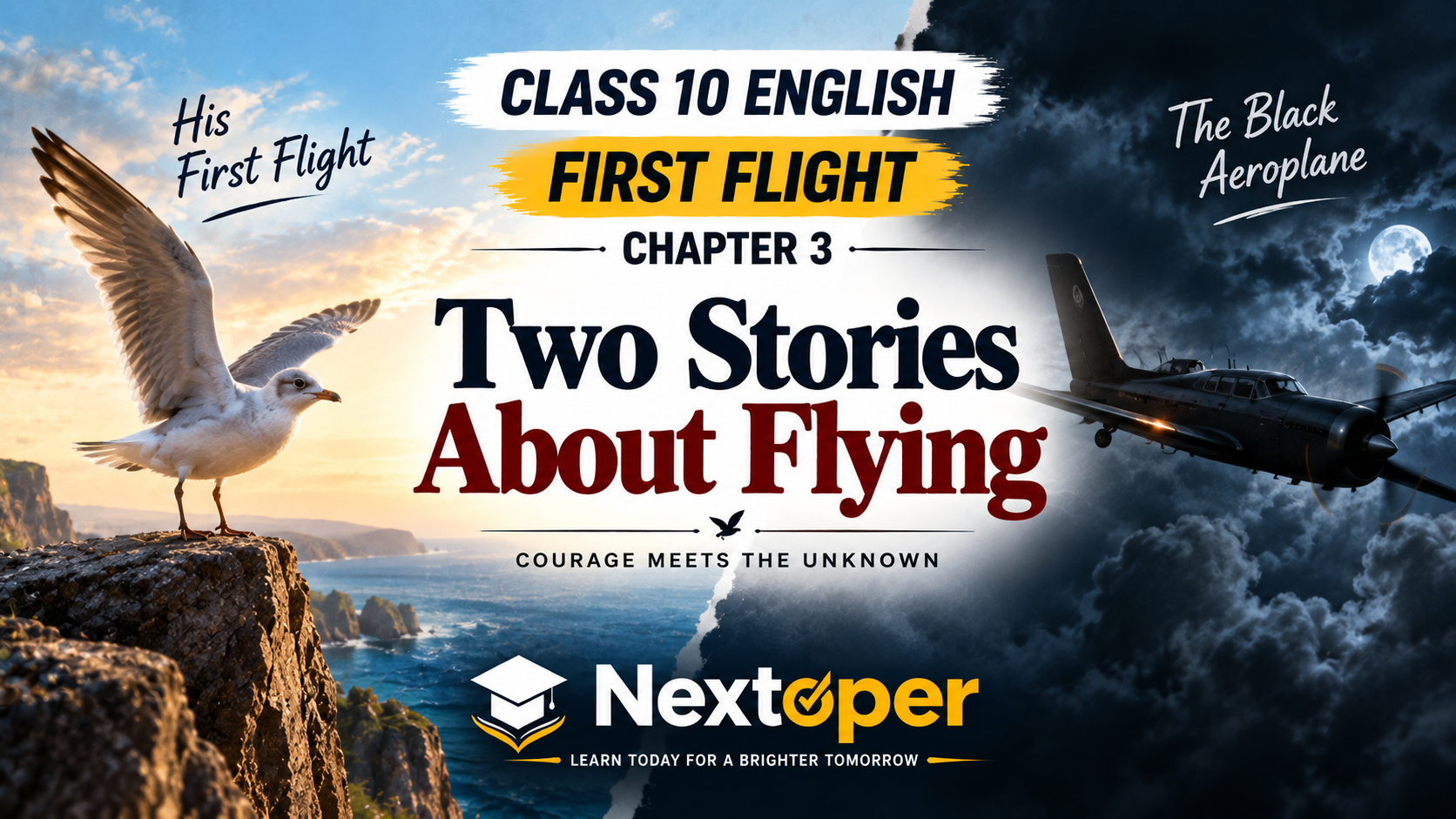
CBSE Class 10 English First Flight Chapter 3 PDF Notes: Two Stories About Flying 2026-27 | Nextoper Notes
These Class 10 English Chapter 3 Notes cover both stories in Two Stories About Flying. You get summaries, character sketches, themes, solved answers, MCQs and board questions.
Short on time? Jump to the quick revision. Have a week? Read every section in order.
We checked each fact against the NCERT text. We also flag mistakes that popular answer pages make. That way you will not copy them.
Keep these Class 10 English Chapter 3 Notes open beside your textbook while you study.
Table of Contents
Tap any link to jump to that part. Studying the night before? Start with 12, then 11, then 13.
- Chapter overview
- His First Flight: summary
- The Black Aeroplane: summary
- Character analysis
- Themes and the big comparison
- Who was the black aeroplane?
- Five mistakes popular answer pages make
- Glossary
- NCERT questions and answers
- Language exercises solved
- MCQs with answers
- Quick revision
- Board exam questions
- FAQs
Class 10 English Chapter 3 Notes: Chapter Overview
This chapter of First Flight holds two short stories about flight. One follows a bird. The other follows a human pilot.
| Point | His First Flight | The Black Aeroplane |
|---|---|---|
| Author | Liam O’Flaherty, an Irish writer | Frederick Forsyth, a British thriller writer |
| Main character | A young seagull | An unnamed pilot who tells the story |
| Told by | A narrator outside the story | The pilot himself (“I”) |
| Setting | A cliff ledge above the sea | A night sky over France, then a storm |
| Central idea | Beating fear | Facing danger and trusting help |
| Ending | First flight; the family cheers | Safe landing; an open mystery |
NCERT opens the chapter with two questions. How does the seagull beat his fear? Who helps the pilot?
Keep both questions in mind as you read. The chapter sits on roughly pages 32 to 41 of the 2026-27 reprint.
Save Free Notes PDF — No Signup Needed! Click Here to Save
His First Flight: Summary
The story covers about one day in a young seagull’s life. Follow it step by step.
The story in seven steps
- A young seagull sits alone on his ledge. His brothers and sister flew away the day before.
- He fears the long drop to the sea. He is sure his wings will fail him.
- His parents scold him and threaten to let him starve. Nothing moves him.
- All day the family flies, dives and fishes in front of him. They also tease him for his cowardice.
- Next morning he is very hungry. He cries out to his mother, and she first mocks him.
- Then she flies across with a piece of fish. She stops in mid-air, just out of reach.
- He dives at the fish and falls. His wings spread, he glides, and he lands on the sea. His family praises him.
The seagull’s 24 hours
| When | What happens | What it shows |
|---|---|---|
| The day before | Brothers and sister fly away; parents call and scold | His fear is real, not laziness |
| All that day | The family flies, fishes and teases him | Shame cannot cure fear |
| Next morning | He is hungry and pretends to doze | Hunger is now stronger than his fear |
| A little later | His mother brings fish, then hovers | The turning point of the story |
| The last moments | He falls, flies and floats on the sea | The act was easier than the fear |
Look closely at the mother. She first screams at him in mockery. Then she brings the fish and stops in mid-air.
That fish trick is the turning point. Board papers return to it often. The story ends with one plain line announcing his first flight.
The Black Aeroplane: Summary
This story is told in the first person by a pilot. It moves from a calm night to a wild storm and a puzzle.
The story in nine steps
- It is 1:30 in the morning. The sky is clear. The pilot flies his old Dakota from France to England.
- He dreams of his holiday and a big English breakfast with his family.
- He calls Paris Control. They tell him to turn twelve degrees west. He switches to his last fuel tank.
- About 150 kilometres past Paris, he sees huge storm clouds. He cannot climb over them. He cannot fly around them either.
- He thinks of going back to Paris. But he wants his breakfast, so he flies into the storm.
- Everything turns black. The plane jumps and twists. The compass spins, and the radio dies.
- A strange black aeroplane appears beside him. It has no lights. Its pilot waves and seems to say, “Follow me.”
- The pilot follows for half an hour. His last tank now holds only five or ten minutes of fuel.
- The guide plane goes down. The pilot sees runway lights and lands. The black aeroplane has vanished.
At the control centre, a woman laughs at his question. Her radar showed only one aircraft that night. The story ends by asking who helped him.
Numbers to remember
Extract questions love small facts. Learn these before the exam.
| Detail | Fact | Why it matters |
|---|---|---|
| Time | 1:30 in the morning | Sets a calm, quiet mood |
| Call sign | Dakota DS 088 | Used in the radio talk with Paris Control |
| Turn | Twelve degrees west | Paris Control’s advice, which he follows |
| Distance | About 150 km past Paris | Where the storm appears |
| Fuel | Second and last tank | Why he cannot fly around the storm |
| Guided flight | About half an hour | How long he trusts the strange plane |
| Fuel left | Five to ten minutes | His fear returns before landing |
| Radar | One aircraft only | The seed of the mystery |
Character Analysis
Board answers ask you to describe a character with proof. Use the trait-plus-evidence pattern in the tables below.
The young seagull
| Trait | Proof from the story |
|---|---|
| Fearful | He is sure his wings will fail. He runs back to his hole under the ledge. |
| Not weak | His little sister has shorter wings, yet she flies. His wings are fine. |
| Hungry and desperate | He has not eaten since the night before. The food nearly drives him mad. |
| Impulsive | He dives at the fish without thinking about the drop. |
| Quick to learn | He forgets his fear at once. He dives, soars and curves, shrieking with joy. |
| Still a beginner | He tires on the sea. His feet sink before he floats. |
The parents and the siblings
The parents are strict but caring. They scold, threaten and tease. Then they use a clever plan.
The mother is the key figure. She is the only one who watches him. She brings the fish and stops just out of reach.
The father seems to ignore him. Yet he flies over the seagull with a scream of praise after the leap. The brothers and sister fly around him and call him to the sea.
Did the mother plan the trick? The text does not say. Her sudden pause fits a plan, so say “she seems to have planned it”.
The pilot
| Trait | Proof from the story |
|---|---|
| Cheerful and calm | He is happy to be alone above the sleeping countryside. |
| Careful | He checks the map and compass and switches fuel tanks on time. |
| Overconfident | He knows he ought to go back, yet he wants breakfast more. |
| Brave, but scared | He admits he feels frightened again when fuel runs low. |
| Trusting | He follows the strange plane like an obedient child. |
| Grateful | He wants to say thank you to his guide. |
The pilot has no name. In your exam answer, call him “the pilot” or “the narrator”.
The pilot of the black aeroplane
This figure never speaks. He appears when the narrator is lost. He waves, leads the way north, then down.
He disappears the moment the runway comes into view. That is why he feels like a mystery.
The woman in the control centre
She is calm and practical. She trusts her radar. Her laugh and her words create the twist at the end.
Themes and the Big Comparison
Both stories test a person in the sky. But the tests are very different.
Six themes to know
- Fear is often bigger than the task. The seagull’s fear is worse than the flight itself.
- Need can push you past fear. Hunger forces the seagull to leap.
- Tough love helps us grow. The parents push him, though it looks harsh.
- Risk needs judgement. The pilot could have turned back but did not.
- Help can come from unexpected places. A strange plane guides the pilot.
- Some questions stay open. The story never names the black aeroplane’s pilot.
Both stories start with an appetite
Here is a link most notes miss. Hunger pushes the seagull to fly. The pilot’s wish for a big English breakfast pushes him into the storm.
So in both stories, a simple wish for food and home drives a big act. Use this idea in any question about motivation. It fits the 2023 board question on motivation and risk.
Side-by-side comparison
| Point | The seagull | The pilot |
|---|---|---|
| What he wants | Food | Home and breakfast |
| What blocks him | Fear from inside | A storm from outside |
| What pushes him | Hunger and his mother’s trick | His own wish to get home |
| Who helps | His family | A mystery plane |
| The lesson | Try, and fear shrinks | Think before you risk; help may come |
| The ending | A joyful first flight | A safe landing and a puzzle |
Who Was the Black Aeroplane?
The story never says. So the exam wants your reasoning, not one “correct” name.
NCERT’s own closing notes ask this very question. Was the plane real, or did the pilot imagine it?
| View | Clues that support it | Weak spot |
|---|---|---|
| A stressed mind imagined it | No lights; no radar trace; it vanished | How did he find a runway with dead instruments? |
| A ghostly guardian saved him | Perfect timing; it led him to the runway | There is no proof at all |
| His own instinct guided him | He is a skilled, calm pilot | He was lost and out of fuel |
Pick one view. Support it with two clues. Admit that the story leaves the question open.
Five Mistakes Popular Answer Pages Make
We compared many answer pages with the NCERT text. These slips keep appearing. Do not copy them.
- “Christmas holiday.” The text says only “my holiday”. Christmas is never mentioned.
- “He landed in England.” He asks the woman where he is. The story never names the airport.
- Made-up extracts. Some pages print lines that are not in the textbook. Match every extract to the real paragraph.
- “Black” always means colour. NCERT says that for the strange black aeroplane it means “without light”.
- “The mother gave him the fish.” She never hands it over before the leap. She hovers just out of reach.
Glossary: Word Meanings
Learn these words with their scenes. Then you can use them in your own sentences.
| Word | Plain meaning | Where it appears |
|---|---|---|
| ledge | A narrow rocky shelf on a cliff | The seagull’s perch |
| upbraiding | Scolding | The parents’ anger |
| skim | To move lightly just above a surface | Flying over the waves |
| herring | A soft-finned sea fish | The older brother’s first catch |
| preening | Cleaning and tidying feathers | The father on the plateau |
| whet | To sharpen | The mother scraping her beak |
| derisively | In a mocking way | The mother’s first scream |
| dizzy | Feeling unsteady, as if spinning | After the fall |
| curveting | Leaping like a horse | The siblings flying |
| banking | Flying with one wing higher than the other | The siblings flying |
| dog-fish | A small kind of shark | Scraps offered at the end |
| Dakota | A type of old propeller aeroplane | The pilot’s plane |
| Over | A radio word meaning “I have finished speaking” | The call to Paris Control |
NCERT Questions and Answers
Below are the textbook questions with model answers in simple words. Put them in your own voice before you write them in an exam. You can compare them with the official NCERT textbook at any time.
For a 40–50 word answer, write four or five short sentences. Give one idea and one proof.
His First Flight: Thinking about the Text (page 36)
Q1. Why was the young seagull afraid to fly? Are all young birds afraid? Do babies find first steps hard?
He felt sure his wings could not hold him. The sea lay far below, so the drop felt deadly. Some young birds may be more timid than others. Human babies feel the same fear. They wobble, fall and try again before they walk.
Q2. “The sight of the food maddened him.” What does this suggest? What made him fly?
The line shows how strong his hunger had grown. He had not eaten since the night before. The fish was so close that he forgot his fear. Hunger made him dive at it. That dive became his first flight.
Q3. Why did his parents threaten him and cajole him to fly?
His parents wanted him to learn a skill he needed for life. Calling and coaxing had failed, so they scolded him. They threatened to leave him hungry. They also flew and fished in front of him. They hoped shame and hunger would move him.
Q4. Have you been pushed by your parents to try something scary?
Think of a time you feared something new. Say who pushed you and how it felt. Here is a sample. Change it into your own story.
I feared deep water. My uncle stood in the pool and held my hands. On the eighth day I let go. I floated, and the fear shrank.
Q5. Flying seems natural for a bird. Was your own success guaranteed, or did trying matter?
For a bird, flying seems natural, so success feels certain. For us, it is not. When I learned cycling, I could have failed. Still, trying mattered most. Without an attempt, success is impossible.
The Black Aeroplane: Thinking about the Text (page 40)
Q1. “I’ll take the risk.” What is the risk? Why does the narrator take it?
The risk is flying straight into a huge storm. He had too little fuel to go around it. He could have turned back to Paris. But he wanted to get home. He also longed for a big English breakfast with his family.
Q2. Describe the narrator’s experience as he flew into the storm.
Inside the clouds everything turned black. The plane jumped and twisted in the air. The compass spun round and round. The other instruments and the radio died. He could not see outside. He was lost in the storm.
Q3. Why does he say he “was not sorry to walk away from the old Dakota”?
The flight had been terrifying. The storm, the dead instruments and the empty tank had shaken him. His words sound calm, but they hide deep relief. On the ground he felt safe at last.
Q4. What made the woman in the control centre look at him strangely?
The pilot asked about another aeroplane. The woman had watched only one aircraft on her radar. No other plane had flown that night. His question made no sense to her. So she laughed and stared at him.
Q5. Who do you think helped the narrator? Give reasons.
The story gives no answer, so give your view with proof. One view is that his frightened mind imagined the plane. Radar showed nothing, and the plane had no lights. It also vanished at the runway. Another view is that a ghostly guide saved him. How else did he find a runway with no instruments?
Language Exercises Solved
These exercises follow the second story. They test word meaning, so learn the pattern.
The many meanings of “black”
| Sentence idea | Meaning of “black” |
|---|---|
| Hands and face are “absolutely black” | Very dirty |
| The taxi driver’s “black look” | An angry, hostile look |
| The “blackest crimes” against humanity | The most wicked and shameful |
| Pinter’s “black comedy” | Comedy about dark, grim subjects |
| Selling goods “in black” | Selling illegally at a higher price |
| Beaten “black and blue” | Beaten until badly bruised |
Match the “fly” phrases
| Phrase | Meaning |
|---|---|
| Fly a flag | Display a flag on a long pole |
| Fly into rage | Become suddenly very angry |
| Fly along | Move quickly or suddenly |
| Fly high | Be successful |
| Fly the coop | Escape from a place |
Words that mean “fly”
Tick these words: swoop, flit, flutter, skim, glide, soar, hover, sail and float. Some keys also accept “dart”. Ask your teacher about it.
Words such as stay, sink and fall do not fit. They describe the opposite of flying.
Writing tasks
One task asks for a funny account of learning a skill. The other asks about being alone in a thunderstorm.
Open with a strong first line. Use three short events. End with a feeling.
✅ Done with the answers? Test yourself with the MCQs below.
MCQs with Answers
These ten questions check the facts that board extracts love. Cover the answers first.
1. Why does the young seagull refuse to leave the ledge? (a) He has hurt his wing (b) He is sure his wings will fail (c) His parents told him to wait (d) He is too sleepy Answer: (b). He feels certain that his wings cannot support him.
2. What finally makes him dive? (a) A storm (b) His father’s shout (c) Hunger and the fish in his mother’s beak (d) A race with his brother Answer: (c). Hunger beats his fear.
3. What does the mother do just before he dives? (a) Drops the fish on the ledge (b) Hovers in mid-air with the fish (c) Flies away (d) Calls the father Answer: (b). She stops just out of his reach.
4. Where does the seagull come to rest at the end? (a) On the plateau (b) On the ledge (c) On the sea (d) On a rock Answer: (c). He floats on the green sea.
5. Which word means “scolding”? (a) Preening (b) Upbraiding (c) Skimming (d) Whetting Answer: (b). The parents were upbraiding him.
6. When does The Black Aeroplane begin? (a) 1:30 in the morning (b) Noon (c) Sunset (d) Breakfast time Answer: (a). The sky is clear and the stars are out.
7. What is the pilot’s call sign? (a) DS 008 (b) DS 088 (c) DC 088 (d) SD 080 Answer: (b). He says “Dakota DS 088” to Paris Control.
8. Why can the pilot not fly around the storm? (a) The clouds are too low (b) He has too little fuel (c) The radio is dead (d) Paris Control forbids it Answer: (b). He does not have enough fuel to go north or south.
9. What happens to the compass inside the clouds? (a) It glows (b) It points north (c) It spins round and round (d) It breaks off Answer: (c). The compass is dead and useless.
10. What does the control-centre woman tell him? (a) Another plane landed first (b) His plane was lost on radar (c) Only his plane was on radar (d) The airport was closed Answer: (c). No other aeroplane flew that night.
Class 10 English Chapter 3 Notes: Quick Revision in 2 Minutes
This is your last-minute page. Read it slowly once, then test yourself.
His First Flight
Memory chain: Ledge → Taunts → Hunger → Fish bait → Leap → Wings → Sea.
- Author: Liam O’Flaherty. The story has an outside narrator.
- The seagull fears that his wings will fail him.
- The parents scold, threaten, tease and then use the fish trick.
- The turning point is hunger plus the mother stopping mid-air.
- He floats on the sea, and his family praises him.
The Black Aeroplane
Memory chain: Clear sky → Paris call → 12° west → Storm → Dead dials → Guide → Runway → Vanish.
- Author: Frederick Forsyth. The pilot tells the story himself.
- His risk is flying into the storm for a family breakfast.
- Three things fail him: dials, direction and daylight. Remember them as the three Ds.
- The guide plane has no lights and leads him north, then down.
- The twist: radar showed only one aircraft.
If the question says…
| Question type | What to write |
|---|---|
| Why did he do this? | Give the reason first, then one proof |
| 40–50 words | Four or five short sentences; one idea, one proof |
| 100–120 words | Three short paragraphs: opening, evidence, closing insight |
| Compare the two | Go point by point, as in the comparison table |
| Who was the pilot? | Pick one view; give two clues |
Board Exam Questions and Answer Guides
Public question-paper compilations list questions from this chapter in 2019, 2020, 2023, 2024 and 2025. We rephrased them below. Check exact wording in the official CBSE papers.
| Year | Topics asked | Format |
|---|---|---|
| 2019 | Parents’ methods; why he feared; why the pilot thought of turning back | 30–40 words |
| 2020 | “Sight of food maddened him”; how he beat fear; why the pilot was frightened again; “everything going well” | 30–40 and 100–150 words |
| 2023 | First flight; family’s role; the risk; extract on the storm; motivation and risk in both stories | 40–50 and 100–120 words; extract |
| 2024 | Early attempts versus first flight; why “exhausted”; compare both approaches; pilot versus Valli | 40–50 and 100–120 words |
| 2025 | Fear and independence; extract on the opening night scene | 40–50 words; extract |
What the trend tells you
- The seagull appears in every year listed. Master his first flight.
- In 2023 and 2024, the long answer linked the pilot with the seagull or with another character. Practise comparing.
- Pilot extracts came in 2023 and 2025. They mix MCQs, inference, vocabulary and one short answer.
This is a pattern, not a prediction. Prepare the whole chapter.
Practice 1: Describe the young seagull’s first flight (40–50 words)
Hunger drove the seagull to his first flight. His mother hovered in mid-air with fish just out of reach. He dived at it and fell into space. Terror gripped him for a moment. Then his wings opened, and he glided, soared and landed on the sea.
Practice 2: Compare how the seagull and the pilot win their sky (100–120 words)
Both the seagull and the pilot wish to conquer the sky. Yet they win in different ways.
The seagull fights an inner enemy: fear. Hunger and his mother’s trick push him off the ledge. He learns that his wings work.
The pilot faces an outer enemy: a storm. He needs quick thinking and unexpected help. A silent plane leads him to a runway.
Fear stalls one hero until need moves him. Risk and luck carry the other. Both stories show that courage grows when we act.
Practice 3: Extract on the opening of The Black Aeroplane
Read the paragraph that begins “The moon was coming up in the east.” Then answer.
- What time of day is it? Night. The time is 1:30 in the morning, and stars shine.
- What does the pilot’s wish to be with family show? He is a warm, family-loving man.
- What does “clear sky” suggest about the weather? It suggests calm, favourable flying conditions.
- How does the calm mood build anticipation (about 40 words)? The peaceful night makes the flight feel easy. The pilot dreams of breakfast at home. So the reader expects a smooth journey. That calm makes the coming storm feel even more shocking.
What Is Two Stories About Flying About?
Two Stories About Flying is Chapter 3 of Class 10 First Flight. It holds two tales of courage in the sky. In the first, a young seagull fears his first flight until hunger makes him leap. In the second, a pilot lost in a storm follows a mystery plane. Radar never saw that plane.
Frequently Asked Questions
Here are quick answers to the questions students search for most.
What is the main message of Two Stories About Flying?
The chapter shows that fear is often bigger than the task itself. The seagull learns his wings work once he dares to use them. The pilot learns that help can arrive when hope seems gone. His risk also shows why courage needs good judgement.
Why was the young seagull afraid to fly?
He was certain that his wings would not carry him. The sea lay far below, so the drop felt deadly. His brothers and sister had already flown away. Even so, he could not find the courage. Hunger finally pushed him to leap.
Who was the pilot of the black aeroplane?
The story never says. The control-centre woman saw only one aircraft on her radar. So the black aeroplane may have been imagined by a frightened pilot. It may also have been a ghostly guide. Pick one view and support it with clues from the text.
What risk does the narrator take in The Black Aeroplane?
He flies his old Dakota straight into a huge storm. He could have turned back to Paris. But he badly wanted to reach home for breakfast with his family. Inside the clouds, his compass and radio failed. His fuel was almost gone.
Is Two Stories About Flying in the CBSE Class 10 syllabus for 2026-27?
Yes. It is Chapter 3 in the NCERT First Flight textbook, which CBSE prescribes for Class 10 English Language and Literature. The 2026-27 reprint still carries it. Always confirm the latest list on the CBSE Academic website before you plan your revision.
🚀 Ready for what comes next? Read our notes on From the Diary of Anne Frank.
To Sum Up
Two very different flyers teach one shared lesson. The seagull beats a fear that lived only in his mind. The pilot survives a storm that was all too real.
Read the summaries, learn the comparison, and practise the board questions. Use these Class 10 English Chapter 3 Notes as your base, and add your own words in the exam.
More Class 10 English Notes
Keep going with the rest of First Flight. These links follow the order of your textbook.
- Previous chapter: Class 10 English Chapter 2 PDF Notes: Nelson Mandela, Long Walk to Freedom
- Previous chapter: Class 10 English Chapter 1 PDF Notes: Letter to God
- All chapters: Class 10 English First Flight Notes and Solutions


If you want to understand facial third proportions, interactive tools can demonstrate how your forehead, nose, and jaw height compare to classic ideal ratios.