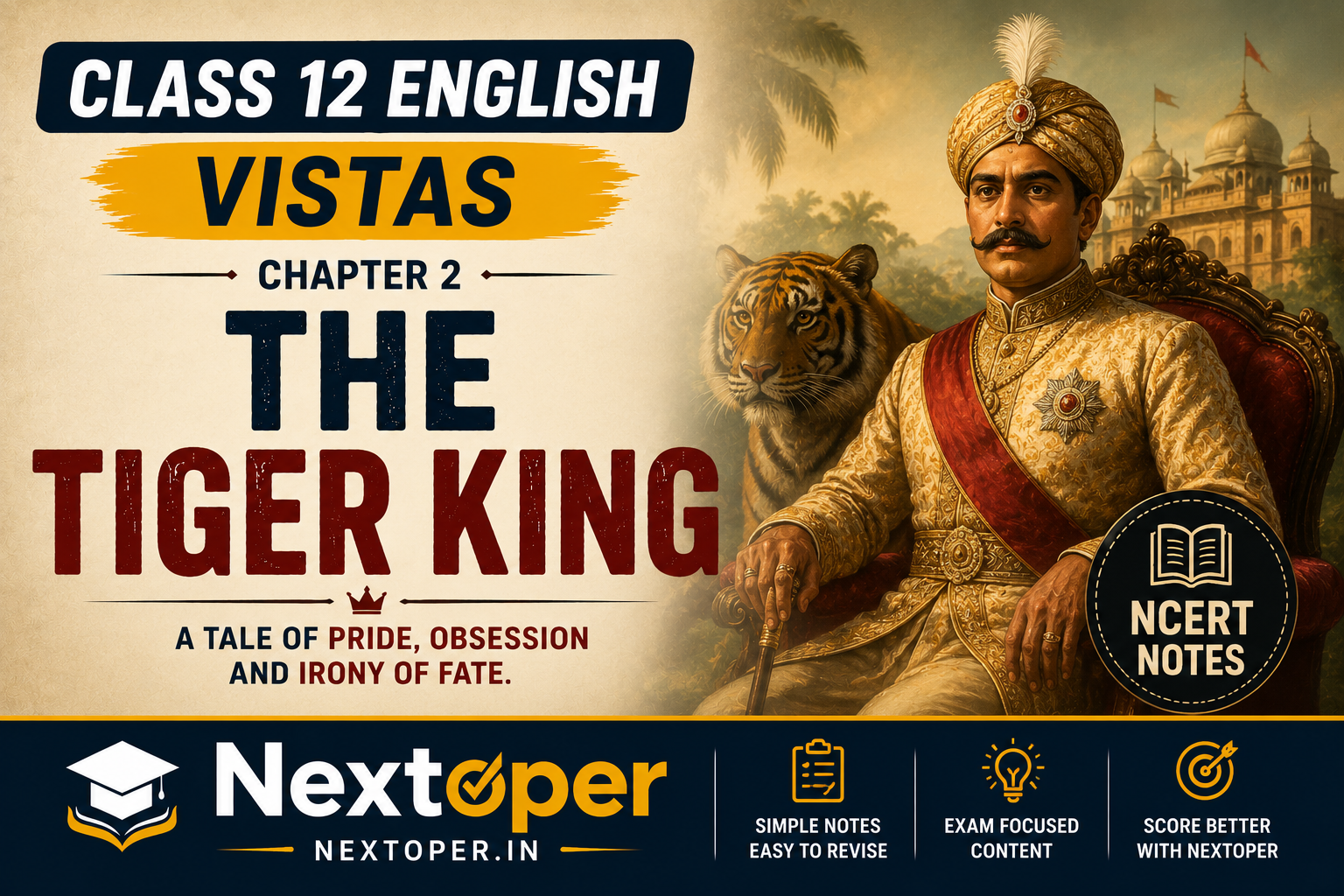
CBSE Class 12 The Tiger King PDF Notes (English Vistas, Chapter 2) — 2025-26
Last updated: 1 September 2026 · Reading time: ~13 minutes
If you’re revising Class 12 English Chapter 2, The Tiger King, this page gives you everything in one place: a clean summary, a character sketch of the Maharaja, the themes examiners actually test, a glossary, textbook answers, MCQs, and a quick-revision box for the night before your exam. Everything here is written the way a teacher would explain it — no filler, no padding.
On this page: Quick Revision · Chapter Overview · Full Summary · Character Sketch · Themes & Dramatic Irony · Glossary · Textbook Q&A · MCQs · Previous Year Questions · FAQs
Quick Revision (Read This First)
- Author: Kalki (R. Krishnamurthy)
- Setting: The fictional princely state of Pratibandapuram, during British colonial rule
- Hero: The Maharaja, nicknamed the Tiger King, real name Jung Jung Bahadur
- Prophecy: An astrologer predicts he will die by a tiger’s hand
- His response: He vows to kill a hundred tigers to defy fate
- Turning point: Tigers run out in his kingdom after he kills seventy; he marries into a tiger-rich family to keep hunting
- The fake hundredth tiger: His dewan smuggles in an old zoo tiger so the king can “win”
- The real cause of death: A splinter from a toy wooden tiger infects his hand and kills him
- Big idea: A satire on the pride, insecurity, and cruelty of those in power
If you remember only one line for tomorrow’s exam: the man who killed ninety-nine real tigers was finally killed by a wooden one — that irony is the whole story.
Chapter Overview
“The Tiger King” is a satirical short story written by Kalki, the pen name of the Tamil writer and journalist R. Krishnamurthy. It appears in Vistas, the supplementary English reader for CBSE Class 12. The chapter tells the life story of the Maharaja of the imaginary state of Pratibandapuram, who becomes so consumed by a childhood prophecy that his entire adult life narrows down to one goal: killing a hundred tigers before a tiger can kill him.
On the surface, this reads like an adventure story about a fearless hunter. Underneath, it is a sharp comment on how unchecked power turns into obsession, how frightened officials will lie to protect their jobs, and how fate has a habit of arriving through the door you didn’t lock. The story matters for your exam not just because of its plot, but because CBSE regularly tests the literary technique behind it — dramatic irony and satire — so understanding how Kalki builds the joke is as important as knowing what happens.
Full Chapter Summary
Get free Class 12 The Tiger King PDF Notes
The Birth and the Prophecy
The narrator opens by telling us the Maharaja is already dead, then goes back to explain why he was called the Tiger King. At his birth, astrologers predicted the newborn prince would grow into a great warrior — but that he would eventually die. When pressed to explain how, they revealed the fatal detail: his death would come from a tiger, because he was born in the hour of the Bull, and the Bull and Tiger are natural enemies.
In an almost magical twist, the ten-day-old infant is said to have spoken, questioning the astrologers and growling a warning: tigers should beware of him. That single moment of childish defiance becomes the seed of everything that follows.
Growing Up and Taking the Throne
The young prince, Jung Jung Bahadur, is raised in the typically Anglicised style of Indian royalty under British rule — English nanny, English tutor, English films — a detail Kalki uses to gently mock how colonial-era royals imitated their colonisers rather than their own culture. At twenty, he takes charge of his state and immediately remembers the old prophecy. Reasoning that self-defence justifies killing a threat before it kills you, he sets out to hunt tigers.
The Hundred-Tiger Vow
After killing his first tiger, he proudly shows the astrologer, who repeats the warning: ninety-nine tigers can be killed safely, but the hundredth is dangerous. The Maharaja, amused, jokes that if even the hundredth tiger is killed, he’ll burn his prediction books and become an insurance agent — a small, comic detail that foreshadows how wrong the astrologer will later be, and how right he will accidentally turn out to be.
From this point, tiger hunting becomes state policy. The king bans anyone else from hunting tigers in Pratibandapuram, on pain of losing all their property. He hunts with total dedication, surviving several close calls where he has to fight a tiger barehanded after his bullet misses.
The British Officer and the Diamond Rings
A memorable subplot involves a high-ranking British officer visiting the state, eager to hunt a tiger himself — mainly so he can be photographed standing over the body. The Maharaja refuses outright, offering absurd alternatives instead: a boar hunt, a mouse hunt, even a “mosquito hunt.” His stubborn refusal puts his throne at risk, since angering a British official during colonial rule was genuinely dangerous for a native ruler.
To smooth things over without giving up his tiger monopoly, the Maharaja sends fifty expensive diamond rings to the officer’s wife, expecting her to keep one or two and return the rest. She keeps all fifty and sends only a polite thank-you note. The bill comes to three lakh rupees — a huge sum — but the Maharaja is relieved simply to have kept his throne. This episode is one of the story’s clearest satirical set-pieces: vanity, bribery, and colonial power dynamics compressed into a few paragraphs of comedy.
Running Out of Tigers
After ten years, the Maharaja has killed seventy tigers — and then the tiger population in his own forests is wiped out. Undeterred, he turns his hunt into a matchmaking strategy: he asks his dewan (minister) to find him a bride from a royal family whose state still has plenty of tigers. Every visit to his in-laws becomes another hunting trip, and he steadily climbs to ninety-nine kills.
The Desperate Hunt for the Hundredth Tiger
With just one tiger left to kill, the Maharaja becomes consumed by anxiety, remembering the astrologer’s old warning about the hundredth tiger being dangerous. Real tigers have become impossible to find anywhere. When sheep start disappearing from a hillside village, he assumes a tiger is responsible and camps in the forest for days, growing increasingly furious when the animal doesn’t appear. Officers lose their jobs over his temper; even the dewan is nearly forced to resign.
The Faked Kill
Terrified of the king’s rage, the aging dewan secretly arranges for an old, half-tame tiger to be smuggled from a zoo in Madras. At midnight, he and his wife drag the animal into a car and release it near the king’s camp. The next morning, the exhausted old tiger wanders toward the Maharaja “as if in humble supplication.” The king fires — and misses. The tiger merely faints from shock. To protect their own jobs, the hunters quietly finish the job at point-blank range and let the Maharaja believe he has personally killed his hundredth tiger. He returns to the capital in triumphant procession, certain that he has finally cheated fate.
The Real Tiger That Gets Him
Some days later, at his son’s third birthday, the Maharaja buys the boy a cheap wooden toy tiger from a local shop — overpaying for it after the shopkeeper, fearing wartime price-control penalties, inflates the price. While playing with his son, a rough wooden splinter from the toy pierces the Maharaja’s hand. The wound turns septic within days. Three surgeons operate — successfully, by their own account — but the Maharaja dies anyway.
The final line of the story delivers the joke Kalki has been building for pages: the hundredth tiger, in the form of a toy, has taken its “final revenge” on the Tiger King. The astrologer’s prophecy is technically fulfilled, but not in any way anyone — reader or Maharaja — could have predicted.
Character Sketch of the Maharaja (the Tiger King)
The Maharaja of Pratibandapuram is proud, stubborn, and fiercely determined once he sets a goal. His decision to hunt a hundred tigers is framed as “self-defence,” but it quickly becomes an obsession that consumes his entire reign — he even chooses a wife based on her father’s tiger population rather than any personal quality.
He is also insecure beneath the bravado. His panic over the hundredth tiger, his fury when officers fail him, and his willingness to pay a fortune in diamonds just to save face with a British officer all reveal a man more anxious about his image and his fate than he lets on. Kalki paints him as intelligent and courageous in physical danger, yet blind to the irony closing in around him — which is exactly what makes him a satirical rather than a tragic figure. His minions, meanwhile, obey him purely out of fear rather than loyalty, a detail the story uses to comment on how absolute power corrupts the people around a ruler, not just the ruler himself.
Themes and Dramatic Irony (Don’t Mix These Up)
Students often confuse “satire” with “dramatic irony” — they are related but not the same thing, and CBSE tests both separately.
- Satire is Kalki’s overall purpose: to mock and criticise the vanity, cruelty, and self-importance of people in power, both the Indian royal and the British officer.
- Dramatic irony is the specific technique used to deliver that satire: the reader can see the joke coming (a man obsessed with escaping death by tiger is eventually killed by a toy tiger) while the character himself has no idea.
Other themes worth knowing for long-answer questions:
- Cruelty toward wildlife dressed up as self-defence — the Maharaja’s hunting is framed as protecting himself, but it wipes out an entire tiger population.
- Fear-driven flattery in hierarchies — the astrologer, the dewan, and the hunters all shape their behaviour around avoiding the king’s anger, not around truth.
- Colonial mimicry — the Maharaja’s English upbringing and his careful diplomacy with the British officer reflect how princely states balanced power under colonial rule.
A close read of the ending, teacher-style: the phrase “the hundredth tiger took its final revenge” is doing double duty. Literally, it nods to the old prophecy about the hundredth tiger being dangerous. But the real hundredth tiger was fake — shot dead by a hunter’s mercy bullet, not the king’s own aim. The actual, fatal “hundredth tiger” turns out to be a cheap wooden toy, carved by an unskilled hand. That gap between what the Maharaja believes he has conquered and what actually destroys him is the sharpest irony in the chapter — worth quoting in any answer about dramatic irony.
Glossary (Difficult Words Explained Simply)
- Dewan — a chief minister who manages state affairs for a king
- Durai — a respectful term used for a British officer or master during colonial rule
- Duraisani — the wife of a durai
- Satyagraha — literally “insistence on truth,” here used humorously to describe the smuggled tiger refusing to leave the car
- Harakiri — ritual suicide, mentioned jokingly as one guess for why the tigers vanished
- Tuft — a small knot of hair kept on the head, traditionally worn by some priests and astrologers
- Suppurating — producing pus, describing how the Maharaja’s wound worsened
NCERT Textbook Q&A (In Your Own Words)
Q1. How does the author use dramatic irony in this satire on the powerful? Kalki lets the reader see what the characters cannot. The Maharaja is convinced he can out-hunt fate itself; the British officer cares only about a photograph, not the actual hunt. Their self-importance is exposed through situations where the reader understands far more than they do — most sharply in the ending, where the king’s death by a toy tiger mocks his lifelong war against real ones.
Q2. What does the story indirectly say about how humans treat animals? The Maharaja justifies killing tigers as self-defence, echoing the old saying that even a cow can be killed if it threatens you. But this “self-defence” wipes out an entire tiger population across two kingdoms, showing how easily cruelty gets dressed up in reasonable-sounding logic.
Q3. Are the Maharaja’s officials sincerely loyal, or just afraid of him? Almost entirely fear-driven. Officers lose their jobs for failing to produce a tiger; the dewan risks his own safety rather than admit failure; hunters quietly cover up a missed shot to protect their positions. Only the original astrologer shows something like genuine conviction, staking his profession on his prediction.
Q4. Can you think of modern examples of powerful people hunting for sport? Several real-world cases of the wealthy and famous facing legal trouble over hunting protected wildlife have made headlines in India over the decades — a reminder that the story’s satire of privilege and carelessness toward wildlife still applies today.
Q5. Why do we need a new, more caring relationship with the whole ecosystem? Every species, including apex predators like tigers, plays a role in keeping an ecosystem balanced. The story’s tiger extinction in Pratibandapuram is presented almost as a joke, but it points to a real problem: unchecked hunting doesn’t just harm one species, it destabilises everything connected to it.
Quick MCQs
- Who is the author of “The Tiger King”? — Kalki
- In which state is the story set? — Pratibandapuram
- How many tigers did the Maharaja vow to kill? — A hundred
- What actually caused the Maharaja’s death? — A splinter from a wooden toy tiger
- What was the astrologer’s warning about? — The hundredth tiger being dangerous
- Why did the tiger population vanish from Pratibandapuram? — Overhunting by the Maharaja
- Who arranged the fake hundredth tiger? — The dewan
- What gift smoothed things over with the British officer? — Fifty diamond rings
Previous Year Question Trends
CBSE boards return to a small set of favourite angles on this chapter almost every cycle:
- Dramatic irony / satire (5-6 marks) — by far the most repeated long-answer type
- Character analysis of the Maharaja — often asked as “conceit of those in power”
- The theme of cruelty toward wildlife — appears regularly as a value-based question
- Short factual recall — how the Maharaja died, why officials feared him
If you only have time to prepare two long answers well, prepare the dramatic irony question and the character/theme question — they cover almost every angle examiners have used on this chapter.
Featured Snippet Answer
The Tiger King is a satirical short story by Kalki about the Maharaja of Pratibandapuram, who is told at birth that he will die by a tiger’s hand and spends his life trying to kill a hundred tigers to escape that fate. After faking his hundredth kill with a smuggled zoo tiger, he is ironically killed by an infection from a splinter in a toy wooden tiger, making the prophecy come true in the least expected way.
FAQs
Who is the Tiger King and why is he called that? The Tiger King is the Maharaja of Pratibandapuram. As a ten-day-old infant he spoke and demanded to know how he would die; astrologers said a tiger would kill him. He growled back that tigers should beware, vowed to kill a hundred tigers, and the nickname stuck for life.
Why is The Tiger King called a satire? It mocks the vanity of rulers under British rule. The Maharaja obsesses over disproving a prophecy through violence, his officers flatter him out of fear, and a British officer cares more about a hunting photograph than the hunt itself. The exaggerated pride of everyone in power is the target of the satire.
How did the Tiger King actually die? After faking his hundredth tiger kill with a smuggled, half-dead animal, the Maharaja bought his son a rough wooden toy tiger. A splinter from it pierced his hand, the wound turned septic, and he died after a failed operation — killed by a tiger after all, just not a real one.
What is the central theme of The Tiger King? The story satirises the arrogance of those in power and their careless cruelty toward wildlife. It shows how obsession with proving a prophecy wrong, fed by frightened flatterers, blinds a ruler until fate catches up with him in an ironic, almost absurd way.
Who is the author of The Tiger King? The Tiger King was written by Kalki, the pen name of R. Krishnamurthy, a well-known Tamil writer and journalist. The chapter is part of the Vistas supplementary reader for CBSE Class 12 English.
To Sum Up
The Tiger King works on two levels — a fast, funny hunting story on the surface, and a pointed satire on power, fear, and pride underneath. For your exam, hold onto three things: the prophecy that starts everything, the fear-driven flattery that surrounds the king, and the wooden splinter that ends it. If you can explain why that ending is ironic and not just unlucky, you can answer almost anything CBSE asks about this chapter.
More Notes: Class 12 Vistas – The Third Level Notes · Class 12 English Vistas – Full Subject Index
Author: Nextoper Editorial Team · Last updated: 1 September 2026 · Source alignment: NCERT (ncert.nic.in)



Pingback: CBSE Class 12 The Enemy PDF Notes- Ch 4 Vistas Summary, themes, MCQs, PYQs 2025-26 - Nextoper
Pingback: CBSE Class 12 English Chapter 3 PDF Notes: Journey to the End of the Earth 2025-26 | Nextoper - Nextoper