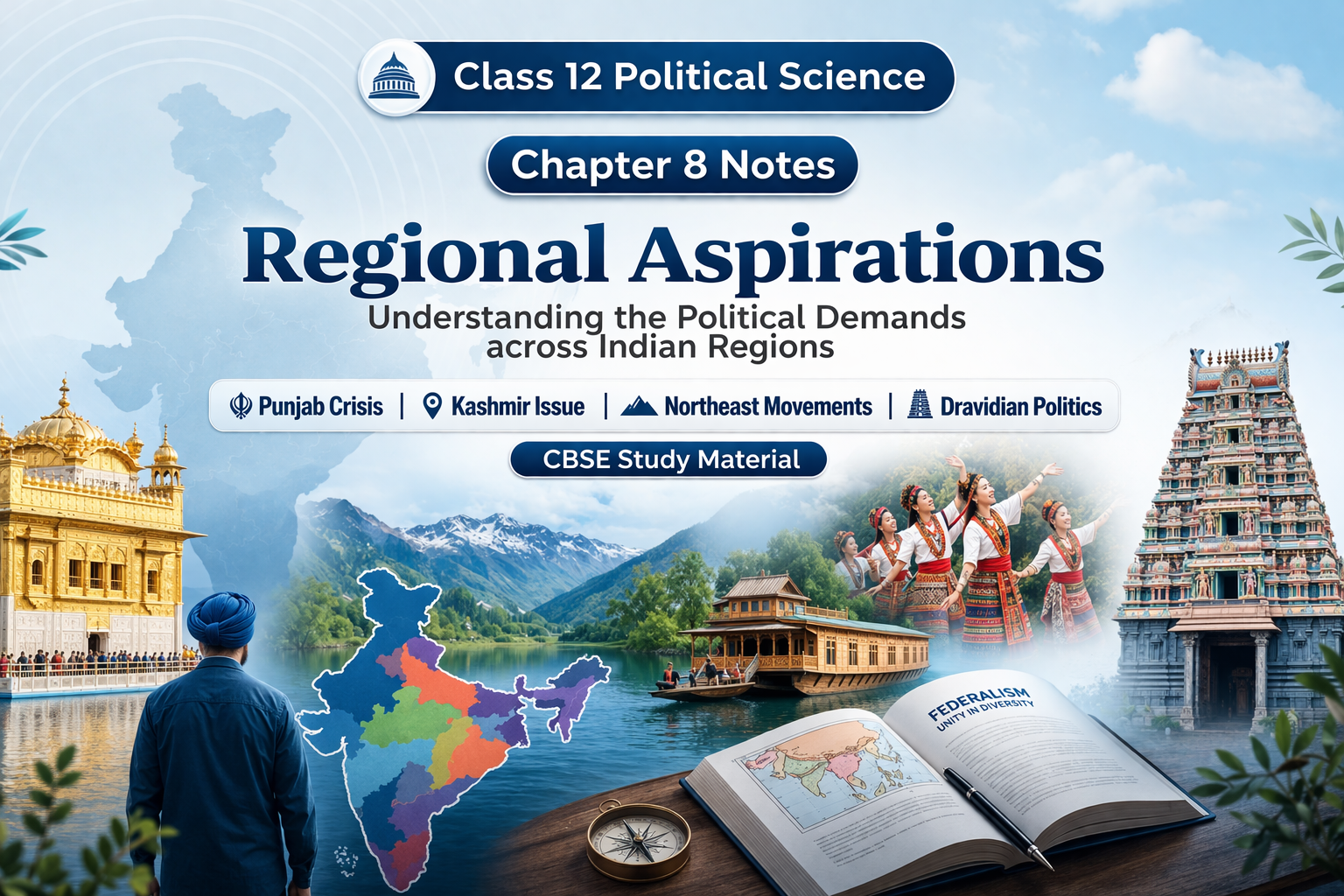
Meta Title: Class 12 Political Science Chapter 8 Notes – Regional Aspirations
Meta Description: Read CBSE Class 12 Political Science Chapter 8 notes on Regional Aspirations. Covers Punjab crisis, Kashmir issue, Northeast movements, Dravidian politics, and more explained simply.
Complete Class 12 Political Science Chapter 8 Notes – Regional Aspirations | CBSE Study Material
Table of Contents
- Introduction
- Meaning of Autonomy and Regional Aspirations
- Main Reasons for Regionalism in India
- Difference Between Regionalism and Separatism
- Jammu and Kashmir Issue
- Punjab Crisis and Operation Blue Star
- Northeast India – Aspirations and Challenges
- Dravidian Movement in South India
- Merger of Sikkim
- Liberation of Goa
- Lessons from Regional Aspirations
- Important Points to Remember
- Important Questions
- Conclusion
Introduction – Regional Aspirations in India
India is a country of extraordinary diversity — different languages, religions, cultures, and geographies exist side by side within a single democratic nation. Class 12 Political Science Chapter 8 on Regional Aspirations explores how different regions of India expressed their unique identities and demands after independence, and how the Indian government responded to these challenges.
Understanding regional aspirations is essential for CBSE Class 12 students because it explains the complex federal dynamics that continue to shape Indian politics today. To understand how these regional issues fit into the broader political picture, you can also read our Class 12 Political Science Chapter 9 Notes on Recent Developments in Indian Politics which covers how regional parties gained national importance.
Meaning of Autonomy and Regional Aspirations – Chapter 8 Class 12
What is Autonomy?
The 1980s are often described as the decade of autonomy in India. Autonomy refers to a state or region demanding special rights or powers to manage its own affairs independently, while still remaining part of the country.
During this period, several states across India raised such demands. In some cases, people took up arms to express their frustration and dissatisfaction with the central government. When regional feelings are channeled constructively, they enrich Indian democracy. However, when they turn into separatist movements driven by outside interference or narrow political interests, they pose serious challenges to national unity.
What Are Regional Aspirations?
Regional aspirations are the specific demands made by people of a particular region based on their language, religion, culture, or geographical identity. These demands typically reflect the desire for:
- Greater political recognition and representation
- Economic development and fairer distribution of resources
- Preservation of local language, culture, and traditions
- More administrative control over local affairs
Class 12 Political Science Chapter 8 CBSE notes explain how India navigated these demands through democratic dialogue rather than suppression.
External Resource: For detailed historical and constitutional information on India’s federal structure and state autonomy, the Constitution of India on the India Code website provides authentic and reliable reference material.
Main Reasons for Regionalism in India – Regional Aspirations Class 12
Regionalism in India did not develop overnight. Class 12 Political Science Chapter 8 identifies several deep-rooted causes behind the growth of regional sentiments:
- Religious and cultural diversity — India’s enormous variety of religious practices and cultural traditions naturally creates distinct regional identities
- Geographical variations — Physical isolation of certain regions, particularly in the Northeast, created communities with their own languages and ways of life
- Political interests and local leadership — Regional politicians built support bases by championing local causes and identities
- Unequal regional development — Some regions felt left behind economically while others prospered, creating resentment and demands for special attention
- Growth of regional political parties — Parties focused on regional issues gave political voice to local grievances that national parties often overlooked
These factors combined to produce strong regional aspirations that the Indian state had to address carefully and continuously throughout the post-independence period.
Difference Between Regionalism and Separatism
Class 12 Political Science Chapter 8 draws an important distinction between regionalism and separatism — two concepts that are often confused but are fundamentally different:
| Regionalism | Separatism |
|---|---|
| Focuses on political, economic, and developmental demands within the region | Demands complete separation of the region from the country |
| Strengthens local identity while remaining part of India | Threatens national unity by promoting division |
| Works within the constitutional framework | Often involves armed struggle or illegal activity |
Understanding this distinction is important for answering CBSE Class 12 Political Science Chapter 8 exam questions accurately.
Jammu and Kashmir Issue – A Key Topic in Chapter 8
Background and Accession to India
Jammu and Kashmir is a region of immense strategic and political significance. It comprises three distinct areas — Jammu, Kashmir, and Ladakh — each with its own cultural character and demographic composition.
Before independence, the state was ruled by Maharaja Hari Singh under a monarchical system. When tribal invaders from Pakistan attacked Kashmir in October 1947, the Maharaja sought India’s military assistance. In exchange, he signed the Instrument of Accession, formally merging Jammu and Kashmir with India.
Special Status Under Article 370
India granted Jammu and Kashmir a special status under Article 370 of the Constitution, giving the state greater autonomy than other Indian states. This arrangement was politically sensitive from the very beginning and remained a subject of intense national debate for decades.
Persistent interference from Pakistan and the growth of internal separatist movements kept the region politically unstable throughout the post-independence period.
Key Political Developments in Jammu and Kashmir
Class 12 Political Science Chapter 8 notes highlight several important political milestones in the Kashmir story:
- Sheikh Abdullah became the dominant political leader and introduced significant land reforms and welfare programs that transformed the lives of ordinary Kashmiris
- Political instability and allegations of rigged elections led to repeated central government interference in state affairs
- In 1974, Prime Minister Indira Gandhi signed an accord with Sheikh Abdullah, temporarily restoring a degree of political stability to the state
- After Sheikh Abdullah’s death, his son Farooq Abdullah became Chief Minister and later chose to ally with the Congress-led central government in 1986
The Kashmir issue remains one of the most complex and long-running challenges in Indian federal politics, making it a consistently important topic in CBSE Class 12 Political Science Chapter 8 study material.
Punjab Crisis – Operation Blue Star and Its Aftermath
Origins of the Punjab Demand
The Akali Dal, founded in the 1920s as a political organization representing Sikh interests, had long demanded a Punjabi-speaking state. This demand was partially addressed in 1966 when the reorganization of Punjab led to the creation of separate states of Haryana and Himachal Pradesh.
However, regional aspirations in Punjab did not end there. At the Anandpur Sahib Resolution of 1973, the Akali Dal put forward demands for greater autonomy for Punjab — including more control over river waters and the transfer of Chandigarh to Punjab.
A more extreme section within the movement began demanding a completely separate Sikh nation called Khalistan, pushing the situation toward a serious security crisis.
Operation Blue Star (1984)
By the early 1980s, militants under the leadership of Jarnail Singh Bhindranwale had occupied the Golden Temple in Amritsar — the holiest shrine in Sikhism — and turned it into an armed fortress.
In June 1984, Prime Minister Indira Gandhi ordered the Indian Army to enter the Golden Temple complex to remove the militants. This military operation, known as Operation Blue Star, deeply wounded the religious sentiments of Sikhs across India and the world.
The consequences were devastating:
- On 31 October 1984, Prime Minister Indira Gandhi was assassinated by her Sikh bodyguards in an act of revenge
- Her assassination triggered horrific anti-Sikh riots across North India, particularly in Delhi, in which thousands of innocent Sikhs were killed
Punjab Accord (1985)
In an effort to restore peace and begin the healing process, Prime Minister Rajiv Gandhi signed the Punjab Accord with Akali Dal leader Harchand Singh Longowal in 1985.
The key provisions of the Punjab Accord were:
- Transfer of Chandigarh to Punjab
- Resolution of Punjab-Haryana border disputes through a proper commission
- Setting up a tribunal for fair river water distribution among Punjab, Haryana, and Rajasthan
- Providing compensation to victims of militancy and communal violence
The Punjab Accord represented one of India’s most important efforts to resolve a regional crisis through democratic negotiation rather than continued conflict.
Northeast India – Aspirations and Challenges
Understanding the Northeast
The Northeast region of India comprises seven states — often called the Seven Sisters — sharing international borders with China, Myanmar, Bangladesh, and Bhutan. This region is extraordinarily rich in cultural diversity, tribal traditions, and natural beauty, but has historically faced challenges related to poor connectivity, limited development, and political unrest.
Class 12 Political Science Chapter 8 gives significant attention to the Northeast because its regional aspirations represent some of the most complex and long-running challenges in Indian federal history.
Demand for Separate States
After independence, most of the Northeast was administratively part of Assam. Many tribal communities felt that their distinct cultural identities, languages, and traditions were not adequately protected within this arrangement.
Over time, these communities demanded separate states where they could govern themselves and preserve their unique ways of life. This led to the creation of several new states in the region including Meghalaya, Manipur, Tripura, and later Mizoram and Arunachal Pradesh.
Mizoram – From Rebellion to Statehood
The story of Mizoram is one of the most remarkable examples of how India resolved a serious armed separatist movement through patient negotiation.
In 1959, a devastating famine struck Mizoram (then part of Assam). The Assam government’s inadequate response to the crisis fueled deep resentment among the Mizo people.
The Mizo National Front (MNF), led by Laldenga, launched an armed insurgency demanding independence from India. The conflict continued for over two decades before Prime Minister Rajiv Gandhi and Laldenga signed the Mizoram Accord in 1986.
Under the accord, Mizoram was upgraded to a full state of India, and the MNF gave up its armed struggle and entered mainstream democratic politics. Today, Mizoram is one of the most peaceful states in the Northeast.
Nagaland – A Long Road to Peace
The Naga National Council (NNC), led by A.Z. Phizo, began an armed struggle for Naga independence as early as 1951. Over the following decades, the movement spawned several armed factions including the NSCN (IM) and NSCN (K).
A peace accord was signed between the Indian government and NSCN (IM) in 2015, but a final comprehensive settlement bringing complete peace to Nagaland remains a work in progress. This makes Nagaland one of India’s longest-running regional conflicts.
The Assam Movement – Opposition to Outsiders
Between 1979 and 1985, the All Assam Students Union (AASU) led a powerful mass movement against illegal migration from Bangladesh into Assam.
The movement expressed genuine fears that:
- Illegal migrants were taking jobs and land from indigenous Assamese people
- The cultural and linguistic identity of Assam was being diluted
- The demographic balance of the state was being permanently altered
The movement ended with the signing of the Assam Accord between AASU leaders and Prime Minister Rajiv Gandhi. However, the issue of illegal migration and its political consequences continues to be one of the most sensitive topics in Assamese politics today.
This topic connects directly to themes discussed in our Class 12 Political Science Chapter 9 Notes on Recent Developments in Indian Politics where the political impact of the Assam movement is further explored.
Dravidian Movement in South India – Regional Aspirations Chapter 8
Origins and Ideology
South India’s regional aspirations took a distinctive cultural and political form through the Dravidian movement in Tamil Nadu.
E.V. Ramaswamy Periyar, known as Periyar, founded this social reform movement with three core objectives:
- Opposing the dominant influence of Brahmin communities in Tamil social and political life
- Resisting the imposition of Hindi as a national language, which Tamil speakers saw as cultural discrimination
- Promoting and celebrating Tamil language and cultural identity as sources of pride and political power
Political Legacy of the Dravidian Movement
The Dravidian movement gave birth to the Dravida Kazhagam (DK) party. This organization later split into two major political parties that have dominated Tamil Nadu politics ever since:
- DMK (Dravida Munnetra Kazhagam) — founded by C.N. Annadurai
- AIADMK (All India Anna Dravida Munnetra Kazhagam) — founded by M.G. Ramachandran
Both parties have alternated in power in Tamil Nadu for decades, and both have consistently championed Tamil cultural identity and state autonomy as their defining political principles.
External Resource: For more information on India’s linguistic diversity and state reorganization, the Registrar General of India website provides authentic census data on India’s languages and demographics.
Merger of Sikkim – Class 12 Political Science Chapter 8
How Sikkim Became Part of India
Sikkim’s story is a unique chapter in India’s post-independence history. After 1947, India managed Sikkim’s defense and foreign affairs while the local king retained control over internal administration.
However, growing democratic aspirations among Sikkim’s people led to increasing pressure for political change. In 1975, a referendum was held in which the people of Sikkim voted overwhelmingly to merge with India.
As a result, Sikkim became India’s 22nd state — the most recent addition to the Indian Union through a fully democratic process. This example demonstrates how India’s regional integration was achieved not only through negotiation and accords but also through democratic participation.
Liberation of Goa – Regional Aspirations Class 12
Portuguese Rule and Indian Liberation
While most of India gained independence from British rule in 1947, the small territories of Goa, Daman, and Diu remained under Portuguese colonial control.
Despite diplomatic efforts over many years, Portugal refused to withdraw from these territories. In December 1961, India launched a swift military operation that liberated Goa, Daman, and Diu from Portuguese rule.
Goa was initially administered as a Union Territory. Following growing demands from its people for full statehood, Goa became a full-fledged state of India in 1987, making it one of the youngest states in the country.
Lessons from Regional Aspirations – What India Learned
Class 12 Political Science Chapter 8 concludes with an important set of lessons that India’s experience with regional aspirations has taught:
- Regional aspirations are a natural and healthy part of democracy — they should be listened to, not suppressed
- Dialogue, negotiation, and power-sharing are far more effective than force in resolving regional conflicts
- Balanced regional development reduces resentment and weakens the appeal of separatist movements
- Respect for cultural and linguistic diversity strengthens national unity rather than weakening it
- Democracy is strong enough to accommodate regional differences while maintaining national integrity
India’s ability to manage its extraordinary diversity through democratic means remains one of its greatest political achievements — a central message of this chapter in Class 12 Political Science CBSE study material.
Important Points to Remember – Class 12 Political Science Chapter 8
- The 1980s are known as the decade of autonomy in India
- Article 370 gave Jammu and Kashmir special autonomous status
- Maharaja Hari Singh signed the Instrument of Accession in 1947
- The Anandpur Sahib Resolution (1973) demanded greater autonomy for Punjab
- Operation Blue Star was launched in June 1984 to flush militants out of the Golden Temple
- Indira Gandhi was assassinated on 31 October 1984
- The Punjab Accord was signed in 1985 between Rajiv Gandhi and Harchand Singh Longowal
- The Mizoram Accord (1986) ended armed insurgency and made Mizoram a full state
- The Assam Accord was signed between AASU and Rajiv Gandhi following the anti-migration movement
- Periyar founded the Dravidian movement in Tamil Nadu, which gave rise to DMK and AIADMK
- Sikkim became India’s 22nd state after a referendum in 1975
- Goa was liberated from Portuguese rule in 1961 and became a full state in 1987
Important Questions – Regional Aspirations Class 12 Political Science
These questions are regularly asked in CBSE board exams and are essential for thorough preparation:
- What are regional aspirations? What are the main causes of regionalism in India?
- What is the difference between regionalism and separatism? Explain with examples.
- Describe the key events in the political history of Jammu and Kashmir after independence.
- What led to the Punjab crisis of the 1980s? What were the consequences of Operation Blue Star?
- What were the main provisions of the Punjab Accord of 1985?
- Describe the factors that led to the Mizo insurgency. How was the conflict resolved?
- What was the AASU movement in Assam? What were its causes and outcomes?
- Explain the origins and political legacy of the Dravidian movement in Tamil Nadu.
- How did Sikkim become a part of India? What role did democratic processes play?
- What lessons can be drawn from India’s experience in managing regional aspirations?
Conclusion – Class 12 Political Science Chapter 8 Regional Aspirations
Class 12 Political Science Chapter 8 on Regional Aspirations tells an inspiring story of how one of the world’s most diverse nations managed to hold itself together through democracy, dialogue, and a genuine commitment to federal principles.
From the Kashmir valley to the hills of Mizoram, from the Golden Temple in Amritsar to the streets of Chennai, India’s regional diversity has at times been a source of tension — but ultimately it has proven to be a source of democratic strength. Every accord signed, every new state created, and every community given political voice has made Indian democracy more representative and more resilient.
These CBSE Class 12 Political Science Chapter 8 notes are designed to help students understand every aspect of regional aspirations clearly and prepare confidently for board exams. For complete exam preparation, also explore our Class 12 Political Science Chapter 7 Notes Security in the Contemporary World and Class 12 Political Science Chapter 9 Notes on Recent Developments in Indian Politics available on this website.



Pingback: Complete Class 12 Political Science Chapter 4 Notes – India's External Relations
Pingback: Class 12 Political Science Chapter 9 Notes – Recent Developments in Indian Politics
Pingback: Challenges of Nation Building Class 12 CBSE – Complete Notes with 10 Must-Know Concepts for Board Exams