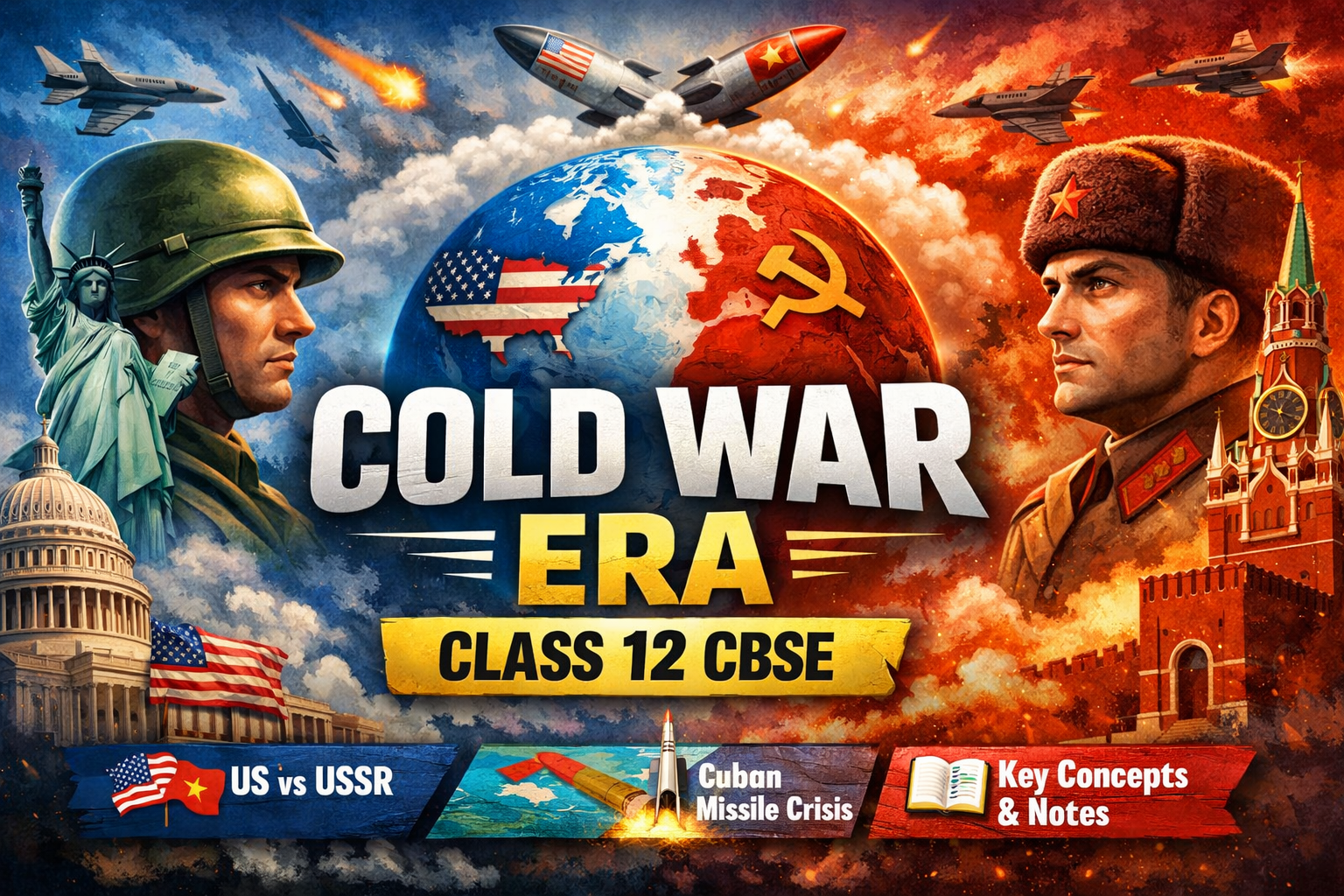
Cold War Era Class 12 CBSE – Complete Notes with 10 Must-Know Concepts for Board Exams
| Field | Detail |
|---|---|
| Chapter | Chapter 1 – The Cold War Era |
| Subject | Political Science (Contemporary World Politics) |
| Class | 12 |
| Board | CBSE |
| Exam Weightage | Check latest CBSE syllabus |
The Cold War Era Class 12 CBSE chapter is the opening chapter of Contemporary World Politics and sets the foundation for understanding how the modern world took shape after World War II. It explains the rivalry between the United States (US) and the Soviet Union (USSR) that dominated global politics for nearly five decades. This chapter carries significant weight in board exams because it introduces concepts like bipolarity, the Non-Aligned Movement, and the logic of nuclear deterrence — ideas that appear across multiple questions every year.
From these notes, you will learn exactly what the Cold War was, why it never became a direct shooting war, how the world split into two rival power blocs, and why countries like India chose a path of non-alignment. Each concept is explained clearly with examples so you can answer both short and long questions with confidence.
Think of the Cold War as the world’s longest and most dangerous standoff — two heavily armed neighbours who kept threatening each other but never actually fired the first shot. Understanding why they held back is the key to unlocking this entire chapter for your board exams.
Table of Contents
- What is the Cold War Era? – Definition and Origins
- The Cuban Missile Crisis – The Cold War at Its Peak
- Logic of Deterrence – Why the Cold War Stayed “Cold”
- The Emergence of Two Power Blocs – NATO vs Warsaw Pact
- Arenas of the Cold War – Where the Rivalry Played Out
- Arms Control Treaties – From Race to Restraint
- Challenge to Bipolarity – The Non-Aligned Movement (NAM)
- Non-Alignment vs Neutrality vs Isolationism – A Critical Distinction
- New International Economic Order (NIEO)
- India and the Cold War – Policy, Benefits, and Criticism
- Important Questions – Cold War Era Class 12 CBSE
- FAQ – Cold War Era Class 12 CBSE
- Quick Revision – Key Points to Remember
- Related Notes on Nextoper – Internal Links
- Useful External Resources
What is the Cold War Era? – Definition and Origins
The Cold War refers to the period of intense rivalry, competition, and tension between the United States of America and the Soviet Union (USSR), along with their respective allies, that lasted from the end of World War II (1945) until the disintegration of the USSR in 1991.
It is called a “cold” war because, despite the extreme hostility between the two superpowers, it never escalated into a direct armed conflict or a “hot war” between them. Wars did happen in various regions — Korea, Vietnam, Afghanistan — but the two superpowers themselves avoided a face-to-face military showdown.
How Did the Cold War Begin?
The Cold War grew out of the aftermath of World War II (1939–1945). In 1945, the Allied Forces — led by the US, Soviet Union, Britain, and France — defeated the Axis Powers. With Germany and Japan defeated and Europe devastated, two powers emerged as the undisputed giants of the world: the US and the USSR.
- The US dropped atomic bombs on Hiroshima and Nagasaki in August 1945, forcing Japan to surrender and ending the war.
- Critics argued the bombings were also meant to warn the USSR and demonstrate American supremacy.
- Whatever the motive, the result was clear: the US and USSR became the world’s two superpowers, each capable of influencing events anywhere on the globe.
The Cold War was not just about military power. It was also a deep ideological conflict — a disagreement about the best way to organise society. The US stood for liberal democracy and capitalism, while the USSR championed socialism and communism.
[Image: World map showing US and USSR as opposing superpowers post-1945 | Alt text: Cold War Era Class 12 CBSE – US vs USSR superpower rivalry map]
The Cuban Missile Crisis – The Cold War at Its Peak
The Cuban Missile Crisis of 1962 is considered the single most dangerous moment of the Cold War Era and is a key topic for Class 12 CBSE board exams.
Background
In April 1961, Soviet leaders feared that the US would invade Cuba and topple its communist leader, Fidel Castro. Cuba was an important Soviet ally, receiving both diplomatic and financial support from the USSR.
Soviet leader Nikita Khrushchev decided to convert Cuba into a military base and secretly placed nuclear missiles there in 1962. This was a significant strategic move — it put American cities within range of Soviet nuclear weapons for the first time, nearly doubling the number of American targets the USSR could threaten.
The Standoff
- Three weeks after installation, the US discovered the missiles.
- President John F. Kennedy ordered American warships to intercept Soviet ships heading to Cuba as a warning.
- The world held its breath — a direct clash between the two nuclear-armed superpowers seemed imminent.
- Both sides ultimately pulled back. Soviet ships slowed down and turned around.
The crisis was resolved without war, but it demonstrated just how close the world had come to nuclear catastrophe. It also showed that both sides preferred a negotiated retreat over mutual destruction.
Logic of Deterrence – Why the Cold War Stayed “Cold”
One of the most important conceptual questions in the Cold War Era Class 12 CBSE chapter is: why did this intense rivalry never turn into a real war?
The answer lies in the concept of deterrence.
Deterrence means that when both sides possess enough nuclear weapons to destroy the other, neither side will dare to attack first. Even if one side launched a surprise attack and destroyed most of the enemy’s weapons, the other side would still have enough left to launch a devastating counter-attack. The destruction would be so catastrophic that no political gain could ever justify starting the war.
This logic works as follows:
- Both superpowers had thousands of nuclear weapons by the early 1950s — each far more powerful than the bombs dropped on Hiroshima and Nagasaki.
- A nuclear war would leave no true winner — both societies would be destroyed.
- Therefore, both sides chose to compete through proxy wars, alliances, and ideological rivalry rather than direct combat.
The Cold War remained cold precisely because both sides were rational enough to understand that fighting would mean mutual annihilation. This is also called Mutually Assured Destruction (MAD).
The Emergence of Two Power Blocs – NATO vs Warsaw Pact
As the Cold War intensified, the world divided into two rival alliance systems — one led by the US and one by the USSR.
The Western Alliance – NATO
The North Atlantic Treaty Organisation (NATO) was formed in April 1949. It was an association of twelve states that agreed: an armed attack on any one of them in Europe or North America would be treated as an attack on all of them. Each member was obliged to help the others.
The Eastern Alliance – Warsaw Pact
The Warsaw Pact was created in 1955 and led by the Soviet Union. Its main purpose was to counter NATO’s military presence in Europe. Most countries of Eastern Europe — Poland, Hungary, Czechoslovakia, Romania, Bulgaria, and others — became part of this alliance.
Why Did Smaller States Join These Alliances?
The superpowers needed smaller allies for four key reasons:
- Access to vital resources like oil and minerals
- Use of their territory to launch weapons or station troops
- Strategic locations from which to spy on the rival superpower
- Economic support — many small allies together could help fund military operations
Smaller states, in turn, received the promise of protection, weapons, and economic aid against their regional rivals. The US also built the Southeast Asian Treaty Organisation (SEATO) and the Central Treaty Organisation (CENTO) in Asia and the Middle East. The USSR and China countered by building close ties with North Vietnam, North Korea, and Iraq.
Arenas of the Cold War – Where the Rivalry Played Out
The Cold War did not stay confined to Europe. It spread to many parts of the world in what are called “arenas” — regions where crisis and armed conflict occurred between the alliance systems without crossing into a full-scale global war.
Key arenas included:
- Korea (1950–53): The Korean War, in which US-backed South Korea and USSR-backed North Korea fought. Nehru played an important mediation role here.
- Berlin (1958–62): The Berlin Blockade and the construction of the Berlin Wall were major flashpoints.
- Congo (early 1960s): UN Secretary-General played a key mediatory role in resolving this crisis.
- Vietnam (1954–75): American military intervention in Vietnam became one of the Cold War’s costliest conflicts.
- Afghanistan (1979–89): Soviet intervention in Afghanistan became a prolonged and draining conflict for the USSR.
In each of these arenas, the logic of restraint ultimately prevailed — the superpowers did not allow regional conflicts to escalate into a nuclear exchange.
[Image: Cold War timeline infographic with key events from 1947 to 1991 | Alt text: Cold War Era Class 12 CBSE – important events timeline from 1947 to 1991]
Arms Control Treaties – From Race to Restraint
This is a section that most competitors skip entirely, making it a unique content gap for CBSE students. Arms control treaties are frequently tested in board exams.
As both superpowers accumulated massive stockpiles of weapons, they also realised that an uncontrolled arms race was dangerous and expensive. Starting in the 1960s, the US and USSR negotiated a series of important agreements to limit and reduce nuclear weapons.
Key Arms Control Treaties
- Limited Test Ban Treaty (LTBT) – 1963: Banned nuclear weapon tests in the atmosphere, outer space, and underwater. Signed by the US, UK, and USSR on 5 August 1963.
- Nuclear Non-Proliferation Treaty (NPT) – 1968: Only the five recognised nuclear weapon states (US, USSR/Russia, UK, France, China) were allowed to keep nuclear weapons. All others agreed not to develop them.
- SALT-I (1972): The first Strategic Arms Limitation Talks agreement, signed by President Nixon and Soviet leader Brezhnev, limiting anti-ballistic missile systems and strategic offensive arms.
- SALT-II (1979): A further agreement limiting strategic offensive arms, signed by President Carter and Brezhnev.
- START-I (1991) and START-II (1993): Strategic Arms Reduction Treaties that went further — they actually required both sides to reduce their existing nuclear arsenals rather than just limiting new ones.
These treaties show that even in the middle of a bitter rivalry, both sides could cooperate when mutual survival was at stake.
Challenge to Bipolarity – The Non-Aligned Movement (NAM)
The Non-Aligned Movement (NAM) was the most important challenge to the Cold War’s bipolar world order and is a heavily examined topic in the Cold War Era Class 12 CBSE chapter.
What Was NAM?
Non-alignment offered newly decolonised countries of Asia, Africa, and Latin America a third option — to remain outside both the American-led and Soviet-led alliance systems. It was not about being inactive or indifferent to world affairs; rather, non-aligned countries actively participated in global diplomacy on their own terms.
Founders of NAM
The movement grew from a 1956 meeting between three key leaders:
- Josip Broz Tito – President of Yugoslavia
- Jawaharlal Nehru – Prime Minister of India
- Gamal Abdel Nasser – Leader of Egypt
They were strongly supported by Sukarno of Indonesia and Kwame Nkrumah of Ghana. These five are recognised as the five founders of NAM.
The first Non-Aligned Summit was held in Belgrade in 1961, attended by 25 member states. Three factors drove its formation:
- Cooperation among the five founding nations
- Escalating Cold War tensions and their spread to new regions
- The emergence of many newly decolonised African nations — by 1960, there were 16 new African members in the UN
By 2019, the 18th NAM Summit was held in Azerbaijan, with 120 member states and 17 observer countries — a testament to how widely the movement grew.
Non-Alignment vs Neutrality vs Isolationism – A Critical Distinction
This is a distinction that almost no competitor article explains clearly, yet it is a direct exam question. Understanding the difference is essential for full marks.
| Concept | Meaning | Example |
|---|---|---|
| Non-Alignment | Staying outside military alliances but actively engaging in world affairs to promote peace | India during the Cold War |
| Neutrality | Staying completely out of wars; not taking any position on conflicts | Switzerland in World War II |
| Isolationism | Staying aloof from world affairs entirely; avoiding all international engagement | US foreign policy from 1787 to WWI |
Non-aligned states like India were not neutral — they actively worked to prevent wars, mediated between rivals (e.g., during the Korean War), and took strong positions on issues like decolonisation and nuclear disarmament. Nor were they isolationist — they were deeply engaged in international organisations and global diplomacy.
New International Economic Order (NIEO)
As NAM grew, non-aligned countries realised that political independence was incomplete without economic independence. Most of these nations were classified as Least Developed Countries (LDCs) and remained economically dependent on their former colonial powers.
The concept of a New International Economic Order (NIEO) emerged from this need. In 1972, the United Nations Conference on Trade and Development (UNCTAD) published a report titled Towards a New Trade Policy for Development, which proposed reforming the global economic system to:
- Give LDCs control over their own natural resources, which were being exploited by wealthy Western nations
- Provide LDCs access to Western markets so they could trade their goods on fair terms
- Reduce the cost of technology transferred from Western countries
- Give LDCs a greater voice in international economic institutions
By the mid-1970s, economic issues had displaced political ones as the top priority of NAM. The movement functioned as an economic pressure group. However, by the late 1980s, the NIEO initiative had faded — developed countries acted as a united bloc in opposing it, while the non-aligned countries struggled to stay united.
India and the Cold War – Policy, Benefits, and Criticism
India’s approach to the Cold War Era was shaped by its leadership of NAM. As Class 12 CBSE students, you should know both the benefits and the criticisms of India’s non-alignment policy.
India’s Two-Fold Response
- India carefully avoided joining either alliance system.
- India actively discouraged newly independent countries from joining either bloc.
India’s policy was not passive withdrawal — Nehru described it as the opposite of “fleeing away.” Indian diplomats frequently mediated between Cold War rivals. India’s role in reducing tensions during the Korean War in the early 1950s is a key example.
Benefits of Non-Alignment for India
India’s non-aligned stance served its national interest in two direct ways:
- Autonomous decision-making: India could take positions that served its own interests rather than those of either superpower.
- Strategic balancing: If pressured by one superpower, India could tilt toward the other. Neither bloc could bully or ignore India.
Criticisms of India’s Non-Alignment
India’s policy was criticised on two main grounds:
- Unprincipled: Critics said India avoided taking firm stands on crucial international issues in the name of national interest.
- Inconsistent: India criticised others for joining alliances, yet signed a 20-year Treaty of Friendship with the USSR in August 1971. Many observers saw this as India effectively joining the Soviet camp. The Indian government’s defence was that the treaty was needed for diplomatic and military support during the Bangladesh crisis, and did not prevent India from maintaining good relations with the US.
With the end of the Cold War in 1991, non-alignment lost much of its earlier relevance. However, its core ideas — that small nations can pursue independent foreign policies, that the international system must be democratised, and that former colonial nations share a common historical bond — remain meaningful today.
Important Questions – Cold War Era Class 12 CBSE
1 Mark Question
Q. What is meant by ‘deterrence’ in the context of the Cold War? Ans. Deterrence means that when both sides possess enough nuclear weapons to destroy each other, neither side will initiate war because the retaliation would cause unacceptable destruction.
3 Mark Questions
Q. Why did the superpowers need military alliances with smaller states?
Ans. Despite their overwhelming nuclear and military power, superpowers valued smaller allies for practical reasons. First, smaller states provided access to vital resources like oil and minerals. Second, they offered territory from which the superpowers could launch weapons or troops and spy on rivals. Third, many small allies together could contribute to the financial cost of maintaining military operations. Smaller states, in turn, gained protection, weapons, and economic aid from their superpower patrons.
Q. What were the main objectives of the New International Economic Order (NIEO)?
Ans. The NIEO was proposed to reform the global trading system in favour of the world’s poorest nations. Its four main goals were: giving Least Developed Countries (LDCs) control over their natural resources being exploited by wealthy nations; providing LDCs fair access to Western markets; reducing the cost of technology transfers from developed countries; and giving LDCs a greater role in international economic decision-making institutions like the World Bank and IMF.
5 Mark Questions
Q. Explain the Cuban Missile Crisis. What does it tell us about the nature of the Cold War?
Ans. The Cuban Missile Crisis of 1962 was the most dangerous episode of the Cold War. In 1961, Soviet leader Nikita Khrushchev feared a US invasion of communist Cuba — an important Soviet ally. He secretly installed nuclear missiles in Cuba in 1962, bringing American cities within range for the first time. When the US discovered this three weeks later, President Kennedy ordered warships to intercept Soviet ships heading to Cuba. The world braced for a nuclear confrontation. Eventually, both sides stepped back — Soviet ships turned around and the missiles were removed.
The crisis illustrates the Cold War’s defining logic: both superpowers were willing to push to the brink but ultimately pulled back because the cost of actual nuclear war was too high for either side to bear. It also showed that crises could spiral dangerously due to miscalculation, making arms control agreements between the two sides all the more urgent.
Q. Describe India’s policy of non-alignment during the Cold War. How did it serve India’s interests?
Ans. India’s non-alignment policy, articulated primarily by Prime Minister Jawaharlal Nehru, aimed to keep India outside the rival US-led and USSR-led alliance systems while remaining actively engaged in world affairs. Nehru made clear that non-alignment was not “fleeing away” from the world but a positive commitment to peace and the reduction of Cold War tensions.
India served as a mediator in several Cold War conflicts — most notably in the Korean War in the early 1950s — and worked to activate international organisations not tied to either bloc. India’s position brought two direct benefits: it allowed India to take international decisions based on its own national interest, and it gave India the strategic flexibility to balance one superpower against the other so that neither could bully or take India for granted.
However, the policy attracted criticism. Some argued India was “unprincipled” in refusing to take firm stands on global issues. Others pointed out that India’s 1971 Treaty of Friendship with the USSR seemed to contradict its non-aligned stance. The Indian government maintained that the treaty was a practical necessity during the Bangladesh crisis and did not prevent good relations with other countries.
FAQ – Cold War Era Class 12 CBSE
Q1. What is the difference between non-alignment and neutrality?
Non-alignment means staying outside military alliances while actively participating in world affairs and working to reduce global tensions. Neutrality, by contrast, means staying completely out of wars and taking no position on conflicts. Non-aligned countries like India were very much involved in world affairs — they mediated in wars and took strong positions on issues like decolonisation. They were not neutral.
Q2. Who were the five founders of the Non-Aligned Movement?
The five founding leaders of NAM were Josip Broz Tito of Yugoslavia, Jawaharlal Nehru of India, Gamal Abdel Nasser of Egypt, Sukarno of Indonesia, and Kwame Nkrumah of Ghana. They first came together in 1956 and held the first Non-Aligned Summit in Belgrade in 1961, with 25 member states attending.
Q3. Why did the Cold War never become a “hot war” or full-scale conflict?
The key reason was nuclear deterrence. Both the US and USSR possessed thousands of nuclear weapons, each far more destructive than those used in World War II. A full-scale nuclear war would have destroyed both societies completely, with no winner possible. Since no political gain could justify such mutual destruction, both sides exercised restraint and avoided direct military confrontation, choosing instead to compete through proxy wars and alliances.
Q4. What was the significance of the Cuban Missile Crisis for arms control?
The Cuban Missile Crisis of 1962 brought home to both superpowers just how close a nuclear war could come due to miscalculation and miscommunication. This experience made both sides more serious about negotiating arms control. Starting in the 1960s, the two countries signed several major agreements — the Limited Test Ban Treaty (1963), the Nuclear Non-Proliferation Treaty (1968), and the SALT agreements — to manage and reduce the risk of nuclear war.
Q5. Is NAM still relevant today? What are its enduring ideas?
With the end of the Cold War in 1991, NAM lost its original context of opposing superpower alliances. However, its core ideas remain relevant. The belief that small and developing nations can pursue independent foreign policies, that the international system must become more democratic and equitable, and that former colonial nations share common interests — these principles continue to guide India’s foreign policy and international diplomacy even today.
Quick Revision – Key Points to Remember
- The Cold War was a period of rivalry and tension between the US and USSR from 1945 to 1991 that never escalated into a direct military conflict.
- The Cold War combined power rivalry, military alliances, and ideological conflict — the US stood for liberal democracy and capitalism; the USSR for socialism and communism.
- Deterrence is the logic that prevented a full-scale war: both sides could retaliate with devastating nuclear force, making any first strike pointless.
- The Cuban Missile Crisis (1962) was the most dangerous moment of the Cold War, resolved when both sides chose negotiation over confrontation.
- NATO (1949) was the US-led western military alliance; the Warsaw Pact (1955) was the Soviet-led eastern military alliance.
- The superpowers needed smaller allies for resources, territory, spy locations, economic support, and ideological legitimacy.
- Key Cold War arenas included Korea, Berlin, Congo, Vietnam, and Afghanistan.
- The Non-Aligned Movement (NAM) was founded by five leaders — Tito, Nehru, Nasser, Sukarno, and Nkrumah — with the first summit in Belgrade in 1961.
- Non-alignment ≠ neutrality ≠ isolationism: non-aligned states actively engaged in world affairs; neutral states stayed out of wars; isolationist states avoided all world engagement.
- NIEO was NAM’s economic agenda — seeking fairer trade terms, control over natural resources, and greater voice in international institutions for developing nations.
Related Notes on Nextoper – Internal Links
Explore these related CBSE notes on Nextoper to strengthen your preparation:
- End of Bipolarity – Class 12 CBSE Political Science Notes
- Alternative Centres of Power Notes – Class 12 Political Science Chapter 4 Notes
- Class 12 Political Science Chapter 6 Notes – International Organizations
- Security in the Contemporary World – Class 12 Political Science Chapter 7 Notes
You can join me on Facebook, Instagram here you will keep getting new notes, updates, and important information related to education.