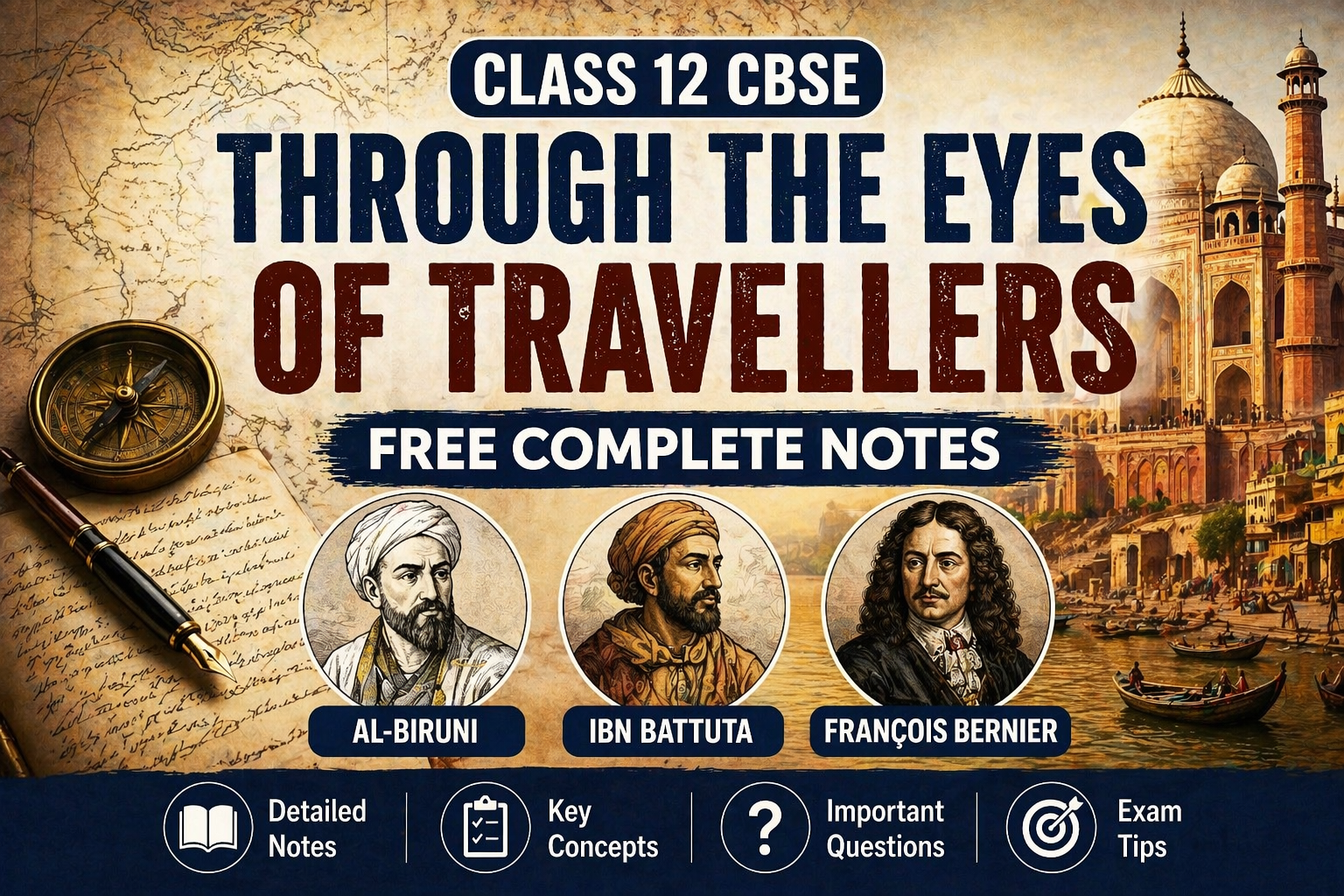
Class 12 CBSE Through the Eyes of Travellers – Free Complete Notes
| Field | Detail |
|---|---|
| Chapter | Chapter 5 – Through the Eyes of Travellers: Perceptions of Society |
| Subject | History (Themes in Indian History – Part II) |
| Class | 12 |
| Board | CBSE |
| Exam Marks | See latest syllabus |
| Difficulty | Moderate / Important |
Through the Eyes of Travellers Class 12 CBSE is a chapter that studies how three foreign travellers — Al-Biruni, Ibn Battuta, and François Bernier — perceived Indian society between the tenth and seventeenth centuries. Their accounts cover caste, trade, cities, women’s lives, slavery, and the philosophical debates of their time. Because each man came from a completely different background, they noticed things that local writers overlooked, making their records uniquely valuable to historians today.
This chapter carries significant weight in the board exam. Students regularly face 3-mark and 5-mark questions asking them to compare the three travellers, explain Al-Biruni’s barriers to understanding, or discuss Bernier’s views on landownership. Source-based questions drawn directly from the NCERT primary sources — such as the description of the postal system or the Varna system — also appear frequently.
The chapter connects to a larger question about how outsiders understand India. Bernier’s flawed descriptions of Mughal India later influenced French philosopher Montesquieu and even Karl Marx. Understanding these travellers, then, is not just about medieval history — it is about how perceptions shape politics across centuries.
What’s in These Notes?
- Who Were the Three Travellers?
- Al-Biruni and the Kitab-ul-Hind: Through the Eyes of Travellers Class 12 CBSE
- Al-Biruni’s Barriers to Understanding India
- Ibn Battuta’s Rihla — The Globe-Trotter from Morocco
- Ibn Battuta on Indian Cities, Trade and the Postal System
- François Bernier — A Doctor Who Compared East and West
- Bernier’s Views on Landownership and Their Global Impact
- All Three Travellers Compared — Class 12 CBSE Quick Table
- Women in Travellers’ Accounts — Sati, Slavery and Labour
- Important Questions — Through the Eyes of Travellers Class 12 CBSE
- FAQ — Through the Eyes of Travellers Class 12 CBSE
- Quick Revision — Key Points to Remember
- Explore More CBSE Notes on Nextoper
- Trusted Resources for Deeper Study
Who Were the Three Travellers?
The subcontinent attracted travellers for centuries — traders, diplomats, scholars, and adventurers. What makes the accounts of Al-Biruni, Ibn Battuta, and Bernier different from local writing is simple: they came from outside. Writers who grow up in a society rarely describe its everyday customs because nothing seems unusual to them. A foreigner, on the other hand, notices exactly those things — the coconut, the paan leaf, the postal system, the practice of sati.
The three travellers the NCERT chapter focuses on operated in very different historical contexts. Al-Biruni arrived in the eleventh century, brought involuntarily from Central Asia as a hostage after Sultan Mahmud’s invasion, and turned that difficult situation into a life’s work of scholarship. Ibn Battuta came in the fourteenth century from Morocco purely out of a love for travel, and his Rihla gives us some of the most vivid street-level descriptions of medieval Indian cities available anywhere. François Bernier arrived in the seventeenth century as a French doctor attached to the Mughal court, and unlike the other two, he was primarily interested in comparing India unfavourably with Europe.
The perspective from which each man wrote shaped everything he recorded. That is the central lesson of this chapter — a traveller’s account is not a neutral camera. It is always coloured by where the traveller came from, what he already believed, and who he was writing for. Understanding those filters is what separates a good board exam answer from a mediocre one.
Al-Biruni and the Kitab-ul-Hind: Through the Eyes of Travellers Class 12 CBSE
Al-Biruni was born in 973 CE in Khwarizm, in present-day Uzbekistan. Khwarizm was a renowned centre of learning, and Al-Biruni received the best education available at the time, becoming fluent in Syriac, Arabic, Persian, Hebrew, and Sanskrit. Though he did not know Greek, he read Greek philosophers through Arabic translations. In 1017, when Sultan Mahmud invaded Khwarizm, he took scholars and poets back to Ghazni; Al-Biruni was among them. He arrived as a hostage but gradually grew fond of Ghazni and stayed there until his death at the age of 70.
His interest in India deepened in Ghazni. Sanskrit works on astronomy, mathematics, and medicine had been flowing into Arabic scholarship from the eighth century onwards, and when the Punjab came under Ghaznavid control, Al-Biruni was able to travel and interact with local Brahmana scholars. He spent years learning Sanskrit and studying religious and philosophical texts alongside these priests.
The Kitab-ul-Hind — Structure and Contents
Kitab-ul-Hind, written in Arabic, is a large and carefully organised work divided into 80 chapters. Its subjects range from religion and philosophy to festivals, astronomy, alchemy, manners and customs, social life, weights and measures, iconography, laws, and metrology (the science of measurement). Each chapter typically follows a three-part structure: Al-Biruni opens with a question, provides a description based on Sanskritic traditions, and then compares the Indian practice with customs in other societies. This almost geometric approach reflected his mathematical mind.
Al-Biruni most likely wrote the Kitab-ul-Hind for people living along the frontiers of the subcontinent — audiences who wanted to understand Indian society but had no access to its texts. He was critical of earlier Arabic translations of Sanskrit works and consciously set out to produce something more rigorous and accurate. Think of it like a student who reads five poor summaries of a book and then goes back to the original to write a better one — that was Al-Biruni’s intellectual motivation.
Al-Biruni’s Barriers to Understanding India
Al-Biruni was unusual among medieval scholars because he was honest about the limits of his own understanding. He identified three barriers that made comprehending Indian society difficult for an outsider:
- Language barrier: Sanskrit was so structurally different from Arabic and Persian that ideas and concepts could not be translated directly. A single Sanskrit word might have multiple meanings depending on context, and the same concept might have numerous different names.
- Religious barrier: The differences in religious beliefs and ritual practices between Islamic and Hindu traditions created a wall of mutual incomprehension.
- Insularity of the local population: Al-Biruni felt that Indians, absorbed in their own philosophical and cultural world, were often reluctant to engage seriously with outsiders.
Despite naming these three barriers, Al-Biruni relied almost entirely on normative Brahmanical texts — the Vedas, the Puranas, the Bhagavad Gita, works of Patanjali, and the Manusmriti. This is a crucial limitation to note for board exams: because his sources were almost exclusively upper-caste, his picture of Indian society reflected the Brahmanical ideal rather than the lived reality.
Al-Biruni on the Caste System
Al-Biruni tried to explain the caste system by comparing it with similar social divisions in other cultures. He noted that ancient Persia also had four social categories: knights and princes, monks and fire-priests, physicians and scientists, and peasants and artisans. His argument was simple: rigid social hierarchies were not unique to India. He also pointed out that within Islam, all men are considered equal before God, differing only in their degree of piety.
However, while Al-Biruni accepted the Brahmanical description of the four varnas — Brahmana, Kshatriya, Vaishya, and Shudra — he firmly rejected the concept of pollution attached to it. His reasoning was philosophical: everything in nature strives to return to purity. The sun purifies the air; salt keeps seawater clean. Social pollution, he argued, went against the laws of nature. In reality, as the NCERT text notes, the system was not as rigid as the texts suggested — those defined as antyaja (outside the system) still participated in economic networks as labourers and artisans.
Ibn Battuta’s Rihla — The Globe-Trotter from Morocco
Ibn Battuta was born in Tangier, Morocco in 1304, into a family known for expertise in Islamic religious law (shari’a). Unlike most scholars of his class, he believed that travel was a more important source of knowledge than books. He set out at the age of 22, and by the time he arrived in India in 1332–33, he had already visited Mecca, Syria, Iraq, Persia, Yemen, Oman, and trading ports along the East African coast.
Travelling overland through Central Asia, he reached Sind in 1333. He had heard about the reputation of Muhammad bin Tughlaq, the Sultan of Delhi, as a generous patron of arts and letters. He made his way to Delhi via Multan and Uch. The Sultan was impressed by his scholarship and appointed him qazi (judge) of Delhi. He held the position for several years, fell out of favour and was imprisoned, was restored to service after a misunderstanding was cleared, and in 1342 was ordered to proceed to China as the Sultan’s envoy to the Mongol ruler.
Ibn Battuta’s journey from India onwards took him to the Malabar coast, the Maldives (where he served as qazi for eighteen months), Sri Lanka, Bengal, Assam, Sumatra, and eventually the Chinese port of Zaytun (modern Quanzhou). He returned to Morocco in 1354, nearly thirty years after leaving home. Travel in the fourteenth century was genuinely dangerous — he was attacked by robbers several times, including an ambush on the road from Multan to Delhi where many in his caravan lost their lives. It took forty days to travel from Multan to Delhi and about fifty days from Sind to Delhi.
The Rihla — How It Was Written
The Rihla was not written by Ibn Battuta himself. When he returned to Morocco, the local ruler instructed a scholar named Ibn Juzayy to sit with Ibn Battuta and write down what he dictated. The result was a richly detailed account of cultures, court life, geography, and everyday customs across the medieval world. His account is often compared to that of Marco Polo, though Ibn Battuta travelled more extensively and to more regions.
Ibn Battuta on Indian Cities, Trade and the Postal System
Ibn Battuta found Indian cities in the fourteenth century densely populated, prosperous, and full of opportunity. Delhi was the largest city he had ever seen, and Daulatabad in Maharashtra rivalled it in size. Most cities had crowded streets and colourful markets stacked with goods of every kind.
The bazaars were not merely commercial spaces. Most had a mosque and a temple within them, and some set aside areas for public performances — singers, musicians, dancers. Ibn Battuta’s famous description of the Tarababad market in Daulatabad, where female singers performed for audiences including Hindu and Muslim rulers alike, shows just how vibrant and cosmopolitan medieval Indian urban life actually was.
Indian agriculture also impressed him. The fertility of the soil allowed farmers to cultivate two crops a year, and the subcontinent was well integrated with inter-Asian trade networks. Indian textiles — cotton cloth, fine muslins, silks, brocades, and satins — were in great demand across West Asia and Southeast Asia. Some fine muslins were so expensive that only nobles and the very wealthy could wear them.
The Postal System — Uluq and Dawa
Perhaps the most remarkable passage in the Rihla for a modern reader is Ibn Battuta’s description of the postal system. The system had two forms. The horse-post, called uluq, ran using royal horses stationed every four miles. The foot-post, called dawa, operated over shorter distances — runners stationed at every one-third of a mile, each carrying a copper-belled rod that would alert the next runner. This system was so efficient that while it took fifty days to travel from Sind to Delhi on the road, spy reports reached the Sultan through the postal system in just five days. Fruits from Khurasan — luxuries that spoiled quickly — were regularly transported to Delhi using this foot-post.
François Bernier — A Doctor Who Compared East and West
François Bernier (1620–1688) was a Frenchman — a doctor, political philosopher, and historian. He arrived in the Mughal Empire in 1656 and stayed for twelve years until 1668. He served first as physician to Prince Dara Shukoh, the eldest son of Emperor Shah Jahan, and later became closely associated with Danishmand Khan, an Armenian noble at the Mughal court, in the role of intellectual and scientist.
Unlike Al-Biruni, who tried to understand India on its own terms, and unlike Ibn Battuta, who recorded whatever excited and surprised him, Bernier had a specific intellectual agenda. He was preoccupied with comparing India unfavourably with Europe — particularly France. His major work was dedicated to King Louis XIV of France, and many of his other writings took the form of letters to influential French ministers and officials. His purpose was to influence European policy-makers by using India as a cautionary example.
His representation of India worked on a model of binary opposition — India as the opposite of Europe, and consistently inferior. He described Mughal cities as full of “ill air,” agricultural land overspread with “bushes,” and the entire political system as one of tyranny and backwardness. These were not always accurate observations, and the NCERT text is careful to point this out. Yet when his works were published in France in 1670–71, they became enormously popular — reprinted eight times in French and three times in English within a few decades, a circulation that Arabic and Persian manuscripts of the same period could not begin to match.
Bernier’s Views on Landownership and Their Global Impact
The single issue Bernier returned to again and again was land ownership. He believed that in the Mughal Empire, the emperor owned all land and distributed it among his nobles, who could not pass it to their children. This, he argued, removed any incentive for landholders to invest in improving land over the long term. Without the security of private property, agriculture suffered, peasants were oppressed, and society stagnated.
Bernier’s picture was actually an oversimplification. Mughal official documents, including Abu’l Fazl’s account in the Ain-i-Akbari, describe land revenue not as rent owed to the emperor as landowner, but as “remunerations of sovereignty” — a tax in exchange for protection, not a claim of ownership. The reality of rural society was far more complex: big zamindars enjoyed superior land rights, a middle layer of prosperous peasants used hired labour, and small subsistence farmers sat at the bottom. This was not the undifferentiated mass of poverty that Bernier described. Even within his own account, contradictions appear — he acknowledged that Bengal surpassed Egypt in agricultural output, that gold and silver from across the world flowed into Hindustan, and that a prosperous merchant community was actively engaged in long-distance trade.
Why This Matters — Montesquieu, Marx, and “Oriental Despotism”
Bernier’s distorted account had real consequences in global intellectual history. The French philosopher Montesquieu used Bernier’s descriptions to develop his theory of oriental despotism — the idea that Asian rulers exercised absolute and arbitrary power over their subjects, who owned nothing and lived in permanent subjugation. This became a foundational idea in European political thought, used to justify later colonial arguments that Asia needed European governance.
In the nineteenth century, Karl Marx drew on this tradition to develop the concept of the Asiatic mode of production. He argued that in India and other Asian countries, surplus was extracted entirely by the state, leaving villages as internally egalitarian but externally stagnant communities, incapable of generating change from within. Both Montesquieu’s and Marx’s theories were significantly shaped by an account that the NCERT now points out was factually incomplete. Students who understand this chain of influence will be able to write genuinely strong 5-mark answers.
All Three Travellers Compared — Class 12 CBSE Quick Table
| Feature | Al-Biruni | Ibn Battuta | François Bernier |
|---|---|---|---|
| Century | 11th (1017 onwards) | 14th (1333–1342) | 17th (1656–1668) |
| Country of Origin | Uzbekistan (Khwarizm) | Morocco (Tangier) | France |
| Primary Work | Kitab-ul-Hind | Rihla | Travels in the Mughal Empire |
| Language of Writing | Arabic | Arabic (dictated to Ibn Juzayy) | French |
| Purpose | Scholarly — to help outsiders understand India | Personal curiosity and love of travel | Political — to warn European rulers using India as a contrast |
| Main Limitation | Over-reliance on Brahmanical texts | Some exaggeration; culturally biased analogies | Deliberate negative comparison; oversimplified land ownership |
| Audience | Peoples on the frontier of the subcontinent | General readers; the Moroccan ruler | European policy-makers and intellectuals |
Women in Travellers’ Accounts — Sati, Slavery and Labour
The men who wrote these travelogues were interested in women — but their interest was selective. They noticed what was dramatic and different: the practice of sati and the existence of slavery. They largely ignored what was ordinary: women working in fields, women participating in trade, women managing households.
Ibn Battuta recorded that slaves — including female slaves — were openly bought and sold in markets, treated as commodities and regularly exchanged as gifts. When he reached Sind, he purchased horses, camels, and slaves as gifts for Sultan Muhammad bin Tughlaq. Some female slaves in the Sultan’s service were highly skilled musicians and dancers. Female slaves were also employed to spy on nobles by entering their homes unannounced. The price of female slaves for domestic labour was very low, and most families that could afford to kept one or two.
Bernier focused on sati — the practice of a widow immolating herself on her husband’s funeral pyre. He noted that while some women appeared to accept death willingly, others were clearly forced. His most striking description is of a child widow at Lahore, no more than twelve years old, being forcibly led to the pyre by Brahmanas and an old woman, trembling and weeping, her hands and feet bound so she could not flee.
However, the NCERT chapter is deliberate in pointing out what the travellers missed. Women’s labour was central to both agricultural and non-agricultural production. Women from merchant families participated in commercial activities — some even took mercantile disputes to courts of law. The travellers’ attention was drawn to the extraordinary and the distressing; the everyday reality of women’s working lives went largely unnoticed.
Important Questions — Through the Eyes of Travellers Class 12 CBSE
1 Mark
Q: What is the Kitab-ul-Hind? The Kitab-ul-Hind is a book written by Al-Biruni in Arabic, divided into 80 chapters covering Indian religion, philosophy, astronomy, social life, customs, laws, and metrology.
3 Marks
Q: What were the three barriers Al-Biruni identified to understanding India?
Al-Biruni, despite his deep scholarship, acknowledged that understanding Indian society posed serious difficulties. The first barrier was language — Sanskrit was so different from Arabic and Persian that even careful translation could not carry ideas across without distortion. The second barrier was religion — the differences in beliefs and ritual practices between the Islamic and Hindu traditions created a deep wall of incomprehension. The third barrier was the insularity of the Indian population — Al-Biruni felt that local scholars were so absorbed in their own intellectual world that they had little interest in engaging with outsiders. These three barriers help explain why even Al-Biruni, who spent years learning Sanskrit and studying Brahmanical texts, produced a picture of Indian society that was shaped more by normative texts than by lived experience.
Q: Why did Bernier describe Indian cities as “camp towns”? Was this accurate?
Bernier described Mughal cities as “camp towns” — he believed they came into existence because the imperial court moved in, and declined rapidly when it moved out. In his view, Indian cities lacked any independent social or economic foundation and survived only through imperial patronage. This picture was inaccurate. During the seventeenth century, roughly 15 per cent of the Indian population lived in cities — a proportion higher than the urban share of Western Europe at the same time. Indian cities included manufacturing towns, trading towns, port towns, sacred centres, and pilgrimage destinations. Merchant communities — called mahajans in western India, led by their chief the nagarsheth — were well-organised and prosperous. Professional classes of physicians, lawyers, teachers, painters, and musicians were active and largely independent of the court.
5 Marks
Q: Discuss Al-Biruni’s understanding of the caste system. What were its limitations?
Al-Biruni was the first major foreign scholar to systematically analyse the Indian caste system. His approach was comparative and, for his time, genuinely sophisticated. He tried to show that rigid social hierarchies were not unique to India by pointing to ancient Persia, where society was also divided into four categories: knights and princes, monks and fire-priests, physicians and scientists, and peasants and artisans. His underlying argument was that social differentiation appears in most civilised societies, though Islam in theory treated all men as equal before God, differing only in piety.
Al-Biruni accepted the Brahmanical description of the four varnas — Brahmana (created from the head of Brahma), Kshatriya (from the shoulders), Vaishya (from the thigh), and Shudra (from the feet) — but firmly rejected the concept of social pollution attached to it. His reasoning drew on natural philosophy: everything in nature strives to return to purity, and a system built on the idea of permanent impurity went against natural law. However, Al-Biruni’s understanding of the caste system had a significant limitation. He depended almost entirely on normative Brahmanical texts like the Vedas, the Puranas, the Bhagavad Gita, and the Manusmriti. These texts described the ideal order from the perspective of the Brahmanas, not the social reality. In practice, the system was far less rigid — the antyaja communities deemed outside the varna system still participated actively in economic networks as labourers and artisans, demonstrating that social oppression and economic integration could coexist.
Q: How did Bernier’s account of Mughal India influence later Western thinkers?
François Bernier’s Travels in the Mughal Empire, published in 1670–71, became one of the most widely read accounts of India in Europe — reprinted eight times in French and translated into English, Dutch, German, and Italian within five years. His core argument was that the Mughal emperor owned all land, distributed it among nobles on a temporary basis, and that this absence of private property had catastrophic consequences: agriculture was ruined, peasants were oppressed, there was no middle class, and society had stagnated into a binary of extreme wealth and extreme poverty.
Bernier’s account profoundly influenced the French philosopher Montesquieu, who used it to develop the theory of oriental despotism — the idea that Asian rulers exercised arbitrary, absolute power over subjects who owned nothing and had no legal protection. This became a major framework in European political thought. Later, Karl Marx drew on this tradition when he developed the concept of the Asiatic mode of production, arguing that in India surplus was appropriated entirely by the state, producing a society of autonomous but internally stagnant villages that lacked the internal contradictions necessary to drive historical change. Both theories were built partly on Bernier’s oversimplified account. The NCERT points out that Bernier’s picture contradicted Mughal documents — Abu’l Fazl described land revenue as a sovereignty tax, not rent, and rural society was in fact characterised by considerable differentiation between zamindars, prosperous peasants, and subsistence farmers. Bernier’s influence, then, is a powerful reminder that a distorted historical account can shape political theory for centuries.
FAQ — Through the Eyes of Travellers Class 12 CBSE
Q: Why did Al-Biruni rely so much on Brahmanical texts if he identified insularity as a barrier? A: Al-Biruni recognised the problem himself but had limited alternatives. In the eleventh century, the most organised body of written knowledge about Indian society was held by Brahmana scholars. He spent years in their company and mastered Sanskrit — so it was naturally their texts he had access to. The limitation is not that he was lazy; it is that the only available gatekeepers to written Indian knowledge were upper-caste priests, which automatically skewed the picture toward the Brahmanical ideal rather than everyday social reality.
Q: What is the difference between the Rihla and the Kitab-ul-Hind? A: The Kitab-ul-Hind is a structured scholarly work in 80 chapters, written to explain Indian society systematically to an outside audience — it is analytical and comparative. The Rihla is a travel narrative — a lively, personal account of what Ibn Battuta saw, heard, and experienced across the medieval world. The Kitab-ul-Hind reads like an encyclopaedia; the Rihla reads like a very well-observed diary.
Q: How did Bernier’s account differ from what Mughal official records actually show? A: Bernier claimed the emperor owned all land and that private property did not exist. Mughal documents like Abu’l Fazl’s Ain-i-Akbari describe land revenue as “remunerations of sovereignty” — essentially a tax paid in exchange for royal protection, not rent paid to the emperor as owner. There were clearly established private land rights, a prosperous zamindari class, and a thriving merchant community — none of which fits Bernier’s picture of undifferentiated poverty under total state ownership.
Q: Why did Ibn Battuta compare the coconut to a human head? A: Ibn Battuta’s audience in Morocco had never seen a coconut. He was writing for people who had no frame of reference, so he worked by analogy: the coconut had two “eyes” and a “mouth” in its shell, and the inside of a young coconut resembles a brain surrounded by fibres like hair. This was Ibn Battuta’s way of making the completely unfamiliar vivid and concrete — a technique he used across his writing whenever he described objects or customs his readers had never encountered.
Q: Were women entirely absent from these travellers’ accounts? A: Not entirely, but their coverage was selective. The travellers described sati and female slavery because these seemed dramatic and strange to outsiders. What they largely ignored was women’s everyday economic role — working in agriculture, participating in non-agricultural production, and in merchant families, sometimes taking commercial disputes to court. The NCERT text specifically notes that it seems unlikely women were confined purely to domestic spaces, contrary to what a simple reading of these accounts might suggest.
Quick Revision — Key Points to Remember
- Al-Biruni (973–1048) came from Khwarizm (Uzbekistan) and wrote Kitab-ul-Hind in Arabic, divided into 80 chapters covering every aspect of Indian society.
- The three barriers Al-Biruni identified were language, religious difference, and the insularity of the local population — yet he still relied almost entirely on Brahmanical texts.
- Ibn Battuta (1304–1377) from Morocco wrote the Rihla, one of the richest accounts of Indian social and cultural life in the fourteenth century.
- Ibn Battuta served as qazi (judge) of Delhi under Sultan Muhammad bin Tughlaq and was later appointed his envoy to China in 1342.
- Bernier was in India from 1656 to 1668 as physician to Prince Dara Shukoh and later as scientist to Danishmand Khan; his Travels in the Mughal Empire was published in France in 1670–71.
- Ibn Battuta’s postal system description is a key NCERT source — the horse-post (uluq) ran every four miles, while the faster foot-post (dawa) ran at one-third of a mile intervals.
- Al-Biruni vs Bernier: Al-Biruni tried to understand India on its own terms using Indian texts; Bernier used India as a negative contrast to argue for European political models.
- Key distinction: Bernier’s claim of royal ownership of all land was factually wrong — Abu’l Fazl records land revenue as a sovereignty tax, not rent, and rural society had a complex hierarchy of zamindars, prosperous peasants, and subsistence farmers.
- Bernier’s account influenced Montesquieu’s theory of “oriental despotism” and Karl Marx’s concept of the “Asiatic mode of production” — both built on an oversimplified picture of Mughal India.
- Board exam common mistake: students often write that sati was the only thing travellers noticed about women — be sure to also mention women’s role in agricultural labour, non-agricultural production, and merchant community activities.
Explore More CBSE Notes on Nextoper
These related chapters build directly on what you have just studied:
Bricks Beads and Bones Class 12 CBSE Notes – Chapter 1 History
Kings, Farmers and Towns Early States and Economies Class 12 CBSE Notes – Chapter 2 History
Kinship Caste and Class Class 12 CBSE Notes – Chapter 3 History
Thinkers Beliefs and Buildings Class 12 CBSE Notes – Chapter 4 History