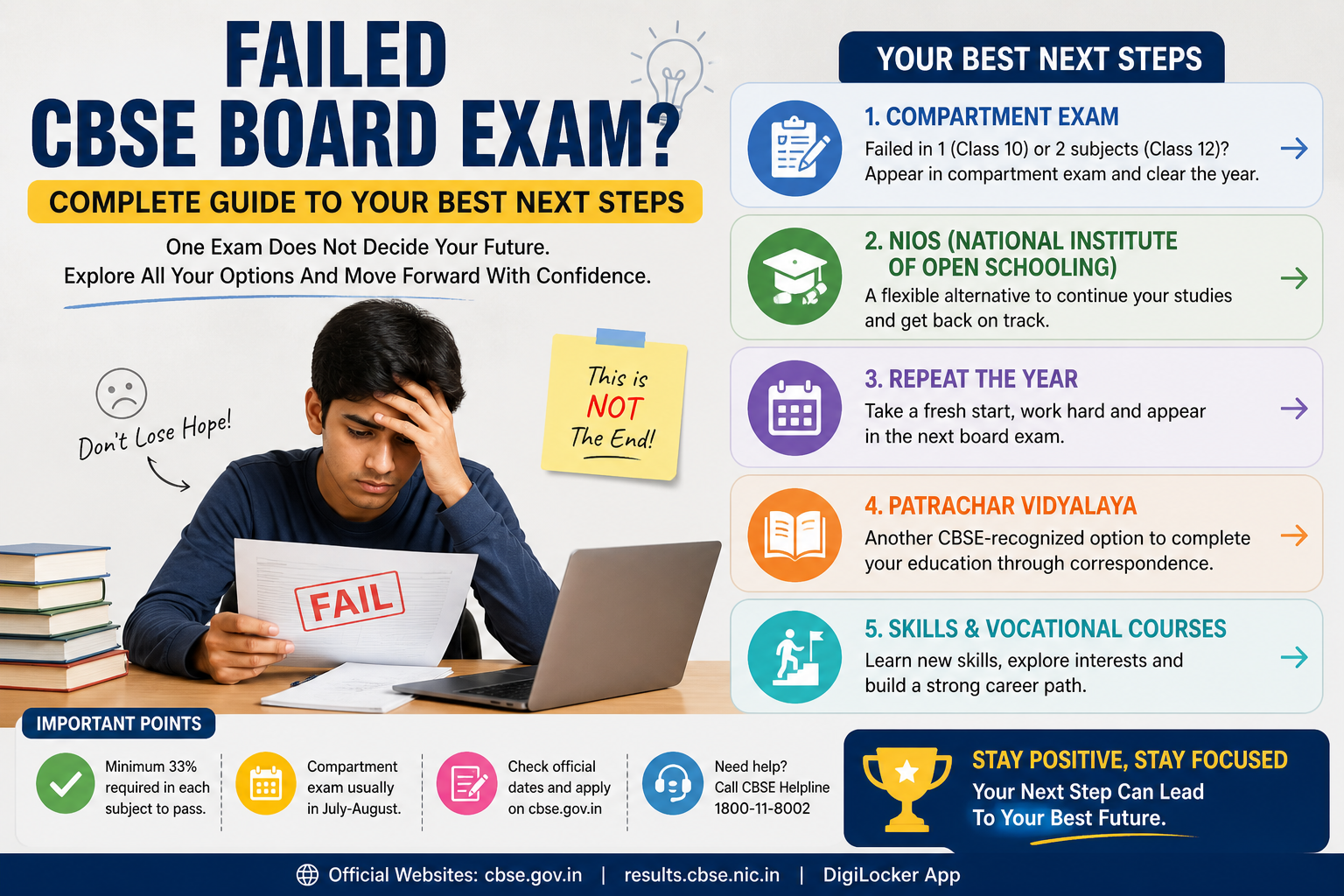
Failed CBSE Board Exam? Complete Guide to Your Best Next Steps
| Applies To | CBSE Class 10 & Class 12 Students |
| Minimum Passing Marks | 33% in each subject (theory + practical combined) |
| Key Options | Compartment Exam / Re-evaluation / NIOS / Repeat Year / Patrachar Vidyalaya |
| Compartment Exam | Usually July–August (check cbse.gov.in for exact dates) |
| Eligible If You Failed | 1 subject (Class 10) / up to 2 subjects (Class 12) |
| Result Portals | cbseresults.nic.in | results.cbse.nic.in | DigiLocker app |
| CBSE Helpline | 1800-11-8002 (toll-free) |
If you failed CBSE board exam this year, the first thing you are probably feeling is not a question — it is a weight. The kind that sits in your chest when you open the result page and the numbers do not add up the way you had hoped. That feeling is real, and you are allowed to feel it. But here is what is equally real: this result is not a final verdict on your future, and there are clear, structured options waiting for you right now.
CBSE has built specific safety nets into its system precisely because results day is not always a celebration. The compartment exam gives you a second shot at a subject you fell short in. Schemes like NIOS and Patrachar Vidyalaya open alternate academic paths. Even repeating a year, though it sounds daunting, has helped thousands of students come back stronger. This article walks you through every option available under the CBSE framework, what each one involves, and how to decide which one fits your situation.
You are not the first student in India to be in this position, and you will certainly not be the last. Every year, nearly 3 lakh students across the country are placed in the compartment category alone — many of them go on to clear their subjects and build careers they are proud of. The next few minutes of reading this guide could change how you approach the next few months.
What’s in This Guide?
- How Does CBSE Decide If You Passed or Failed?
- What Is the Compartment Exam and How Does It Work?
- What Are Your Options If You Failed CBSE Board Exam?
- Failed in Class 10 vs Class 12: How the Rules Differ
- Can Grace Marks or Re-evaluation Save Your Result?
- Will Colleges Know You Appeared in Compartment?
- Frequently Asked Questions
- 6 Things to Do Right Now If You Failed
- Explore More on Nextoper
- Official Resources That Can Help You
How Does CBSE Decide If You Passed or Failed?
Before you decide on your next step, it helps to understand exactly how CBSE marks a student as passed or failed — because the rules are more nuanced than just a total percentage.
The 33% Subject-Wise Rule
CBSE requires a minimum of 33% marks in each individual subject to pass. There is no concept of an “overall pass” where a high score in one subject compensates for a very low score in another. For Class 10, this means 33 out of 100 in every subject. For Class 12, you must achieve 33% separately in theory and 33% in practical/internal assessment components wherever they exist.
For example, if a subject has 70 marks for theory and 30 marks for practicals, you need at least 23 in theory and at least 10 in practicals. Scoring 80 in practicals will not save you if you scored 15 in theory. Many students do not realise this split-component rule until they read their mark sheet carefully.
What Counts as “Failed” vs “Compartment”?
There is a difference between failing in one or two subjects and failing in three or more. If you score below 33% in one subject (Class 10) or up to two subjects (Class 12), CBSE places you in the compartment category — which means you have not fully failed but need to clear those specific subjects. If you have fallen short in three or more subjects, you are considered to have failed the examination entirely and must either repeat the year or explore alternate paths like NIOS.
⚠️ Important Check Before You Panic
CBSE does award grace marks in some cases, and result errors do happen. If your marks are very close to 33%, keep reading — Section 5 of this guide covers re-evaluation and verification options that many students overlook.
What Is the Compartment Exam and How Does It Work?
The compartment exam is CBSE’s official second-chance system. It is not a lesser examination — it carries the same weight as the main board exam and, once cleared, results in a completely legitimate pass certificate for that subject. Lakhs of students appear for it every year without any stigma attached.
Eligibility: Who Can Appear?
- Class 10: Students who failed in one subject are eligible for compartment. Failing in two or more subjects means you are not eligible and must repeat the year.
- Class 12: Students who failed in up to two subjects are placed in compartment. Failing in three or more means you need to repeat or switch to NIOS.
Timeline and How to Apply
The compartment exam is typically held in July or August, around six to eight weeks after results are declared. CBSE opens the application window shortly after results — usually within one to two weeks. You apply through your school, which submits the compartment form to CBSE on your behalf. Always confirm the deadline directly on cbse.gov.in, since it changes year to year.
The practical examinations for compartment candidates are usually conducted by the school itself during the same period. Keep in touch with your school’s office so you do not miss any internal date.
How Many Times Can You Appear?
CBSE allows students up to three chances to clear a compartment subject. The first opportunity is the July/August compartment exam. If you miss or do not clear it, you can appear again in the main board exams the following March. A third chance follows the year after that. This means you have real time to prepare — not just a hurried few weeks if you do not feel ready for the first window.
✅ Tip from Students Who’ve Been There
Most compartment toppers say the same thing: they focused on only that one subject for six weeks, solved the last five years’ papers, and paid specific attention to unit weightage. The compartment syllabus is identical to the main exam — nothing is removed or added.
What Are Your Options If You Failed CBSE Board Exam?
Here is a side-by-side look at every realistic path open to you. Your best choice depends on how many subjects you failed in, which class you are in, and what your career goals are.
| Option | Who It’s For | Time to Complete | Certificate | College Eligible? |
|---|---|---|---|---|
| Compartment Exam | Failed 1 subject (Cl. 10) or up to 2 (Cl. 12) | 6–8 weeks prep; exam in July/Aug | CBSE — same as main board | Yes, fully |
| Repeat Year (Regular) | Failed 2+ subjects (Cl. 10) or 3+ (Cl. 12) | 1 full academic year | CBSE — full board result | Yes, fully |
| NIOS (National Open School) | Any student who wants flexibility | 6 months to 2 years depending on stream | NIOS — recognised by UGC & AICTE | Yes — most Indian colleges |
| Patrachar Vidyalaya | Delhi students who failed Class 12 | Direct Class 12 exam (skip Class 11) | CBSE via Patrachar | Yes |
| Diploma / ITI | Students who prefer vocational/skill path | 6 months to 2 years | State board / NCVT | Limited — trade-specific lateral entry |
| Re-evaluation / Verification | Students close to 33% or suspecting error | 4–6 weeks for result | Existing CBSE marksheet updated if changed | Yes — if marks change to pass |
NIOS — The Flexible Alternative Most Students Don’t Know Enough About
NIOS (National Institute of Open Schooling) is run by the Government of India and is fully recognised by universities, UGC, and AICTE. If you failed in three or more subjects in Class 12, or simply want to avoid repeating an entire year in school, NIOS lets you study at home and appear for exams on a schedule that suits you. Its On-Demand Examination (ODE) feature allows you to take individual subjects at almost any point in the year — a major advantage over waiting for the annual main board cycle.
A student from Lucknow who failed Class 12 in three subjects in 2023 used NIOS ODE to clear all three within five months and joined a BBA programme the following academic session — on time, without losing a full year. This path is more common than most students realise.
Patrachar Vidyalaya — For Delhi Students Specifically
If you are based in Delhi and failed Class 12, Patrachar Vidyalaya is a government-aided open school that allows you to directly appear for the CBSE Class 12 exams without sitting through another year of Class 11. The school provides study material, and the certificate is equivalent to any regular CBSE Class 12 result. It is a lesser-known but genuinely valuable option for students in the capital.
Failed in Class 10 vs Class 12: How the Rules Differ
Most articles online address either Class 10 or Class 12 — but a lot of students (and parents) search for both at once, especially in families with siblings in different classes. Here is a clear breakdown of how the rules change between the two.
Class 10 — More Restrictive Compartment Rules
For Class 10, CBSE only allows compartment if you have failed in one subject. If you have failed in two or more, you must repeat the entire Class 10 board exam the following year. There is no option to carry forward passed subjects. However, since Class 10 has six subjects (including one additional/optional), there is some flexibility in which subjects count toward your eligibility.
One important point for Class 10 students: your internal assessment marks (20 marks per subject from school activities, projects, and periodic tests) are already finalised before the board exam. These do not change in a compartment or repeat attempt, which means your starting point is partially set before you even sit for the exam.
Class 12 — More Options, More Complexity
Class 12 students have slightly more breathing room — compartment is allowed in up to two subjects. However, the stakes are higher because Class 12 results directly affect college admissions. The compartment marksheet is usually released before most college admission deadlines, but this varies by institution and state. Students appearing in compartment should keep their target colleges informed and check their specific policies.
Class 12 students also have access to the NIOS and Patrachar routes described above, which are not relevant for Class 10 since those institutions primarily cover the senior secondary level.
Can Grace Marks or Re-evaluation Save Your Result?
This is a question almost no one is talking about — but it matters more than most students realise. Before you register for compartment or start planning a repeat year, check whether your marks could change through official CBSE channels.
CBSE Grace Marks Policy
CBSE has a grace marks provision under which a student who fails by a very small margin in one or two subjects may be awarded additional marks to help them pass. The exact criteria are not publicly advertised (CBSE applies this internally), but students who are within a few marks of 33% in a subject often find their result updated on the final mark sheet. If you are 1–5 marks below the passing threshold in a subject, contact your school immediately — your principal can raise the issue with the regional CBSE office.
Verification of Marks and Re-evaluation
CBSE allows two formal processes after results:
- Verification of Marks: A check that your answer sheet was totalled correctly and no question was left unevaluated. This costs around ₹500 per subject and is a quick process.
- Photocopy of Answer Sheet: You can request a copy of your evaluated answer sheet and check for yourself whether marks were awarded correctly.
- Re-evaluation: Once you have the photocopy, if you find clear errors, you can apply for re-evaluation of specific questions. This is the strongest tool available but also the most time-consuming.
These processes have genuine timelines — typically four to six weeks from result date. Apply within the CBSE-specified window (usually two to three weeks after results). Missing this window means you lose the option entirely for that year.
Will Colleges Know You Appeared in Compartment? What Happens to Admissions?
This is possibly the most anxious question students have, and yet no major competitor article addresses it. Let us be clear about what actually happens.
What Your Mark Sheet Shows
If you appear in the compartment exam and pass, CBSE issues a separate compartment pass certificate (or in some cases, an updated marksheet) that shows your compartment result. This document is legitimate and accepted by universities across India. However, most colleges can see — from the date of issue and the marking style — that you appeared in a compartment round rather than the main exam. Whether this matters depends entirely on the institution.
Central Universities and DU, JNU, BHU
Most central universities, including Delhi University, accept compartment mark sheets for admission. DU’s CSAS portal and CUET-based admissions typically process compartment results as long as they arrive before the final allotment round. However, many DU colleges start their first merit lists before compartment results are out, meaning compartment students often miss the first one or two rounds and join from round three onwards. You should still apply and remain active in the admission portal.
Private Colleges and State Universities
Private colleges generally have more flexible admission timelines and often accommodate compartment candidates. State universities vary significantly — some are strict about requiring the main board result, while others explicitly accept compartment certificates. Always email the admission office directly and keep proof of your compartment registration handy.
✅ Practical Advice
Apply to colleges even before your compartment result is out. Fill every form you can with your current marks. Once you clear compartment, update your application immediately. Many students lose seats simply because they waited.
Frequently Asked Questions by CBSE Students
Q: I failed in two subjects in Class 10 — can I still appear for compartment?
No, unfortunately not. CBSE only allows the compartment exam for Class 10 students who failed in exactly one subject. If you have failed in two or more, you will need to repeat Class 10 and appear for the full board exam next year. It is a tough situation, but many students have used that extra year to come back with significantly better marks. Your passed subjects in this attempt do carry some internal advantage in terms of preparation confidence.
Q: Can I apply to NIOS even if I’ve already passed some subjects in CBSE?
Yes. NIOS has a provision called Transfer of Credit where you can carry forward subjects you already passed in CBSE and only appear for the ones you failed in under NIOS. This is called the “TOC scheme” and it saves you time. You do not have to redo everything from scratch. Check the NIOS website or contact a NIOS study centre near you for the exact documentation required.
Q: What happens if I miss the compartment exam deadline?
If you miss the July/August compartment window, your next opportunity is the main board exam in March the following year. There is no special late-entry option for the same year’s compartment exam once the form deadline passes. This is why it is critical to apply as soon as the CBSE application window opens — usually within two weeks of the main result. Set a reminder and check cbse.gov.in daily after your result date.
Q: Will it affect my admission to engineering or medical colleges if I cleared my Class 12 through compartment?
For JEE (Main and Advanced) and NEET, what matters is that you have a valid Class 12 pass certificate and meet the subject and percentage requirements. Both exams accept compartment certificates as long as you cleared Class 12 before the admission deadline. Many students who gave JEE in Class 12 and appeared in compartment simultaneously have gone on to crack engineering admissions. The key is that your compartment result must be out before the respective counselling round begins.
Q: How long does a CBSE re-evaluation take, and does it actually work?
A re-evaluation typically takes four to six weeks from the date of application. It does work — not always, but in cases where a question was genuinely skipped during marking or totalling was incorrect, marks do change. The best approach is to first get the photocopy of your answer sheet and assess it yourself (or with a teacher) before deciding whether to pay for re-evaluation. That way you are not spending money on a process unlikely to change the result.
6 Things to Do Right Now If You Failed
- Breathe first, decide second. Do not register for anything, call any coaching centre, or make any academic decision in the first 24 hours. Results are emotional. Give yourself one day before you act.
- Read your marksheet carefully and count the failing subjects. The number of subjects you failed in determines which paths are open. Write it down — “I failed in X subjects in Class Y” — before looking at any options.
- Check your marks against the 33% threshold subject-by-subject. If you are 1–5 marks below in any subject, call your school immediately and ask about grace marks or verification of marks. Do this within the first week — the window closes fast.
- Apply for compartment (if eligible) the moment the form opens. Schools usually collect applications within the first two weeks after results. Do not wait. Forms have closed earlier than expected in past years.
- If compartment is not an option, research NIOS and your state’s open school. Contact the nearest NIOS Regional Centre or call their helpline. Ask specifically about the Transfer of Credit scheme so you only appear in failed subjects.
- Tell your parents the full picture calmly. A lot of students delay this and it causes more stress. Most parents respond better to clear information than to silence. If you need support having the conversation, bring a trusted teacher into it.
Explore More on Nextoper — Guides That Can Help Right Now
Whatever your next step is, these Nextoper guides break down the details you need — for free.
Official Resources That Can Help You
cbse.gov.in — The official CBSE website publishes compartment exam dates, application forms, re-evaluation schedules, and all policy circulars the moment they are released. If you are going to bookmark one site, make it this one. Essential for any student navigating CBSE processes after results.
cbseacademic.nic.in — CBSE Academic’s portal hosts the official syllabus, sample papers, and marking schemes for both main board and compartment exams. Students preparing for the compartment exam should download the latest marking scheme here — it tells you exactly what examiners look for in each question. Indispensable for targeted preparation.
ncert.nic.in — NCERT’s website provides free access to all Class 9–12 textbooks in PDF format. Since the CBSE compartment exam follows the same NCERT syllabus as the main exam, students can download textbooks, solved examples, and supplementary materials at no cost. If you cannot access physical books right now, start here.
One Result Does Not Write Your Whole Story
Failing a board exam is hard — there is no point softening that reality. But it is also recoverable in ways the Indian education system has explicitly designed for. Hrishikesh Kulkarni, who failed his Class 12 boards on the first attempt, went on to become an Associate Director at a leading media company. He is not unusual. Every year, thousands of students who appeared in compartment or used NIOS join colleges, crack entrance exams, and build careers they are proud of.
Your immediate next step is simple: read your marksheet, count the failing subjects, and use this guide to identify the one or two options that apply to your situation. Once you know your path, the preparation becomes manageable. Nextoper has free study resources, notes, and practice papers for Class 9–12 across all subjects — use them. You have more tools available than you think.