Career Options After 12th Arts: Best High Paying Jobs Guide
| Applies To | Class 12 Arts / Humanities students |
| Stream | Arts / Humanities (History, Political Science, Geography, Sociology, Psychology, etc.) |
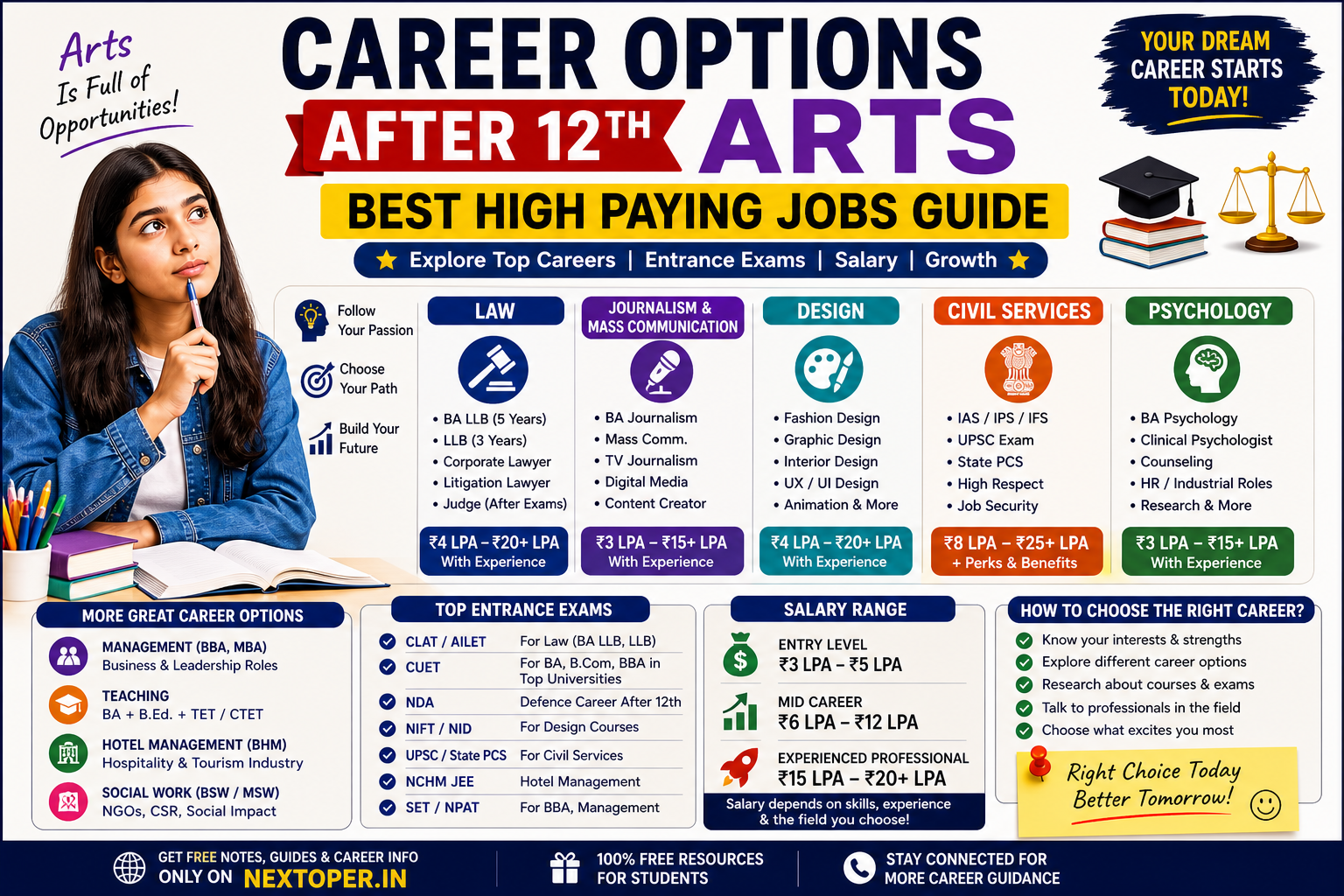
| Top Career Options | Law, Journalism, Design, Civil Services, Psychology, Management, Teaching, Hotel Management |
| Key Entrances | CLAT / AILET (Law) | CUET (BA/BCom) | NDA (Defence) | NIFT / NID (Design) | UPSC (IAS) |
| Salary Range | ₹3 LPA (entry) to ₹20+ LPA (experienced professional) |
| Free Help | nextoper.in — notes, career guides, entrance info — all free |
If you’re searching for career options after 12th arts, you’ve probably heard something like, “Arts mein kya hoga?” at least ten times this week. That’s exhausting. And honestly, a little unfair. Because the truth is — the Arts stream opens up more doors than most people realise.
Think law, journalism, designing, civil services, psychology, hotel management, social work, fashion, and a dozen more. Some of these pay really well. Some give you a lot of social impact. Some offer both. This guide walks you through the real career options — with actual salary numbers, entrance exams, and what each field is really like day to day.
Take Priya from Delhi, for example. She scored 78% in Class 12 Arts, got confused by all the “options” she found online, and almost gave up on further education. Then she found out about integrated BA LLB programs, wrote CLAT, and today she’s a second-year law student at a top NLU. Her story isn’t rare. High paying jobs in arts are very real — you just need the right information to find them.
What’s in This Guide?
- Why Is the Arts Stream Actually Worth It?
- What Are the Career Options After 12th Arts?
- Which Career Options After 12th Arts Pay the Most?
- What Government Jobs Can You Get After 12th Arts?
- Which Professional Courses Should Arts Students Consider?
- How to Choose the Right Career After 12th Arts
- 6 Things to Do Right Now to Find Your Career Path
- Student FAQ — Real Questions, Real Answers
- Explore More on Nextoper — Related Guides
- Official Sites That Can Help You Decide
Why Is the Arts Stream Actually Worth It?
A lot of students take Arts because it’s “easier” — at least that’s what everyone says. But here’s what nobody tells you: the skills you build in Arts are the ones the world actually runs on. Communication. Critical thinking. Understanding people. Persuasion. These aren’t soft skills — they’re career skills.
Companies across India hire Arts graduates for roles in HR, media, law, government, and administration. The demand isn’t going away. If anything, it’s growing. As automation handles routine technical work, human-centred skills — which Arts trains you in — are becoming harder to replace.
Flexibility Is the Real Advantage
One big benefit of Arts is how flexible it stays. A PCM student who doesn’t crack JEE has very limited backup options. But an Arts student? You can switch between fields much more easily. You can study law, psychology, journalism, design, business — even economics or data sciences — without needing a specific science background.
Take the example of Rohit from Lucknow. He chose Arts because he loved history. He ended up studying economics, cleared the UPSC prelims at 23, and is now preparing for the mains. He says his Arts background gave him an edge in essay writing, ethics, and general studies — sections that can make or break UPSC.
Arts and Changing Job Market
Digital media, content creation, UX writing, social media strategy — these are all booming right now. And they all need people who can think creatively and communicate well. The Arts stream trains you for exactly this. Many of India’s highest-paid content creators, authors, lawyers, and IAS officers came from Humanities.
What Are the Career Options After 12th Arts?
Here’s the complete picture — no filter, no bias. These are all the serious career options after 12th arts you can choose from.
Law
Law is one of the most respected and well-paying careers you can enter after 12th Arts. The BA LLB integrated program is 5 years long and is offered by NLUs (National Law Universities) across India. Entry is through CLAT — one of the most competitive but very doable exams if you prepare well.
Lawyers in India earn anything from ₹4 LPA early on to ₹30+ LPA with experience. Corporate lawyers, criminal lawyers, and constitutional lawyers all follow different paths. Law is also a stepping stone to the judiciary — becoming a judge is one of the most prestigious career paths in India.
Journalism and Mass Communication
Journalism isn’t just about TV anchors. It includes digital journalism, investigative reporting, PR, content strategy, and social media management. You can pursue a BA or BMC (Bachelor of Mass Communication) after 12th. Top colleges include IIMC, Symbiosis, and Jamia Millia Islamia.
The media industry is large and growing. Entry-level roles pay around ₹3–5 LPA. Senior reporters and editors at big publications earn ₹10–20 LPA. Digital media roles — especially in content and strategy — can pay significantly more.
Psychology
Psychology is one of the fastest-growing career fields in India right now. After a BA in Psychology (3 years), you can do an MA or MSc, then specialise in clinical, counselling, industrial, or educational psychology. The demand for mental health professionals is going up every year.
Entry salaries are around ₹3–6 LPA. Clinical psychologists with experience and private practice can earn ₹15–25 LPA. You can also work with corporates, schools, hospitals, and NGOs.
Design — Fashion, Graphic, Interior, and UX
If you’re creative, design is one of the best bets for high paying jobs in arts after 12th. Entrances like NIFT, NID, and UCEED test your visual thinking — not bookish knowledge. Fashion designers, UX designers, graphic designers, and interior designers are all in demand.
Top design grads from NIFT or NID start at ₹5–8 LPA. With 5 years of experience, ₹15–25 LPA is very achievable. UX/UI design in tech companies pays exceptionally well — some roles start at ₹10+ LPA.
Hotel Management and Hospitality
Hotel management is a great option if you enjoy people, travel, and fast-paced environments. IHM (Institute of Hotel Management) colleges are the gold standard in India. Entry is via NCHM JEE. After a 3-year BHM degree, you can work in hotels, airlines, resorts, cruise lines, and event companies.
Starting salary: ₹3–5 LPA in hotel chains. With experience and international stints, ₹15–20 LPA is normal. Front office managers, food & beverage heads, and general managers earn even more.
BBA / Business Administration
Many Arts students don’t realise they can study business too. A BBA (Bachelor of Business Administration) doesn’t require PCM. It’s a 3-year course that opens the door to an MBA later. After MBA from a top college, ₹10–25 LPA packages are common.
CUET scores are used by many top colleges for BBA admissions. IPU CET, SET, and NPAT are other popular BBA entrance exams.
Social Work
If you want to make a real difference, social work is a deeply meaningful career. BSW (Bachelor of Social Work) is a 3-year program. After MSW, you can work with NGOs, UN agencies, government departments, and corporate CSR teams. Salaries range from ₹3–10 LPA depending on the organisation.
Teaching
Teaching gets a bad reputation for salary — but government school teachers in India earn ₹40,000–₹80,000 per month. The path is BA + B.Ed + CTET or state TET. Private school teachers and coaching institutes also pay well in metro cities.
Which Career Options After 12th Arts Pay the Most?
This is the section nobody else gives you properly. Here are real salary ranges — not vague promises. These numbers are based on entry-level to mid-career professionals in India (2024–25 data).
| Career Field | Entry Level (0–2 yrs) | Mid-Career (5+ yrs) | Top Earners |
|---|---|---|---|
| Law (Corporate) | ₹5–8 LPA | ₹15–25 LPA | ₹50 LPA+ |
| Civil Services (IAS/IPS) | ₹56,000/mo + perks | ₹1.44 lakh/mo | Cabinet Sec: ₹2.5 lakh/mo |
| UX / Graphic Design | ₹4–8 LPA | ₹12–20 LPA | ₹30 LPA+ |
| Fashion Design (NIFT) | ₹4–7 LPA | ₹10–18 LPA | ₹25 LPA+ |
| Journalism (Digital) | ₹3–6 LPA | ₹8–15 LPA | ₹25 LPA+ |
| Psychology (Clinical) | ₹3–6 LPA | ₹10–18 LPA | ₹25 LPA+ |
| Hotel Management | ₹3–5 LPA | ₹10–18 LPA | ₹25 LPA+ |
| BBA + MBA | ₹4–8 LPA | ₹12–20 LPA | ₹40 LPA+ |
| Teaching (Govt) | ₹35,000–50,000/mo | ₹55,000–80,000/mo | PGT: ₹1 lakh/mo |
The highest paying jobs in arts after 12th are law, civil services, and design — but only when you pick the right college and entrance exam. Salary depends a lot on the institution you graduate from. An NLU law graduate earns much more than someone from a random private college.
What Government Jobs Can You Get After 12th Arts? GAP FILL
This is one of the most searched things by Arts students — and most websites barely cover it. Here’s a full picture of government career options after 12th arts.
UPSC Civil Services (IAS, IPS, IFS)
The most prestigious government exam in India. You need a graduation degree (any stream) to appear for UPSC. So the path is: complete your BA/BCom/BSc → crack UPSC prelims → UPSC mains → interview. Arts students consistently do well in UPSC because the GS papers (History, Polity, Geography, Sociology) align perfectly with what they’ve studied.
UPSC IAS officers start at ₹56,000/month + DA + HRA + other perks. Senior IAS officers earn ₹1.44 lakh/month. The job also comes with huge social impact, housing, transport, and job security.
SSC (Staff Selection Commission)
SSC conducts multiple exams — SSC CGL, SSC CHSL, SSC MTS. Arts graduates can appear for CGL (after graduation) and CHSL (after 12th). These lead to roles in Income Tax, CBI, Central Secretariat, and many other departments. Salary: ₹25,000–₹80,000/month depending on the post.
State PSC Exams
Every state has its own Public Service Commission — UPPSC (UP), MPSC (Maharashtra), TNPSC (Tamil Nadu), BPSC (Bihar), RPSC (Rajasthan), and so on. These lead to SDM, BDO, and other district-level officer roles. The syllabus heavily favours Arts students — especially History, Polity, and current affairs.
Defence (NDA and CDS)
The NDA (National Defence Academy) exam allows Arts students to join the Army, Navy, or Air Force after 12th. Age limit: 16.5 to 19.5 years. CDS (Combined Defence Services) is for graduates. Both are conducted by UPSC twice a year.
Railway and Banking Jobs
RRB (Railway Recruitment Board) and IBPS Bank PO/Clerk exams are open to Arts graduates too. These give stable jobs with good salaries and benefits. Bank PO starts at ₹36,000–₹40,000/month. Railway Group D starts at ₹18,000–₹22,000/month.
Which Professional Courses Should Arts Students Actually Consider?
Not all courses are equal. Some cost a lot and give little return. Others open big doors quickly. Here’s an honest breakdown.
Integrated BA LLB (5 Years)
Best entry point for law. You skip the wait of doing a separate BA and then LLB. Entrance: CLAT (Common Law Admission Test). Top colleges: NLSIU Bangalore, NLU Delhi, NALSAR Hyderabad, NLIU Bhopal. Fee: ₹1–2 lakh/year at government NLUs. Worth every rupee.
BA / BMC in Journalism or Mass Communication
Good if you like storytelling, reporting, or content creation. IIMC Delhi is the gold standard. Jamia Millia, ACJ Chennai, and Symbiosis Pune are also excellent. After graduation, internships matter more than marks in this field.
NIFT / NID for Design
If you’re creative and visual, design schools are life-changing. NIFT conducts its own entrance. NID uses its DAT (Design Aptitude Test). Both test creativity and visual thinking — not bookish stuff. Start preparing with sketching and observation from Class 11 itself.
Bachelor of Social Work (BSW)
A 3-year course offered by TISS, Delhi University, Jamia, and many state universities. TISS is the best institution for social work in India. After MSW from TISS, you can work at UN agencies, World Bank projects, and top NGOs.
BA Economics + MBA Later
This is an underrated path. BA Economics from a good college (Delhi University’s BA Eco Hons, for example) followed by MBA from IIM can land you ₹20+ LPA packages. Economics trains your analytical thinking in a way that suits MBA prep perfectly.
How to Choose the Right Career After 12th Arts
This is the part nobody else walks you through. Everyone tells you what options exist. Nobody tells you how to actually pick one for yourself. Here’s the honest process.
Step 1 — Figure Out What You’re Actually Good At
Not what your parents want. Not what your friends are doing. Ask yourself: What do you do without being told? What subject do you read about even when there’s no exam? That’s a signal. If you love arguing and debating — law. If you love telling stories — journalism or content. If you love making things look good — design. If you love understanding people — psychology.
Step 2 — Check the Entrance Exam Requirement
Every serious career has an entrance exam attached. CLAT for law, CUET for graduation, NIFT entrance for fashion, UPSC for civil services. Figure out the exam first — then plan backwards. Ask: “If I start preparing today, when can I realistically write this exam?”
Step 3 — Check College Quality, Not Just Course Name
A Journalism degree from IIMC is very different from one at a random private college. An LLB from an NLU is different from a private law college. The institution matters a lot for placement and reputation. Do your research before paying fees.
Step 4 — Talk to Someone Actually in That Field
Not a college counsellor. Not a YouTube channel. Talk to a real person working in that field. LinkedIn is great for this. Message working professionals, ask them one or two real questions. Most people are happy to help a student who reaches out respectfully.
Step 5 — Don’t Finalise Out of Fear
Many students pick a “safe” option (like teaching or government jobs by default) out of fear — not interest. That’s fine as a backup. But make sure you also give yourself permission to aim for something you actually want. The fear of failure is not a good career advisor.
6 Things to Do Right Now to Find Your Career Path
Reading about careers is good. Doing something about it today is better. Here are 6 specific steps you can take right now — all free, all doable.
- Write down 3 subjects you actually enjoyed in Class 10–12. Not the ones you were forced to study — the ones you found interesting. This is the fastest shortcut to figuring out your right direction.
- Search for the CLAT 2026 syllabus on clat.ac.in. Just read it once. If you find it interesting (English, GK, Legal Reasoning, Maths — just at Class 10 level), law might be worth exploring seriously.
- Visit nextoper.in and browse the career section. We have free guides on law, journalism, design, psychology, and government jobs — all written for CBSE students like you, in simple language.
- Search for 2 professionals in your preferred field on LinkedIn. Read their profiles. See what college they went to, what their early career looked like. This gives you a real-world roadmap — not textbook theory.
- Check the official NIFT or NLU website for admission details. Read the eligibility, fees, and exam dates. Seeing real numbers helps you plan better and reduces the fear of the unknown.
- Talk to one elder sibling, cousin, or family friend who works in a field you like. Ask them one question: “What do you wish you had known before choosing this field?” That one conversation can save you months of confusion.
Student FAQ — Real Questions, Real Answers
Yes, absolutely. UX/UI designers, digital journalists, and experienced content strategists earn ₹12–20 LPA without an MBA. The key is skill + the right college + real experience. High paying jobs in arts are very real across multiple fields — law and MBA are just two of many paths.
That’s more common than you think. Start by ruling things out — what do you know you DON’T want? Then see what’s left. Pick a broad field (like social sciences or design or communication), start a 3-year degree, and give yourself time to explore. Many students find their direction in the first year of college. You don’t need a perfect answer right now.
After 12th itself, you can write SSC CHSL, NDA, and state-level PSC exams. After graduation, UPSC, SSC CGL, and banking exams open up. Government jobs after 12th arts stream are plentiful — and they’re some of the most stable careers in India with good pay and pension.
For entrance exams — not as much as you think. CLAT, NIFT, NCHM JEE, and UPSC all depend on your exam performance, not your board percentage. You just need to meet the minimum eligibility (usually 45–50%). So even if you didn’t get a stellar score, your career options after 12th arts are still wide open. Focus on entrance prep.
Most Arts careers take 3–5 years post-graduation to reach a comfortable salary. Law takes longer — junior advocates earn very little for the first 2–3 years. But fields like design and digital media can start paying ₹5–8 LPA early if you build a strong portfolio. Plan your finances for the first 2–3 years honestly, then things usually pick up fast.
Explore More on Nextoper — Related Guides
Here are some other guides that Arts students often find helpful right after reading this one.
- PCB vs PCM Stream: Easy Steps to Choose the Right One
- Class 11 Subject Combination: Free Complete Guide for Students
- Best Courses After 12th: Complete Stream-Wise Guide for 2026
Official Sites That Can Help You Decide
- ncert.nic.in
NCERT’s official site has career guidance publications and vocational course information for Class 11 and 12 students. If you want reliable, government-approved information about course pathways after 12th, this is the place to start — especially for understanding CBSE-aligned options. - cbseacademic.nic.in
CBSE Academic’s portal lists vocational subjects, skill modules, and guidance documents for students choosing their stream and career direction. Arts students should check the Skill Education section — it has a lot of practical options that are often ignored. - cbse.gov.in
The main CBSE site has information on board exams, result links, and official notifications about curriculum changes. If you need to check eligibility for scholarships, official exam schedules, or board-related documentation for college admissions, this is your go-to.
One Last Thing Before You Close This Tab
Choosing a career after 12th arts is genuinely hard. Anyone who tells you it’s simple is either lucky or lying. There are too many options, too many opinions, and too much pressure from all sides.
But here’s the thing — one student from Bhopal who took Arts because she loved sociology ended up at TISS Mumbai, did her MSW, and now works for an international development agency earning more than most engineering graduates she knows. She didn’t have a perfect plan at 17. She just kept asking questions and staying curious.
Your next step today: pick one career from this guide that you’re even a little curious about. Just one. Then look up its entrance exam. That’s it. Nextoper.in has free notes and guides to help you along the way — no cost, no catch.