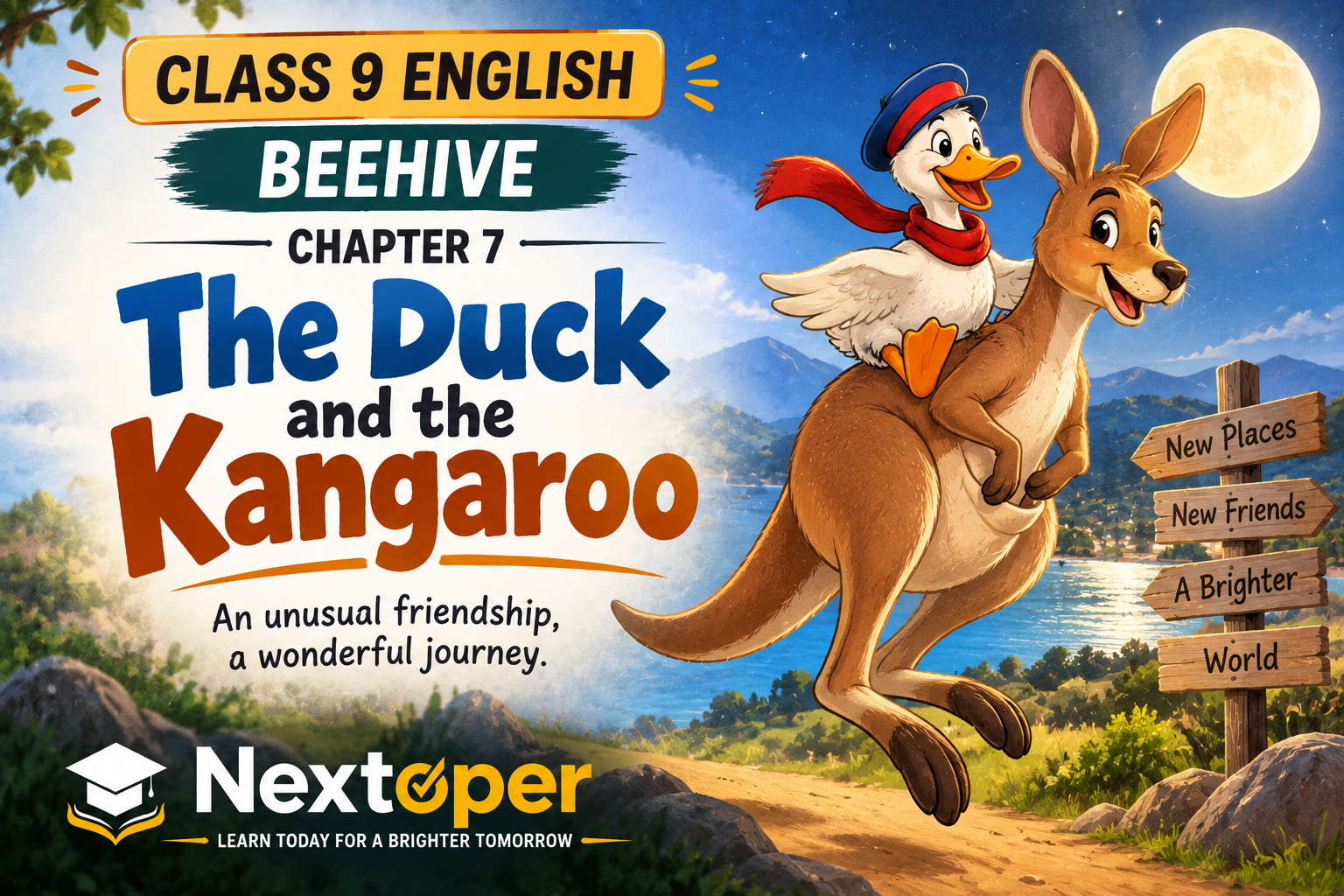
CBSE Class 9 English Chapter 7 PDF Notes: The Duck and the Kangaroo 2025-26
If you are looking for Class 9 English Chapter 7 Notes, you have landed on the right page. This guide covers “The Duck and the Kangaroo,” Poem 7 from the Beehive textbook, written by Edward Lear. You will get a clear summary, a stanza-by-stanza explanation, a glossary, the main literary devices, exam-style questions with answers, MCQs, and a fast revision block for the night before your test.
Edward Lear wrote strange, funny poems on purpose. He liked to invent words, mix up real feelings with silly situations, and build a world where a duck and a kangaroo can hold a serious conversation. This poem is one of his best-loved pieces for exactly that reason. Once you understand the story and the humour behind it, the questions in your exam become easy to answer in your own words.
Nextoper CTA: Bookmark this page before your test. Scroll to the Quick Revision section if you have less than ten minutes.
Table of Contents
- Chapter Overview
- Full Summary
- Character Sketch
- Themes of the Poem
- Glossary
- Textbook Q&A
- MCQs
- Quick Revision
- Previous Year Style Questions
- Featured Snippet Answer
- FAQs
Chapter Overview
“The Duck and the Kangaroo” belongs to a poetic tradition called nonsense verse. Nonsense poems do not try to be realistic. Animals talk, made-up places exist, and ordinary problems get solved in silly ways. Edward Lear, the poet, is famous for inventing this style in English literature during the nineteenth century. He is also known for his limericks and his drawings, since he began his career as an illustrator before becoming a poet.
The poem has five stanzas. Each one moves the story forward one small step: the Duck’s wish, the Duck’s request, the Kangaroo’s hesitation, the Duck’s solution, and finally, their journey together. This steady structure is part of why the poem is easy to follow even though the situation itself is completely impossible in real life.
Get free Class 9 English Chapter 7 PDF Notes
Full Summary
The Duck lives in a pond and feels stuck there. Watching the Kangaroo hop easily across fields and water, the Duck grows restless and calls its own life “a bore.” It admires the Kangaroo’s freedom and wishes it could move the same way.
Encouraged by this admiration, the Duck asks for a ride on the Kangaroo’s back so it can finally see the world. It promises to behave perfectly during the trip, staying quiet except for an occasional quack, and dreams aloud of visiting faraway, imaginary places.
The Kangaroo does not say no right away, but it does not agree instantly either. It raises a fair concern: the Duck’s feet are always wet and cold, and carrying that dampness for a long journey might give the Kangaroo painful joint trouble. Lear turns the word “rheumatism” into a joke here by splitting it as “roo-Matiz,” poking fun at the Kangaroo’s own name.
The Duck, however, had already planned for this. It explains that it bought four pairs of woollen socks that fit its webbed feet, along with a warm cloak, and that it intends to smoke a cigar each day to stay comfortable. This answer satisfies the Kangaroo completely.
Convinced, the Kangaroo agrees at once. It only asks the Duck to sit steadily at the very end of its tail so that the hopping stays balanced. Under pale moonlight, the two set off and hop around the entire world three times, ending the poem in complete happiness. The closing question — who could be as happy as this pair — has no real answer expected; it simply celebrates their joy.
At its heart, the poem is about solving a real problem through honesty and preparation, rather than ignoring it. That is what allows the friendship, and the adventure, to actually happen.
Character Sketch
The Duck is restless, imaginative, and surprisingly practical. It is not satisfied with routine and speaks up about what it wants instead of staying quiet. What makes the Duck memorable is that it does not simply complain — it prepares a real solution (the socks and cloak) before the Kangaroo even finishes raising its worry. That combination of ambition and foresight is what an examiner usually wants you to notice when a question asks you to describe the Duck’s personality.
The Kangaroo is careful and reasonable rather than unfriendly. It does not refuse the Duck outright, and it does not agree carelessly either — it takes a moment to think, states its objection honestly, and changes its mind once that objection is properly answered. This makes the Kangaroo a good example of a thoughtful friend, not a reluctant one.
Themes of the Poem
- Friendship and cooperation: two very different creatures manage to travel together because they listen to each other.
- The desire for adventure: the Duck’s boredom with routine life drives the entire plot.
- Problem-solving through honesty: the Kangaroo’s objection is not brushed aside; it is answered directly.
- Contentment through shared effort: the final stanza links happiness to the fact that both friends made an effort for each other.
Common Mistake: A lot of students write that the Kangaroo refused the ride because the Duck was too heavy. That is incorrect and will lose you marks. The poem is specific — the objection is about wet, cold feet causing rheumatism, not about weight. Always quote the exact reason when this question comes up.
Glossary
| Word/Phrase | Meaning |
|---|---|
| Good gracious | an exclamation showing surprise |
| Reflection | careful thinking |
| Unpleasantly | in an unpleasant, uncomfortable way |
| Roo-Matiz | Lear’s invented spelling of “rheumatism,” split to echo “kangaroo” |
| Worsted | a firm, high-quality wool |
| Cloak | a loose outer garment worn over other clothes |
| Pale | light in colour |
| Bound | to leap forward quickly |
The Dee and the Jelly Bo Lee are not real places — Lear invented them purely for their playful sound, which is typical of nonsense verse.
Textbook-Style Q&A
Q1. Why does the Duck call its life in the pond “a bore”? The Duck feels bored because its life in the pond never changes. Watching the Kangaroo hop freely over fields and water makes the Duck long for the same kind of freedom and adventure, so its own surroundings start to feel dull and limiting by comparison.
Q2. What exactly does the Duck ask the Kangaroo to do? The Duck asks for a ride on the Kangaroo’s back so that it can travel and see the world beyond the pond. It promises good behaviour throughout the journey, saying it will sit still and stay almost silent, only quacking occasionally.
Q3. Why does the Kangaroo hesitate before agreeing? The Kangaroo hesitates because of a genuine physical concern — the Duck’s feet are constantly wet and cold, and carrying that dampness for a long hop could give the Kangaroo rheumatism. It is a practical worry, not a sign of unkindness.
Q4. How does the Duck solve the Kangaroo’s problem? The Duck reveals that it had already anticipated the concern. It bought four pairs of worsted socks sized for its webbed feet and a cloak to stay warm, showing that it had planned ahead rather than reacting on the spot.
Q5. What condition does the Kangaroo set once it agrees? The Kangaroo agrees on one condition: the Duck must sit steadily at the very end of its tail. This detail matters because a hopping animal needs balanced weight, and an unsteady passenger could disrupt the whole journey.
Q6. How does the poem end, and what mood does the ending create? The poem ends with the pair hopping around the entire world three times under pale moonlight, closing with the rhetorical question of who could possibly be as happy as they are. The mood is joyful, light, and celebratory.
Multiple Choice Questions
- Who wrote “The Duck and the Kangaroo”? a) William Wordsworth b) Edward Lear c) Robert Frost d) Ogden Nash
- What does the Duck call its pond? a) Beautiful b) Peaceful c) Nasty d) Large
- What does the Kangaroo fear it might catch from the Duck’s wet feet? a) A cold b) Rheumatism c) A fever d) An infection
- How many pairs of socks does the Duck buy? a) Two b) Three c) Four d) Five
- Where must the Duck sit for the journey? a) On the Kangaroo’s head b) In its pouch c) At the end of its tail d) On its back paws
- How many times do they hop around the world? a) Once b) Twice c) Three times d) Four times
Quick Revision
- Poet: Edward Lear, known for nonsense verse.
- Plot in one line: bored Duck asks Kangaroo for a ride; Kangaroo worries about rheumatism; Duck shows it bought socks and a cloak; they hop the world three times.
- Key pun: “roo-Matiz” = rheumatism + roo (from kangaroo).
- Rhyme scheme: stanza 1 is ababccaa, stanza 2 is ababccbb, stanzas 3–5 are ababccdd.
- Theme in one line: friendship works when both sides listen and adjust.
- Common trap: the Kangaroo’s objection is about wet, cold feet — never about weight.
Memory trick: remember the story as B-A-O-S-H — Bored, Ask, Objection, Solution, Hop. Each letter is one stanza, in order.
Previous Year Style Questions
CBSE English poems from Beehive are rarely asked as full stanza-explanation questions; they show up more often as short 2–3 mark questions on theme, character, or literary device, and occasionally as a 1-mark MCQ. Based on that pattern, these are worth practising:
- In 2–3 sentences, explain what the Duck’s preparation (socks, cloak) tells you about its character.
- What is the effect of splitting the word “rheumatism” into “roo-Matiz”?
- What message about friendship does the poem give? Answer in about 40 words.
Featured Snippet Answer
The Duck and the Kangaroo is a nonsense poem by Edward Lear in which a bored Duck asks a Kangaroo for a ride to see the world, the Kangaroo hesitates because the Duck’s wet feet might cause it rheumatism, the Duck reveals it has already bought warm socks and a cloak to solve the problem, and the two friends happily hop around the world three times together, showing that friendship grows stronger when both sides find a way to meet each other halfway.
FAQs
What is the theme of “The Duck and the Kangaroo”? The poem shows that friends who adjust for each other and solve problems together find real happiness. The Duck wants adventure, the Kangaroo has a genuine worry, and both compromise so the friendship can move forward.
Why did the Kangaroo hesitate to give the Duck a ride? The Kangaroo was not unwilling out of unkindness. It worried that the Duck’s wet, cold feet resting against it for a long hop could give it rheumatism, so it asked for time to think it over.
What is “roo-Matiz” in the poem? Roo-Matiz is Edward Lear’s playful spelling of rheumatism, split across two lines so the first half, roo, echoes the word kangaroo. It is a pun that turns a real illness into a joke fitting the speaker.
What is the rhyme scheme of “The Duck and the Kangaroo”? The first stanza follows ababccaa, the second follows ababccbb, and the third, fourth, and fifth stanzas follow ababccdd. The pattern shifts slightly but always keeps a strong closing rhyme.
Who wrote “The Duck and the Kangaroo” and what type of poem is it? Edward Lear, a British poet and illustrator known for limericks and invented words, wrote it. It is a narrative nonsense poem — a light, funny story told using made-up words and impossible situations.
To Sum Up
“The Duck and the Kangaroo” works because it takes a silly situation and gives it real emotional logic — a bored friend, a fair concern, a thoughtful solution, and a happy ending. For your exam, focus on the exact reason for the Kangaroo’s hesitation, the meaning of “roo-Matiz,” and the poem’s message about friendship. Those three points cover almost everything examiners tend to ask.
More Notes You Might Need
- Class 9 English Chapter 6 PDF Notes No Men Are Foreign
- Class 9 English Chapter 5 PDF Notes A Legend of the Northland
- Class 9 English full subject index
Author Bio
Written and reviewed by the Nextoper Editorial Team, a group of CBSE English educators who prepare chapter notes aligned with the current NCERT syllabus for the 2025-26 session.
Freshness note: This page was last checked and updated on 14 September 2026 against the current CBSE 2025-26 syllabus.