CBSE Class 11 English Chapter 6 Silk Road PDF Notes 2026-27 – Summary, Themes and NCERT Answers | Nextoper Notes
What is Class 11 English Chapter 6 Silk Road about?
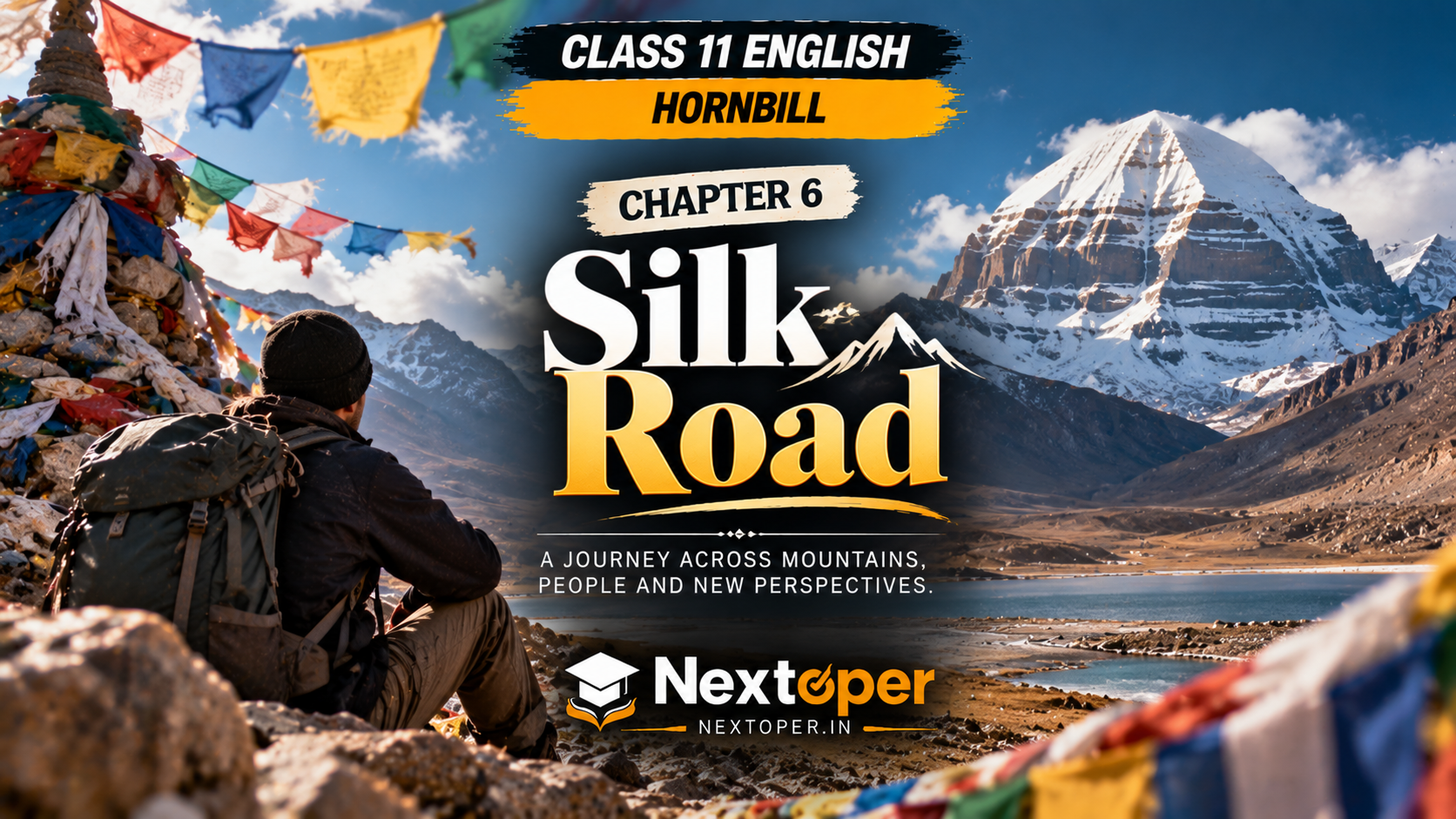
Silk Road is a prose travelogue in NCERT Hornbill, Chapter 6. Nick Middleton wrote it. He travels across Tibet towards Mount Kailash. His goal is the kora, a sacred walk around the mountain. On the way he meets nomads, crosses a snowy pass and falls ill. At Darchen he finds a companion, Norbu.
| Fact | Detail |
|---|---|
| Chapter | Silk Road, NCERT Hornbill (Class 11 English), Chapter 6, pages 57–67 |
| Author | Nick Middleton |
| Type | Travelogue, told in the first person |
| Route | Ravu → mountain pass → salt lake → Hor → Darchen |
| Main goal | To complete the kora around Mount Kailash |
| Also in this NCERT chapter | The poem “Father to Son” by Elizabeth Jennings (pages 68–69) |
Save Free Notes PDF – Class 11 English Chapter 6 Silk Road PDF Notes | Click Here to Save
The Silk Road was an ancient network of trade routes across Asia. NCERT (National Council of Educational Research and Training) publishes the textbook that CBSE schools use. Hornbill is the NCERT core English book for Class 11.
What is the summary of Silk Road?
Nick Middleton leaves Ravu in Tsetan’s car, with Daniel translating. They cross a snowy pass at 5,515 metres and reach Hor. Daniel returns to Lhasa. At Darchen, Nick Middleton falls ill with a cold and altitude trouble. Tibetan medicine cures him. Then he meets Norbu, who also wants to do the kora.
1. Leaving Ravu
On a clear morning, Nick Middleton says goodbye to Ravu. Lhamo gives him a long-sleeved sheepskin coat. Tsetan looks at him and says he now looks like a drokba.
Tsetan then takes a short cut south-west towards Mount Kailash. It crosses high passes. The only worry is snow.
2. Plains, kyang and mastiffs
The short cut runs over wide, empty plains. Gazelles look up and bound away. A great herd of kyang, or wild ass, gallops in tight formation.
Later the car passes lone herders and dark tents. Each tent has a huge Tibetan mastiff. The dogs race towards the car like bullets and chase it for a while.
3. Snow and the pass
The track climbs beside an icy river. At 5,210 metres a wide strip of snow blocks the way. Tsetan flings soil on the ice for grip. Daniel and Nick Middleton walk so the car stays light.
A second block forces Tsetan to drive round the snow. At 5,400 metres Nick Middleton’s head throbs. The pass top is at 5,515 metres. A cairn there carries silk scarves and prayer flags, and they walk round it clockwise.
4. Salt lake and Hor
They eat hot noodles at a workcamp beside a dry salt lake. The salt flats are traces of the ancient Tethys Ocean. By late afternoon they reach Hor, on the old trade route from Lhasa to Kashmir. Daniel leaves for Lhasa in a truck.
Hor is grim, dusty and littered. Yet it stands beside Lake Manasarovar, Tibet’s most respected lake. Earlier travellers were moved to tears by it. Nick Middleton’s visit feels very different.
5. A sleepless night and a doctor
They reach Darchen after 10.30 p.m., at 4,760 metres. A blocked nose and a heavy chest keep Nick Middleton from sleep. Sitting up helps. Lying down makes him afraid. He stays awake all night.
Next morning Tsetan takes him to the Darchen medical college. A Tibetan doctor blames a cold and the effects of altitude. He gives a five-day course of medicine. That night Nick Middleton sleeps soundly, and Tsetan leaves for Lhasa.
6. No pilgrims, then Norbu
Darchen looks better after rest. But there are no pilgrims. Nick Middleton has arrived too early in the season. Parts of the kora route may still be blocked by snow.
In a cafe he meets Norbu, a Tibetan scholar from Beijing. Norbu says they could be a team of academics who have escaped from the library. Norbu is as ill-equipped as Nick Middleton. Still, Nick Middleton decides he may be the ideal companion.
| Place or event | Height | What happens |
|---|---|---|
| First snow patch | 5,210 m | Tsetan spreads soil on the icy snow |
| Climbing further | 5,400 m and above | Nick Middleton’s head throbs |
| Top of the pass | 5,515 m | Cairn with scarves and prayer flags |
| Darchen | 4,760 m | Cold, blocked nose, sleepless night |
Who are the main characters in Silk Road?
The main characters in Silk Road are Nick Middleton, Tsetan, Daniel, Lhamo and Norbu. Nick Middleton is the writer and narrator. Tsetan drives him. Daniel translates. Lhamo gives him a coat. Norbu becomes his possible walking partner. A Tibetan doctor also helps him at Darchen.
| Character | Role in Silk Road | Key traits, with proof |
|---|---|---|
| Nick Middleton | Narrator and writer | Curious, humorous, determined. He jokes about his own “positive thinking” plan. |
| Tsetan | Driver | Skilled and practical. He solves the snow problem and takes the sick writer to a doctor. His jokes are dry. |
| Daniel | Translator, travels as far as Hor | Helpful and careful. He warns that the icy top layer is the real danger. |
| Lhamo | Woman at Ravu | Kind and thoughtful. She gives a warm coat as a farewell gift. |
| Norbu | Tibetan scholar from Beijing | Cheerful and self-mocking. He is enthusiastic but unprepared, and not a practising Buddhist. |
| Tibetan doctor | Doctor at Darchen | Calm and plain. He reassures the writer that he will be fine. |
Two travellers are only mentioned. Ekai Kawaguchi was a Japanese monk who reached Lake Manasarovar in 1900. Sven Hedin was a Swede who visited a couple of years later.
What are the main themes of Silk Road?
Silk Road shows travel as a test of body and mind. Five themes stand out. They are hardship at high altitude and legend versus reality. They also include the kindness of local people, the problem of language and humour. Humour keeps every hardship light. Use these themes to support long answers.
| Theme | Evidence in the chapter |
|---|---|
| Hardship of a hard journey | Snow at 5,210 metres, a throbbing headache, and a night when sleep feels unsafe. |
| Legend versus reality | Earlier travellers wept at Lake Manasarovar. Hor, beside it, is dusty and littered. |
| Kindness of hill people | Lhamo’s coat, the waving herders, Tsetan’s care and the doctor’s reassurance. |
| Communication across languages | “Through Daniel” and “through Tsetan” show how every message is translated. |
| Humour as a survival tool | The mastiff chase, the “sheep dung” pellets and Norbu’s big tummy. |
Style note: the account is in the first person and mostly in the active voice. NCERT’s own notes say this active voice shapes the narrative style. Vivid images such as “rose-tinted blush” make the scenery easy to picture.
What do the difficult words in Silk Road mean?
Silk Road has seven highlighted expressions and three Tibetan words. NCERT asks you to infer each meaning from context. This table gives every meaning as the chapter uses it. Learn these definitions in that exact sense, not as general dictionary meanings.
| Word | Meaning in Silk Road | Where it appears |
|---|---|---|
| ducking back | Going quickly back inside, head lowered | Lhamo goes into her tent |
| manoeuvres | Planned, tight movements | The kyang herd wheels and turns together |
| billowed | Rose and spread in big clouds | Dust rising from the herd |
| swathe | A wide strip | Snow lying across the track |
| cairn of rocks | A heap of stones that marks a spot | Top of the pass, with scarves and flags |
| careered down | Rushed downhill at speed | The far side of the pass |
| salt flats | Flat land crusted with salt | The plateau near the dry salt lake |
| kora | A pilgrimage walk around a sacred mountain | Around Mount Kailash |
| drokba | A nomadic herder (Tibetan word) | Tsetan’s word for the writer in his coat |
| kyang | A wild ass (Tibetan word) | The galloping herd on the plains |
| Tibetan mastiff | A huge, fierce guard dog | Standing guard at nomad tents |
| brackish | Slightly salty | “Brackish lakes” on the plateau |
The Tethys Ocean is an ancient ocean that once lay where Tibet now stands. NCERT’s extract says its sea bed was pushed upward when India collided with Asia. Sea fossils in Himalayan rocks are the proof.
What are the NCERT question answers for Silk Road?
Each NCERT exercise question from Chapter 6 appears below. A model answer in our own words follows each one. Each answer follows the 2026-27 text. Rewrite them in your own style, and match the length your teacher expects. Read the original in the NCERT Hornbill chapter PDF.
Understanding the text, I: Give reasons
1. The article has been titled “Silk Road.”
The journey follows an old trade route. The writer’s highway runs along the route from Lhasa to Kashmir. The text says mastiffs reached China along the Silk Road as tribute. It also calls plastic a successful Chinese export on today’s Silk Road. So the title joins his trip to old and new trade.
2. Tibetan mastiffs were popular in China’s imperial courts.
Tibetan mastiffs are huge, black and fearless. They charge at a speeding car like a bullet. Such fierce dogs make strong hunters. So Chinese imperial courts valued them. They were sent along the Silk Road as tribute from Tibet.
3. The author’s experience at Hor was in stark contrast to earlier accounts of the place.
Earlier visitors wrote of Lake Manasarovar with awe. Ekai Kawaguchi wept at its holiness. Sven Hedin was moved too. Nick Middleton finds Hor grim. It has no plants, only dust, rocks and rubbish. The cafe is shabby concrete with broken windows.
4. The author was disappointed with Darchen.
Darchen is dusty and half-ruined, with heaps of rubble. His first night there is sleepless. The bigger blow is that no pilgrims have arrived. He is too early in the season. So he has no company for the kora. He also cannot learn if the snow has cleared.
5. The author thought that his positive thinking strategy worked well after all.
Nick Middleton jokes about his self-help plan of positive thinking. In Darchen he feels stuck. Then Norbu appears, also eager to do the kora. Norbu says they could be a team of academics. Nick Middleton wonders if his strategy is working after all.
Understanding the text, II: Briefly comment on
1. The purpose of the author’s journey to Mount Kailash.
His purpose is to complete the kora, the sacred walk around Mount Kailash. He tells Lhamo this at Ravu. Every stage of the trip serves that goal. The journey is part adventure and part pilgrimage.
2. The author’s physical condition in Darchen.
At 4,760 metres, Nick Middleton has a cold and a blocked nose. His chest feels heavy when he lies down. Sitting up relieves it. He fears he may not wake if he sleeps, so he stays up all night. A Tibetan doctor blames a cold and altitude. Five days of medicine help him sleep.
3. The author’s meeting with Norbu.
In a Darchen cafe, Norbu asks to share the table. He speaks English and works in Beijing. He has written about the Kailash kora but never walked it. He says they could be a team. Nick Middleton is relieved, though Norbu is as ill-equipped as he is.
4. Tsetan’s support to the author during the journey.
Tsetan drives the car by a short cut over the Changtang. He spreads soil on icy snow so the car grips. He checks the tyres and has the punctures fixed. When Nick Middleton falls ill, he takes him to the medical college. He leaves only when he is sure the writer will live.
5. “As a Buddhist, he told me, he knew that it didn’t really matter if I passed away, but he thought it would be bad for business.”
Tsetan says death matters little to a Buddhist. Then he adds that a dead client would hurt his business. The joke shows his dry humour and practical mind. It also shows the light tone of the chapter. Behind the joke, he has cared for Nick Middleton well.
Talking about the text: discussion pointers
- Sensitive hill-folk: Lhamo’s coat, the herders’ waves, Tsetan’s care and the doctor’s calm words.
- Why people accept hard journeys: faith, curiosity, adventure and the pride of finishing something difficult.
- Legends and reality: Hor looks poor, yet the lake is still honoured. Reality can disappoint, but meaning stays.
Thinking about language
1. Tsetan’s English. He uses short, polite lines with “sir”. He probably picked it up from guiding visitors. This is an inference, so say “probably” in your answer.
2. “Through Daniel” and “through Tsetan”. They show a language gap. Lhamo and the doctor speak Tibetan. Nick Middleton speaks English. Translators join the two.
3. Kora, drokba, kyang. A kora is a pilgrimage walk. A drokba is a nomadic herder. A kyang is a wild ass. All three words are Tibetan.
Working with words
1. Picturesque phrases. The chapter offers “rose-tinted blush”, “plumes of dust” and “glinting in the sunshine”.
- shaggy monsters: “shaggy” means hairy and untidy. It makes the mastiffs wild and frightening.
- brackish lakes: “brackish” means slightly salty. It shows the water is not fit to drink.
- rickety table: “rickety” means shaky. It shows how basic the cafe is.
- hairpin bend: a very sharp U-shaped turn on a mountain road.
- rudimentary general stores: “rudimentary” means very basic. The shops sell only simple goods.
Noticing form
1. Passive sentences. The text has only a few. Four examples follow.
- “It was marked by a large cairn of rocks.”
- “I’d been told…”
- “One of my nostrils was blocked again.”
- “I was simply not allowed to go to sleep.”
Active voice keeps the story direct and fast. It puts “I” at the centre. So you feel you are travelling with Nick Middleton.
2. Five sentences like “Tsetan was eager to have them fixed.”
- Meera was eager to have her phone repaired.
- The shopkeeper was keen to have the shelves painted.
- I was glad to have my bag carried upstairs.
- Our teacher was happy to have the room cleaned.
- He was eager to have his hair cut before the wedding.
Things to do: the Tethys Ocean
The Tethys Ocean was an ancient ocean between old continents. When India pushed into Asia, the sea bed rose upward. Fossils of sea creatures in Himalayan rocks prove it. The salt flats of Tibet are its last traces.
Which MCQs help you revise Silk Road?
These ten MCQs test the facts that students most often mix up. Each answer comes with a one-line reason from the chapter. Try all ten without looking at the notes. Then check your score and revisit the sections where you slipped.
- Who wrote Silk Road?
- A. Elizabeth Jennings
- B. Nick Middleton
- C. Sven Hedin
- D. Ekai Kawaguchi
Answer: B. Nick Middleton is the author and narrator.
- Who gives Nick Middleton a sheepskin coat at Ravu?
- A. Norbu
- B. Daniel
- C. Lhamo
- D. Tsetan
Answer: C. Lhamo gives it as a farewell present.
- What does “kyang” mean?
- A. Wild ass
- B. Mastiff
- C. Herder
- D. Salt lake
Answer: A. Tsetan uses the word for the galloping wild ass.
- How high is the top of the pass?
- A. 5,515 metres
- B. 5,210 metres
- C. 5,400 metres
- D. 4,760 metres
Answer: A. The other heights are the snow patch, the headache point and Darchen.
- What does Tsetan fling on the icy snow?
- A. Salt
- B. Petrol
- C. Water
- D. Dirt
Answer: D. Soil gives the tyres grip.
- Which river actually flows from Lake Manasarovar, says the writer?
- A. Indus
- B. Ganges
- C. Sutlej
- D. Brahmaputra
Answer: C. The other three only rise nearby on Mount Kailash.
- Why can’t Nick Middleton sleep at Darchen?
- A. Loud noise
- B. Hunger
- C. Fear of mastiffs
- D. A cold and altitude effects
Answer: D. The doctor names both causes.
- How long is his course of Tibetan medicine?
- A. Five days
- B. One day
- C. Three days
- D. Fifteen days
Answer: A. The “fifteen” in the text counts the paper packets.
- Where does Norbu work?
- A. Lhasa
- B. Chinese Academy of Social Sciences, Beijing
- C. Darchen medical college
- D. Oxford
Answer: B. He works in its Institute of Ethnic Literature.
- Why are there no pilgrims in Darchen?
- A. Snow closed the road
- B. A festival is on
- C. Mastiffs scared them off
- D. Nick Middleton arrived too early in the season
Answer: D. He timed his arrival for the start of the season, but it was too early.
What should you revise the night before the exam?
Revise the order of the journey, five names, three heights and four model answers. The order is snow, pass, salt lake, Hor, Darchen. The names are Nick Middleton, Tsetan, Daniel, Lhamo and Norbu. The heights are 5,210, 5,515 and 4,760 metres.
Quick revision box
- Memory trick: “Some People Say Hello, Dear” = Snow, Pass, Salt lake, Hor, Darchen.
- Who left when: Daniel leaves at Hor. Tsetan leaves at Darchen.
- Three Tibetan words: kora, drokba, kyang.
- Three numbers: 5,210 m, 5,515 m, 4,760 m.
- Tone of the chapter: humour in hardship.
Five-minute self-check
| Question | Your answer (tap to check) |
|---|---|
| Where does Daniel leave the journey? |
ShowAt Hor, by truck to Lhasa. |
| What is a kora? |
ShowA pilgrimage walk around a sacred mountain. |
| Why is Darchen a letdown? |
ShowNo pilgrims, because he is too early in the season. |
| What is the doctor’s verdict? |
ShowA cold plus the effects of altitude. |
| Which words does Norbu use for a team? |
ShowTwo academics who have escaped from the library. |
Which practice questions should you try on Silk Road?
These are practice questions written by Nextoper. They are not previous-year board questions. We do not claim they will appear in any exam. Use them to test whether you can answer without the notes. Attempt each one in writing before you open the hint.
- Short answer: How does Tsetan deal with the snow at 5,210 metres?
Hint
Soil on ice, lighter car, second detour.
- Short answer: Why does Nick Middleton call Hor “grim”?
Hint
No plants, rubbish, broken windows, and the contrast with the lake’s fame.
- Long answer: Write a 120-word diary entry by Nick Middleton about the night at Darchen.
Hint
Blocked nose, heavy chest, fear of sleep, relief at sitting up.
- Long answer: “Humour is the real guide of this journey.” Discuss with three examples.
Hint
“But no smoking”, the sheep-dung pellets, Norbu’s big tummy.
- Value-based: What can you learn from Norbu’s attitude to a hard task?
Hint
Honest about limits, cheerful, ready to hire help.
- Language: Pick two words from the chapter that show speed. Use each in a sentence.
Hint
Careered, galloping, speeding.
What mistakes do students make in Silk Road answers?
Students often swap names, numbers and small facts. Some online notes repeat these slips. The table below lists the common ones, with the correct fact and the NCERT page. Check every name and number against your textbook before the exam.
| Wrong version | What the NCERT text says | Page |
|---|---|---|
| The driver is “Tenzin”. | The driver is Tsetan. | 57 |
| The plains herd was yaks. | It was a herd of kyang, or wild ass. Yaks come up only in Norbu’s plan to carry luggage. | 58, 64 |
| Daniel travelled to Darchen. | Daniel leaves at Hor and returns to Lhasa. | 60 |
| All four rivers flow from Lake Manasarovar. | Only the Sutlej flows from the lake. The rest rise nearby on Mount Kailash. | 60 |
| He drank coffee at Hor. | He was served tea in the town’s only cafe. | 61 |
| Kawaguchi arrived in 1990. | Kawaguchi arrived in 1900. | 61 |
| The medicine lasted fifteen days. | It was a five-day course. Fifteen is the number of paper packets. | 62 |
| Darchen was full of pilgrims. | There were no pilgrims. He was too early in the season. | 63 |
| The kora is part of a self-help plan. | The kora is the goal. Positive thinking is a running joke. | 57, 63 |
Which lines in Silk Road deserve a second look?
A few short lines carry the chapter’s tone. Each one shows humour, character or contrast. Quote them in your answers in short pieces only. Then explain what they show in your own words. Learning all five gives you ready evidence for any character or tone question.
| Line | Why it matters | Use it for |
|---|---|---|
| “Not knowing, sir, until we get there.” | Tsetan is honest about the snow and keeps calm. | Tsetan’s character |
| “…bad for business.” | A joke that mixes belief with practical worry. | Humour, Tsetan |
| “…escaped from the library.” | Norbu and Nick Middleton share a bond as academics. | Norbu, positive thinking |
| “Like a log, not a dead man.” | It recalls his night-time fear and shows relief. | Physical condition |
| “…but no smoking.” | Dry humour at a moment of real danger. | Tone of the chapter |
What is Silk Road in one short answer?
Short answer: Silk Road, in NCERT Hornbill Chapter 6, is Nick Middleton’s travel story. He travels from Ravu towards Mount Kailash to complete the kora. Snow, high altitude and illness slow him down. At Darchen he finds no pilgrims, but he meets Norbu, a cheerful Tibetan scholar. The story shows how humour and friendship make a hard journey lighter.
What do students ask most about Silk Road?
These five answers cover the most common questions on Silk Road. Each one stands on its own. For more detail, use the summary, character and NCERT answer sections above. Each answer opens with the direct reply, then adds one useful detail. You can read them in any order.
Who is the author of Silk Road in Class 11 English?
Nick Middleton wrote Silk Road, which appears in NCERT Hornbill, Chapter 6. He is a geographer and travel writer. The chapter is his first-person account of a journey towards Mount Kailash.
What is the summary of Silk Road Class 11?
In Silk Road, Nick Middleton travels from Ravu towards Mount Kailash to complete the kora. He crosses a snowy pass, reaches Hor and falls ill at Darchen. After Tibetan medicine he recovers. With no pilgrims around, he meets Norbu, a Tibetan scholar. Norbu says they could be a team.
Why is the chapter titled Silk Road?
The title fits because the journey joins the old Lhasa–Kashmir trade route. The text also ties Tibetan mastiffs and Chinese plastic to the Silk Road. The title ties Nick Middleton’s trip to that long trading history.
Who is Norbu in Silk Road?
Norbu is a Tibetan scholar at the Chinese Academy of Social Sciences in Beijing. He has written about the Kailash kora for years but never walked it. He meets Nick Middleton in a Darchen cafe and says they could be a team.
What does kora mean in Silk Road?
A kora is a pilgrimage walk around a sacred mountain, here Mount Kailash. Nick Middleton hopes to complete it. Norbu has written about it for years but never walked it. NCERT asks you to guess the word’s meaning from context.
Keep these Class 11 English Chapter 6 Silk Road notes handy during revision week. Read the summary once, then learn the three heights and the five names. Practise the model answers aloud. A calm, clear answer beats a long one.
Sources