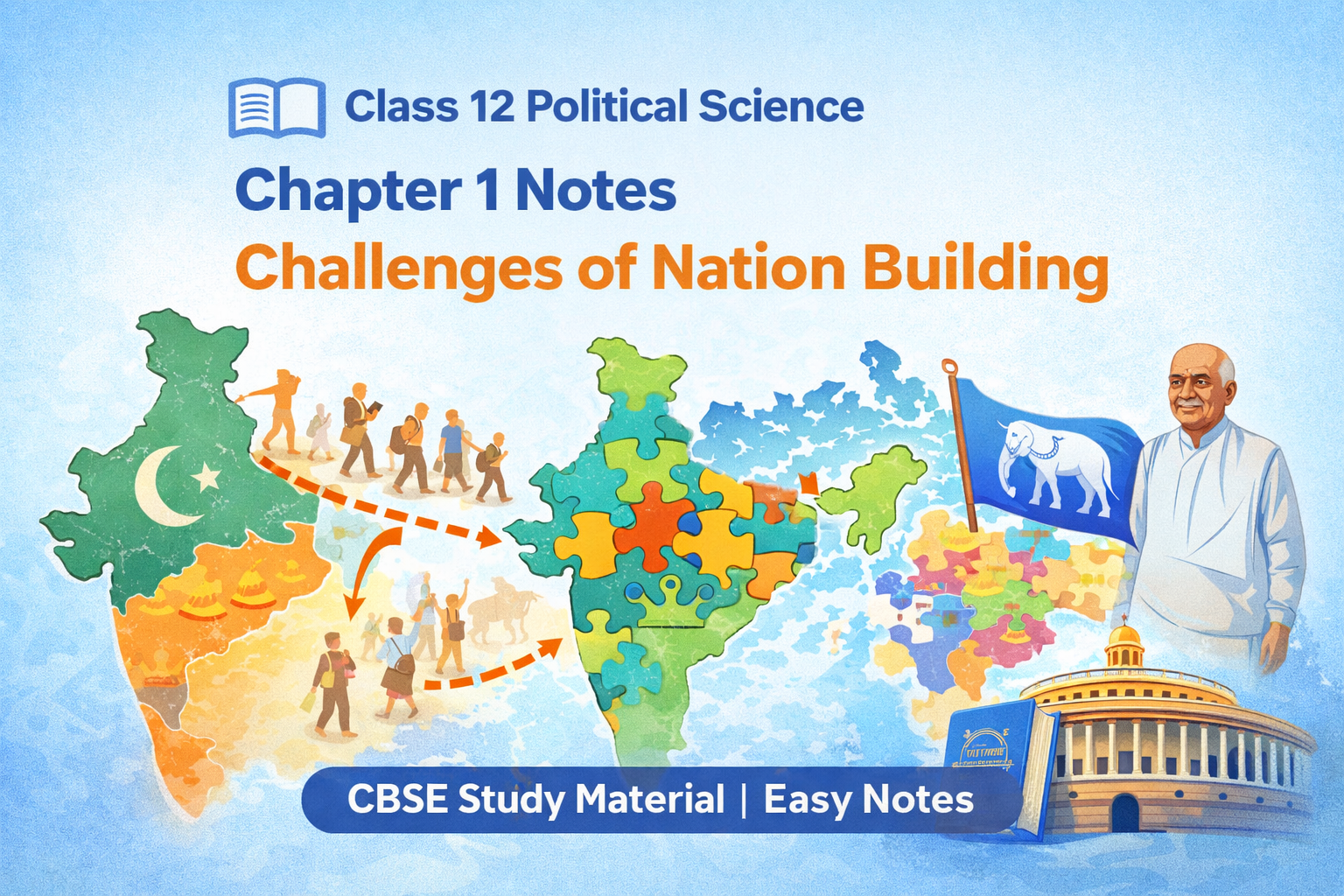
Challenges of Nation Building Class 12 CBSE – Complete Notes with 10 Must-Know Concepts for Board Exams
| Field | Detail |
|---|---|
| Chapter | 1 – Challenges of Nation Building |
| Subject | Political Science |
| Class | 12 |
| Board | CBSE |
| Exam Weightage | Check latest CBSE syllabus |
The Challenges of Nation Building Class 12 CBSE chapter opens your Political Science course with one of the most gripping stories in modern history — how a newly independent India, divided by partition and holding together hundreds of princely states, managed to become a united democratic republic within just a few years. This chapter carries real weight in board exams and is frequently asked in both short-answer and long-answer questions.
These notes cover every major topic from the chapter: the three core challenges India faced at independence, the trauma of partition and displacement, Sardar Patel’s role in merging princely states, the difficult cases of Hyderabad and Kashmir, and the linguistic reorganization of states. Each concept is explained in plain language so you can understand it quickly and write it confidently in your exam.
Reading this chapter is not just about board marks — it tells you how fragile India’s unity actually was in 1947 and how much courage it took for its leaders to hold everything together. That context makes every political decision in modern India more meaningful.
Table of Contents
- Three Major Challenges Faced by India at Independence
- Partition – Displacement, Violence, and Rehabilitation
- Challenges of Nation Building Class 12 CBSE – Merger of Princely States
- Hyderabad and Manipur – Two Critical Cases
- Challenges of Nation Building Class 12 CBSE – Linguistic Reorganization of States
- The State Reorganization Commission and Its Outcome
- Important Questions – Challenges of Nation Building Class 12 CBSE
- Quick Revision – Key Points to Remember
- Related Notes on Nextoper – Internal Links
- Useful External Resources – Outbound Links
Three Major Challenges Faced by India at Independence
When Jawaharlal Nehru addressed the Constituent Assembly at midnight on 14–15 August 1947, the joy of independence was real — but so was the weight of responsibility. India had just emerged from colonial rule into a deeply uncertain situation. Leaders across party lines agreed on two immediate commitments: India would be governed democratically, and the government would work for the welfare of all its people.
But agreeing on principles was the easy part. The actual work of building a nation involved three enormous challenges that no textbook formula could fully prepare them for.
Challenge 1 – Unity in Diversity
India was — and remains — one of the most diverse countries on earth. Different religions, languages, castes, and regional identities existed side by side, and there was genuine fear in 1947 that such diversity would pull the country apart. Many foreign observers doubted whether India could hold together as a single nation at all.
The challenge was not to erase this diversity but to create a framework where it could coexist within one democratic republic. The Constitution’s commitment to secularism, federalism, and fundamental rights was India’s answer to this challenge.
Challenge 2 – Establishing and Sustaining Democracy
Guaranteeing fundamental rights and holding free elections were not automatic outcomes — they required deliberate institutional design. The Constitution gave every citizen the right to vote regardless of caste, religion, gender, or income. Political competition was channeled through elections and parliamentary debate rather than force.
This was radical for its time. Most newly independent countries in the 20th century eventually slipped into authoritarianism. India’s commitment to universal adult suffrage — giving the vote to every adult citizen — was a conscious and bold choice.
Challenge 3 – Equitable Development
Independence meant little if economic and social inequality remained unchanged. The Constitution explicitly recognized that certain communities — scheduled castes, scheduled tribes, and religious minorities — had been historically disadvantaged and needed special protection and support.
The challenge was to pursue development that reached all sections of society, not just urban elites or dominant communities. This is why concepts like reservations, land reform, and public sector investment were debated so intensely in early independent India.
[Image: Timeline showing three major challenges of India at independence in 1947 | Alt text: Challenges of Nation Building Class 12 CBSE – three major challenges timeline diagram]
Partition – Displacement, Violence, and Rehabilitation
The creation of Pakistan on 14 August 1947 was the result of a long and painful political process. The Muslim League, led by Muhammad Ali Jinnah, proposed the two-nation theory — the idea that Hindus and Muslims were two separate nations and could not coexist in one country. Congress opposed this theory, but ultimately accepted partition as the only way to achieve independence without prolonged civil war.
The division was based on religion: areas with Muslim majorities became Pakistan (West Pakistan and East Pakistan), and the rest remained India. But drawing a line through Punjab and Bengal — two of India’s most populous and mixed provinces — created a humanitarian catastrophe.
Scale of the Tragedy
- Approximately 80 lakh (8 million) people migrated across the new borders in both directions — one of the largest forced migrations in human history.
- Between 5 and 10 lakh people lost their lives in communal violence, particularly in Punjab and Bengal.
- Cities like Amritsar and Calcutta saw horrific communal riots.
- Khan Abdul Ghaffar Khan — known as the Frontier Gandhi — was a prominent voice against partition, but his opposition could not prevent it.
The Position of Women During Partition
Partition’s violence fell especially hard on women, and this aspect is often underemphasized. Thousands of women were abducted across both sides of the border. Many were forcibly converted or married against their will. In some instances, families killed their own women in the name of protecting family honor — a brutal expression of how women’s bodies became contested symbols during communal violence.
Governments on both sides eventually set up recovery programs, but the psychological and social scars lasted for generations.
After Partition
Even after partition, Muslims remained 12% of India’s population by 1951, which directly contradicted the two-nation theory’s premise. India chose to remain a secular republic where religion was not a criterion for citizenship — a conscious rejection of the logic that had created Pakistan.
Challenges of Nation Building Class 12 CBSE – Merger of Princely States
At the time of independence, British India consisted not just of provinces under direct British rule but also 565 princely states — territories ruled by kings, nawabs, and maharajas who had treaty relationships with the British Crown. When the British left, these treaties lapsed, and technically each princely state became legally independent.
This created an explosive situation. If even a handful of large states chose independence or merged with Pakistan, India’s map would have become fragmented and unworkable.
Sardar Patel’s Decisive Role
Sardar Vallabhbhai Patel, India’s first Home Minister, took personal charge of the integration process. Working with V.P. Menon, his chief adviser, Patel used a combination of persuasion, negotiation, and — when necessary — firm political pressure to bring the princely states into the Indian Union.
Most rulers signed the Instrument of Accession, a legal document by which they agreed to merge with India in exchange for certain guarantees about their titles and privy purses. In states like Orissa, Chhattisgarh, and Saurashtra, dozens of small states merged without significant trouble.
Some rulers initially resisted:
- The Nizam of Hyderabad wanted full independence.
- The Nawab of Bhopal refused to join the Constituent Assembly.
- The rulers of Travancore also initially sought independence.
Patel’s patience and political skill brought most of them around — with the notable exception of Hyderabad, which required a different resolution.
[Image: Map of India showing princely states before integration in 1947 | Alt text: Challenges of Nation Building Class 12 CBSE – princely states map before merger]
Hyderabad and Manipur – Two Critical Cases
Hyderabad
Hyderabad was the largest and wealthiest princely state in India, ruled by the Nizam, Mir Osman Ali Khan. The Nizam argued that Hyderabad should be recognized as an independent state. He even approached the United Nations and explored the possibility of joining Pakistan.
Meanwhile, the situation inside Hyderabad was deteriorating. Farmers in the Telangana region had launched an armed revolt against oppressive landlords and the Nizam’s rule. The Nizam responded by sending Razakars — a private militia — to suppress the uprising, resulting in mass violence against civilians.
Faced with this internal disorder and the Nizam’s refusal to negotiate, the Indian government authorized a military operation in September 1948. The operation, called “Police Action” (Operation Polo), lasted just four days. The Nizam surrendered, and Hyderabad merged with India.
Manipur
Manipur presented a different challenge. Maharaja Bodhchandra Singh had signed the Instrument of Accession, agreeing to merge with India. However, popular opinion in Manipur was divided. Elections held in 1948 had created a constitutional monarchy with an elected legislature, and several political parties — particularly the Praja Shanti Party — opposed the merger.
Despite this opposition, the Central Government proceeded with full integration. Manipur was merged into India, though the process left a legacy of political resentment that had long-term consequences for the region’s relationship with the Indian state.
Challenges of Nation Building Class 12 CBSE – Linguistic Reorganization of States
One of the most persistent demands in early independent India was for states to be reorganized along linguistic lines — meaning that people who shared a common language should live in the same administrative state. This demand was not new: back at the Nagpur session of 1920, Congress had itself promised linguistic reorganization of provinces.
After independence, however, Nehru and other leaders became wary of the idea. They feared that drawing boundaries based on language would deepen regional identities and threaten national unity — especially so soon after partition.
Potti Sriramulu and the Andhra Movement
The demand for a separate Telugu-speaking state became a defining political flashpoint. A Gandhian activist named Potti Sriramulu went on a hunger strike demanding that Andhra Pradesh be carved out of Madras state for Telugu speakers.
Sriramulu died after 56 days of fasting in December 1952. His death triggered widespread protests and riots across the Telugu-speaking regions. The Central Government was forced to act: Andhra Pradesh was formally created in 1953, becoming the first state formed on a linguistic basis.
The State Reorganization Commission and Its Outcome
The Andhra experience made it clear that linguistic demands would not go away. Rather than responding to one demand at a time, the government set up the State Reorganization Commission (SRC) in 1953 under Fazal Ali.
The Commission examined the existing boundaries of all states and recommended that language should be the primary basis for reorganization. Its report led to the States Reorganisation Act of 1956, which redrew India’s internal map significantly:
- 14 states and 6 union territories were created.
- States like Kerala, Karnataka, Maharashtra, and Gujarat were shaped (or laid the groundwork for shaping) along linguistic lines.
- The reorganization largely settled the linguistic question, though it created new boundary disputes in some areas that continue to this day.
The reorganization was a pragmatic recognition that India’s unity did not require cultural uniformity — different linguistic communities could coexist as equal partners in a federal republic.
Important Questions – Challenges of Nation Building Class 12 CBSE
Q1. Who was known as the “Frontier Gandhi”? (1 Mark) Ans: Khan Abdul Ghaffar Khan was known as the Frontier Gandhi. He opposed the two-nation theory and the partition of India.
Q2. What were the three major challenges India faced at independence? (3 Marks) Ans: India faced three interconnected challenges after independence. The first was maintaining national unity despite enormous diversity in religion, language, and culture. The second was building and sustaining democratic institutions, including universal adult suffrage and fundamental rights. The third was ensuring that economic and social development reached all sections of society, including historically disadvantaged communities, rather than benefiting only a privileged few.
Q3. What role did Sardar Patel play in the integration of princely states? (3 Marks) Ans: Sardar Vallabhbhai Patel, as India’s first Home Minister, took charge of negotiating the merger of 565 princely states into the Indian Union. Working with V.P. Menon, he persuaded most rulers to sign the Instrument of Accession through a mix of diplomacy and political pressure. In states like Orissa, Saurashtra, and Chhattisgarh, multiple small kingdoms were merged smoothly. For states like Hyderabad, which refused to cooperate, Patel authorized military action. His decisive leadership prevented the fragmentation of India into dozens of independent territories.
Q4. Why was Andhra Pradesh created in 1953, and what was its significance? (3 Marks) Ans: Andhra Pradesh was created in response to the intense demand for a separate state for Telugu-speaking people. Gandhian activist Potti Sriramulu died after a 56-day hunger strike demanding this state, triggering widespread unrest. The government created Andhra Pradesh in 1953, making it the first state in independent India formed on a linguistic basis. This decision set a precedent and led directly to the formation of the State Reorganization Commission in 1953, whose recommendations reshaped India’s internal map through the States Reorganisation Act of 1956.
Q5. Analyse the impact of partition on India’s people and its long-term consequences for Indian politics. (5 Marks) Ans: The partition of India in 1947 was one of the most traumatic events in South Asian history, with consequences that shaped Indian politics for decades. At the immediate human level, the scale of displacement was staggering — around 80 lakh people crossed the new borders between India and Pakistan, and between 5 and 10 lakh lost their lives in communal violence. Punjab and Bengal bore the worst of this violence, with cities like Amritsar and Calcutta witnessing horrific riots. Women suffered disproportionately: thousands were abducted, forcibly converted, or killed by their own families in acts rationalized as protecting honor. The psychological trauma of partition left a deep mark on multiple generations. At the political level, partition complicated India’s relationship with the Muslim community that remained within its borders. Despite the two-nation theory’s logic, 12% of India’s population in 1951 was Muslim, which challenged the idea that Hindus and Muslims could not coexist. India’s choice to remain a secular republic was partly a direct rejection of partition’s logic. The trauma of partition also intensified anxieties about national unity, making leaders like Nehru initially cautious about linguistic reorganization of states, fearing it would deepen divisions further. In the long term, partition established the India-Pakistan relationship as one of deep mutual suspicion, shaping subcontinental geopolitics in ways that are still felt today.
Quick Revision – Key Points to Remember
- India gained independence on 14–15 August 1947, with Jawaharlal Nehru becoming the first Prime Minister.
- The three major challenges were national unity, democracy, and equitable development.
- The Muslim League’s two-nation theory led to the partition of India and the creation of Pakistan.
- Partition caused the migration of approximately 80 lakh people and the deaths of 5–10 lakh in communal violence.
- Despite partition, Muslims remained 12% of India’s population in 1951, disproving the two-nation theory.
- India had 565 princely states at independence, each technically free to choose their own political future.
- Sardar Vallabhbhai Patel led the integration of princely states, with most rulers signing the Instrument of Accession.
- The Nizam of Hyderabad was forced to merge after a four-day military operation (Operation Polo) in September 1948.
- Potti Sriramulu died after a 56-day hunger strike, leading to the creation of Andhra Pradesh in 1953 — India’s first linguistic state.
- The States Reorganisation Act of 1956 created 14 states and 6 union territories based primarily on language.
These CBSE Class 12 Political Science Chapter 9 notes are structured to help students grasp these complex developments clearly and prepare confidently for board exams. For complete exam preparation, also explore our Class 12 Political Science Chapter 8 Notes on Regional Aspirations and Class 12 Political Science Chapter 7 Notes on Security in the Contemporary World available on this website.
Stay Updated with CBSE Notes
For more useful study material, notes, and updates, follow us on Instagram and stay connected.


Pingback: Class 12 Pol Science Notes Chapter 8 Regional Aspirations in English
Pingback: Recent Developments in Indian Politics Notes in English – Full Regional Aspirations Summary, Notes, NCERT Solutions & Study Resources - Nextoper
Pingback: Class 12th Pol Science Chapter 6 Notesn
Pingback: Class 12 Political Science Chapter 8 Notes
Pingback: Class 12 Politics of Planned Development – Complete Notes with 10 Must-Know Concepts