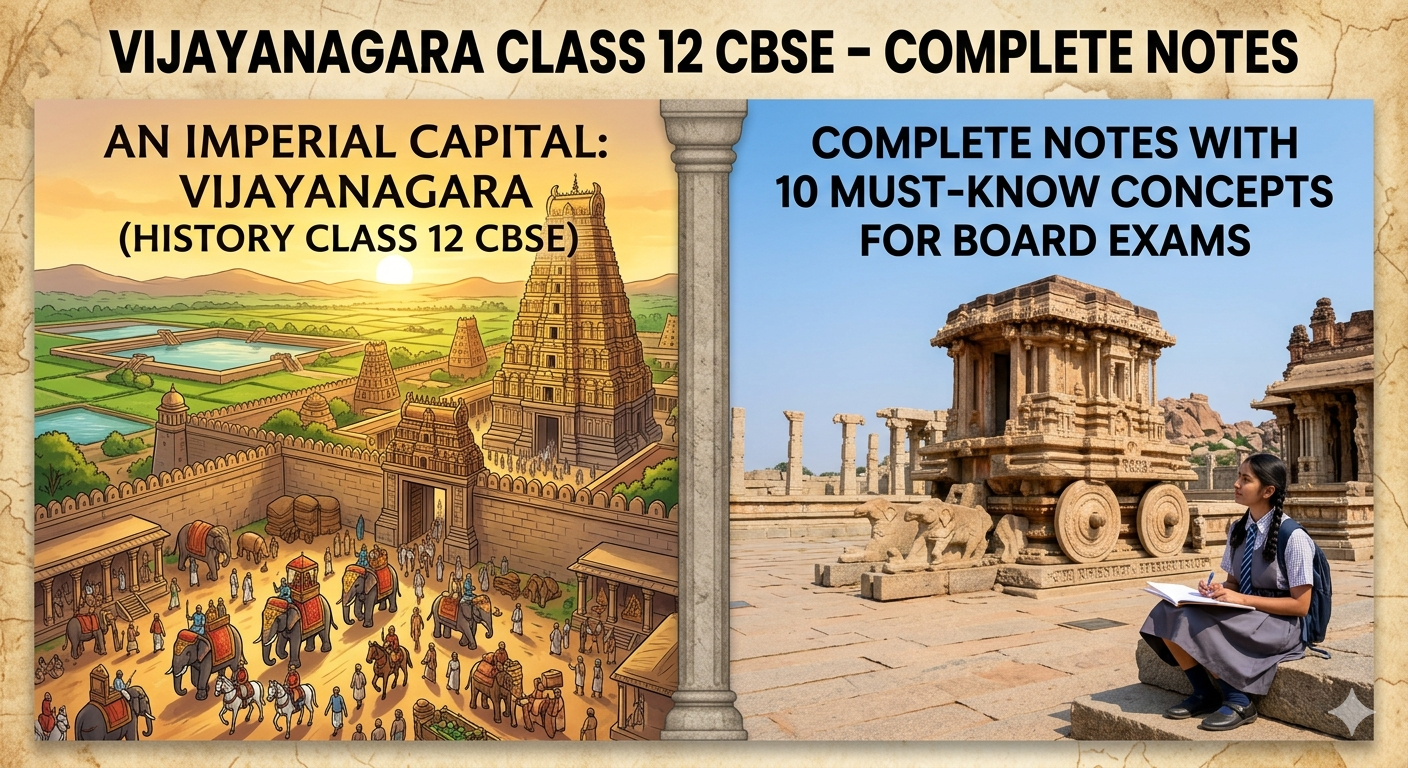
Vijayanagara Class 12 CBSE – Complete Notes with 10 Must-Know Concepts for Board Exams
| Field | Detail |
|---|---|
| Chapter | 7 – An Imperial Capital: Vijayanagara |
| Subject | History |
| Class | 12 |
| Board | CBSE |
| Exam Weightage | Check latest CBSE syllabus |
Vijayanagara Class 12 CBSE is one of the most visually rich and historically significant chapters in your History Part 2 textbook. Chapter 7 takes you inside one of medieval India’s greatest empires — its rise to power, its legendary capital city, and its eventual fall. Understanding this chapter well can help you write confident, detailed answers in your board exam.
In these notes, you’ll find everything from the founding of the empire and its dynasty timeline to its water systems, temple architecture, and administrative structure. Each concept is explained simply, with exam-relevant points highlighted throughout. Whether you’re doing your first reading or last-minute revision, this guide has you covered.
The Vijayanagara Empire wasn’t just a political story — it’s a lesson in how power, religion, trade, and art can come together to build something extraordinary. As you read, notice how many of the empire’s strategies — from military supply chains to temple patronage — are surprisingly relatable to modern governance. That’s what makes this chapter come alive.
Table of Contents
- Origin and Expansion of the Vijayanagara Empire
- How Historians Rediscovered Hampi – Vijayanagara Class 12 CBSE
- Rulers, Trade, and Military Power
- Dynasties of Vijayanagara
- The Nayaka System and Administration
- Water Resources and City Planning
- Royal Centre and Ceremonial Life
- Religious Centre and Temple Architecture – Vijayanagara Class 12 CBSE
- Important Questions – Vijayanagara Class 12 CBSE
- Quick Revision – Key Points to Remember
- Related Notes on Nextoper – Internal Links
- Useful External Resources – Outbound Links
Origin and Expansion of the Vijayanagara Empire
The Vijayanagara Empire was founded in 1336 CE by two brothers, Harihara and Bukka, in the Deccan region of South India. The name “Vijayanagara” literally means City of Victory — a fitting title for an empire that would dominate medieval South India for over two centuries.
At its height, the empire stretched from the Krishna River in the north all the way to the southern tip of the Indian peninsula. It brought together people who spoke different languages — Telugu, Kannada, Tamil — and followed diverse religious traditions, making it a genuinely multicultural state.
On its northern borders, the empire constantly faced pressure from the Deccan Sultans and the Gajapatis of Orissa. Within its own territory, it inherited the legacy of powerful earlier kingdoms like the Cholas (builders of the Brihadeeswara Temple at Thanjavur) and the Hoysalas (who built the Chennakeshava Temple at Belur). In 1565 CE, the empire suffered a catastrophic defeat at the Battle of Talikota, after which the city was looted and eventually abandoned. Today, this site is known as Hampi, named after the local goddess Pampadevi.
[Image: Map showing the extent of the Vijayanagara Empire from the Krishna River to the southern tip of India | Alt text: Vijayanagara Class 12 CBSE – empire map showing territorial extent]
How Historians Rediscovered Hampi – Vijayanagara Class 12 CBSE
The ruins of Hampi were largely forgotten until Colonel Colin Mackenzie rediscovered them around 1800 CE. Working for the East India Company, Mackenzie prepared the first detailed survey map of the site. He gathered early information from the priests of the Virupaksha Temple and from local oral traditions linked to the goddess Pampadevi.
Colin Mackenzie was born in 1754 CE and became one of colonial India’s most important figures in the fields of antiquarianism, surveying, and cartography. In 1815, the British government appointed him the first Surveyor General of India, a post he held until his death in 1821.
Later, nineteenth-century photographers documented the monuments systematically, and historians collected inscriptions from temples across the region. Scholars then cross-referenced these findings with accounts written by foreign travelers and with literature in Telugu, Kannada, Tamil, and Sanskrit. This multi-source approach allowed researchers to piece together a detailed picture of the once-glorious imperial capital.
In the twentieth century, the Archaeological Survey of India and Karnataka’s archaeology department launched systematic preservation efforts. In 1976, a comprehensive documentation project divided the Hampi area into 25 grid sectors, later subdivided further. Through excavation and mapping, researchers recovered the foundations of shrines, roads, market platforms, and residences.
Rulers, Trade, and Military Power
The Vijayanagara state was often called the Karnataka Empire by its contemporaries. Three important royal titles defined its power relationships with neighboring states: Gajapati (lord of elephants), Asvapati (lord of horses), and Narapati (lord of people).
Cavalry was the empire’s military backbone. Since horses didn’t breed well in the Deccan climate, Vijayanagara imported them from Arabia and Central Asia. Arab merchants initially controlled this trade. When the Portuguese arrived in India in 1498 CE, they introduced superior firearms and influenced maritime commerce, gradually replacing Arab dominance in horse trading.
The empire also hosted thriving markets dealing in spices, textiles, and gemstones. These markets were both a symptom and a source of the city’s wealth. Foreign travelers frequently commented on the scale and energy of Vijayanagara’s commercial districts.
Dynasties of Vijayanagara
The empire passed through four ruling dynasties over its roughly 330-year history:
- Sangama Dynasty (1336–1485) – Founded by Harihara and Bukka; established the empire’s foundations.
- Saluva Dynasty (1485–1503) – Military commanders who seized power and consolidated control.
- Tuluva Dynasty (1503–1570) – The era of Krishnadeva Raya, the empire’s most celebrated ruler.
- Aravidu Dynasty (1570–1670) – Ruled from Penukonda and later Chandragiri after the fall of Hampi.
Krishnadeva Raya deserves special attention for board exams. Between 1512 and 1520, he conquered the Raichur Doab, subdued the rulers of Orissa, and defeated the Sultan of Bijapur. He was also a patron of literature and temple construction, and he authored Amuktamalyada, an important Telugu literary work. After his death in 1529 CE, internal rivalries among nobles gradually weakened central authority, setting the stage for the empire’s eventual collapse at Talikota.
The Nayaka System and Administration
The Nayaka system was the backbone of Vijayanagara’s regional administration. Nayakas were military chiefs — usually Telugu or Kannada speakers — who controlled forts, maintained armies, and administered local territories.
Under the Amara-Nayaka system, these chiefs were given the right to collect taxes and revenue from their assigned regions. In return, they provided troops and maintained loyalty to the central authority. They were expected to send tribute and gifts, especially during royal festivals.
Over time, many Nayakas effectively became independent powers, particularly after the weakening of central authority in the later dynasties. However, they also played a vital social role — funding the construction of temples and irrigation works, which kept local economies running and cemented their legitimacy in the eyes of local populations.
Water Resources and City Planning
Vijayanagara’s location near the Tungabhadra River was strategic. Surrounded by granite hills that fed numerous streams into the river, the city had a reliable water supply in an otherwise relatively dry region.
Engineers constructed sophisticated infrastructure to manage this water:
- Kamalapuram Reservoir – stored large quantities of water for urban and agricultural use
- Hiriya Canal – channeled water from the reservoir into fields and the city centre
The city’s fortifications were equally impressive. The traveler Abdur Razzaq recorded up to seven concentric lines of fortification enclosing not just the city but also its surrounding fields and gardens. Builders used precisely fitted stone blocks without mortar — the walls held together purely by weight and design. Broad planned roads connected neighborhoods, markets, and temple complexes. The city also featured Indo-Islamic architectural elements in its gateways and domes, reflecting cultural exchange with neighboring Deccan Sultanates.
[Image: Ruins of the fortification walls at Hampi showing stone construction | Alt text: Vijayanagara Class 12 CBSE – Hampi fortification walls historical ruins]
Royal Centre and Ceremonial Life
The Royal Centre, located in the southwestern part of the city, contained over sixty temples and numerous palace complexes. Temples in this zone were instruments of royal legitimacy — rulers built and patronized them to publicly display their divine sanction and political authority.
Key structures in the Royal Centre include:
- Raja’s House – the largest palace-like complex, enclosed by high double walls
- Sabha Mandapa – a pillared assembly hall used for court ceremonies
- Mahanavami Dibba – a massive platform with a base of about 11,000 square feet and a height of around 40 feet, used for royal festivals
The Mahanavami festival was the most important public ceremony of the year. During this event, the king performed elaborate rituals, inspected his army, and received tribute from Nayakas who arrived bearing gifts and tax payments. These public spectacles reinforced the political bond between the ruler and his subordinates.
The Lotus Mahal — an elegant structure in the royal complex — is believed to have served as either a council hall or a palace pavilion. The Hazara Rama Temple nearby contains exquisite relief sculptures depicting scenes from the Ramayana and was used for royal religious rituals.
Religious Centre and Temple Architecture – Vijayanagara Class 12 CBSE
The northern part of the city, near the Tungabhadra River, formed the religious heart of Vijayanagara. This zone housed the famous Virupaksha Temple and the Vittala Temple, two of the most celebrated surviving monuments from this period.
The Virupaksha Temple remains an active place of worship even today. Vijayanagara rulers publicly identified themselves with Lord Virupaksha, often using the royal title “Hindu Suratrana” to assert divine authority over their subjects.
Temples in Vijayanagara were not merely religious sites — they functioned as major social, economic, and cultural institutions. Rulers granted land to temples, and temples in turn supported local education, organized festivals, and even served as centres for market activity.
Architecturally, this era introduced several landmark features to South Indian temple design:
- Raya gopurams – monumental tower gateways marking the temple entrance
- Pillared mandapas – large colonnaded halls used for assemblies and rituals
- Long corridors – lined with vendors’ pavilions on chariot lanes
- Stone chariot and musical pillars – the Vittala Temple’s most famous features, demonstrating extraordinary technical skill
The musical pillars at the Vittala Temple are a point frequently asked in board exams. When struck, they emit distinct musical notes — evidence of the remarkable craftsmanship of Vijayanagara artisans.
Important Questions – Vijayanagara Class 12 CBSE
Q1. Who founded the Vijayanagara Empire and when? (1 Mark) Harihara and Bukka founded the Vijayanagara Empire in 1336 CE.
Q2. What was the Amara-Nayaka system? (3 Marks) The Amara-Nayaka system was an administrative arrangement unique to the Vijayanagara Empire. Under this system, military chiefs called Nayakas were granted rights to collect revenue and taxes from specific territories. In return, they maintained armies and provided military service to the central authority. They also sent tribute to the royal court, especially during festivals. Over time, some Nayakas became semi-independent rulers, though initially they were loyal subordinates who helped administer the vast empire.
Q3. Describe the architectural achievements of the Vijayanagara Empire. (5 Marks) The Vijayanagara Empire made spectacular contributions to South Indian architecture. Rulers introduced the tradition of large Raya gopurams — towering gateways that became a defining feature of South Indian temple complexes. Inside the temples, expansive pillared mandapas served as assembly and ceremonial halls, while long corridors flanked by vendor pavilions added to the temple’s role as a social hub. The Vittala Temple at Hampi stands out for two extraordinary features: a sculpted stone chariot in the temple courtyard and musical pillars that produce different musical notes when struck. The Lotus Mahal and Hazara Rama Temple in the Royal Centre reflect the period’s blend of Indo-Islamic and traditional Dravidian styles. Beyond temples, the empire’s engineers also built impressive secular structures: the Mahanavami Dibba platform for royal ceremonies, the Kamalapuram Reservoir, and the Hiriya Canal, which brought water to fields and the city centre. Together, these achievements show how Vijayanagara combined religious devotion, political spectacle, and practical engineering.
Q4. What role did Colin Mackenzie play in rediscovering Vijayanagara? (3 Marks) Colin Mackenzie, working for the East India Company, rediscovered the ruins of Hampi around 1800 CE. He prepared the first survey map of the site, gathering information from the priests of the Virupaksha Temple and from local traditions. Later appointed as the first Surveyor General of India in 1815, Mackenzie’s documentation work gave historians a foundational reference for studying the empire.
Q5. Why was Vijayanagara’s location strategically important? (1 Mark) Vijayanagara was located near the Tungabhadra River and surrounded by granite hills, providing natural defences and a reliable water supply for agriculture and urban life.
Quick Revision – Key Points to Remember
- Vijayanagara, meaning “City of Victory,” was founded in 1336 CE by Harihara and Bukka of the Sangama dynasty.
- The empire passed through four dynasties: Sangama, Saluva, Tuluva, and Aravidu.
- Krishnadeva Raya (Tuluva dynasty) was the most powerful ruler; he authored Amuktamalyada in Telugu.
- The empire fell to a coalition of Deccan Sultans at the Battle of Talikota in 1565 CE.
- Colin Mackenzie rediscovered Hampi around 1800 CE and became India’s first Surveyor General in 1815.
- The Amara-Nayaka system was the key administrative arrangement — Nayakas collected tax and provided military service in return.
- Abdur Razzaq recorded that Vijayanagara had up to seven concentric lines of fortification.
- The Virupaksha Temple remains an active shrine; rulers used the title “Hindu Suratrana” to associate with Lord Virupaksha.
- The Vittala Temple is famous for its stone chariot and musical pillars — important for board exams.
- Temples in Vijayanagara served as social, economic, and cultural centres, not just places of worship.
Related Notes on Nextoper
Explore these related CBSE notes on Nextoper to strengthen your board exam preparation:
- Class 12 History Notes: Chapter 1 Bricks, Beads and Bones
- Class 12 History Notes Chapter 1 Bricks, Beads and Bones in Hindi
- Class 12th History Part2 Chapter 7 – An Imperial Capital: Vijayanagara
These Vijayanagara Class 12 CBSE notes cover every major concept from Chapter 7, Part 2 of your History textbook. For the best results, read through once for understanding, then use the Quick Revision section the night before your exam. Good luck with your board preparation!

Pingback: Class 12 Political Science The End of Bipolarity Notes Handwritten-Style | Nextoper Notes - Nextoper