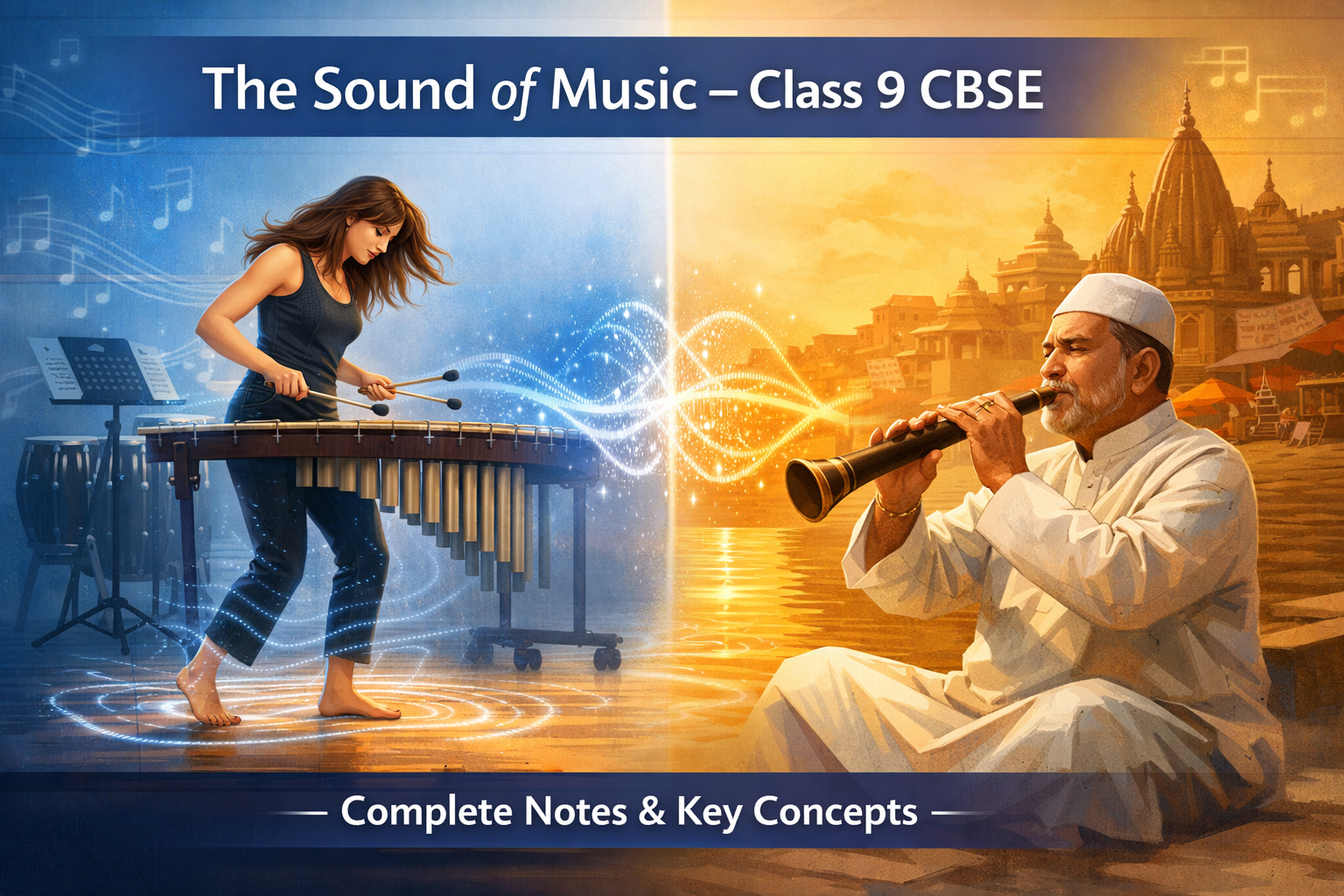
The Sound of Music Class 9 CBSE – Complete Notes with 10 Must-Know Concepts for Easy Board Prep
Quick Overview
| Field | Detail |
|---|---|
| Chapter | Chapter 2 – The Sound of Music |
| Subject | English – Beehive |
| Class | 9 |
| Board | CBSE |
| Exam Weightage | Check latest CBSE syllabus |
The Sound of Music Class 9 CBSE is a uniquely structured chapter because it tells not one but two inspiring true stories. The first is about Evelyn Glennie, a Scottish percussionist who became a world-class musician despite being profoundly deaf. The second is about Ustad Bismillah Khan, the legendary Indian shehnai player whose music defined a nation’s cultural identity for decades.
These notes will take you through both parts of the chapter completely — summaries, key events, themes, character insights, important word meanings, and board-style questions. Everything you need to prepare The Sound of Music for your CBSE Class 9 English exam is right here, organized clearly so you can study efficiently and revise quickly before your exam.
What makes this chapter genuinely special is that both stories carry the same underlying truth — music is not something you simply hear, it is something you feel, live, and breathe. Evelyn proved this literally. Bismillah Khan proved it spiritually. Understanding both lives will help you write richer, more thoughtful answers in your board exam.
Table of Contents
- About the Authors
- The Sound of Music Class 9 CBSE – Part 1 Overview
- Evelyn Glennie – Early Life and the Challenge of Deafness
- The Turning Point – Ron Forbes and a New Way of Listening
- Evelyn’s Journey to the Royal Academy of Music
- Evelyn Glennie’s Achievements and Message
- The Sound of Music Class 9 CBSE – Part 2 Overview
- History of the Shehnai
- Bismillah Khan – Early Life and Musical Training
- Bismillah Khan’s Career and National Recognition
- Awards and Legacy of Bismillah Khan
- Themes of The Sound of Music Class 9 CBSE
- Important Word Meanings
- Important Questions – The Sound of Music Class 9 CBSE
- Quick Revision – Key Points to Remember
- Related Notes on Nextoper – Internal Links
- Useful External Resources – Outbound Links
About the Authors
The Sound of Music Class 9 CBSE is written by two different authors, one for each part.
Deborah Cowley is a Canadian writer and broadcaster who wrote the first part about Evelyn Glennie. Her writing style is warm and human, focusing on Evelyn’s inner strength rather than just her disability.
Vishnu Khare is an acclaimed Indian poet and literary critic who wrote the second part about Bismillah Khan. His account celebrates the cultural and spiritual dimensions of Bismillah Khan’s music with deep respect and sensitivity.
The Sound of Music Class 9 CBSE – Part 1 Overview
The first part of The Sound of Music Class 9 CBSE tells the remarkable true story of Evelyn Glennie, one of the world’s finest percussionists. What makes her story extraordinary is that she achieved this distinction without being able to hear in the conventional sense.
Evelyn lost most of her hearing by the age of eleven due to progressive nerve damage. Doctors told her that a career in music was impossible. She chose to prove them wrong — not by finding a workaround, but by developing an entirely different way of experiencing music through the vibrations felt in her body.
Her story is not simply about overcoming disability. It is about redefining what it means to listen, to feel, and to perform. This is why The Sound of Music is one of the most powerful chapters in Class 9 English Beehive.
Evelyn Glennie – Early Life and the Challenge of Deafness
Growing Up in Scotland
Evelyn Glennie was born in Scotland and showed an early love for music. She began losing her hearing gradually at the age of eight due to nerve damage — a condition where the auditory nerves that carry sound signals to the brain stop functioning properly.
By the time she was eleven, her hearing loss was severe enough that most people, including medical professionals, assumed her musical journey was over before it had truly begun.
How Evelyn Responded
Rather than accepting this verdict, Evelyn made a quiet but determined decision. She would not let her ears define the boundaries of her musical life. She began paying close attention to how different sounds created physical vibrations — sensations she could feel through her skin, her feet, and even through the floor beneath her.
Her mother noticed that even without hearing, Evelyn’s natural sense of rhythm remained completely intact. This observation became the foundation on which Evelyn rebuilt her musical identity.
The Turning Point – Ron Forbes and a New Way of Listening
The most important moment in Evelyn’s early musical journey came when Ron Forbes, a percussionist at her school, recognized her extraordinary potential. Forbes saw what others had dismissed, and he made a suggestion that changed everything.
He told Evelyn: do not try to listen through your ears. Instead, sense the music through other parts of your body. Feel it rather than hear it.
How Evelyn Learned to Feel Music
Following Forbes’ guidance, Evelyn began experimenting with how different notes registered in different parts of her body:
- Higher pitched sounds — she could feel these from her waist upward, particularly in her chest and shoulders
- Lower pitched sounds — these registered from her waist downward, traveling through her legs and feet
- Vibrations through the floor — standing barefoot allowed her to feel the resonance of percussion instruments directly through the ground
This method of experiencing music was not a compromise. It was a genuinely different and equally valid form of musical perception — one that Evelyn mastered completely through years of practice and concentration.
Evelyn’s Journey to the Royal Academy of Music
With Ron Forbes as her mentor and her own extraordinary determination driving her forward, Evelyn began preparing for formal music education at the highest level.
She applied to the Royal Academy of Music in London — one of the most prestigious conservatories in the world. The admission process was rigorous and competitive, designed for students with full hearing ability.
Evelyn not only gained admission but graduated as the top student in her batch, receiving the Academy’s most coveted awards and recognition. This achievement remains one of the most powerful statements against the assumption that disability limits potential.
Performing Barefoot
One of the most distinctive aspects of Evelyn’s performances is that she removes her shoes before playing. This is not a stylistic choice — it is practical. Without shoes, she can feel the vibrations of her instruments and the stage more accurately through the soles of her feet. This detail is frequently asked in The Sound of Music Class 9 CBSE exam questions.
Evelyn Glennie’s Achievements and Message
Evelyn Glennie went on to build one of the most distinguished careers in the world of percussion music. Her achievements include:
- Mastering over 1,000 different percussion instruments from cultures around the world
- Performing with major international orchestras and ensembles across Europe, North America, and Asia
- Receiving the Royal Philharmonic Society’s Soloist of the Year Award in 1991
- Giving free concerts in hospitals and prisons to bring music to people who rarely experience live performance
Evelyn’s message to the world is consistent and clear — music is not about the mechanics of hearing. It is about emotion, expression, and communication. Her life demonstrates that the human spirit, when truly committed to something, finds ways to transcend any obstacle placed before it.
[Image: Bismillah Khan playing the shehnai at a cultural performance in India | Alt text: The Sound of Music Class 9 CBSE – Bismillah Khan playing shehnai at Indian cultural event]
The Sound of Music Class 9 CBSE – Part 2 Overview
The second part of The Sound of Music Class 9 CBSE shifts from Scotland to India, from percussion to the haunting melody of the shehnai, and from one musical genius to another — Ustad Bismillah Khan.
Where Evelyn’s story is about conquering physical limitation, Bismillah Khan’s story is about devotion — to music, to his city, and to his culture. His life represents the finest traditions of Indian classical music and the values of humility, spiritual dedication, and artistic excellence.
Together, these two stories create a chapter that is far greater than the sum of its parts. They show students that greatness in music — or in anything — comes not from privilege or perfect circumstances, but from passion and persistence.
History of the Shehnai
Before understanding Bismillah Khan, it helps to understand the instrument he made famous.
The shehnai is a woodwind instrument with a double reed. It produces a sound that is both melancholic and celebratory — which is why it is played at both weddings and religious occasions across India.
Origins of the Shehnai
- The shehnai is believed to have evolved from the pungi, a simpler reed instrument that was commonly played by snake charmers
- According to tradition, a barber from a family of musicians redesigned the pungi by improving its reed and lengthening its body, creating a richer, more refined sound — and thus the shehnai was born
- The pungi had been banned by Emperor Aurangzeb because of its shrill, unpleasant tone. The shehnai, with its more melodious sound, replaced it and gradually became welcome in temples, royal courts, and ceremonial events
- Over centuries, the shehnai became associated with auspiciousness — it was believed that its music brought good fortune to any occasion it graced
Understanding this history helps students appreciate why Bismillah Khan’s elevation of the shehnai to the concert stage was such a culturally significant achievement.
Bismillah Khan – Early Life and Musical Training
Ustad Bismillah Khan was born in 1916 in Dumraon, Bihar. His family had been musicians for generations — his grandfather played the shehnai in the royal court of the Bhojpur king, and his father, Paigambar Bux Khan, served as a shehnai player in the court of the Maharaja of Dumraon.
Music was not something Bismillah Khan chose — it was the world he was born into.
The Banks of the Ganga – His True Classroom
As a young boy, Bismillah moved to Benaras (Varanasi) with his family. The city would become his lifelong home and his greatest source of inspiration.
He practiced for long hours on the ghats (steps) along the river Ganga, where he believed the flowing water and the sounds of the city merged with his music to create something sacred. His favorite practice spots included the temple of Balaji and the Mangala Maiya temple.
For Bismillah Khan, playing the shehnai was never merely a performance — it was a form of prayer and devotion. This spiritual dimension is what gave his music its extraordinary depth and emotional power.
Bismillah Khan’s Career and National Recognition
Bismillah Khan’s rise to national prominence was gradual, built entirely on the quality of his music and the force of his dedication.
Key Milestones in His Career
All India Radio, Lucknow — His performance here was one of the first occasions when the shehnai was presented as a serious classical instrument deserving of broadcast and formal recognition.
15 August 1947 — Independence Day — Bismillah Khan became the first Indian to greet the nation’s independence by performing the shehnai from the Red Fort in Delhi. His music on that historic morning became part of India’s memory of its freedom.
International Performances — He represented India at major cultural festivals and concerts in Tehran, Montreal, Cannes, and Osaka, bringing the shehnai to audiences who had never heard anything like it.
Despite this global recognition, Bismillah Khan never felt truly comfortable away from Benaras. He is famously quoted as having said that no matter where he traveled in the world, his heart always longed for the smell of the Ganga and the sound of the temples of Benaras. This rootedness is one of the most touching aspects of his character.
Awards and Legacy of Bismillah Khan
For his extraordinary contributions to Indian classical music, Bismillah Khan received the highest honors that India offers:
- Padma Shri — 1961
- Padma Bhushan — 1968
- Padma Vibhushan — 1980
- Bharat Ratna — 2001, India’s highest civilian award
Despite these honors, he remained deeply humble throughout his life. He continued to live simply in Benaras, surrounded by his music and his faith.
Unity Through Music
One of the most beautiful aspects of Bismillah Khan’s life was his complete transcendence of religious boundaries. Though a devout Muslim, he played his shehnai daily at Hindu temples and considered his music an offering to God — regardless of which tradition the sacred space belonged to.
His life is a living example of the values that define The Sound of Music Class 9 CBSE — that art belongs to everyone, and true devotion to craft dissolves every barrier between human beings.
Themes of The Sound of Music Class 9 CBSE
Both parts of this chapter share several powerful themes that students should understand clearly for their exams:
Triumph over adversity — Evelyn Glennie overcame profound deafness; Bismillah Khan overcame the obscurity of a folk instrument to reach global stages.
Dedication and perseverance — Both musicians practiced for years without shortcuts, letting their craft develop at its own pace.
Music as a universal language — Evelyn’s music crossed the barrier of disability; Bismillah’s crossed the barriers of religion and nationality.
Humility in greatness — Despite world fame, both artists remained grounded — Evelyn in her message of inclusion, Bismillah in his love for Benaras.
Spiritual dimensions of art — Bismillah Khan’s approach to music as devotion reflects a profound truth about how the greatest artists relate to their craft.
Important Word Meanings
| Word | Meaning |
|---|---|
| Percussionist | A musician who plays percussion instruments like drums and xylophones |
| Impaired | Weakened or damaged, especially a sense or function |
| Vibration | A rapid back-and-forth movement that produces sound or sensation |
| Auspicious | Bringing good fortune; considered favorable |
| Maestro | A master musician, especially one who is greatly respected |
| Reed | A thin strip of material in a wind instrument that vibrates to produce sound |
| Devout | Deeply religious and committed to worship |
| Melancholic | Having a feeling of deep sadness or thoughtfulness |
Important Questions – The Sound of Music Class 9 CBSE
1 Mark Questions
Q: Who wrote Part 1 of The Sound of Music? Part 1 was written by Deborah Cowley, a Canadian writer and broadcaster.
Q: Why does Evelyn Glennie perform barefoot? She performs barefoot to feel the vibrations of the music through the soles of her feet, compensating for her inability to hear with her ears.
Q: What award did Bismillah Khan receive in 2001? Bismillah Khan received the Bharat Ratna in 2001, India’s highest civilian honor.
3 Marks Questions
Q: How did Ron Forbes help Evelyn Glennie discover a new way of experiencing music? Ron Forbes was a percussionist at Evelyn’s school who recognized her extraordinary potential despite her deafness. Rather than treating her hearing loss as an insurmountable barrier, he encouraged her to stop trying to listen through her ears and instead sense music through her body. He helped her discover that higher notes could be felt from the waist upward while lower notes registered from the waist downward. This breakthrough completely transformed Evelyn’s approach to music and set her on the path to becoming a world-class percussionist.
Q: How is the shehnai connected to the pungi? What changed between the two instruments? The shehnai is believed to have developed from the pungi, a simpler reed instrument traditionally played by snake charmers. Emperor Aurangzeb had banned the pungi from his court because of its shrill and unpleasant sound. A musician from a barber family improved the instrument by refining its reed and extending its body, creating a richer and more melodious sound. This improved instrument became the shehnai, which gradually earned a place in temples, royal courts, and eventually concert stages across the world.
5 Marks Questions
Q: Compare the musical journeys of Evelyn Glennie and Bismillah Khan. What common qualities made both of them great? Evelyn Glennie and Bismillah Khan came from entirely different countries, cultures, and musical traditions, yet their journeys share a remarkable number of qualities. Evelyn faced the challenge of deafness — a condition that most people would consider a permanent barrier to a musical career. Rather than accepting this limitation, she developed an entirely new way of perceiving music through the vibrations felt in her body, practiced relentlessly, and eventually graduated as the top student at the Royal Academy of Music in London. Bismillah Khan faced a different kind of challenge — he played a folk instrument that was not taken seriously as a vehicle for classical performance. Through decades of dedicated practice on the ghats of Benaras and a deep spiritual approach to his art, he elevated the shehnai to concert stages around the world and eventually received the Bharat Ratna. Both musicians share the qualities of extraordinary dedication, complete humility, and a belief that music is not just a skill but a way of life. Evelyn’s message is that music is about feeling, not hearing. Bismillah’s message is that music is about devotion, not ambition. Together they show that true greatness in any art comes from loving it more than you love the recognition it brings.
Quick Revision – Key Points to Remember
- The Sound of Music Class 9 CBSE has two parts written by two different authors — Deborah Cowley and Vishnu Khare
- Evelyn Glennie was born in Scotland and began losing her hearing at the age of eight due to nerve damage
- By age eleven, her hearing was severely impaired, but she refused to abandon music
- Ron Forbes, her school percussionist, taught her to feel music through vibrations rather than hear it with her ears
- Evelyn feels higher notes from the waist up and lower notes from the waist down
- She performs barefoot to sense floor vibrations more accurately during concerts
- She graduated as the top student at the Royal Academy of Music, London
- Bismillah Khan was born in 1916 in Dumraon, Bihar, into a family of hereditary musicians
- The shehnai evolved from the pungi, which had been banned by Emperor Aurangzeb for its shrill tone
- Bismillah Khan practiced on the ghats of the Ganga in Benaras and treated his music as a form of worship
- He was the first Indian to perform at the Red Fort on Independence Day, 15 August 1947
- He received the Bharat Ratna in 2001 — India’s highest civilian award
- Despite global fame, he remained rooted in Benaras and its culture throughout his life
Related Notes on Nextoper
Explore these related CBSE notes on Nextoper to strengthen your preparation:
- Class 9 English Beehive Chapter 3 Notes – The Little Girl
- Class 9 English Beehive Chapter 1 Notes – The Fun They Had
- Class 9 English Beehive Chapter 4 Notes – A Truly Beautiful Mind
Prepared by the Nextoper Editorial Team | Based on NCERT Class 9 English Beehive | For CBSE Board Exam Preparation


Pingback: Class 9 English Beehive Chapter 5 Notes The Snake and the Mirror
Pingback: Class 9 English Beehive Chapter 10 Notes – Kathmandu
Pingback: Class 9 English Beehive Chapter 11 If I Were You Notes
Pingback: Class 9 Moments Chapter 1 Notes - The Lost Child | Nextoper
Pingback: Class 9 English Beehive Chapter 3 PDF Notes – The Little Girl | Nextoper - Nextoper